
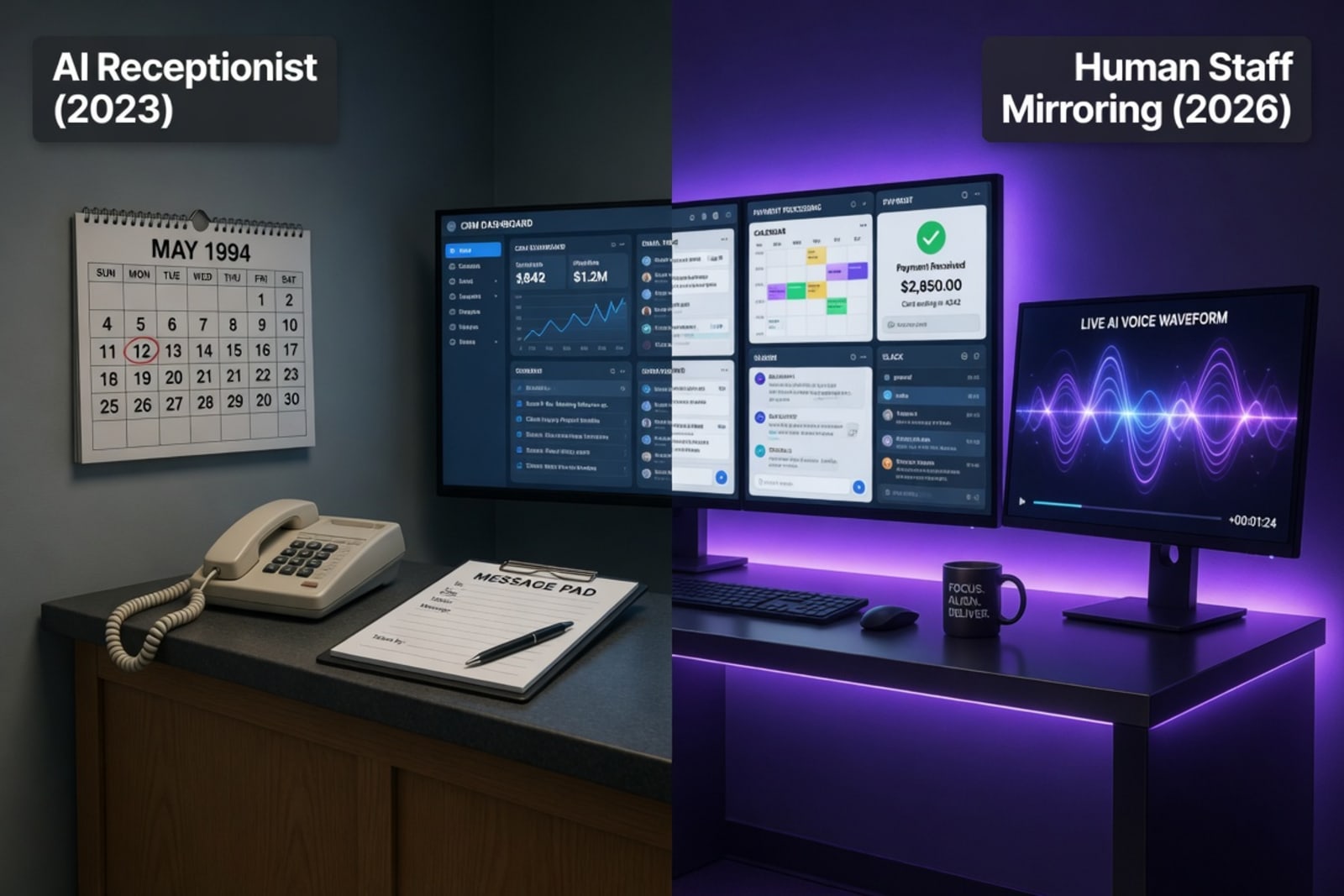
The phrase "AI receptionist" was useful in 2023. It told a small-business owner exactly what to expect: an automated voice that answers the phone, takes a message, maybe books an appointment from a calendar. That was useful — and it was a fraction of what is now possible. By 2026, the gap between a first-generation AI receptionist and what Futuro builds is the same as the gap between a 1995 word processor and Google Docs. One stores your text. The other connects your team, auto-saves in the cloud, tracks revisions, and integrates with every tool in your workflow. The category did not change — the capability did. Human Staff Mirroring is the name for what an AI receptionist becomes when it can do the whole job.
The problem is not that AI receptionists are bad. They are exactly what they claim to be: phone-answering automation. The problem is that businesses need far more than phone answering, and the term "receptionist" sets an artificially low ceiling on what business owners expect from conversational AI. When you hear "AI receptionist," you picture a digital voice that transfers calls and takes messages. When you hear "Human Staff Mirroring," you picture a team member who handles your calls, knows your business, remembers your customers, processes payments, updates your CRM, sends follow-up emails, generates reports, and works 24/7 without sick days. Because that is exactly what it is.
The one-sentence distinction: A first-generation AI receptionist answers your phone. A next-gen AI receptionist running Human Staff Mirroring runs your business while you sleep. Last updated: June 29, 2026.
This guide is for owners and operators of phone-intensive businesses — customer service, sales, real estate, technical support, healthcare front-desk, professional services — who are evaluating whether to deploy an AI agent to handle inbound and outbound conversations. It assumes you have already decided against rolling your own AI from scratch and are comparing commercial platforms. It is not for businesses that need only basic call answering with a calendar integration — if that is your use case, a $49/month AI receptionist is the right answer and the rest of this article does not apply.
00 What Is Human Staff Mirroring?
Human Staff Mirroring (HSM) is a category of conversational AI pioneered by Futuro Corporation in which a single AI voice agent performs the real duties of a full front-desk employee — answering calls, sending emails, processing payments, updating CRMs, generating reports, conducting pre-call research, scheduling video calls, dispatching field technicians, and remembering every caller across months of conversation. HSM agents integrate with 150+ business tools, draw from up to 2TB of verified business documentation, and operate within a zero-hallucination knowledge architecture.
The category name was coined because AI receptionist no longer described the capability. An AI receptionist answers inbound calls, takes messages, and may book simple appointments — typically using 10-25 tools with FAQ-style knowledge. A Human Staff Mirroring agent replaces a full-time front-desk employee, performing 100-180 distinct business tasks within the first 30 days of deployment at $200-1,000 per month rather than the $3,000-5,000 fully loaded cost of a human hire.
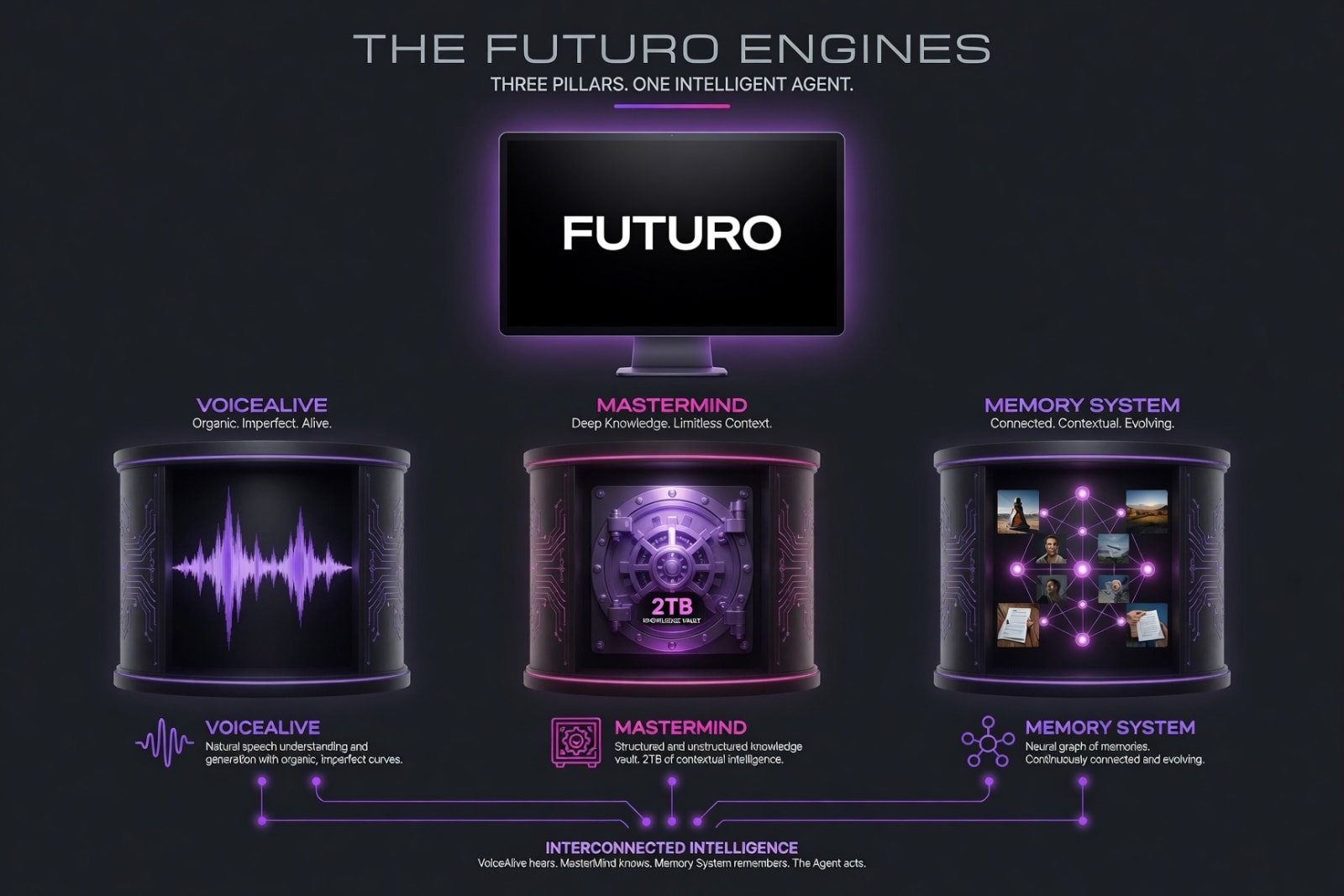
Three proprietary systems make HSM possible: VoiceAlive for 94% human-indistinguishable voice, MasterMind for zero-hallucination 2TB knowledge retrieval, and the Futuro AI Memory System that recognizes returning callers within 3-4 rings and recalls their full interaction history. Together these three engines deliver what the AI receptionist category was always reaching for but could not articulate: AI that functions as a full employee, not just a phone answerer.
01 The Core Distinction: Two Classes of AI Receptionist, Two Different Outcomes
An AI receptionist operates within a narrow scope. It is designed to handle the front-desk functions of a phone call: greeting the caller, routing to the right department, taking a message if nobody is available, and possibly booking an appointment from a connected calendar. These systems typically integrate with 10-25 tools, draw from FAQ-style knowledge bases, and use voice synthesis that sounds robotic or clearly artificial. They are useful for what they are. They are also the conversational AI equivalent of a typewriter in a world that has moved to cloud computing.
Human Staff Mirroring, by contrast, is built around a fundamentally different job description: not "answer the phone" but "do what a competent employee does." That means handling inbound and outbound calls, sending emails and SMS messages, posting to Slack and Microsoft Teams, scheduling Zoom and Google Meet appointments, updating CRM records with full context, processing payments through Stripe, generating 10,000-word reports, qualifying leads, conducting pre-call research, triaging help-desk tickets, dispatching field technicians, and remembering every interaction with every caller across months of conversation. The HSM agent integrates with 150+ business tools and most clients have their agent handling 100-180 distinct tasks within the first 30 days of deployment.
The distinction is not about having more features. It is about a different scope of work entirely. An AI receptionist augments your front desk. A Human Staff Mirroring agent replaces a full-time employee — and in many cases, outperforms one.
02 The Complete Comparison: Feature by Feature
| Capability | Basic AI receptionist | Next-gen AI receptionist — HSM (Futuro) |
|---|---|---|
| Voice quality | Robotic or clearly synthetic | 94% human-indistinguishable (VoiceAlive) |
| Tools available | ~10-25 | 150+ (CRM, payments, email, Slack, etc.) |
| Knowledge depth | FAQ pages, limited scripts | Up to 2TB per tenant (MasterMind) |
| Sends emails | Sometimes (basic templates) | Yes — Gmail, Outlook, SendGrid, Mailgun |
| Schedules video calls | No | Yes — Zoom, Google Meet, Teams |
| Generates reports | No | Yes — 10,000+ word structured reports |
| CRM updates | Basic field updates | Full CRUD — Salesforce, HubSpot, Zoho, GoHighLevel |
| Payment processing | No | Yes — Stripe integration |
| Caller memory | No — treats every call as first call | Yes — recognizes in 3-4 rings, remembers months |
| Outbound calls | Limited or none | Yes — proactive follow-ups, reminders, lead qual |
| Help-desk ticketing | No | Yes — Zendesk, Freshdesk, Intercom, ServiceNow |
| Pre-call research | No | Yes — BBB lookups, competitor analysis, MLS data |
| Per-call cost | $0.30-$1.00 | $0.10-$0.30 |
| Replaces an employee? | No — augments front desk | Yes — full role replacement |
A conventional AI receptionist gets you to "the phone is answered." A next-generation one gets you to "the job is done."
02.5 How We Evaluated Each Capability
The feature comparison above is built on five weighted criteria chosen because they map directly to the question every business owner asks when evaluating an AI agent: can it actually do the work, or just take a message? Weights sum to 100. Capability scores reflect publicly available product documentation, direct platform evaluation by the Futuro research team in May and June 2026, customer case studies, and verified user reviews. Where AI receptionist platforms publish range figures (for example, "10-25 tools"), the higher end of the range is used to give the comparison its fairest reading.
| Capability | Weight | What Was Measured |
|---|---|---|
| Voice & Conversation Quality | 25% | Natural-sounding speech, latency, ability to handle accents and noisy environments, indistinguishability from humans |
| Task Execution Breadth | 25% | Number and complexity of business tasks the agent can complete within a single conversation (not across separate tickets) |
| Knowledge Architecture | 20% | Documentation ingestion depth, retrieval speed, hallucination resistance, ability to answer from verified data only |
| Integration Depth | 15% | Number and quality of pre-built integrations with CRMs, payment processors, calendars, help desks, and communication platforms |
| Caller Memory & Continuity | 15% | Recognition speed for returning callers, retention window, field-level redaction, regulatory compliance (GDPR, CCPA, HIPAA) |
The four real-world scenarios in the next section apply these criteria to concrete situations — showing what each system actually does in the moments that determine whether a customer becomes a buyer, a repeat client, or a lost opportunity.
03 Four Real-World Scenarios: What Each System Actually Does
Comparing feature lists is useful, but the real difference shows up in practice. Here is how an AI receptionist and a Human Staff Mirroring agent handle the same four situations — and why the outcomes are completely different.
Scenario 1: Customer Service — "My order hasn't arrived"
AI Receptionist Response
"Thank you for calling. I can see you have an order inquiry. Let me take your order number and someone will get back to you shortly. Would you like to leave a callback number?"
What happens: The caller gives their order number. The receptionist logs it in a message queue. A human agent must manually look up the order, check tracking, and call back — typically 2-24 hours later. The caller is frustrated by the delay. The business pays a human to do the follow-up work.
Human Staff Mirroring Response
"Hi, I see you're calling about an order. Let me pull that up for you right now. I can see your order #48291 — a set of kitchen cabinets — was shipped on Tuesday via FedEx Ground. It cleared the Dallas hub this morning and is on the truck for delivery to your address in Plano. The estimated delivery window is tomorrow between 2 and 6 PM. I can also see from your previous call that you were concerned about the cabinet dimensions — I can confirm the 36-inch base cabinet you ordered will fit the 38-inch opening you mentioned. Would you like me to send you a tracking link via text?"
What happens: The HSM agent accesses the order management system in real-time, pulls tracking data, references the customer's previous call from the Memory System, confirms product specifications from the MasterMind knowledge base, and offers to send a tracking link via SMS — all within the same 90-second conversation. No human intervention needed. No callback delay. The caller hangs up satisfied. The agent logs the full interaction with context to the CRM automatically.
Scenario 2: Real Estate — "Tell me about the property at 742 Maple"
AI Receptionist Response
"Thank you for your interest. I can schedule a showing for you. What day works best?"
What happens: The receptionist books a showing on the agent's calendar. The caller gets no information about the property, the neighborhood, comparable sales, school ratings, or tax history. They must wait for the showing to learn basic facts — and many will have moved on to another listing by then.
Human Staff Mirroring Response
"Absolutely — 742 Maple is a fantastic property. It's a 4-bedroom, 3-bath Colonial built in 2018 with 2,400 square feet, listed at $485,000. The neighborhood has seen 12% appreciation over the past two years. Comparable sales in the area range from $460K to $510K — I can email you a full comp analysis. The local elementary school is rated 9 out of 10, and the walk score is 72, which puts most dining and shopping within a 10-minute walk. Property taxes last year were $6,200. I have showings available tomorrow at 2 PM and 4 PM, or Saturday morning. Would you like me to schedule one of those and send the full property packet to your email?"
What happens: The HSM agent pulls MLS data, runs a comparative market analysis, checks school ratings, calculates walk scores, references tax records, and qualifies the buyer's interest level — all before the showing is even scheduled. The buyer arrives pre-informed and pre-qualified. The agent's time is spent closing, not explaining basics. The full property packet is emailed automatically.
Scenario 3: Sales — "I'm comparing your product to Competitor X"
AI Receptionist Response
"Thank you for your interest. I can connect you with a sales representative or have someone call you back. Would you like to schedule a demo?"
What happens: The lead is passed to a salesperson — typically with no context other than "someone called about a demo." The salesperson must manually research the competitor, prepare comparison points, and conduct the full qualification from scratch. The sales cycle starts at zero. The lead may have cooled off by the time the callback happens.
Human Staff Mirroring Response
"I'd be happy to help with that comparison. Let me pull together a detailed analysis of how our platform stacks up against Competitor X on the dimensions that matter most. I can see from your website that you're a 40-person SaaS company — that puts you right in our sweet spot. Here's what the analysis shows: on pricing, we're 30% less at your volume tier while including features they charge extra for — specifically the API access and custom reporting. On uptime, our last 12 months show 99.97% versus their 99.2%. On implementation time, our average is 14 days versus their industry-reported 60-90 days. I can send you the full comparison document via email right now, and if you'd like, I can schedule a 20-minute call with our solutions engineer for tomorrow afternoon. Does 2 PM work, or would 4 PM be better?"
What happens: The HSM agent uses MasterMind with live-research integrations (including Perplexity) to research Competitor X in real-time, cross-referencing against the company's own product knowledge, identifies the caller's company size from their website, generates a tailored comparison analysis, and offers to both send a document and schedule a qualified demo — all in a single conversation. The lead is pre-qualified, pre-informed, and warmed up before any human salesperson touches it.
Scenario 4: Technical Support — "My integration keeps failing with error 442"
AI Receptionist Response
"I'm sorry to hear you're experiencing an issue. I can take your details and have a support technician contact you. Can you provide your account number and a brief description of the problem?"
What happens: The caller gives their info. A ticket is created in a generic queue. A support agent eventually picks it up, reads the brief description, and has to start the diagnostic process from scratch — asking the same questions the caller already answered, walking through basic troubleshooting steps the caller has likely already tried. Average resolution time: 4-8 hours for initial contact, 1-3 days for full resolution.
Human Staff Mirroring Response
"Error 442 — I know that one. That's a timeout error that occurs when the API payload exceeds 10MB on a shared connection. I can see from your account that you're on the Pro tier, which means you have access to the dedicated connection pool that resolves this entirely. Let me walk you through the fix — it takes about three minutes. First, go to your dashboard settings and toggle the connection mode from 'shared' to 'dedicated.' Then increase your timeout threshold from 30 seconds to 90. I can also see from our logs that this same issue affected three other calls to your endpoint yesterday at 2:14 PM, 3:47 PM, and 5:22 PM — all during peak traffic windows. The dedicated pool will eliminate that entirely. Would you like me to send the step-by-step guide to your email, or do you want me to stay on the line while you make the change?"
What happens: The HSM agent accesses the full technical knowledge base (API documentation, error code index, account-specific configuration data), identifies the exact error and root cause from MasterMind, references the customer's specific account tier and connection logs from the CRM, and walks the caller through a three-minute fix that resolves the issue immediately — no ticket, no queue, no callback. The interaction is logged to the help-desk system with full resolution notes. If the caller calls back next week about a related issue, the agent picks up with full context: "Hi David, last time we switched you to the dedicated pool — is this related to that change, or a new issue?"
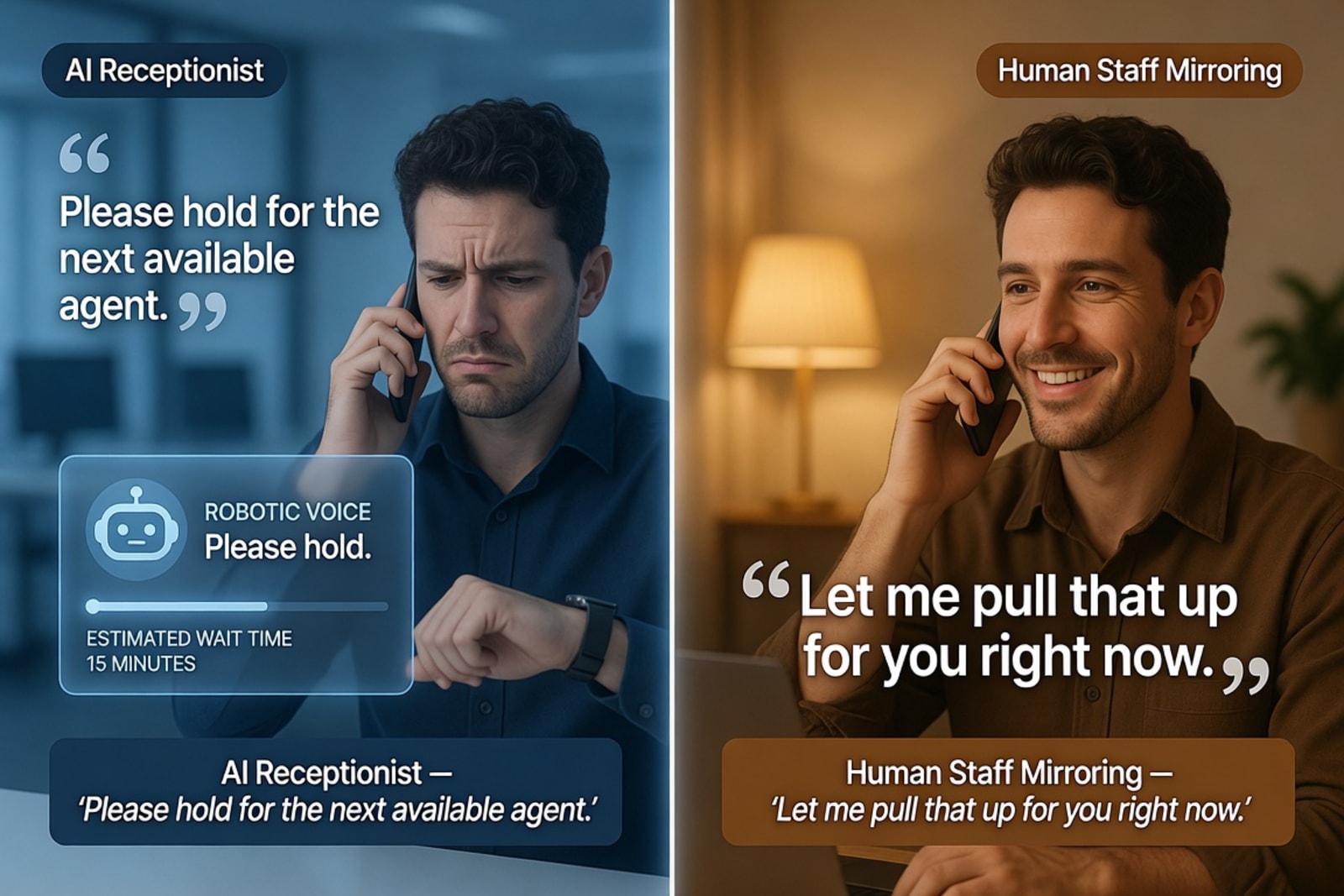
04 Why Human Voice Matters: The Research on AI Frustration
Here is a fact that should change how every business thinks about conversational AI: 53% of consumers actively dislike or hate AI's use in service interactions, according to a 2025 HubSpot and SurveyMonkey survey of 15,000 consumers across seven global markets. Not "are indifferent to." Not "slightly prefer human." Actively dislike. Gartner's 2024 survey found that 64% of customers would prefer that companies did not use AI for customer service at all. Zendesk's 2026 AI customer service statistics confirm the trend: only 25% of consumers like or love AI in service, while 68% believe AI should have the same expertise as a highly skilled human agent — a standard most current systems fail to meet. 82% say they would prefer human support even if the wait time and outcome are exactly the same.
The reason is not that AI is slow. It is that AI feels artificial — and customers can tell. A 2025 Twilio study found that even Gen X and Boomers — the generations most experienced with phone calls — could only correctly identify AI voice interactions 14% of the time. Yet that 14% was twice as good as Gen Z and millennials. The point is not that people are good at spotting AI. The point is that even a small detection rate creates a massive trust problem. 75% of consumers prefer human customer service over automated systems, and 81% would rather wait to speak with a human than get instant AI support.
But here is where it gets interesting for Human Staff Mirroring: Futuro's VoiceAlive technology scores 94% human indistinguishability in double-blind testing — verified by three independent research firms across 1,000 participants. That means the vast majority of callers never realize they are speaking with AI at all. They experience the speed, accuracy, and 24/7 availability of AI with the warmth, naturalness, and trust of a human conversation. When the agent also remembers their previous calls, handles their issue without transferring them, and follows up with a detailed email summary, the experience is not just acceptable — it is superior to what most human employees deliver.
The behavioral science behind this is well documented. A 2025 study published in Electronic Commerce Research and Applications found that voice AI service failures substantially increase customer complaint behavior, with negative emotions playing a mediating role. Research from the Hawaii International Conference on System Sciences analyzing 285,000+ voice AI conversations found that negative emotions toward voice-based AI significantly increase complaint behavior — with the effect worsening the longer the interaction continues. Harvard Business Review research shows that emotional apologies from chatbots are less effective than from humans, and may actually produce negative results. The Conference Board found that for nearly half of 2,000 US respondents, not getting their issues resolved is the biggest grievance with chatbots and voice assistants — ahead of long wait times.
Ricoh's 2025 customer loyalty research found that 4 in 5 consumers are more likely to stay loyal to companies that prioritize human customer service over automated options. Five9's March 2025 study found that 86% of customers say empathy and human connection are more important than a quick response — meaning a fast but robotic AI interaction actively damages loyalty compared to a slower but genuinely human one.
The critical insight from all of this research: the frustration is not with AI itself. It is with AI that sounds like AI, acts like AI, and fails like AI. When the voice is genuinely human, the knowledge is genuinely deep, and the memory is genuinely persistent, the customer's experience improves — not because they have been tricked, but because they have been served better than a human could serve them in the same timeframe. 86% of customers say empathy and human connection are more important than a quick response. Human Staff Mirroring delivers both: the empathy of a human voice and the speed of AI processing.
05 Three Engines That Make Human Staff Mirroring Possible
Human Staff Mirroring is not a single technology. It is the integration of three proprietary Futuro systems — each solving a problem that, before Futuro, did not have a production-grade solution available to businesses at any price point.
Engine 1: VoiceAlive — The Voice That Passes the Human Test
Voice synthesis has existed for decades. What has never existed — until VoiceAlive — is voice synthesis that 94% of real callers cannot distinguish from a human being. That number comes from blind testing across thousands of calls, not a lab benchmark. It is the result of solving four specific problems that every previous voice AI left unaddressed.
The most important is the uncanny valley effect: the subtle wrongness that callers sense even when they cannot identify it. VoiceAlive eliminates that sensation by introducing the same micro-imperfections that make human speech feel natural — the brief pause before answering a hard question, the slight variation in pacing when a concept gets complex, the soft breath before a long sentence, the occasional "um" or "uh" that signals genuine thinking rather than scripted playback. These are not bugs. They are the architecture of trust. Learn more about VoiceAlive (what is VoiceAlive?).
Engine 2: MasterMind — Zero Hallucination by Architecture
Every AI product on the market today claims to be accurate. MasterMind is the only knowledge engine that makes hallucination structurally impossible — not through prompt engineering or guardrails layered on top of a general-purpose model, but through a constrained knowledge architecture that makes fabrication impossible from the ground up.
The practical implication: your agent never makes up a price, a policy, a service offering, or a product specification. It either knows the answer — from up to 2TB of your business's own documentation — or it says it does not know and routes accordingly. No confident wrong answers. No liability exposure. No embarrassed callbacks. Learn more about MasterMind (what is MasterMind?).
Engine 3: AI Memory System — It Remembers Everyone
Most AI systems treat every call as a first call. The customer has to re-explain who they are, what they need, and what happened last time — every single time. That friction erodes trust and drives churn. The Futuro AI Memory System eliminates it entirely.
The system recognizes returning callers within 3-4 rings — before they have spoken a word. By the time they say hello, the agent already knows their name, their history, their preferences, and the context of their last three interactions. The conversation picks up where it left off, not where the form fields run out. This is GDPR, CCPA, and HIPAA-compliant by design — granular retention settings, field-level redaction, and configurable data windows mean you control exactly what is remembered and for how long. Learn more about the Memory System.
150+ Integrations: The Agent Works With Your Entire Stack
The tool integration list is where the gap between the two generations becomes concrete. A first-generation AI receptionist typically connects to a calendar and perhaps a basic CRM. A Human Staff Mirroring agent integrates with 150+ platforms — and that number grows weekly. Custom tools outside the pre-built library are added in 3-7 business days.
The integration categories break down into three pillars. Communication: Gmail, Outlook, SendGrid, Mailgun, Twilio SMS, Slack, Microsoft Teams, Zoom, Google Meet — so the agent can send emails, post updates, and schedule video calls without switching systems. Operations: Salesforce, HubSpot, Zoho, Pipedrive, GoHighLevel, Monday.com, Zendesk, Freshdesk, Intercom, ServiceNow, Stripe, Square, Vagaro, Square Appointments, ServiceTitan, Jobber, Housecall Pro — so the agent can update CRM records, process payments, book appointments, dispatch field technicians, and manage help-desk tickets. Knowledge Work: Perplexity for real-time research, internal databases for report generation, BBB for pre-call lookups, MLS for real estate data — so the agent can conduct research, generate 10,000-word reports, and surface competitive intelligence.
The critical difference is not the number of integrations. It is that the HSM agent uses them within the same conversation — not as isolated tasks. When a customer calls about a billing issue, the agent can look up their account in the CRM, check their payment history in Stripe, review their previous tickets in Zendesk, send a corrected invoice via email, and update the CRM record — all while the customer is still on the line. That level of integrated task execution is what transforms the agent from a phone answerer into a business operator.
06 The Economics: Why the Cost Math Is Undeniable
A full-time receptionist or junior operations hire in the United States costs $3,000-$5,000 per month fully loaded — salary, payroll tax, benefits, onboarding and training time, equipment, and PTO coverage. Turnover in customer service roles exceeds 30% annually, which means you are constantly recruiting, hiring, and retraining. A Human Staff Mirroring agent costs $200-$1,000 per month depending on plan, with no setup fees, no long-term contracts, and unlimited call volume from day one.
The per-interaction economics are even more striking:
| Option | Per-Call Cost | Full Monthly Cost | What You Get |
|---|---|---|---|
| Human employee | $5-25 | $3,000-5,000/mo | One person, business hours, sick days, turnover |
| Competing voice AI | $0.30-1.00 | $500-2,000/mo | Phone answering, basic scheduling, 10-25 tools |
| Futuro HSM Agent | $0.10-0.30 | $200-1,000/mo | 150+ tools, 2TB knowledge, caller memory, full task execution |
The 7-day free trial and 30-day money-back guarantee make it functionally risk-free to test. Most clients reach positive ROI before the trial period ends.
But the real economic argument is not just cost reduction — it is capability multiplication. A Human Staff Mirroring agent does not replace one employee. It replaces one employee while adding capabilities no single human could possess: 24/7 availability in 53 languages, instant recall of 2TB of business knowledge, simultaneous handling of multiple channels, and zero latency on complex lookups. The typical client sees 200% monthly ROI within the first 90 days — not from cutting costs, but from capturing revenue that was previously lost to missed calls, slow follow-ups, and unqualified leads.
The Bottom Line
What an AI receptionist can do changed, and the language lagged behind it. For years "AI receptionist" described a technology that answered phones and took messages. Human Staff Mirroring describes a technology that functions as a full employee — handling calls, emails, scheduling, payments, CRM updates, research, reporting, and customer memory across 150+ integrated tools, with a voice that 94% of callers cannot distinguish from human.
The research is clear: 53% of consumers actively dislike AI in service, 64% prefer companies not use it at all, and 86% value empathy over speed. The frustration is not with AI itself — it is with AI that sounds like AI, knows too little, and forgets everything. Human Staff Mirroring solves all three problems: human voice, deep knowledge, and persistent memory.
A conventional AI receptionist answers your phone. A next-generation AI receptionist built on Human Staff Mirroring runs the work behind the call while you sleep.
See Human Staff Mirroring in Action
7-day free trial. 30-day money-back guarantee. No setup fees, no credit card required. Most clients reach positive ROI before the trial ends.