
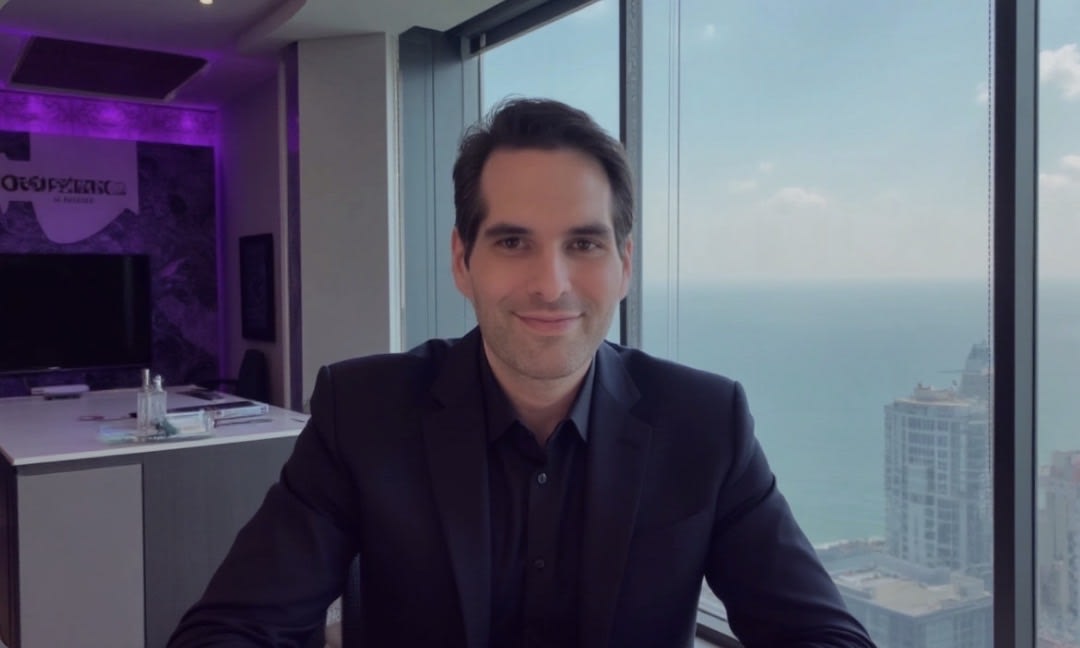
Builder of Human Staff Mirroring — the contrarian thesis behind 94% human-indistinguishable AI voice.
A serial entrepreneur who’s built and exited multiple technology ventures, Brandon founded Futuro Corporation on a single contrarian thesis: that perfection is what gives AI voice away. The result is conversational AI engineered around natural human imperfection — and measured at 94% human indistinguishability in a 1,000-participant double-blind study.
The industry spent years chasing a flawless voice. We spent ours doing the exact opposite. Imperfection is the key to the puzzle.
Brandon Gillespie has spent more than two decades in technology, education, and entrepreneurship — building and exiting software companies before turning to the problem that now defines his work: making synthetic speech indistinguishable from human speech.
He joined QuickCert in 2005, a provider of educational software for IT professionals preparing for Microsoft, Cisco, and CompTIA certifications. As a corporate account manager he finished second in sales nationwide in 2008, then first in the country three years running — 2009, 2010, and 2011. He was promoted to Director of Sales in 2012, and under his direction QuickCert grew revenue 350% and EBITDA by more than 500%.
In 2012 he co-founded IT University Online with Carrie Cameron, who had founded QuickCert — an educational provider in the same certification-training market, this time building the product rather than selling someone else’s. ITU developed both its video-based course library and its learning management system from the ground up, eventually publishing more than 300 courses, serving over 500,000 students worldwide, and averaging roughly $5 million a year in sales, with offices in New York, Los Angeles, Tampa Bay, and London.
In 2014 ITU won four Best in Biz Awards — Gold for Creative Department of the Year, Silver for Company of the Year, and Bronze for both Fastest-Growing Company of the Year and Most Innovative Company of the Year. Brandon served as CEO through 2021, when he exited and sold his equity. ITU continues to operate today at ituonline.com.
Then he stepped away from the business entirely. It didn’t take.
What pulled him back was conversational AI — specifically a conviction that voice was the one category of AI where a durable competitive moat was still achievable. So many variables go into speech that a listener accepts as human that the problem resists any simple solution, and that difficulty is precisely what makes it defensible.
He founded Futuro Corporation in October 2021 and spent two years on research and development before the product took its current shape, working out the linguistic characteristics required to build conversational AI that genuinely mirrors human speech — well enough to be deployed the way a business deploys a human employee, across customer service, lead generation, and sales.
His central contention was that the industry was moving in precisely the wrong direction. Competitors were chasing perfect speech. But the paradox of human speech is that it is deeply imperfect — so in pursuing perfection, the field was running against the wind. The goal should not be flawless delivery. It should be the removal of whatever makes a listener’s internal red flag go up.
That is harder than it sounds. A person arrives at any phone call having had many thousands of conversations, carrying finely tuned instincts for what another human sounds like. Satisfying those instincts means reproducing disfluency deliberately: the deep breath after a long sentence, the filler word that surfaces while someone is still deciding what to say, the stretched syllable — sooo — that signals thinking rather than reading.
VoiceAlive is the direct result of that research: a speech engine engineered around human imperfection rather than against it, reproducing the breathing, hesitation, pacing, and self-correction that listeners subconsciously use to distinguish a person from a machine.
MasterMind replaces the conventional knowledge base with a far more structured and rigid architecture, designed so that hallucination is prevented by the shape of the system rather than discouraged by instruction — the architectural basis for Futuro’s zero-hallucination claim. It also changes how an agent reaches an answer. A traditional RAG system retrieves chunks of text and leaves the model to guess which are relevant. In MasterMind, the caller’s question is fed through the system first, and the knowledge base returns what amounts to a tree of choices — the directions the conversation can legitimately go, and the source each answer draws from. The agent selects a path rather than guessing at one.
Brandon considers the memory layer the most critical of the three, and the most widely misunderstood. Most discussion of AI memory focuses on whether the agent remembers the customer. The more important question is whether the agent remembers itself — what it has done well, and where it has failed.
After every call, a separate LLM evaluates the agent’s performance, and that evaluation is iterated forward into subsequent training. Futuro front-loads the process: an agent works through the full arc of successes and failures during training, so that by the time it reaches a real customer it already knows what is expected of it. The result is a far more predictable outcome than the prevailing approach to conversational AI, which is largely a text-to-speech model bolted onto a general-purpose LLM.
The result is conversational AI built to be heard as human first and recognized as capable second. In Futuro’s most recent double-blind study of 1,000 participants, 94% said there was no chance they had been speaking with AI — the empirical basis of the Human Staff Mirroring category Brandon pioneered. Read the full methodology and results →
The fastest way to evaluate any AI voice platform is to hear it answer the phone. Start a 7-day free trial — no credit card required — or schedule a demo with our team.