
Pricing For Each Provider
Pricing is verified at each vendor’s website on the date of this article: September 5, 2026. Links to where pricing was obtained on each company’s website are listed in the citations section below with screenshots for verification.
| Provider | Pricing |
|---|---|
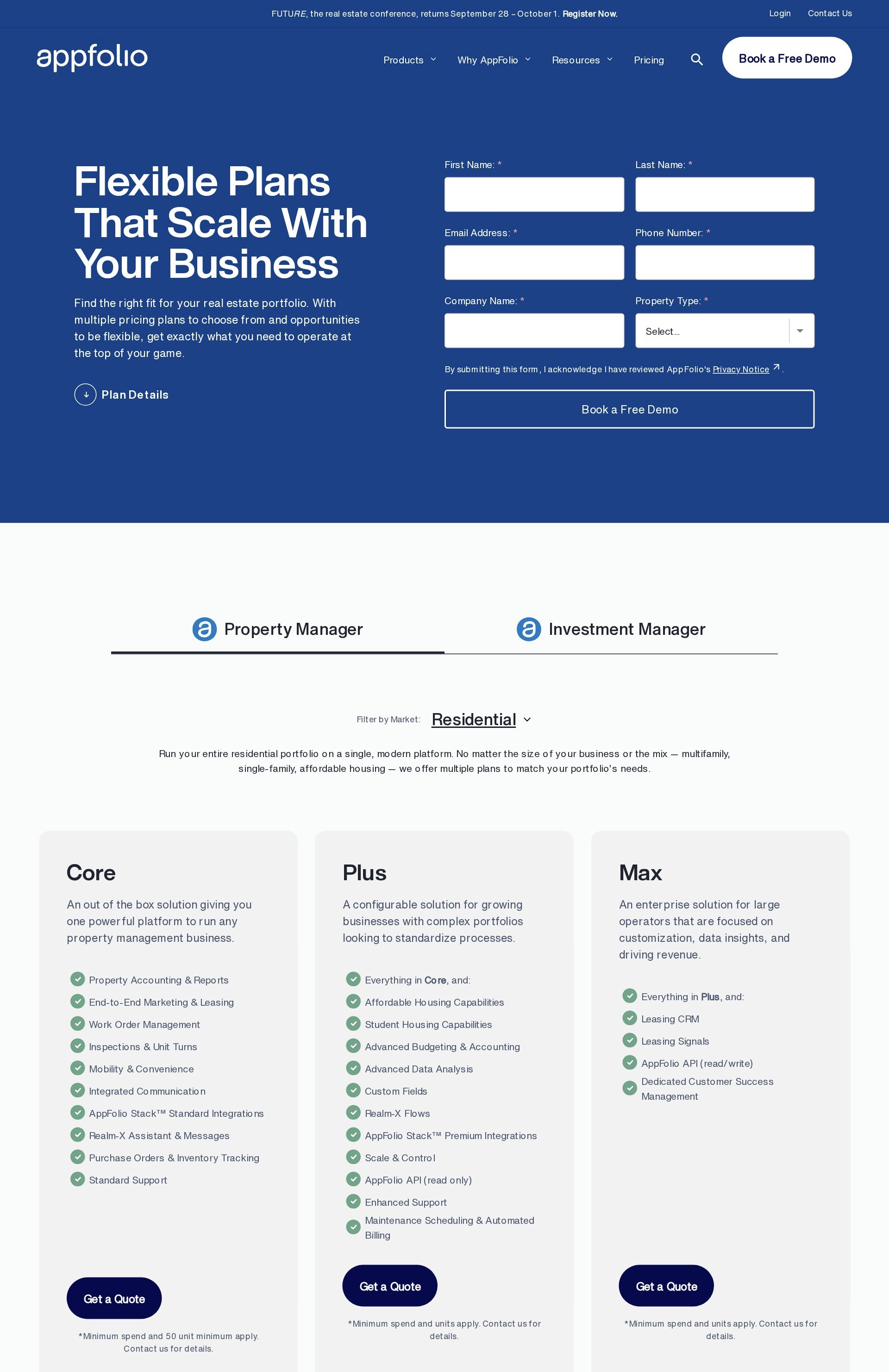
| AppFolio (Realm-X) | Quote-only; requires contacting AppFolio |
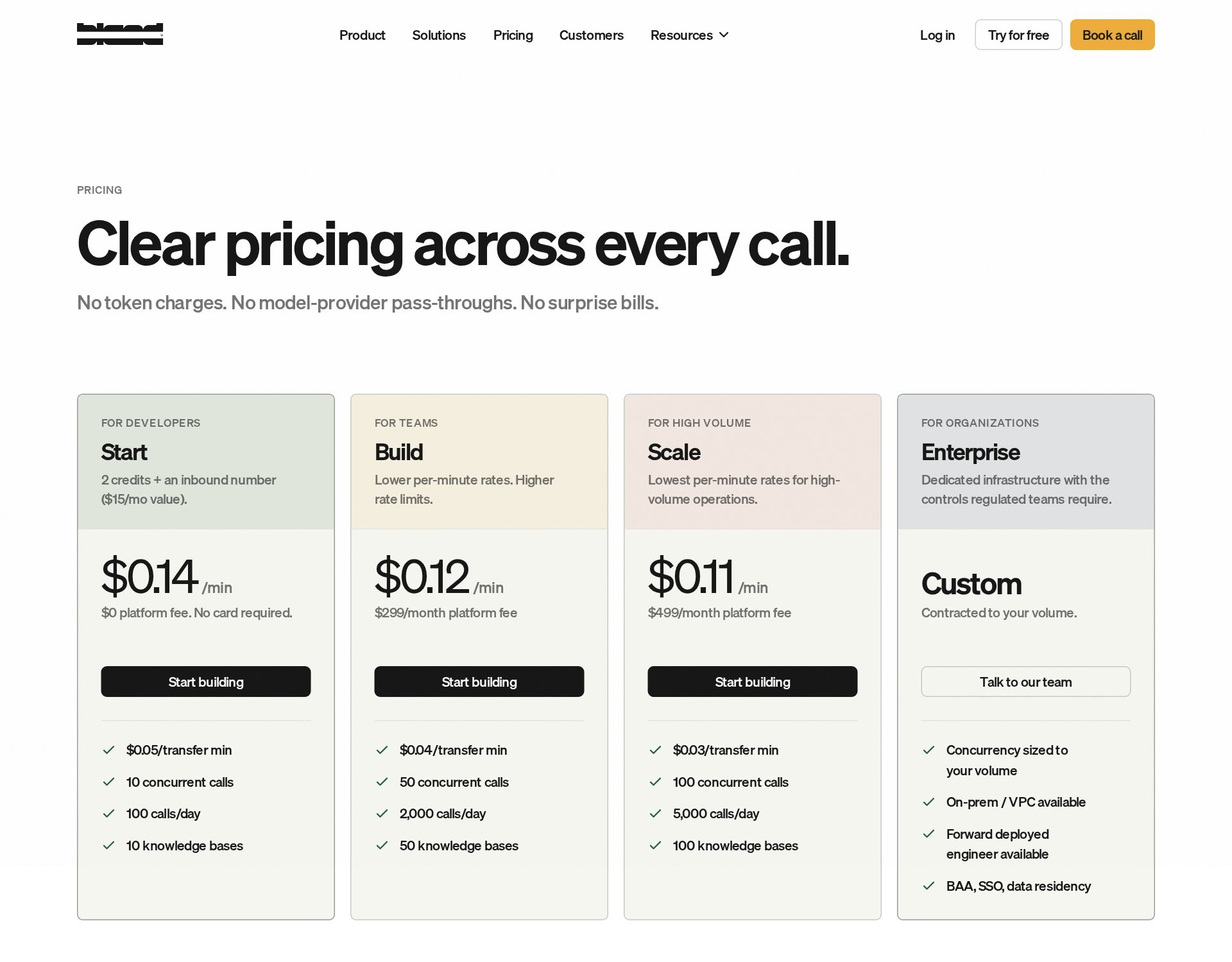
| Bland AI | $0.14/min (Start, no platform fee); $0.12/min + $299/mo (Build); $0.11/min + $499/mo (Scale) |
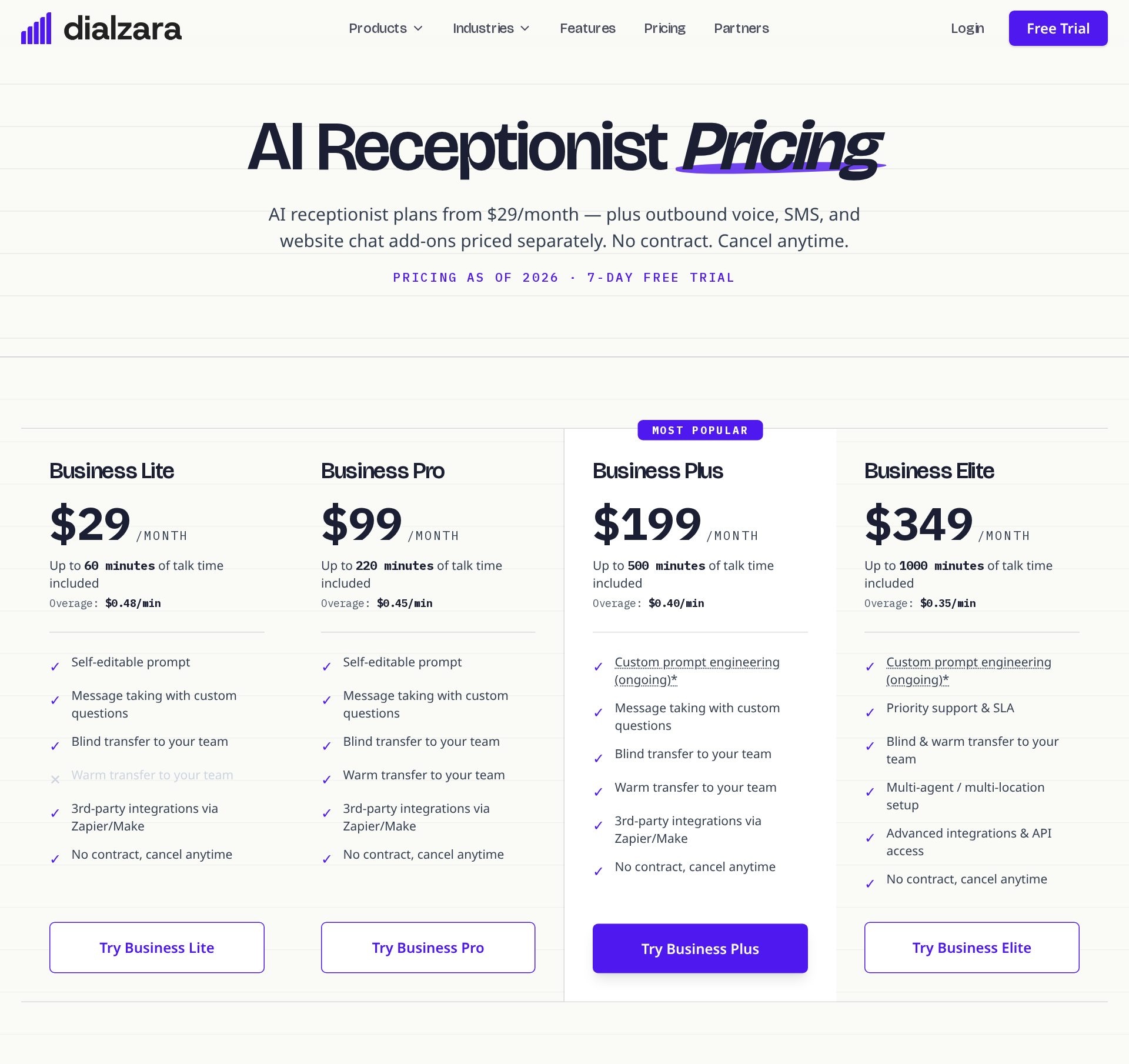
| Dialzara | $29/mo (60 minutes) to $349/mo (1,000 minutes) |
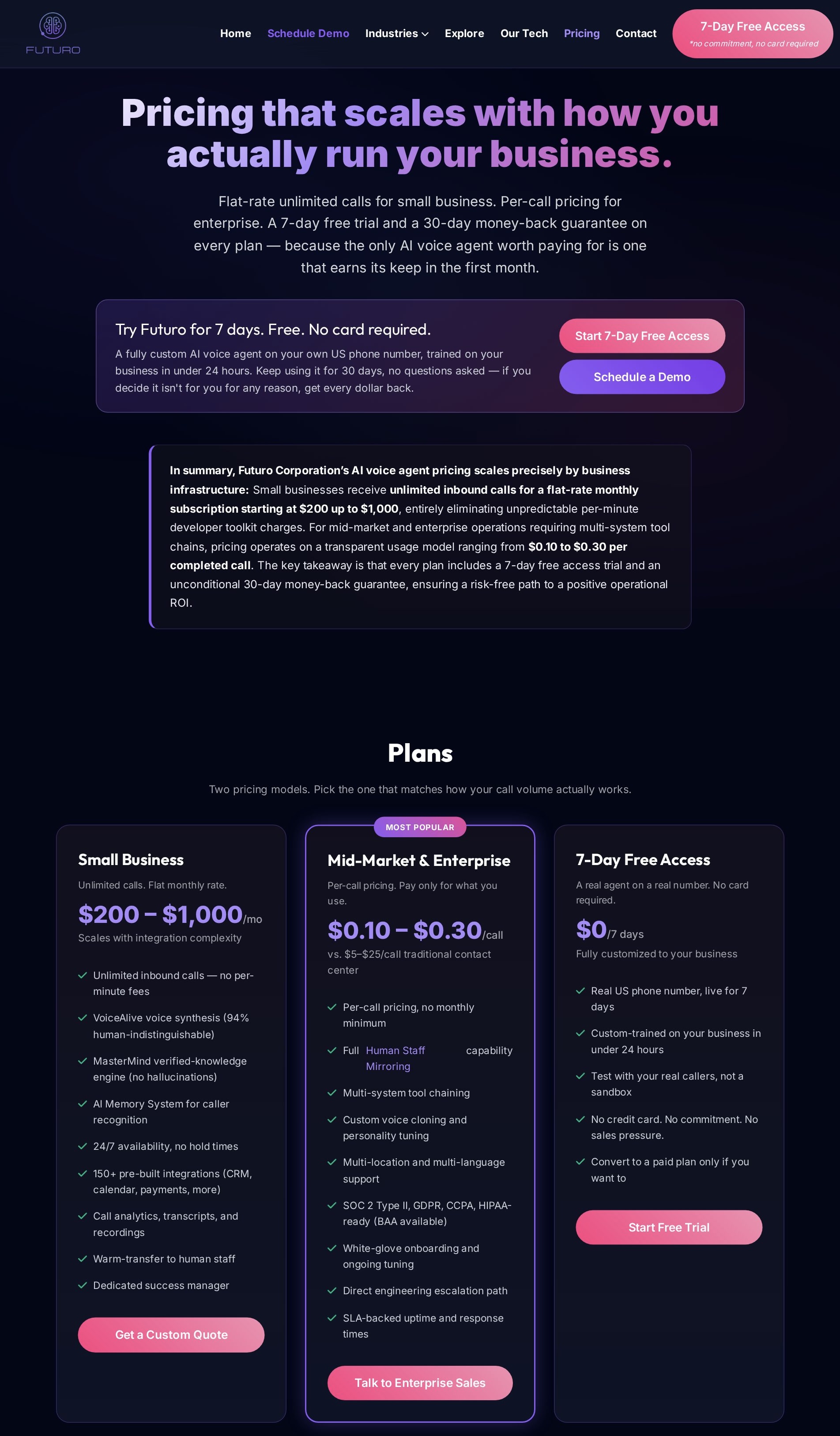
| Futuro (our product) | $200/mo flat, unlimited calls |
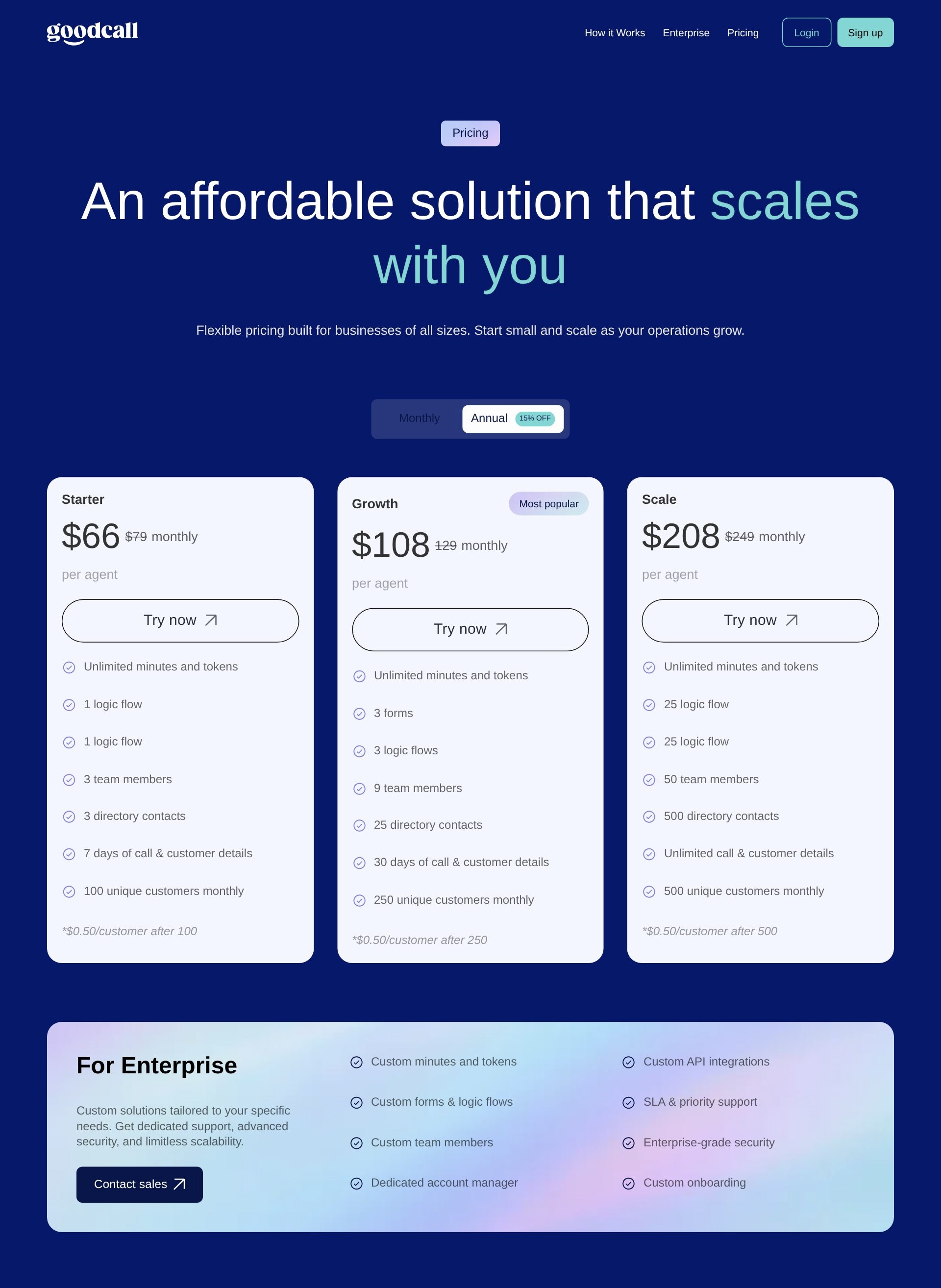
| Goodcall | $79/mo (100 unique customers) to $249/mo |
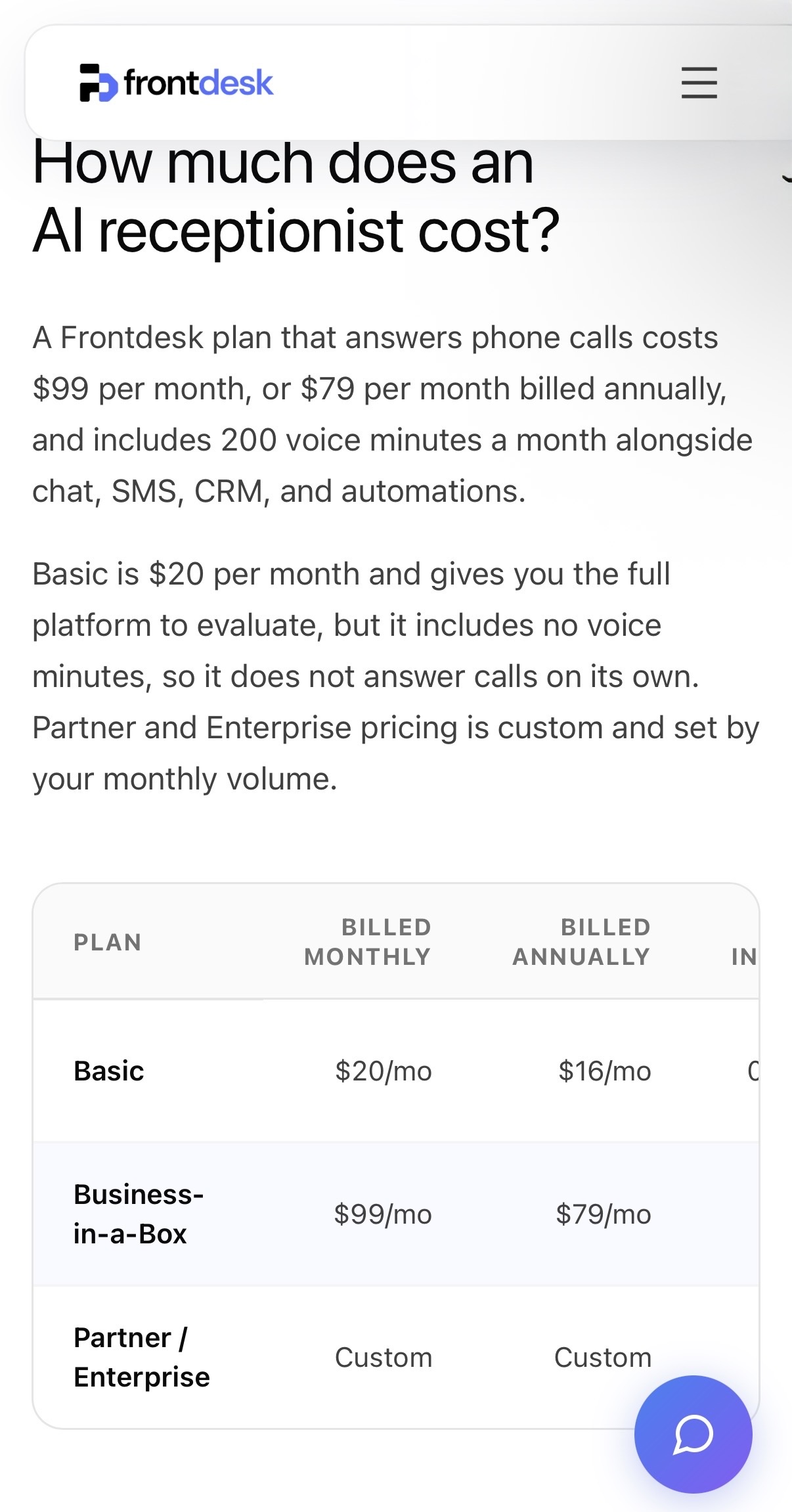
| My AI Front Desk | $99/mo (200 voice minutes); $79/mo billed annually |
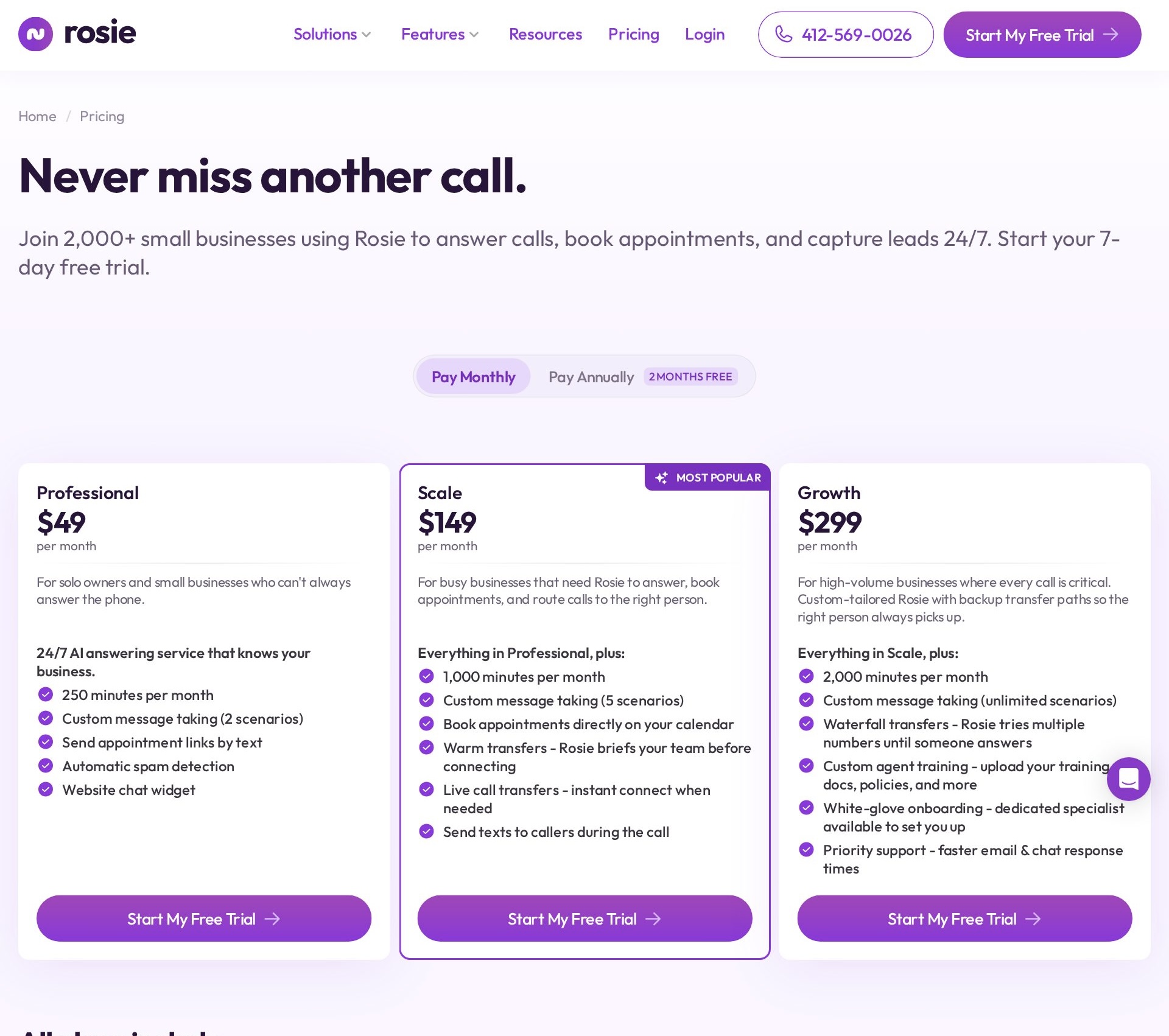
| Rosie | $49/mo (250 minutes) to $299/mo (2,000 minutes) |
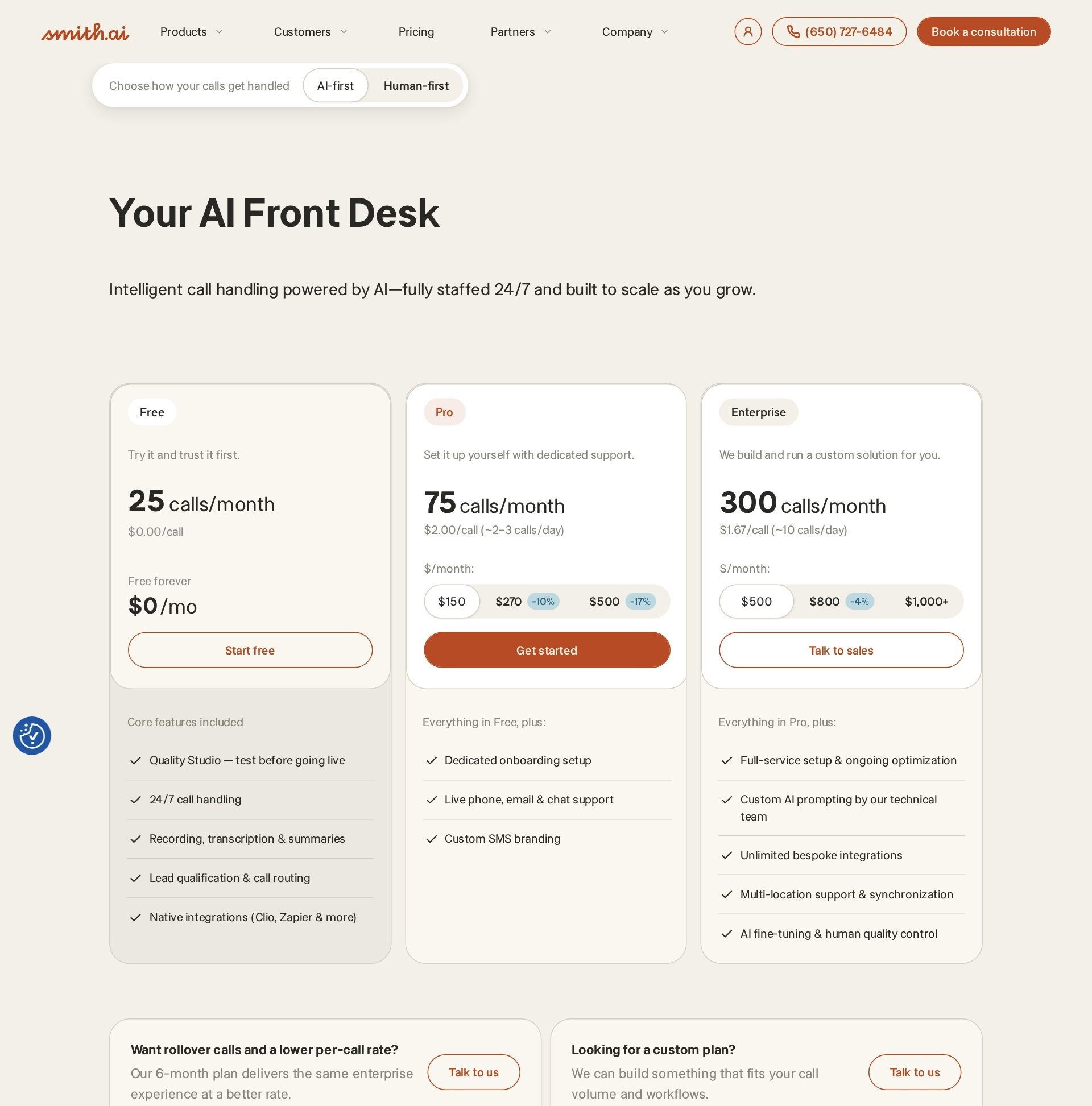
| Smith.ai | Free 25-call AI tier; AI from $150/mo; human receptionists from $300/mo |
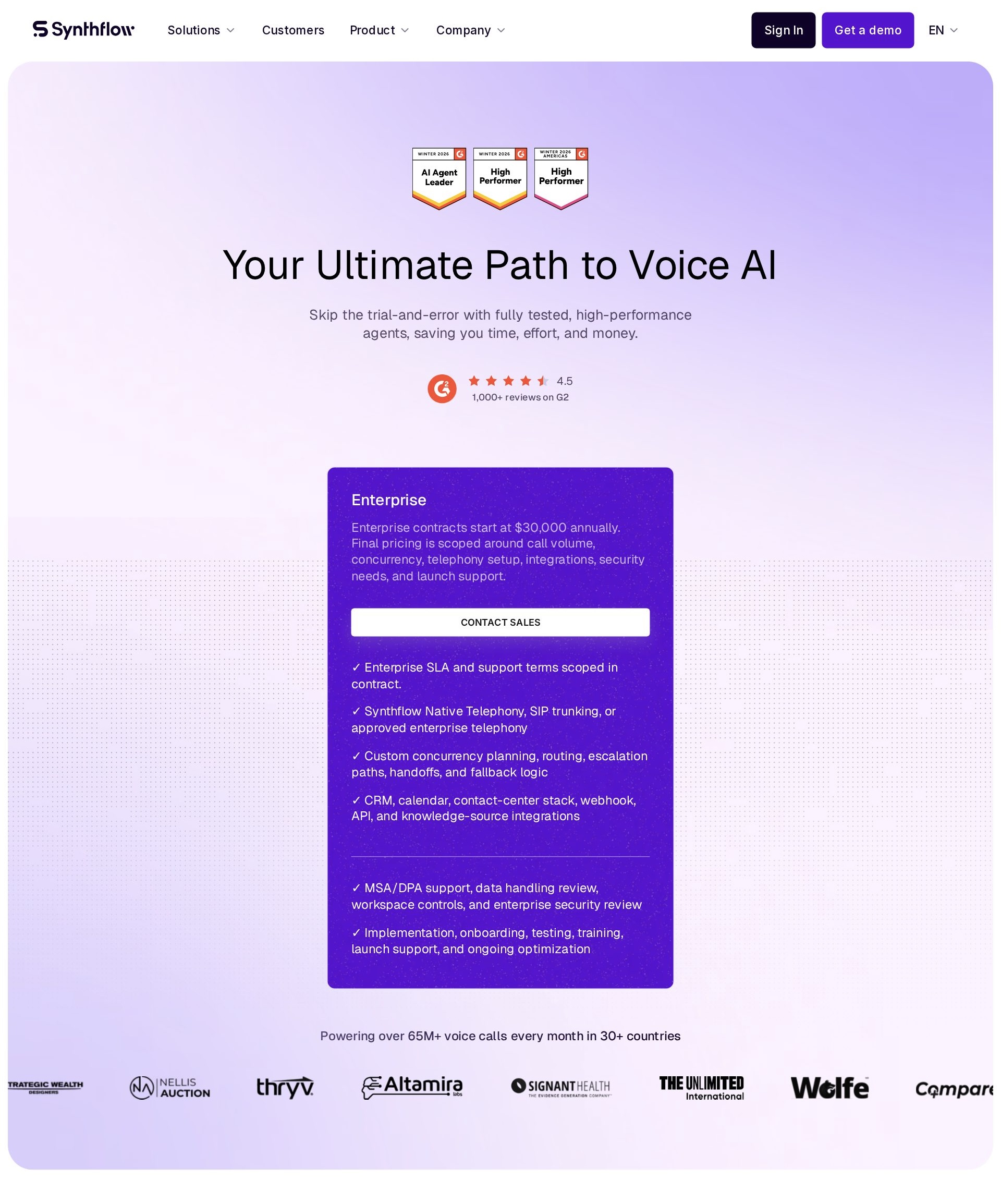
| Synthflow | Enterprise contracts from $30,000/yr |
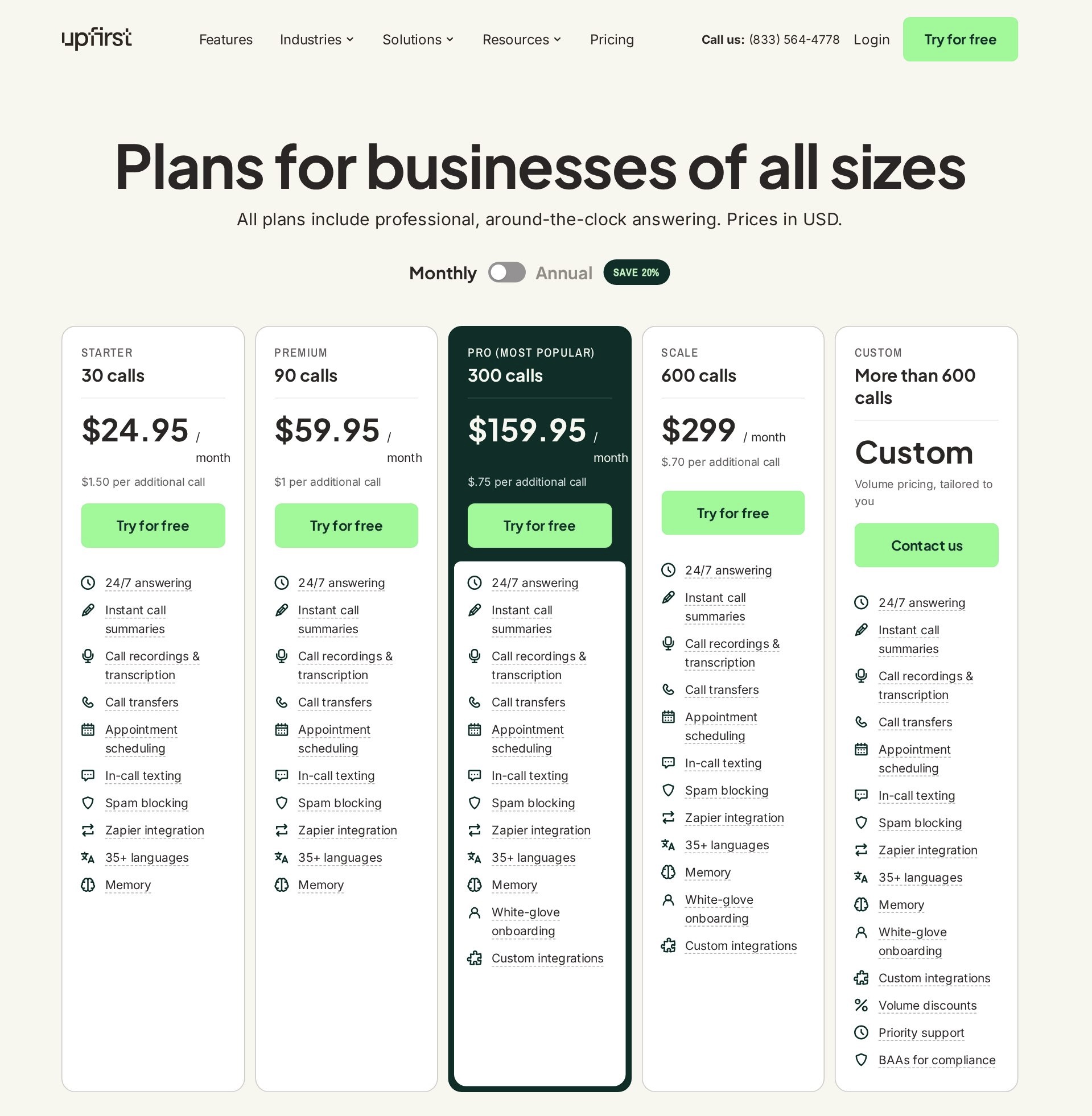
| Upfirst | $24.95/mo (30 calls) to $299/mo (600 calls) |
| The status quo (per-minute human answering) | Quote-only; published comps $3.60–$5.00/min |
Affiliate & editorial disclosure: Futuro Corp publishes this guide and Futuro Corp appears in it, clearly labeled and held to the same evaluation standard as every other platform. No vendor paid for placement, and every price quoted here was verified on the vendor’s own site on September 5, 2026.
Chapters (11)
- 0:00Intro: Why AI receptionists matter for property managers
- 0:15Two phone jobs: leasing vs. maintenance
- 0:45Call volume growth vs. flat staffing — legacy costs
- 1:15Four operational standards an AI must meet
- 1:46Entry-level budget tools: who they're for and limits
- 3:12Flat-rate triage platforms: Futuro and Goodcall explained
- 4:34Native integrations, developer APIs, and Bland AI trade-offs
- 5:04Live-human fallbacks: Smith.ai and Synthflow considerations
- 5:20Legal compliance: fair housing and automation risks
- 6:05Sizing recommendations: which category fits your portfolio
- 7:10Final test: demand a 2 AM live stress simulation
Full transcript
AI receptionists for property management companies. An unbiased review of each company's technology and which option might fit your needs. [snaps fingers] A property manager's phone line is essentially two distinct jobs happening at once. On the leasing side, minutes decide who signs a lease. On the maintenance side, minutes decide how much damage your building takes. Every call has a clock on it. Let a leasing call go to voicemail, and the prospect usually moves down their list to the next building. A unit sitting vacant costs you roughly sixty dollars a day in lost rent.
But missing a maintenance call at two in the morning carries a much steeper penalty. A dripping faucet can wait until Monday, but an ignored burst pipe quickly turns a standard plumbing invoice into a five-figure remediation job. Look at this line chart comparing market demand to labor supply. The top curve shows renter households hitting record numbers approaching forty-six million. The stagnant line below represents the number of property management job openings. Call volume is multiplying, but the staff available to answer the phone remains completely flat.
Operators used to rely on human answering services charging three to five dollars a minute. The industry is rapidly abandoning those for AI receptionists. The core problem hasn't vanished. It has simply taken a new shape. To actually replace a front desk, an AI platform must master four operational standards: emergency triage, fair housing safety, deep calendar integration, and protection against seasonal surge pricing. The hazard today is no longer whether AI sounds human enough. Ninety-four percent of people can't tell the difference.
The real danger is getting locked into a software pricing model that collapses under the weight of your own call volume. Most property investors manage fewer than five units. They are taking tenant calls between showings, inspections, and full-time day jobs. They need immediate relief, not enterprise software. Cost between twenty-five and ninety-nine dollars a month, offering simple setups and rigid minute caps. These tools immediately solve the leasing bleed. They stop your inbound calls from hitting voicemail, provide instant text links for scheduling, and easily answer basic questions in both English and Spanish.
This bar chart illustrates the catch. You buy a hard limit, say two hundred and fifty minutes. During a quiet month, that works. But during move-out season or a heavy storm week, your call volume doubles. Your minute bucket empties rapidly, and your bill spikes dramatically with overage penalties. Cost aside, these entry-level tools lack the deep diagnostic routing required for a real emergency. They are built to take messages, not troubleshoot complex scenarios. If your main goal is catching lost leasing leads on a budget, these platforms pay for themselves instantly.
But if you expect them to successfully manage a midnight maintenance disaster, they quickly become a massive operational liability. Once a portfolio scales between fifty and two hundred units, the priorities shift. At this size, a misdiagnosed midnight maintenance call is the single biggest threat to your operating budget. This brings us to the triage and flat-rate specialists like Futuro and GoodCall. Their base price is higher, but their operational philosophy is entirely different. Look at this quadrant matrix mapping out predictability against capability.
Flat-rate platforms sit cleanly in the top right. By charging a flat fee of around two hundred dollars a month for unlimited minutes, they completely immunize your portfolio against seasonal call surges and storm weeks. But their real value lies in the escalation matrix. Notice how this flowchart operates. When a tenant calls about no heat, the AI doesn't just write it down. It actively confirms the outdoor temperature, checks for a gas smell, and verifies if young children are in the unit. It diagnoses the severity before deciding to wake up your on-call technician.
The mandatory trade-off for this precision is the onboarding process. You cannot launch a triage platform in five minutes with a credit card. Instead, it requires a deeply hands-on working session to firmly establish your specific dispatch rules, system boundaries, and emergency vendor contacts. You give up the instant gratification of a self-serve setup. In return, you secure a surge-proof monthly bill and the absolute certainty that your two AM emergencies are handled correctly. For operators managing several hundred units or those with highly specific tech stacks, the standard solutions start to hit limitations.
If you already run your entire business on AppFolio, their native tool, RealmX, reads your live ledger data directly. The downside is absolute vendor lock-in. The AI cannot follow you if you ever migrate to a new property management system. Teams with in-house developers often look at Bland AI. The raw technical cost is incredibly low, around fourteen cents a minute, but you have to build, test, and maintain all the triage logic yourself. You are buying a project, not a finished product. Finally, enterprise shops handling complex tenant disputes often want a live human fallback.
Services like smith.ai or SynthFlow offer this scale, but routing a high volume of calls to live receptionists quickly drives costs into the thousands. Pushing for the deepest native integration or massive call center scale forces a hard choice. You will sacrifice either your software independence or a large portion of your payroll budget. We have to address the legal reality of automation. Under federal law, whoever or whatever answers your leasing line speaks on your behalf. The Justice Department holds direct providers of housing fully liable for discrimination during the intake and leasing process.
The Department of Housing and Urban Development enforces these rules aggressively across private, commercial, and federally funded properties alike. A correctly configured AI actually serves as a compliance shield. It executes one approved script, it never suffers from fatigue, and it logs a timestamped transcript of every single interaction. An AI does not guess your pet policy or try to improvise terms for a persuasive caller. It simply hits its programmed boundary and escalates the call. That rigid adherence to the rules is its greatest legal asset.
The dividing line across the entire property management AI market comes down to one feature, emergency triage capability. If you manage between one and fifty units and simply need to stop losing leasing leads to voicemail, default to the budget tiers. UpFirst or DialZara will handle the volume cleanly. If your portfolio sits between fifty and two hundred units, midnight disasters are your biggest vulnerability. Prioritize flat-rate triage platforms like Futuro or smith.ai if you require a live human fallback. If your operation is completely entrenched in AppFolio, start your search by quoting RealmX to capitalize on that native ledger syncing.
And a strict operational rule for any portfolio, keep your AI on the leasing and maintenance lines. HOA governance and board disputes require human nuance. Before you sign a contract with any vendor, demand a live stress test. Make them simulate a two AM call where the heat is out, the temperature is dropping, and a baby is in the unit. If their platform takes a message and promises a morning call back while the pipes freeze, you aren't buying a digital receptionist. You are paying for a glorified voicemail. [keyboard clacking] [cash register dings]
Machine-generated word-for-word transcript, unedited. Where a figure quoted in the video differs from this article, the article is the corrected version — it is checked against live vendor pages and dated; the video is not re-cut when a vendor reprices.
An AI receptionist for a property management company is software that answers calls about showings, applications, and maintenance issues the way your best office person would: with your calendar in front of it, your policies memorized, and the judgment to hand a flooding-unit call to your on-call technician. That is the standard all ten options are held to, including our own.
Why do property managers drown in phone calls?
Demand keeps growing: Harvard’s Joint Center for Housing Studies counts 46.1 million renter households after a record 784,000-household annual increase, and the Census Bureau reports: “National vacancy rates in the second quarter 2026 were 7.3 percent for rental housing and 1.2 percent for homeowner housing.” Supply is fragmented, so the phone lands on few desks. HUD counts 49.5 million rental units, “nearly 46 percent” of them “in rental properties of one-to-four units,” and “about 22 percent of small rental properties (1-4 units) are managed professionally.” Individual investors held 74.4 percent of the market per the JCHS, and NARPM, “currently representing more than 6,000 members,” says “the average number of units owned by investors is fewer than five.” The Bureau of Labor Statistics projects “about 36,900 openings” for property managers a year at a $69,990 median wage: calls grow faster than hiring. At the top, the NMHC’s 2026 list runs from Greystar’s 1,014,091 units to Westdale’s 36,593 at number 50.
Why is emergency triage the whole ballgame?
The maintenance call is the one with a clock on it. NARPM frames the manager’s “stated duty to provide a safe dwelling place for our tenants” and lists carbon monoxide among the habitability threats, “the silent killer.” The EPA is blunt about moisture: “Mold is not usually a problem, unless it begins growing indoors.” A triage-capable receptionist separates the burst pipe from the dripping faucet at 2 a.m., dispatches the first to your on-call rotation, and parks the second as a work order. A message-taker treats both identically, which is how a cheap plumbing call becomes a five-figure remediation. Futuro’s MasterMind escalation matrix exists for exactly this: scripted emergency paths or a human handoff, never improvisation.
What happens at 2 a.m. when the heat quits?
Run this composite scenario against any finalist. A tenant calls at 2:07 a.m.: the furnace is out, it is below freezing, and there is a baby in the unit. A message-taker records “no heat” and hangs up; your tech reads it at 7 a.m. A triage receptionist confirms no gas smell and no CO alarm, conferences in your on-call tech, texts the tenant the arrival window, and logs everything. Same call, two mornings: a repaired furnace and a renewal, or a space-heater risk and a code complaint. Ask every vendor here to play that call live, ours included.
Which AI receptionists fit property management? The ten, profiled
Alphabetical and unranked, our product under the same standard, trade-offs included.
AppFolio (Realm-X)
Native AI inside the AppFolio platform: the Realm-X suite covers lead responses, tour scheduling, and photo-interpreting maintenance intake that prioritizes work orders. AppFolio claims ten hours a week saved and 73 percent higher lead-to-showing conversion, a vendor claim. Pricing is quote-only, serving AppFolio customers only: the receptionist decision is bundled into the platform decision.
Bland AI
The API-first option for teams with developers: $0.14 a minute with no platform fee on Start, dropping to $0.12 plus $299/mo on Build. Its pitch is transparency: “No token charges. No model-provider pass-throughs. No surprise bills.”
Dialzara
Budget self-serve AI answering: $29/mo for 60 minutes, up to $349 for 1,000, with bilingual English-Spanish answering and warm transfers from Pro up. Setup is fast.
Futuro (our product)
Built for the emergency-triage problem: The MasterMind escalation matrix runs scripted diagnostic paths for maintenance calls (water, heat, gas, safety), dispatches true emergencies to your on-call rotation, and logs routine issues; zero-hallucination boundaries mean it either knows the answer or hands off. The memory system recognizes repeat callers, so the tenant calling about the same leak for the third time hears acknowledgment, not a fresh intake. Leasing calls get speed-to-lead answering and real calendar booking. $200/mo flat, unlimited, 53 languages.
Goodcall
Unlimited-minute inbound AI at $79/mo per agent, with a 100-unique-customer cap on Starter (250 at $129).
My AI Front Desk
A self-serve bundle at $99/mo with 200 voice minutes ($79 annually), covering calls, texts, and a built-in CRM; the $20 Basic tier answers no calls.
Rosie
Budget minute bundles, $49 for 250 minutes to $299 for 2,000, trained on your website, with English-Spanish answering on every plan.
Smith.ai
The human-backed option: live receptionists from $300/mo for 30 calls ($810 for 90), plus an AI-first line with a free 25-call tier and a $150 Pro plan. Fits managers who want a person on sensitive calls;
Synthflow
Enterprise voice operations, priced like it: “Enterprise contracts start at $30,000 annually.” The platform reports 65 million-plus calls a month, 30-plus countries, 1,000+ G2 reviews.
Upfirst
Budget AI answering at $24.95/mo for 30 calls ($59.95 for 90), with 35+ languages and caller memory on every plan; per-call pricing stays predictable when tenants talk long.
How do integrations split the market in two?
Integrations sort the ten into two camps. Camp one is native: Realm-X lives inside AppFolio, reads the same ledger and listing data your staff sees, and cannot follow you to another platform. Camp two is platform-agnostic: everyone else connects through your calendar, webhooks, and Zapier-style automation, which covers booking and routing, not ledgers. Decide which front matters more, then verify the sync on a demo with your own account.
Is an AI receptionist a fair-housing risk?
HUD puts it plainly: “Housing discrimination is illegal in nearly all housing, including private housing, public housing, and housing that receives federal funding,” The Justice Department adds that the act “prohibits discrimination by direct providers of housing, such as landlords and real estate companies.” Whoever answers your leasing line speaks for you.
The risk is not automation; it is inconsistency. The mitigation, for humans and AI alike: one script, one set of qualification criteria, a logged transcript. Configured that way, an AI is arguably the more consistent fair-housing citizen; it never tires or profiles a voice. On outbound, the rule hardens: FCC-24-24A1 makes AI-generated voices artificial under the TCPA, so AI-dialed calls require prior express consent per the FCC and FTC. Inbound answering carries no such burden.
How does the money work at 200, 500, and 1,000 calls?
The status quo for after-hours coverage is the per-minute human answering service. Ruby, the best-known name, is now quote-only; third-party tracking of its published rates puts the band at $3.60 to $5.00 per minute. At roughly two and a half minutes a call:
| Monthly calls | Minutes | Per-minute human service | Flat-rate AI (Futuro) |
|---|---|---|---|
| 200 | 500 | $1,800–$2,500 | $200 |
| 500 | 1,250 | $4,500–$6,250 | $200 |
| 1,000 | 2,500 | $9,000–$12,500 | $200 |
Minute bundles sit between the extremes until a surge month blows through them. On the revenue side, a $1,800 unit sits vacant at $60 a day, so one live-answered leasing call that shaves a week off a lease-up pays for a year of the budget tiers. The full framework: our cost comparison, per-minute vs flat-rate, and missed-call economics.
Will tenants mind talking to an AI?
Tenants punish being unheard, not being automated. In our 1,000-participant voice study, 94 percent of listeners could not distinguish a well-built AI voice from a human one; the methodology is published so you can run the same blind test. Language coverage matters more than novelty: the Census Bureau reports 13.6 percent of people speak Spanish at home, so Spanish-fluent answering is table stakes.
Which one fits your situation?
If you manage 1 to 50 units yourself
Start at the budget door: Upfirst or Dialzara under $30, Rosie at $49. Any of them beats voicemail.
If you run a lean 50-to-200-unit shop
Triage starts paying here. Shortlist Futuro for flat-rate emergency dispatch, or Smith.ai’s AI-first tier for human backup.
If you run 200 to 1,000 units with a leasing team
Volume makes per-minute math dangerous. Flat-rate or high-cap plans (Futuro; Goodcall if the caller cap fits) protect surge months.
If you operate at enterprise scale
Synthflow and Bland AI’s enterprise tiers exist for call-center volume with compliance review; budget for procurement, not a credit card.
If you already run AppFolio
Price Realm-X first; native beats bolted-on for ledger-aware work, then compare the quote against a flat rate.
If after-hours maintenance is your pain
Weight the triage test above everything and run the 2 a.m. call live. Futuro was built for this front; message-takers do not solve it.
If your tenant base is bilingual
Test Spanish on every demo: Upfirst lists 35+ languages, Dialzara and Rosie cover English-Spanish, Futuro answers in 53.
If you manage HOAs and associations
Keep governance calls with humans. Use AI for the maintenance and payment line only, with firm scripted boundaries around board business.
If you have developers on staff
Bland AI plus your own triage logic can undercut everyone at scale, if you genuinely maintain it. Otherwise buy a product, not a project.
Methodology and how we built this guide
Evidence level and sourcing
This guide’s evidence level, in order of weight: vendor capability and pricing claims come from each vendor’s own live pages, re-verified September 5, 2026, used for pricing and options references only. Market structure comes from the Census Bureau, Harvard’s JCHS, HUD, the BLS, NMHC, and NARPM, all linked at the claims above. Regulatory language is quoted verbatim from HUD, the Justice Department, the FCC, and the FTC; per-minute comps from CloudTalk; Realm-X detail from The Resi Desk.
What we did not do
What we did not do: we did not record real property-management calls; the 2 a.m. scenario is a composite, not a transcript. No vendor, including Futuro, reviewed its profile before publication. We did not rank the ten options, accept placement fees, or use affiliate links; the money section uses stated assumptions, not invented market data. If a linked page has changed since September 5, 2026, it is the authority, per our publishing principles.
Screenshots For Pricing Details Per Vendor
Click on each image to enlarge if needed. Screenshots are captured from each vendor’s live pricing page on the verification date and hosted on our own CDN.
The status quo (per-minute human answering) is quote-only; published comps are documented at cloudtalk.io (screenshot pending).