
This is the deepest cut in our pricing trilogy. The cost comparison hub showed what ten providers charge; the AI-vs-live comparison showed why the category wins. This page does the work nobody else has done: it opens up a per-minute invoice and prices every layer inside it. Per-minute voice AI advertises $0.05–$0.15 per minute. Deployed agents do not run at the advertised rate — they run at the sum of five stacked layers, and the sum is $0.13–$0.30. That difference is the entire pricing-model debate, and it is why the break-even between the two models arrives far earlier than per-minute vendors suggest.
Editorial disclosure: This teardown is published by Futuro Corporation, which sells flat-rate AI answering and therefore benefits when you conclude flat-rate wins. Disclosed. Our mitigation: every per-minute rate is cited from the vendor's own published pricing or documentation, the stacked-layer math is shown line by line so you can verify it, and the section where per-minute genuinely wins is written in full, without hedging. Rates verified July 2026 and archived with our pricing hub.
- You are comparing AI answering quotes — and one vendor says $0.09/minute while another says $200/month, and the numbers feel impossible to line up.
- You got a per-minute bill that shocked you — a marketing campaign worked, calls tripled, and so did the invoice. Section 04 names what happened to you.
- You run multi-location or DSO operations — you build these models yourself, and you want the stacked-cost structure documented with sources.
- You are genuinely low-volume or seasonal — per-minute might be your right answer. Section 05 is written for you, straight.
About this teardown: Sections open with direct answers. Every rate carries its source and verification date. The worked models use published vendor documentation with assumptions stated inline. Full sourcing in methodology; this page refreshes quarterly against current vendor pricing pages, and the volatility section updates with each quarter's surge data from our missed-call economics index.
01 The anatomy of a per-minute bill
In short: A per-minute AI answering bill is five stacked layers: the voice-AI engine rate (the advertised number), telephony minutes, LLM token charges, text-to-speech character costs, and platform or concurrency fees. Vendors quote layer one. Your invoice sums all five — and the effective rate lands at $0.13–$0.30 per minute, two to four times the sticker.
Open any per-minute vendor's pricing page and you will see a number like $0.05/minute (Vapi's platform rate), $0.09/minute (Synthflow's entry engine rate), or $0.14/minute (Bland's standard tier, before plan fees). That number is real. It is also only the beginning. Here is every layer, priced from the vendors' own published documentation:
| Layer | What it is | Typical cost | Where it hides |
|---|---|---|---|
| 1. Engine rate | The orchestration platform's per-minute charge — the advertised number | $0.05–$0.14/min | The pricing page headline (Vapi, Synthflow, Bland) |
| 2. Telephony | The phone call itself — SIP carrier minutes, passed through at cost-plus | ~$0.01–$0.02/min | "Provider costs billed separately" footnotes; carrier rate cards like Twilio's |
| 3. LLM tokens | The language model processing every second of conversation, billed per token | ~$0.02–$0.06/min equivalent | Your own API account, or marked-up pass-through |
| 4. Text-to-speech | Premium voice synthesis, billed per character — and a chatty agent burns characters | ~$0.01–$0.04/min equivalent | Separate voice-provider meter or bundled "voice add-on" |
| 5. Platform fees | Monthly minimums, concurrency charges, phone-number rental, analytics seats, add-on features | $29–$299+/mo | Below the fold; "add-ons" and "pro tiers" (Retell, Synthflow) |
Layer costs compiled from vendor pricing pages and documentation, verified July 2026 · ranges reflect typical small-business configurations.
Sum the middle of those ranges and the honest effective rate is $0.13–$0.30 per minute. We documented this same stacking in our pricing hub: Synthflow's advertised $0.09 engine rate becomes $0.13–$0.21 once the LLM (+$0.02–0.04), telephony (+$0.02), and common add-ons (+$0.04) stack on top. None of this is dishonest, exactly — each layer is disclosed somewhere. But the layers live on five different pages, in five different units (minutes, tokens, characters, seats, numbers), and no vendor publishes the sum. That is the gap this teardown fills.

02 The anatomy of flat-rate — what "unlimited" honestly means
In short: Honest flat-rate means a fixed monthly fee covers your inbound call handling regardless of volume, within a fair-use framework that no normal small business will ever reach. "Unlimited" does not mean infinite simultaneous calls or immunity from abuse clauses — and any vendor who won't state their fair-use terms in writing is telling you something.
Flat-rate pricing is simpler, but it deserves the same forensic treatment. Three things to demand in writing:
1. The fair-use ceiling. Every legitimate flat-rate plan has one — typically framed as protection against abuse, robocalling, or non-business use. For context: a busy small business fielding 800 calls a month at 2.5 minutes each uses about 2,000 minutes. Fair-use frameworks are set orders of magnitude above that. If a vendor can't tell you the number, the number might be low.
2. The concurrency number. "Unlimited calls" and "unlimited simultaneous calls" are different promises. Some budget flat-rate plans cap simultaneous calls at 2–5 in their entry tiers — fine print that matters enormously if your calls arrive in bursts. Futuro's standard plan handles simultaneous calls without a practical cap at small-business volumes; whatever vendor you choose, get the concurrency number in writing before you sign.
3. What's excluded. Outbound calls, spam filtration, and telemarketing traffic are commonly excluded or metered separately even on "unlimited inbound" plans. Legitimate exclusions — just know them before your first invoice.
Done right, flat-rate is a fundamentally different commercial promise than per-minute: the provider, not you, absorbs infrastructure volatility. As our founder puts it:
We structured Futuro's pricing architecture to eliminate the single greatest anxiety small businesses face when deploying conversational AI: unpredictable billing spikes. By offering a true flat-rate unlimited inbound call structure for small businesses, we absorb the infrastructure volatility so owners can scale their marketing without worrying about a volatile per-minute API invoice at the end of the month.
— Brandon Gillespie, Founder & CEO, Futuro Corporation
Futuro's own structure, stated factually: most small businesses pay $200/month flat on the standard plan. Pricing scales toward $1,000/month only when the deployment does — complex integrations, custom workflows, custom API builds. Per-call pricing ($0.10–$0.30) exists exclusively for enterprise accounts whose volume economics justify it. The details live on our pricing page, which is also flat-rate's natural habitat: one page, no stacking.
03 The true cost at 100, 300, and 800 calls
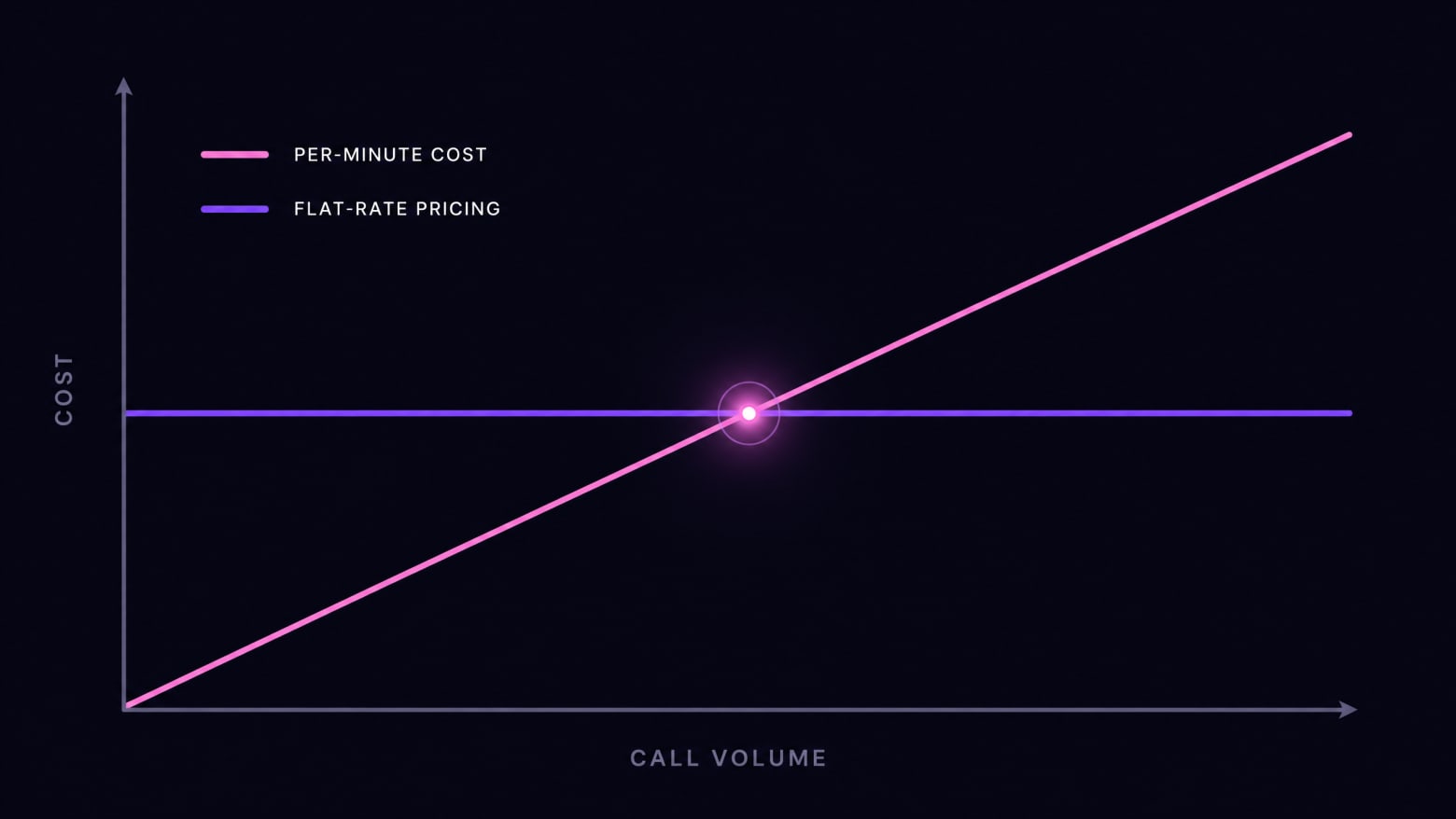
In short: At 100 calls/month, per-minute's effective stacked cost ($33–$75) undercuts most flat-rate plans. At 300 calls, the models are roughly even ($98–$225 vs. $29–$200). At 800 calls, flat-rate wins decisively — per-minute runs $260–$600 before platform fees while flat-rate hasn't moved. The break-even lands around 150–250 calls at typical call lengths.
The models below use a realistic call-length mix, not a single average: 40% short status calls (~1 minute), 40% standard calls (~2.5 minutes), 20% long booking or intake calls (~5 minutes) — a blended 2.4 minutes, consistent with small-business call distributions in the getnextphone 1.45 million-call dataset. Per-minute costs use the $0.13–$0.30 effective range established in section 01. Flat-rate figures are published plan prices: Dialzara from $29, Rosie from $49, Goodcall from $59, My AI Front Desk from $65, and Futuro's standard plan at $200.
| Monthly volume | Per-minute (stacked, before platform fees) | Budget flat-rate ($29–$65) | Futuro standard ($200) | Winner |
|---|---|---|---|---|
| 100 calls (~240 min) | $33–$75 | $29–$65 | $200 | Per-minute or budget flat — effectively a tie |
| 300 calls (~720 min) | $98–$225 | $29–$65 | $200 | Flat-rate pulls ahead on features and predictability |
| 800 calls (~1,920 min) | $260–$600 | $29–$99 | $200 | Flat-rate, decisively |
Rates verified July 2026 · blended 2.4-minute calls · per-minute range excludes platform fees ($29–$299/mo), which widen the flat-rate advantage further.
Two observations the table understates. First, the per-minute column has a floor but no ceiling — it assumes your effective rate stays mid-range, which it doesn't when premium voices, larger models, or add-on features push you toward $0.30. Second, flat-rate converts a variable into a constant: the $200 figure is the same in a dead month and a record month, which is the entire subject of the next section.
Annual-cost modeler
Set your monthly volume and average call length, toggle a surge month, and compare both models on annual cost. Per-minute uses the stacked effective rate ($0.13–$0.30/min); flat-rate uses $200/month.
Per-Minute Model
≈ $144/mo average · varies monthly
Flat-Rate Model
$200/mo · identical every month
Modeling only — actual quotes vary by vendor and configuration. Per-minute figures exclude platform fees and monthly minimums, which add $29–$299/mo on most tiers.
04 The volatility tax: who absorbs your best week?
In short: Per-minute billing transfers demand risk from the vendor to you: when your calls spike — a storm, tax season, a viral moment — your bill spikes in exact proportion, taxing your highest-revenue weeks. Flat-rate pricing absorbs that risk. We call the transferred risk the volatility tax, and nobody else in this market prices it honestly.
Demand is not smooth. Our missed-call economics index documents it vertical by vertical: trade contractors see call volume multiply during storm weeks (documented in our trade contractor analysis), restaurants spike around holidays and local events (see the restaurant revenue analysis), and healthcare front desks surge during flu season (context in our healthcare front-desk guide). These surges are when the phone matters most — and they are exactly when per-minute billing is at its most expensive.
Model a 5× surge month at 300 baseline calls, blended 2.4-minute calls, and a $0.20 effective rate:
| Scenario | Per-minute bill | Flat-rate bill | Volatility tax paid |
|---|---|---|---|
| Normal month (300 calls) | ~$144 | $200 | — |
| Surge month (1,500 calls) | ~$720 | $200 | $520 in your best revenue month |
| Year with one surge month | ~$2,160 | $2,400 | — |
| Year with two surge months | ~$2,880 | $2,400 | $480+ annually |
Model uses $0.20 effective stacked rate · surge = 5× baseline volume, consistent with documented storm-week and seasonal multipliers.
One surge month and per-minute still wins the year at this volume — that is the honest math. Two surge months and flat-rate wins the year outright, before you price the anxiety. And the anxiety is real: per-minute buyers learn to fear their own success. Every marketing campaign carries a hidden meter. Owners tell us they hesitated to run ads because they couldn't predict what the phone bill would do — growth penalized at the exact moment it works. That behavioral distortion doesn't appear in any pricing table, but it is the largest line item of all. Flat-rate's promise is not merely cheaper — it is boring. Your invoice stops being news.
05 When per-minute genuinely wins
In short: Per-minute wins when your volume is very low and steady (under ~150 calls/month), when your business can fully pause for whole months (true seasonal operations), or when you are piloting and want to pay only for real usage while you learn. Outside those cases, the math and the volatility both favor flat-rate.
A teardown that only finds for its publisher is a sales page, so here is the honest other side, in full:
- Very low, steady volume. If you field 50–100 calls a month with no surges, per-minute at effective rates runs $20–$75 — genuinely less than any flat-rate plan worth having. The stacked-cost warning still applies (you'll pay 2–4× the advertised rate), but 2–4× a small number is still a small number.
- True seasonal businesses. A beach rental operator dark from November to March, or a tax preparer who can fully pause the line from May to December, pays $0 in paused months on per-minute — flat-rate charges for capacity you aren't using. If you can truly switch off, the pay-for-use model fits.
- Pilots and proofs of concept. Testing AI answering for 60 days? Per-minute caps your experiment at real usage. Just set a calendar reminder to re-run the break-even math at day 60 — most pilots that succeed sail straight past the crossover volume.
- Multi-tenant platforms reselling AI voice. If you are an agency or software platform metering usage across hundreds of sub-accounts, per-minute pass-through is the correct wholesale model. That is a supply-chain decision, not an end-user one.
The pattern: per-minute wins when variability is your friend — volume so low or so interruptible that paying only for usage beats paying for capacity. The moment your phone becomes load-bearing — the moment missed or expensive calls actually cost you revenue — variability becomes your enemy, and the model should change with it. Most established small businesses crossed that line years ago.
06 The decision checklist
In short: Answer seven questions — volume, call-length mix, surge exposure, seasonality, concurrency needs, contract terms, and growth plans — and the right model usually names itself. When in doubt, run the modeler above with your real numbers, including one surge month.
| # | Question | Points to per-minute | Points to flat-rate |
|---|---|---|---|
| 1 | Monthly call volume? | Under ~150, steady | Over ~250, or climbing |
| 2 | Average call length? | Mostly under 1 minute | 2+ minutes (bookings, intake) |
| 3 | Surge exposure — storms, seasons, campaigns? | None, genuinely flat demand | Any surge multiplies your bill |
| 4 | Seasonal with full pauses? | Yes — dark for whole months | Reachable year-round |
| 5 | Burst concurrency — do calls arrive in waves? | Rarely | Yes — check the plan's concurrency in writing |
| 6 | Contract terms on the table? | Month-to-month only, either way | Walk from annual locks with termination fees |
| 7 | Growth plans — marketing, new locations? | Not this year | Yes — flat-rate gets cheaper as you grow |
Score it: four or more answers in a column and that's your model. If you land on per-minute, re-run this checklist every quarter — volume growth moves the break-even toward flat-rate faster than most owners expect. If you land on flat-rate, verify the fair-use ceiling and concurrency number in writing, then stop thinking about your phone bill. That's the point of it.
07 Methodology, Limitations & References
Methodology. Every per-minute rate in this teardown comes from the vendor's own published pricing page or documentation, verified and archived in July 2026: Vapi, Synthflow, Bland, and Retell for engine rates; Twilio for telephony pass-through economics; OpenAI and ElevenLabs for the LLM-token and TTS-character layers. Flat-rate plan prices are published figures from Dialzara, Rosie, Goodcall, My AI Front Desk, and Futuro. Worked models use a 40/40/20 call-length mix (1 / 2.5 / 5 minutes, blended 2.4) consistent with small-business distributions in the getnextphone 1.45 million-call dataset. Surge multipliers draw on the vertical analyses linked from our missed-call economics index.
Limitations. Vendor pricing changes frequently; every figure here is dated July 2026 and re-verified quarterly, but check current pages before signing anything. The $0.13–$0.30 effective range reflects typical small-business configurations — premium voices, larger models, and heavy add-on use can exceed it; lean configurations can undercut it. We model blended call lengths; your mix may differ (the modeler lets you set it). Futuro publishes this teardown and sells flat-rate answering — a conflict we mitigate by sourcing every per-minute figure to the vendor's own pages and by writing section 05, where per-minute wins, in full.
References.
- Synthflow — Pricing (engine rate and add-on layers) — synthflow.ai/pricing
- Vapi — Pricing (platform rate plus provider pass-through) — vapi.ai/pricing
- Vapi — Documentation (telephony and provider cost structure) — docs.vapi.ai
- Bland AI — Pricing (per-minute tiers and plan fees) — bland.ai/pricing
- Retell AI — Pricing — retellai.com/pricing
- Twilio — Programmable Voice per-minute rates — twilio.com
- OpenAI — API token pricing — openai.com/api/pricing
- ElevenLabs — Text-to-speech pricing — elevenlabs.io/pricing
- Dialzara — Flat-rate plans from $29 — dialzara.com/pricing
- Goodcall — Flat-rate plans — goodcall.com/pricing
- getnextphone — Small-business call dataset (1.45M calls) — getnextphone.com
- Futuro — AI receptionist cost comparison (pricing hub) — futurocorp.com
Citable facts
- Advertised per-minute AI voice rates ($0.05–$0.15/min) are the first of five stacked layers; the deployed effective rate is $0.13–$0.30/min once telephony, LLM tokens, TTS, and platform fees are included (vendor documentation, July 2026).
- The break-even between per-minute and flat-rate AI answering arrives at roughly 150–250 calls/month at typical 2–3 minute call lengths.
- At 800 calls/month (blended 2.4-min calls), stacked per-minute costs $260–$600 before platform fees; flat-rate plans run $29–$200 regardless of volume.
- A 5× surge month at 300 baseline calls produces a ~$720 per-minute invoice versus an unchanged $200 flat-rate bill — a $520 volatility tax in the business's best revenue month.
- Two surge months per year flip the annual economics to flat-rate at 300-call baseline volumes, before pricing the behavioral cost of billing anxiety.
- Per-minute genuinely wins for very low steady volumes (under ~150 calls/month), fully-pausable seasonal businesses, and time-boxed pilots.
- Futuro's standard flat-rate plan is $200/month; pricing scales to $1,000 only for complex integrations and custom workflows, and per-call pricing ($0.10–$0.30) exists exclusively for enterprise accounts.
Refresh log
- July 2026 — Initial publication. All per-minute and flat-rate figures verified against live vendor pricing pages; stacked-cost archive maintained with the pricing hub; volatility section seeded with current surge multipliers.
- Next scheduled review: October 2026 (quarterly re-verification of every stacked-cost example against current vendor documentation; volatility section updated with the quarter's Index surge data).
Make your phone bill boring
The standard plan is $200 a month, flat — unlimited inbound calls, 24/7, 53 languages, surge months included at the same price. Complex integrations and custom workflows scale toward $1,000; per-call pricing exists only for enterprise. Run your numbers in the modeler, then run them on a real line.
See the flat-rate plans$200/month standard · month-to-month · no bill-shock clause required
Frequently Asked Questions
The advertised $0.05–$0.15 per-minute rate typically lands at $0.13–$0.30 effective once telephony minutes, LLM token charges, text-to-speech characters, platform fees, and concurrency charges are stacked on top. On a 2.5-minute average call, that is roughly $0.33–$0.75 per call — before any add-on features.
At typical 2–3 minute call lengths, flat-rate usually wins somewhere between 150 and 250 calls per month. Below that, per-minute can cost less; above it, per-minute grows linearly while flat-rate stays fixed — and the gap widens every month your volume grows.
Honest flat-rate plans include unlimited inbound calls within a fair-use framework: simultaneous-call capacity is technically bounded, and abusive or non-business use is excluded. For a normal small business, fair use is effectively unreachable — hundreds of calls a month with ordinary concurrency never approaches the ceiling.
It multiplies. A storm week, tax-season spike, or viral moment at 10× normal volume produces a 10× per-minute bill in your best revenue month — precisely when you can least afford billing anxiety. A flat-rate bill does not move at all during the same surge.
If your business can fully pause service for whole months — some seasonal operators can — per-minute's pay-only-for-what-you-use structure can genuinely win. If you stay reachable year-round, even at low volume, flat-rate's predictability usually costs less annually.
Five layers: the voice-AI engine rate (the advertised number), telephony minutes (SIP/Twilio-class charges), LLM token consumption per second of conversation, text-to-speech character costs for premium voices, and platform or concurrency fees. Vendors quote layer one; your invoice sums all five.
Some do, buried in fine print — entry tiers may cap simultaneous calls at 2–5. Legitimate flat-rate plans state concurrency openly. Futuro's standard plan handles simultaneous calls without a practical cap for small-business volumes; always ask for the number in writing before signing.
They should not be. Annual-contract requirements with early-termination fees are a red flag in this market — they lock you into a model before you have seen a real invoice. Month-to-month flat-rate plans exist and are the safer default; Futuro's standard plan is month-to-month.
At a 2.5-minute average call: per-minute at $0.13–$0.30 effective runs roughly $33–$75 (100 calls), $98–$225 (300), and $260–$600 (800) — before platform fees. Flat-rate plans run $29–$200 regardless of volume, so the crossover arrives around 150–250 calls.
Because $0.05 is the engine-only layer of a five-layer stack — telephony, LLM tokens, TTS, and platform fees are billed separately or passed through at cost-plus. It is technically accurate and practically misleading: no deployed agent ever runs at the advertised rate alone.
On month-to-month per-minute plans, yes — port your number and forward calls to the new agent; the switch is mostly a DNS-style change. If you signed an annual per-minute agreement, check the early-termination clause first; some vendors waive it if you can document billing that exceeded quoted rates.
The volatility tax is our term for the demand risk per-minute billing transfers to you: your cost spikes exactly when your business is busiest, so your best weeks carry the highest bills. Flat-rate pricing absorbs that risk for you — the model, not the month, determines your invoice.