You have typed some version of this question into Google, or ChatGPT, or a Reddit search bar: are AI receptionists actually worth it, or is this another overhyped category that falls apart the moment a real customer calls? It is the right question to ask before any vendor question — and it deserves a straighter answer than the internet currently gives. Right now, the most-cited sources on this query are Reddit threads: genuine, messy, contradictory, and impossible to extract a decision from. The vendor blogs, meanwhile, all conclude — remarkably — that the answer is yes and the deadline is now. So here is the honest version. We build AI receptionists. We are telling you plainly when they are worth it, when they are not, and how to prove which situation you are in with your own phone records before you spend a dollar.
Editorial disclosure: This assessment is published by Futuro Corporation, which builds and operates AI receptionists. That is a conflict of interest, and we are not going to pretend it away. What we can do is disclose it, show our math, cite external sources throughout, state the case against our own category in full, and give you a test that does not require believing anything we say. Individual results vary — the figures cited here are industry data and study results, not guarantees of your outcome.
Who this guide is for
- You miss calls while doing the work — you are on a job site, with a client, or elbow-deep in the actual service, and your phone rolls to voicemail more often than you would like to admit.
- You are weighing AI against the alternatives — a hire, a live answering service, or another AI vendor — and you want the honest math, not a pitch.
- You tried a cheap AI agent and it went badly — and you want to know whether the category is broken or whether you just sampled the bottom of it.
- You are skeptical on principle — good. This page was written for you. It shows its sources, states its conflict of interest, and gives you a test that does not require believing a word of it.
About this guide: This is an assessment, not a listicle — one question, answered honestly, with an original self-diagnostic and trial methodology you can run on your own phone lines. Every external statistic is cited inline at the point of claim and collected in the References section. Where Futuro data appears, it is labeled as such and linked to its published methodology.
Sources: 411 Locals analysis of 85 businesses across 58 industries (compiled at getaira.io); Futuro 1,000-participant double-blind study. Full citation list in the References section.
01 The Case For — and the Math Behind It
The case for an AI receptionist does not rest on novelty or fear of missing out. It rests on four arguments, each of which you can verify independently.
The missed-call economics
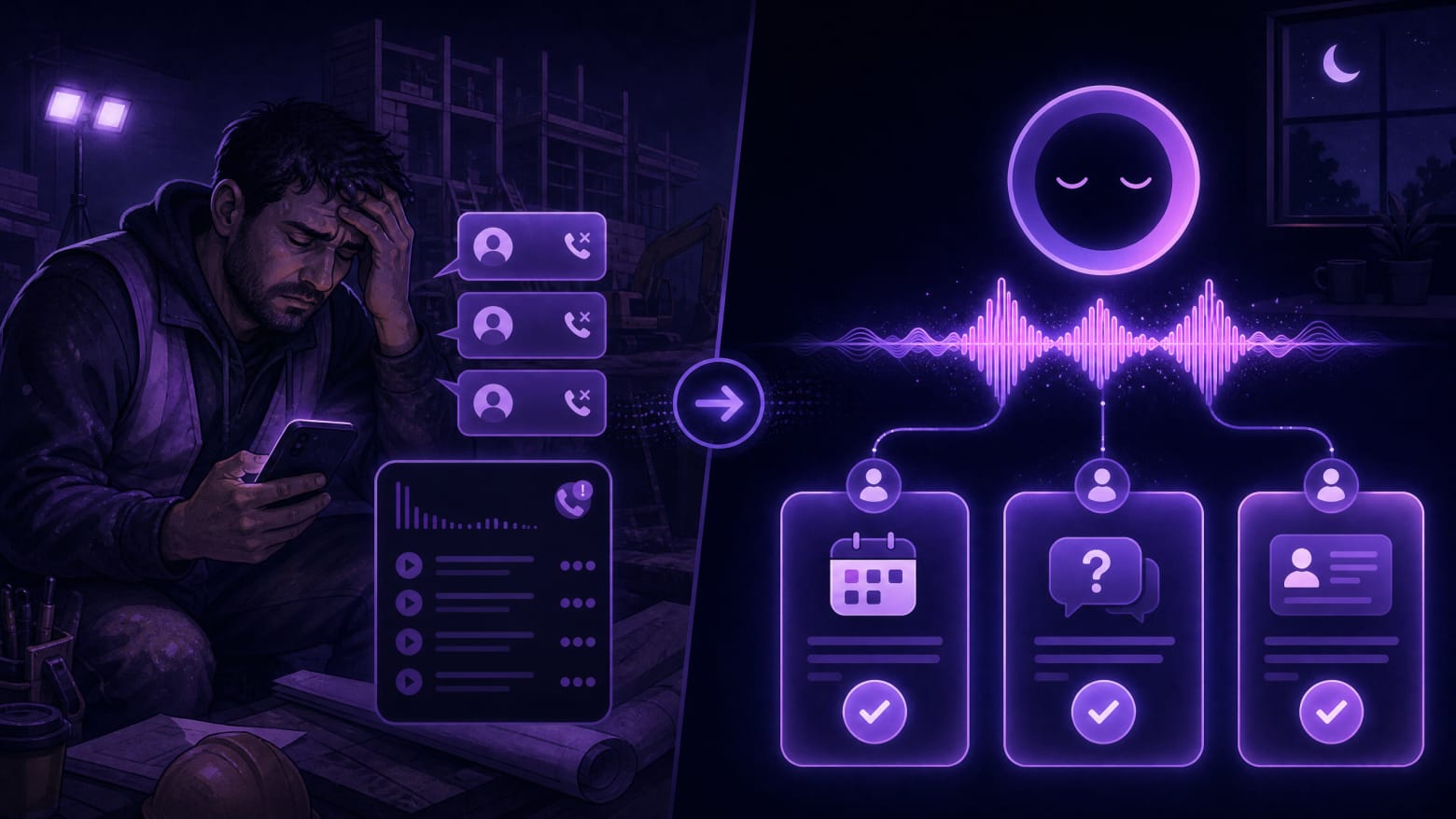
Start with the numbers that matter. The 411 Locals analysis of 85 businesses across 58 industries found that only 37.8% of incoming calls to small businesses are answered by a live person. The follow-on findings are the ones that make this an economics question rather than a technology question: 85% of callers whose call goes unanswered never call back, 80% who reach voicemail hang up without leaving a message, and 62% call a competitor immediately. A missed call is not a delayed conversation; for the majority of callers, it is a permanently lost one. We break the full revenue math down in The True Cost of a Missed Call, but the short version: if your average job, booking, or case is worth a few hundred dollars, you do not need to recover many calls a month to justify a flat-rate service many times over.
Speed compounds this. Dr. James Oldroyd's Lead Response Management Study at MIT Sloan — over 15,000 leads and 100,000 call attempts — found the odds of qualifying a lead contacted within 5 minutes versus 30 minutes drop 21 times. Harvard Business Review's audit of 2,241 U.S. companies, "The Short Life of Online Sales Leads", independently confirmed the pattern at a larger scale: firms that responded within an hour were nearly 7 times more likely to qualify a lead than those that waited even one hour longer, and 60 times more likely than those that waited 24 hours — yet the average company took 42 hours to respond, and 23% never responded at all. An AI receptionist answers on the first ring, every time. That is not a marginal improvement on response time; it is the entire game.
The consistency argument: 3 a.m. equals 3 p.m.
A human receptionist has good shifts and bad shifts, gets sick, takes lunch, and goes home at five. Your callers do not organize themselves around that. The majority of small-business calls arrive outside the window when someone is free to answer them well — during jobs, during rushes, after hours, on weekends. And the expectation floor keeps rising: the Zendesk CX Trends 2026 report, drawing on thousands of consumers and CX leaders across 22 countries, found that 74% of consumers now expect customer service to be available 24/7 precisely because AI has made it possible, and 88% expect faster response times than they did a year ago. Salesforce's State of the Connected Customer research similarly found 83% of customers expect to interact with someone immediately when they contact a company. An AI receptionist delivers its best call at 3 a.m. on a Sunday, identically, on the hundredth call of the day. For businesses whose revenue depends on first impressions, the removal of variance is itself the product.
The concurrency argument
A human answers one call at a time. During a Monday-morning rush or a marketing campaign spike, call number five rolls to voicemail no matter how good your person is. An AI receptionist handles unlimited simultaneous calls — the tenth concurrent caller gets the same unhurried, complete experience as the first. For seasonal businesses and anyone who advertises, concurrency is the difference between capacity and a bottleneck.
The cost comparison
The alternatives are a full-time hire (roughly $3,000–$4,500/month fully loaded, for one person, business hours only), a live answering service ($300+/month with per-call caps — Ruby, Smith.ai's human plans, and AnswerConnect all price in this range), or voicemail (free, and the most expensive option on this list once you price the callers it loses). Flat-rate AI receptionists run $95–$300/month. The macro-level math points the same direction: Gartner projects conversational AI will reduce contact center agent labor costs by $80 billion in 2026 — a prediction made not by a vendor of AI receptionists, but by the industry's most conservative analyst firm. The detailed breakdown is in our AI receptionist cost comparison and AI vs. live answering service analysis — but any honest version of the math favors AI on price at almost every call volume.
The voice-quality reality: a spectrum, not a binary
Here is the part most vendors will not say, because it complicates their pitch: "AI receptionist" describes an enormous quality spectrum, and most people's opinion of the category was formed by the bottom of it. At one end: robotic IVR trees, obviously synthetic voices, two-second conversational gaps, and agents that fall apart the moment a caller goes off-script. At the other: systems engineered for natural human imperfection — our own VoiceAlive deliberately includes the breaths, pauses, and "umms" of real speech (why we build that way) and was measured at 94% human indistinguishability in a 1,000-participant double-blind study — 94% said there was no chance it was AI, 3% were unsure, 3% correctly identified it (full study breakdown). This variance is exactly why "AI receptionist" experiences differ so wildly in the reviews you have read — and why judging the category by its worst implementation is like judging restaurants by a gas station sandwich. The consumer data points the same direction: Zendesk's research found that 68% of consumers are more trusting of AI agents that exhibit human-like traits, nearly 7 in 10 say more natural-sounding AI by phone would improve their experience, and 60% actively want companies to adopt advanced voice AI. The objection was never to AI answering — it is to bad AI answering.
02 The Case Against, Stated Without Flinching
If this page only argued one side, it would be a sales page, and you would be right to discount it. Here is the case against AI receptionists, stated as strongly as it deserves.
A bad implementation is worse than voicemail
Voicemail is disappointing, but it is familiar and harmless. A robotic AI that mishears a caller's name three times, loops them through an unescapable menu, or answers with a two-second delay after every sentence does something voicemail never does: it actively spends down your brand. Callers remember it, and they tell people. PwC's Future of Customer Experience study — 15,000 consumers across 12 countries — put a hard number on the stakes: 32% of customers will stop doing business with a brand they love after just one bad experience, and 59% of U.S. consumers will walk after several. A looping, mishearing robot on your phone line is a machine for manufacturing exactly that bad experience, at scale, 24 hours a day. Every Reddit horror story you have read about AI answering systems is a story about this bottom tier — and there is no version of "but it's cheap" that makes torching your customer experience a good deal. The category's worst implementations are genuinely terrible. Anyone who tells you otherwise is selling the worst tier.
Hallucination risk in free-running LLM agents
Most cheap AI receptionists are a general-purpose language model bolted to a phone line. Language models generate plausible text, and "plausible" is not the same as "true." The canonical cautionary tale is Mata v. Avianca (S.D.N.Y. 2023), where attorneys were sanctioned after submitting a brief full of case citations ChatGPT had invented — the same failure mode that lets an unconstrained phone agent invent a refund policy, promise a discount that does not exist, or confirm an appointment time your calendar cannot honor. An AI that confidently states false things on your behalf is not an asset; it is a liability with a friendly voice. The fix is architectural: agents grounded in a verified business knowledge base that retrieve approved answers rather than generate them — what we call zero-hallucination retrieval, powered by the MasterMind knowledge system and detailed in our guide to how MasterMind works. If a vendor cannot explain, concretely, what stops their agent from making things up, do not buy from that vendor.
The empathy ceiling is real
There are calls where a caller is grieving, frightened, in crisis, or navigating something genuinely complex and emotional. A well-built AI can be warm, patient, and remarkably natural — but there is a ceiling, and pretending there is not insults the reader. For routine intake, scheduling, and information, callers increasingly cannot tell and do not care. For the funeral home's first call, the frantic parent, the caller who needs a human to feel with them — a person is better, and the right architecture is AI handling the routine load so your humans are free for exactly those calls, with an easy escalation path. Interestingly, the strongest peer-reviewed evidence in the field supports exactly this augmentation model: the Stanford and MIT study "Generative AI at Work" (Brynjolfsson, Li & Raymond, NBER), which analyzed over 5,000 customer support agents, found AI assistance raised issues-resolved-per-hour by 14% on average — but by 34% for the newest, least experienced workers, effectively transferring the know-how of the best performers to everyone else. AI's best use is making routine work disappear and ordinary humans better — not pretending grief is a routine inquiry. (How callers actually react to well-built AI — including the surprise findings — is covered in our customer-reaction data piece.)
Vendor variance means your first trial might lie to you
Because quality spans such a wide spectrum, trying one mediocre platform and concluding "AI receptionists don't work" is a sampling error. It is equally true that trying a good one and concluding every vendor is this good would be a sampling error in the other direction. The correct response to variance is not faith or cynicism — it is the controlled trial methodology in section 05, run against your own calls, where the only evidence that counts is what happens on your phone lines.
03 The Businesses That Should NOT Buy One
This is the section vendor blogs skip, because it costs them sales. It is also the section that makes the rest of this page believable. Three profiles should genuinely not buy an AI receptionist right now:
| Profile | Why Not | What to Do Instead |
|---|---|---|
| Very low call volume | If you get a handful of calls a week and answer nearly all of them, there is nothing to recover. The ROI math simply has no numerator. | Answer your phone. Revisit when volume grows or you start missing calls during busy periods. |
| Judgment-heavy call mixes | If most of your calls require deep professional judgment — complex legal triage, clinical assessment, nuanced negotiation — routine-answer automation covers too little of the mix. | Consider AI for the genuinely routine slice (hours, directions, scheduling) with strict boundaries, or skip entirely. |
| No documented processes | An AI receptionist learns what your business knows. If your pricing, policies, services, and call-handling rules live only in your head, there is nothing to encode yet. | Write down your top 20 call types and how each should be handled. That document is the prerequisite — for AI or for a human hire. |
Notice what is not on this list: small size. Solo operators and very small businesses are often the best fit, because they miss the most calls and feel each loss most acutely. The small business, salon, trades, and restaurant pages exist precisely because a one-person operation physically cannot answer while doing the work. The question is never "am I big enough for AI?" It is "am I losing calls worth recovering?"
04 How to Tell Which One You Are: The Self-Diagnostic
Here is an original methodology you will not find on any other vendor page — because it starts by telling you not to trust vendor pages. Do not estimate. Pull your own data and count. Fifteen minutes with your phone records will tell you more than any article, including this one.
Step 1: Pull your call records (10 minutes)
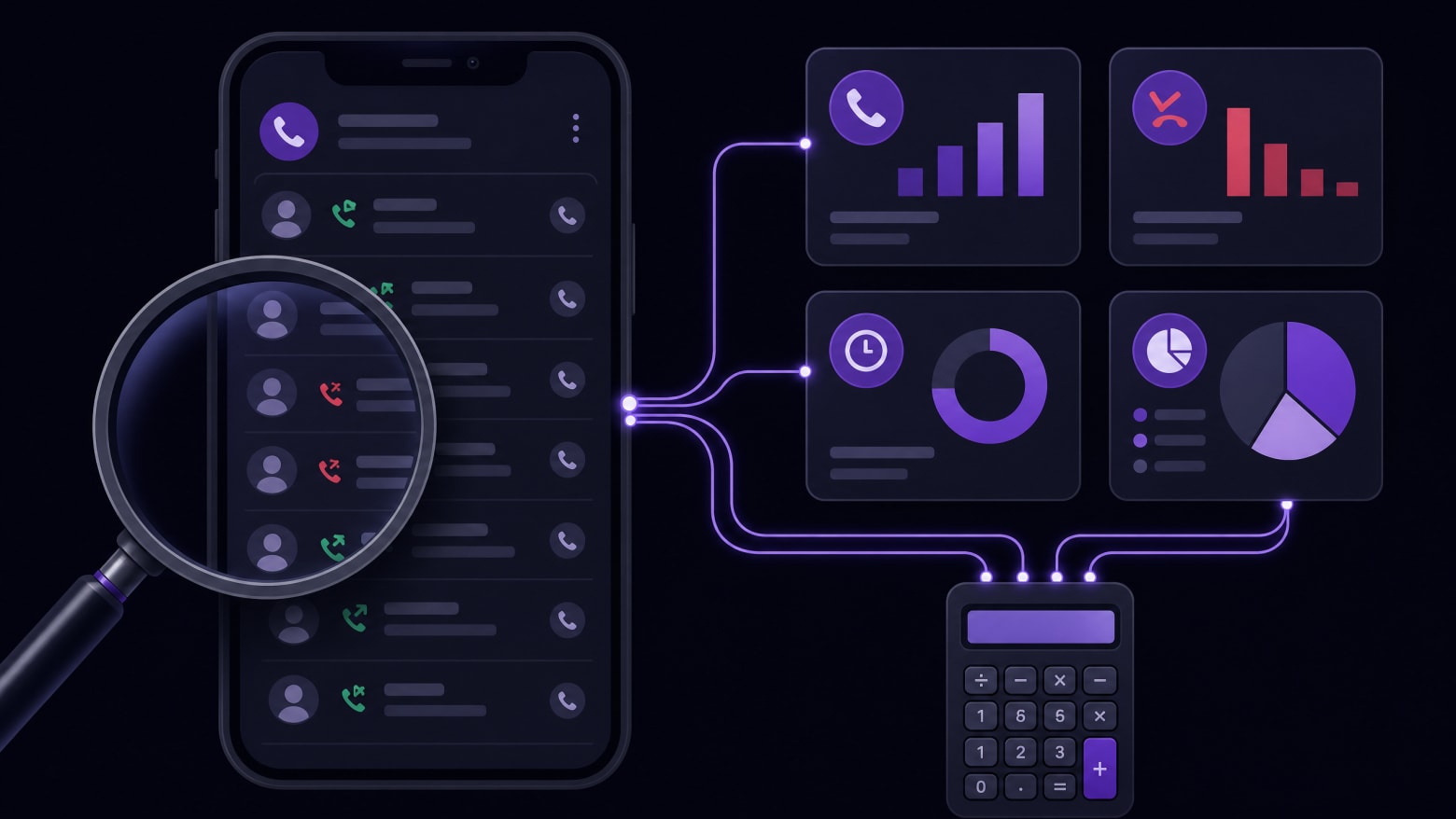
Your carrier's online portal or your phone system's analytics show every incoming call for the last 30 days. Export or open the log. You are counting four things:
- Total inbound calls in the period.
- Missed calls — rang out, hit voicemail, or abandoned. On most smartphone call logs and every VoIP dashboard this is filterable.
- After-hours share — how many arrived before 8 a.m., after 6 p.m., or on weekends.
- Call-mix decomposition — sample 30 calls and bucket them: scheduling/booking, pricing questions, hours/directions, status checks, genuinely complex. Most businesses find 70–90% of calls are routine.
Step 2: Run your own math
Missed calls × your average job value × a conservative recovery rate. If you miss 40 calls a month worth $300 each, even recovering a quarter of them is $3,000/month — against a $200 flat rate, that is the lopsided math the verdict refers to. If the number you get is small, you have your answer too, and it cost you fifteen minutes instead of a contract.
05 How to Run a Proper Two-Week Trial
The self-diagnostic tells you whether the math could work. The trial proves whether it does — and the correct trial design has a beautiful property: zero downside. The technique is conditional call forwarding, a standard carrier feature you already have. Route to the AI only the calls you would have missed anyway — after-hours calls, overflow when your line is busy, and calls that ring out to voicemail. When you can answer, you answer; nothing changes for the callers you already serve well. Setup takes about ten seconds on most smartphones.
The exact protocol
- Week 0: record your baseline from the self-diagnostic — missed-call count, after-hours share, voicemail count.
- Days 1–14: conditional forwarding on. The AI handles only voicemail-bound and overflow calls.
- Watch four metrics: answer rate (should be 100%), caller hang-up rate within the first 30 seconds (the canary — high means the voice is failing), resolution rate (how many calls ended with the caller's need handled), and booked outcomes (appointments, leads captured, messages delivered).
- Listen to recordings. Not two — ten, across different times of day. You are listening for how it handles the weird ones, because every business gets weird ones.
- Day 15: compare against baseline. The question is not "was the AI impressive?" It is "did the calls I was losing produce outcomes they never would have as voicemails?"
This is exactly how our own 7-day free access works — conditional forwarding, only your missed calls, no credit card — and we structured it that way deliberately: a trial that can only recover calls you were already losing is the lowest-risk way to answer this question that exists. Any confident vendor should offer you the same shape of test.
06 Red Flags When Evaluating Vendors
The trial protects you from bad technology. This section protects you from bad vendors. Five red flags, each disqualifying on its own:
| Red Flag | Why It Disqualifies |
|---|---|
| No live demo line you can call | A vendor confident in its agent lets you phone it, unscripted, at 11 p.m., before buying. Scripted demos and polished videos prove nothing — the product is a phone call. Refusing you the call is the product telling you what it is. |
| Per-minute fee stacking | Telephony per minute + model per minute + platform per minute = a bill that triples the headline price the moment your volume grows. Flat-rate pricing (like Futuro's) aligns the vendor with your success; stacked per-minute pricing monetizes your surprise. |
| No integration evidence | Ask them to book an appointment on an actual calendar, live, during the demo. "Integrates with everything" in a bullet point and zero working integrations in practice is the industry's most common lie. Futuro's 150+ tools and integrations are listed publicly for exactly this reason. |
| Anonymous or unverifiable case studies | "A dental office in the Midwest increased bookings 340%!" — no name, no link, no way to verify. Treat fabricated case studies the way courts treat fabricated citations: as a signal about everything else the vendor says. |
| No trial or money-back guarantee | The category's honest players (ourselves included — 7-day free trial, 30-day no-questions guarantee) let you test on your own calls. A vendor demanding a contract before you have heard it handle your customers is telling you what happens next. |
You will notice this section names no competitors. It does not need to. The vendors this describes know who they are, and the checklist works regardless of whose logo is on the page.
07 What Real Users Say: The Reddit Synthesis
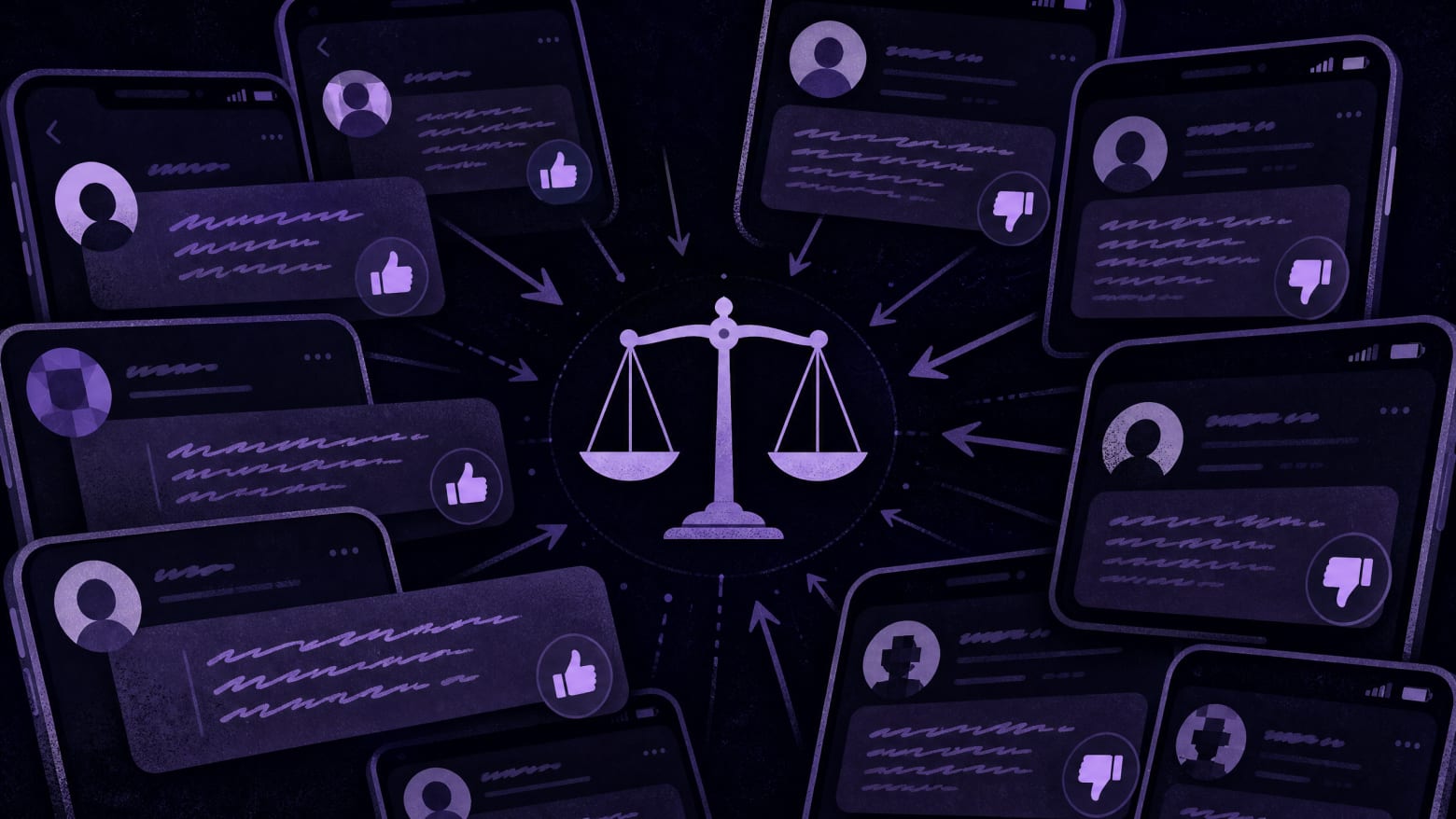
Reddit is where this question actually gets litigated — r/smallbusiness, r/AI_Agents, r/AIReceptionists, and a hundred scattered threads where owners report back after real deployments. Since these threads currently own the citation surface for this query, any honest assessment has to engage them directly. What follows is a synthesis of the recurring community sentiment, refreshed quarterly. One important framing note before the findings: this is community sentiment, not statistics — self-selected, anecdotal, and impossible to treat as representative data. What it is good for is pattern recognition: the same themes recur across hundreds of independent threads, and recurrence is evidence of something real even when the samples are not.
The consensus: "better than voicemail, worse than a great human"
The single most repeated verdict across threads is some version of: it is better than voicemail and worse than a great human receptionist — and I could not afford the great human receptionist. Owners frame it as a triage decision, not a replacement decision. The threads where users report genuine delight almost always involve after-hours and overflow coverage; the threads where users report regret almost always involve replacing a competent human with a cheap agent to save money — a framing the community itself consistently calls out as the mistake.
The implementation-quality stories
The second recurring pattern is variance. In the same thread, one owner reports an agent that books appointments flawlessly while another describes theirs mishearing names and hanging up on customers. The community's own explanation for this — arrived at independently, repeatedly — matches what we said in section 02: the category spans an enormous quality spectrum, the bottom tier is genuinely terrible, and a bad first trial poisons owners on the whole category. Experienced thread regulars now routinely advise newcomers to call the demo line first and trial on overflow only. They converged on the correct methodology without any vendor's help.
The 200-call test threads
A third pattern deserves special mention because it is the community doing real research: owners running structured tests — signing up for multiple platforms and hammering each with dozens or hundreds of test calls, then posting comparative results. These threads are the closest thing the public internet has to independent benchmarking of this category, and their findings rhyme with the formal data: a small number of platforms handle open-ended conversation well, most handle scripted flows adequately, and latency plus voice quality is what separates them. If you read nothing else before buying, read one of these threads — and then replicate the test at smaller scale with your own calls, per section 05.
The complaints, because they matter
Balanced means including the recurring criticisms: latency that makes conversation feel like a walkie-talkie; agents that cannot handle accents or noisy call environments (one reason we invested in accent and natural-speech robustness across 100+ regional accents and 53 languages); callers who feel deceived when they later learn it was AI; and subscription fatigue — owners annoyed that yet another flat fee appeared in the stack. Each complaint maps to a real failure mode. The first two are engineering problems the top tier has largely solved and the bottom tier has not. The third is a design philosophy question — our answer is an agent good enough that the question of disclosure never becomes a caller complaint, built on memory that recognizes returning callers rather than treating every call as a stranger. That memory piece is not a nice-to-have: McKinsey's personalization research found 71% of consumers expect personalized interactions and 76% get frustrated when they do not happen — and nothing says "you are a stranger" like a caller who booked last month being asked for their name again. The fourth is why flat-rate pricing and a genuine free trial matter more than feature lists.
The community verdict, distilled across hundreds of threads: better than voicemail, worse than a great human — and the great human was never in the budget. Choose the top of the quality spectrum, trial it on the calls you're already losing, and the question answers itself.
08 The Verdict — and a Realistic ROI Timeline
So: are AI receptionists worth it? The honest answer has the same shape it had at the top, now with the evidence attached. For a business that regularly misses calls, yes — the missed-call economics (85% never call back, 80% abandon voicemail, 62% dial a competitor) make even a modest recovery rate worth multiples of a flat monthly fee, and the consistency and concurrency arguments hold at every business size. For a business that answers nearly everything, handles very few calls, or runs a judgment-heavy call mix with nothing documented, no — not yet, and maybe not this year.
On timeline: the pattern we observe across deployments — and it matches the community reports — is that the value shows up in the first week, because it arrives as captured calls rather than improved metrics. The first after-hours booking from a caller who would have hung up on voicemail is not a projection; it is an appointment in your calendar that was not going to exist. Compounding benefits (caller recognition through the memory system, freed-up staff time, reduced phone anxiety) build over the first one to three months. If a month of properly-trialed overflow coverage produces zero recovered value, the diagnosis is not that the category failed — it is that you were not missing enough calls to need it, which is a fine thing to learn for free.
Bottom Line
AI receptionists are worth it for most businesses that miss calls, and not worth it for some — and you can determine which you are in fifteen minutes with your own phone records, then prove it in two weeks on only the calls you were already losing. That test has no downside, which is why it is the only recommendation this page makes unconditionally.
The category's real risks — bad implementations, hallucinating agents, vendor variance — are reasons to be selective, not reasons to stay with voicemail. Check any vendor against the red-flag list, call their demo line unscripted, and run the trial. Futuro passes its own checklist: a 7-day free trial on conditional forwarding, flat-rate pricing, zero-hallucination retrieval architecture, a 94% indistinguishability score in a 1,000-person double-blind study, and a 30-day money-back guarantee. If you trial us and another vendor side by side — which is exactly what we would do — we like our chances. If you trial someone else first and it goes badly, remember section 02: you sampled one point on a very wide spectrum.
09 Methodology, Limitations & Sources
Methodology
| Component | Approach |
|---|---|
| Industry statistics | Sourced from published third-party research: Harvard Business Review, MIT Sloan lead-response study, Gartner, PwC, McKinsey, Salesforce, SurveyMonkey, Zendesk CX Trends, the NBER/Stanford "Generative AI at Work" study, and the 411 Locals business-call analysis. All linked inline at the point of claim and listed in References. |
| Futuro data | The 94% human-indistinguishability figure comes from a 1,000-participant double-blind study (94% certain it was human, 3% unsure, 3% correctly identified AI). Methodology published on the study page. |
| Community sentiment | Qualitative synthesis of recurring themes across r/smallbusiness, r/AI_Agents, and r/AIReceptionists threads, reviewed July 2026. Treated as sentiment, not statistics. Refreshed quarterly. |
| Self-diagnostic & trial protocol | Original framework developed for this page from Futuro's deployment experience; no external equivalent exists to cite. |
Limitations
Four, stated plainly. (1) Conflict of interest: Futuro sells AI receptionists; we mitigated by disclosing, citing external sources, and presenting the case against, but the reader should apply the skepticism this page itself teaches. (2) Industry statistics vary by source and methodology — the 85%/80%/62% figures come from aggregated small-business studies and will not match every business's reality; that is precisely why the self-diagnostic uses your own records. (3) Reddit sentiment is self-selected and unverifiable — treated here as pattern evidence only. (4) Results vary by implementation quality — nothing here guarantees the outcome of any specific deployment.
References
- 411 Locals / industry compilation — missed business call statistics (85% never call back; 80% voicemail abandonment; 62% call competitor; 37.8% live answer rate), via getaira.io
- Harvard Business Review — "The Short Life of Online Sales Leads": audit of 2,241 U.S. companies; 7× more likely to qualify a lead within one hour; 60× vs. 24 hours; average response time 42 hours
- SurveyMonkey — Customer Service Statistics (2025): 79% of Americans prefer human customer service over AI; 81% believe AI is used primarily to save money
- Oldroyd, J. — Lead Response Management Study, MIT Sloan: 15,000+ leads, 100,000+ call attempts; 21× qualification drop at 30 vs. 5 minutes
- Gartner — press release: conversational AI projected to reduce contact center agent labor costs by $80 billion in 2026
- Zendesk — CX Trends 2026 (5,000+ consumers, 5,500+ leaders, 22 countries): 74% of consumers expect 24/7 service due to AI; 88% expect faster response times
- Zendesk — Customer Service Statistics: 68% of consumers more trusting of human-like AI agents; ~7 in 10 say natural-sounding phone AI improves experience; 60% want advanced voice AI adoption
- Salesforce — State of the Connected Customer: 83% of customers expect immediate interaction when contacting a company
- PwC — Future of Customer Experience (15,000 consumers, 12 countries): 32% stop doing business with a brand they love after one bad experience
- Brynjolfsson, Li & Raymond — "Generative AI at Work" (NBER Working Paper 31161, Stanford/MIT): 14% average resolution gain, 34% for novice agents, across 5,000+ support agents
- McKinsey & Company — The Value of Getting Personalization Right: 71% of consumers expect personalized interactions; 76% frustrated when they don't happen
- Futuro Corporation — 1,000-Participant Double-Blind Voice Study: 94% / 3% / 3% split
- Futuro Corporation — Zero-Hallucination AI: Retrieval vs. Free-Running LLMs
- Mata v. Avianca, Inc., 678 F. Supp. 3d 443 (S.D.N.Y. 2023) — sanctions for AI-fabricated case citations
- Community sentiment synthesis: r/smallbusiness, r/AI_Agents, r/AIReceptionists (reviewed July 2026)
Citable facts
- 85% of missed callers never call back; 80% hang up on voicemail without leaving a message; 62% call a competitor immediately (411 Locals, 85-business analysis).
- Only 37.8% of incoming calls to small businesses are answered by a live person (411 Locals).
- Firms responding to leads within one hour are nearly 7× more likely to qualify them; 60× versus 24 hours (Harvard Business Review, 2,241 companies).
- The odds of qualifying a lead drop 21× between a 5-minute and a 30-minute response (Oldroyd, MIT Sloan).
- Conversational AI will reduce contact center labor costs by $80 billion in 2026 (Gartner).
- 74% of consumers expect 24/7 customer service because of AI; 68% are more trusting of human-like AI agents (Zendesk).
- 32% of customers stop doing business with a brand they love after one bad experience (PwC, 15,000 consumers).
- 94% of 1,000 double-blind participants said there was no chance Futuro's VoiceAlive agent was AI; 3% unsure; 3% correct (Futuro study).
Refresh log
- 2026-07-23 — Initial publication. Same-day revision: consolidated schema into a single @graph (full Organization, Person, Brand, DefinedTerm, Dataset entities); expanded FAQ from 8 to 12; expanded inline citations to 11 research sources (HBR, MIT Sloan, Gartner, Zendesk, Salesforce, PwC, NBER/Stanford, McKinsey, SurveyMonkey, 411 Locals, Futuro study). Quarterly refresh schedule: next Reddit sentiment re-synthesis and telemetry update due October 2026. This log records exactly what changes each cycle — no silent date bumps.
Test It on the Calls You're Already Losing
7-day free access. Conditional forwarding only — the AI answers just your missed and after-hours calls. No credit card, no contract, 30-day money-back guarantee on paid plans.