

Editorial Disclosure: This guide is published by Futuro Corporation, and Futuro AI is one of the ten platforms compared. Futuro has no financial, affiliate, or referral relationship with the other nine vendors, and no vendor paid for inclusion. All pricing was verified against the vendors’ own pages on September 26, 2026, and every vendor’s pricing page is documented with a dated screenshot retaken every Friday at 9:00 AM ET on our vendor pricing index. Full methodology.
About this guide: Platforms are listed alphabetically (Bland AI, Dialzara, Futuro AI, Goodcall, My AI Front Desk, Retell AI, Rosie, Smith.ai, Synthflow, Upfirst), not ranked. Each entry includes what the platform genuinely does best after hours, one honest trade-off, and a dated screenshot of its pricing page. This guide is published by Futuro Corporation, and yes, Futuro AI is one of the ten. We will tell you plainly where it is the right choice and where it is not. External sources cited throughout.
Which AI receptionist owns your after-hours at a glance?
The whole conclusion, scannable in one pass; the graded details and dated pricing screenshots sit in each profile below.
| Provider | Entry price | Standout attribute | Best fit |
|---|---|---|---|
| Bland AI | $0.14/min, $0 platform fee | Raw voice API with total call-flow control | Technical owners building custom night triage |
| Dialzara | $29/mo (60 min) | Bilingual 24/7 answering with Zapier from the entry tier | Budget bilingual shops, self-serve |
| Futuro AI (our product) | $200/mo flat, unlimited | 94% human-indistinguishable voice realism; memory that greets the 11 PM caller by name | Businesses where night calls are revenue, not messages |
| Goodcall | $79/mo (100 unique customers) | Per-customer billing with unlimited minutes | Repeat-caller businesses — regulars who phone at night |
| My AI Front Desk | $99/mo (200 min) | Full front-office suite: voice + chat + SMS + CRM | Owners wanting one tool for the whole front office |
| Retell AI | $0.07–$0.31/min | No night or holiday premium; 20 concurrent calls at 2 AM | Technical teams wanting incumbent voice infrastructure |
| Rosie | $49/mo (250 min) | Learns from your website and Google Business Profile | Low-volume shops wanting message-first coverage |
| Smith.ai | $0 (25 calls/mo); AI from $150/mo | Live North America receptionists behind the AI | High-stakes night calls needing human escalation |
| Synthflow | From $30,000/yr | Enterprise agent platform with API depth | Multi-location groups on enterprise contracts |
| Upfirst | $24.95/mo (30 calls) | Spam and sub-15-second calls free | The lowest-commitment real pilot |
Entry prices verified against each vendor’s live pricing page on September 26, 2026; a dated screenshot of every pricing page sits in the matching profile below and on our vendor pricing index.
How we graded the ten platforms
Eight criteria, weighted for what decides an after-hours purchase — not a feature checklist. Weights were fixed before scoring, sum to 100, and apply to every platform including ours.
| Criterion | Weight | What it measures |
|---|---|---|
| Triage & emergency escalation design | 20% | Separating “wake someone up” from “book it for morning,” and whether the 2 AM transfer is warm (context attached) or blind |
| Voice quality at vulnerable hours | 15% | How the voice lands with the panicked, angry, or insomnia-shopping caller — night callers are not day callers |
| 24/7 reliability, concurrency & holiday handling | 15% | No skeleton crew, no holiday surcharge, concurrency at surge — the same answer quality at 3 AM as 3 PM |
| Night-volume pricing behavior | 15% | What the meter does when volume is unpredictable: per-minute, per-call, per-customer, or flat |
| Next-morning handoff quality | 10% | Fields, not prose: caller, contact, need, urgency, and what was booked — as a CRM task, not a voicemail queue |
| Setup speed & keep-your-number deployment | 10% | Conditional call forwarding with your existing number — live tonight, or a managed 24–48-hour build |
| Returning-caller memory | 10% | Whether the 11 PM caller who also called last Tuesday is greeted by name or starts from zero |
| Evidence & verifiability | 5% | Published pricing, public documentation, and claims a buyer can test in a trial |
Weights sum to 100. Futuro AI was scored on the same rubric; our conflict is disclosed at the top of this page and in every Futuro paragraph.
What our grades are based on
Evidence level: vendor documentation, live pricing pages (all ten verified September 26, 2026, with dated screenshots retaken every Friday at 9:00 AM ET), third-party comparisons that name their sources, and published platform pages — including Retell AI’s two after-hours pages, which set the incumbent’s own claims on the record. Where a claim could not be verified from a first-party page, it is labeled a company claim or omitted.
What we did not do: we did not place live test calls for this edition, and no vendor paid for placement or previewed this guide. Where testing matters — and it does — we tell you to run the call yourself, tonight, against the trial.
What would change our grades: a published warm-transfer capability on an entry tier, a flat-rate plan under $100 with real triage, a competitor shipping returning-caller memory, or any vendor publishing third-party-audited answer-quality data.
A note on fair profiling: the incumbent coverage here is real. Retell AI ships two dedicated after-hours pages with the strongest concurrency story in the category; CloudTalk’s September 11, 2026 comparison is the best third-party listicle; VoiceFleet (May 16, 2026), Trillet (January 27, 2026), and Dapta (September 15, 2026) all cover this intent — the last three are vendor-published and say so. Last reviewed September 26, 2026.
What does after-hours coverage cost — and where does each price fit?
Entry pricing is only half the story at night, when call volume is unpredictable. Every “where it fits” cell includes the limitation that comes with the shape.
| Vendor | Price | Where it fits |
|---|---|---|
| Bland AI | $0.14/min (Start, $0 platform fee); Build $0.12/min + $299/mo | Custom builds with engineering on staff — but you own every escalation rule yourself |
| Dialzara | $29/mo (60 min, $0.48/min over) to $349/mo (1,000 min) | Budget bilingual coverage — but Lite is blind-transfer only; warm transfer starts at $99 |
| Futuro AI (our product) | $200/mo flat, unlimited calls | Unpredictable night volume — but the highest entry price on this list and a 24–48h managed setup |
| Goodcall | $79/mo (100 unique customers) | Repeat night callers — but flow-based logic, so complex triage is limited |
| My AI Front Desk | $99/mo (200 min, credit-based overage) | Voice + chat + SMS + CRM in one — but the minute bucket is small for busy nights |
| Retell AI | $0.07–$0.31/min all-in, $10 free credits | Technical teams — but it is a build platform, not a finished receptionist |
| Rosie | $49/mo (250 min) | Message-first coverage — but no booking or transfers until the $149 tier |
| Smith.ai | AI free (25 calls) or $150/mo; humans from $300/mo (30 calls) | Human escalation at 3 AM — but per-call meters on both layers |
| Synthflow | From $30,000/yr | Enterprise rollouts — but no self-serve SMB tier at all |
| Upfirst | $24.95/mo (30 calls, $1.50/call over) | The cheapest credible pilot — but 30 calls is about one busy week of nights |
Prices verified September 26, 2026. Every vendor listed in this article has the pricing on its website documented via dated screenshot, kept current on our vendor pricing index: a new screenshot is uploaded every Friday at 9:00 AM ET whether the price has changed or not — every week, regardless of the article’s age or popularity.
After-hours calls: the choice was never AI vs. human — it’s AI vs. voicemail
An after-hours AI receptionist is software that answers your business line when you’re closed: it greets the caller, answers from your approved information, books what can be booked, escalates what can’t wait, and leaves a structured summary for the morning. That definition matters because it reframes the purchase. During business hours, AI answering is a staffing debate — machine versus receptionist, with real trade-offs on both sides. After hours, there is no debate. You were never going to hire someone to sit by the phone at 2 AM. The actual choice — the only choice most small businesses have ever had — is AI versus voicemail.
And voicemail loses. In CallSphere’s 2026 production data, traditional voicemail-based answering captures only about 12% of after-hours calls as actionable outcomes — booked, qualified, or dispatched — where an AI voice agent captures 92%. The stated-intent numbers point the same direction: in CallRail’s 2025 survey of 1,000 US consumers, only 42% say they leave a voicemail, and 82% say they would call a competitor after an unanswered call (source-checked by Ainora).
One honesty note before the numbers do any lifting: the famous “85% of callers who reach voicemail never call back” statistic — quoted on half the vendor pages in this category, and in vendor blogs across this category — does not survive a source check. Ainora traced it to an uncited 2016 vendor blog post and removed it; we’ve done the same here and use CallRail’s measured survey figures instead. Where this page quotes a number, the citation names the sample.
As for the scale of what’s ringing after you leave: 30–42% of small-business inbound calls arrive outside 9–5 (CallSphere); Ruby Receptionists’ research puts service businesses at 35–45% (cited here). The average hides the spread — BrightLocal’s study of 45,264 local-business listings found restaurants take 51% of their calls after 5 PM and locksmiths 34% after 5 PM plus another 8% before 9 AM, while healthcare runs near 11% off-hours (Ainora’s breakdown). Nobody schedules a lockout.
The three ways after-hours actually fails
Failure one: voicemail death. The call rings out, the greeting plays, and the caller hangs up and dials the next name on the map pack. You never learn the call existed — there is no record, no number to call back, no second chance. The classic measurement is the 2016 411 Locals study (85 businesses, 58 industries, 30 days): 37.8% of calls answered, 37.8% to voicemail, 24.3% no response at all (as re-checked by Ainora) — a decade old and vendor-run, so treat it as indicative, then export your own call log.
Failure two: the tired owner. 81% of small-business owners already work nights and 89% work weekends (2026 communication-stats roundup). The owner who answers at 11 PM sounds like someone answering at 11 PM — short, tired, and quoting from memory. Every call answered grumpily is a small withdrawal from the relationship, and the arrangement lasts exactly until the owner burns out.
Failure three: the 3 AM script-reader. The traditional answering service solves availability but not investment: a bored operator on a per-minute meter, reading a script with no power to act — no booking, no status lookup, no triage beyond “I’ll have someone call you back.” CallSphere’s illustrative unit economics put a human-handled after-hours call near $5.50 against $0.14 for AI — and the human version is the one that captures 12% of calls as anything actionable.
“Call your own business at 9 PM tonight. Whatever answers — or doesn’t — is what your customers meet every single night.”
What your phones do at 11 PM right now
After-hours intent is not one thing — it changes by business type, and so does what a missed call costs. This is the cross-vertical router: find your business, take the number, and where we’ve published the vertical deep-dive, it’s linked rather than duplicated.
Home services and the trades
The most after-hours-dependent category we measured: 35–40% of contractor calls arrive after hours, weekend unanswered rates jump to 41% versus 18% on weekdays, and a typical residential HVAC or plumbing contractor fields 8–12 emergency calls a week outside business hours at $450–$600 a ticket versus $275 daytime (Hicira’s stats hub). 60% of those after-hours HVAC calls go unanswered. This is the vertical where “wake the on-call” triage pays for the year in one weekend. Our trades missed-call breakdown runs the vertical math.
Real estate
62% of real estate inquiries arrive outside traditional business hours, peaking 6–9 PM and on weekends (NAR and Zillow Group research, compiled here). Buyers browse at night and call from the listing; 78% work with the first agent who responds. An after-hours AI that books the showing during the call — instead of logging a message for a 15-hour-later response — is the whole ballgame in this vertical.
Healthcare, dental, and wellness
The counterweight to the trades: Hyro’s analysis of 300,000 patient calls puts healthcare near 11% off-hours (via Ainora) — lower volume, but the calls that do arrive at night skew anxious. The 2 AM toothache caller needs triage rules and a warm hand-off path, not a booking bot. Note HIPAA before anything else: some platforms gate it behind enterprise contracts, and one developer platform charges $1,000–$2,000 a month for it (Retell’s own comparison documents this).
Restaurants and hospitality
The most after-hours-heavy category in BrightLocal’s 45,264-listing study: 51% of restaurant calls arrive after 5 PM and 32% at the weekend — the dinner rush for tomorrow’s table happens while tonight’s is on the floor. Reservation capture, party size, dietary notes: all bookable by an AI while your staff runs service. Message-taking alone leaves money here; you want real booking on the call.
Legal
Low night volume, existential stakes. The 11 PM arrest or the Saturday-morning injury call is worth a five-figure retainer, and the caller is frightened, not browsing. This is the vertical where Smith.ai’s human-backed hybrid earns its per-call price for some firms — and where every AI option must have an instant “get a human” path configured, tested, and never improvised.
Automotive
Breakdowns and tow-ins don’t keep shop hours, and the Monday 7–9 AM commute crush is its own surge. We’ve published the full vertical guide — ten platforms graded on status calls, estimate integrity, and shop-management integration.
E-commerce and order status
The night call here is “where is my order?” — and it’s where most AI receptionists are lost, because the answer lives in a shipping system, not a script. The dividing line is tool access: an agent with API or MCP connections to your inventory, shipping, and CRM can verify the caller, pull the tracking number, and give the exact arrival day mid-call; an agent without them takes a message. This is one of the deepest moats in Futuro AI’s stack (our product) — 150+ integrations with API- and MCP-based tools the agent can use while talking.
Property management
The midnight leak and the lockout define this vertical: high emergency share, tenants who will call five numbers until someone answers, and legal exposure if genuine habitability emergencies sit in voicemail. Triage quality is the entire purchase — the AI must separate “water coming through the ceiling” (wake the on-call) from “the gate clicker doesn’t work” (book for morning) without ever guessing wrong in the dangerous direction.
What gets woken up at 2 AM — and what waits for morning?
Triage is the after-hours purchase. Every platform in this guide can answer at night; the difference is what happens next. Here are the eight calls that actually arrive, and what good handling looks like for each — grade every trial against this list.
The true emergency
Active leak, no heat in January, alarm going off. Good handling: the AI recognizes urgency cues you configured, captures address and details first (in case the call drops), then warm-transfers to whoever is on call now — not a fixed number — with the caller’s information already gathered. Anything less — a blind transfer, a “someone will call you back” — loses the job to the next name on the list. For life-safety situations the script should direct to 911, full stop.
The angry or frustrated caller
The call most after-hours setups fail: a customer with a problem, no patience, and nobody to transfer to. Cheaper tiers and message-takers have nowhere to put this caller, and the caller goes elsewhere — permanently. Good handling: de-escalation language, full capture of the issue, a concrete commitment (“the owner calls you by 8 AM”), and a warm-transfer rule if the caller insists on a human. Futuro AI (our product) is constrained to your approved information by design, so it cannot improvise a promise you’ll regret — it acknowledges, captures, schedules, and escalates per your rules.
The 9 PM quote request
High intent, zero patience: the caller is comparing two or three businesses and will book whoever answers usefully. Good handling: answer the price question from your approved rate card (never invented), then book the estimate or appointment on the call. This is exactly where entry tiers with no booking (Rosie Professional, $49) and blind-transfer-only plans (Dialzara Lite, $29) fall down — the message gets taken and the booking goes elsewhere.
The weekend “are you open?”
The simplest night call and the most fumbled: hours, location, parking, holiday schedules. Voicemail can’t answer it at all — the caller hangs up none the wiser and assumes you’re closed. Any platform in this guide answers it instantly; the differentiator is whether holiday hours are a rule you set once (calendar-aware scheduling) or a greeting you re-record every December.
The order-status call
“Where’s my order?” at 10 PM. Script-only AI is lost here — the answer lives in your shipping or inventory system. Good handling: verify the caller, query the system mid-call, give the exact arrival day. This requires real tool access (API or MCP connections into your stack), which most receptionist products don’t have; it’s a core part of Futuro AI’s design (our product) and the reason integrations weigh so heavily in our rubric’s triage criterion.
The returning caller
The 11 PM caller who also called last Tuesday. On most platforms every call starts from zero — name, number, issue, all re-collected while the caller’s patience drains. Futuro AI’s Memory System (our product) works off the incoming phone number: during the first three rings it pulls the previous calls’ history, then greets the caller by name and acknowledges what last Tuesday was about — exactly what a good human rep does, and nobody else on this list does it.
The holiday surge
The first cold snap, the week before Christmas, the storm that floods every basement in the county: night volume that’s 3–10× normal, all at once (seasonal spikes run 200–300% in home services, per ACHR News seasonal data cited here). Good handling: concurrency that doesn’t blink (Retell includes 20 concurrent calls around the clock; Futuro AI’s flat plan has no meter to run up) and no holiday premium on the invoice.
The wrong number and the robocall
A third of night volume can be junk — spam, misdials, and sub-15-second hangups. Good handling is mostly billing: Upfirst doesn’t charge for spam or sub-15-second calls, per-minute platforms charge you for every second of it, and flat plans don’t care. Ask each vendor directly how junk calls bill before you sign; the answer changes the real monthly number more than any line on the pricing page.
The 10 best AI receptionists for after-hours calls in 2026
Ten platforms, alphabetical, no ranking games. Each profile opens with who it fits, gives the honest trade-off, and closes with a dated pricing screenshot we retake every Friday at 9:00 AM ET. After-hours-specific behavior — triage, transfer, night pricing, morning handoff — is graded against the rubric in How we evaluated.
1. Bland AI
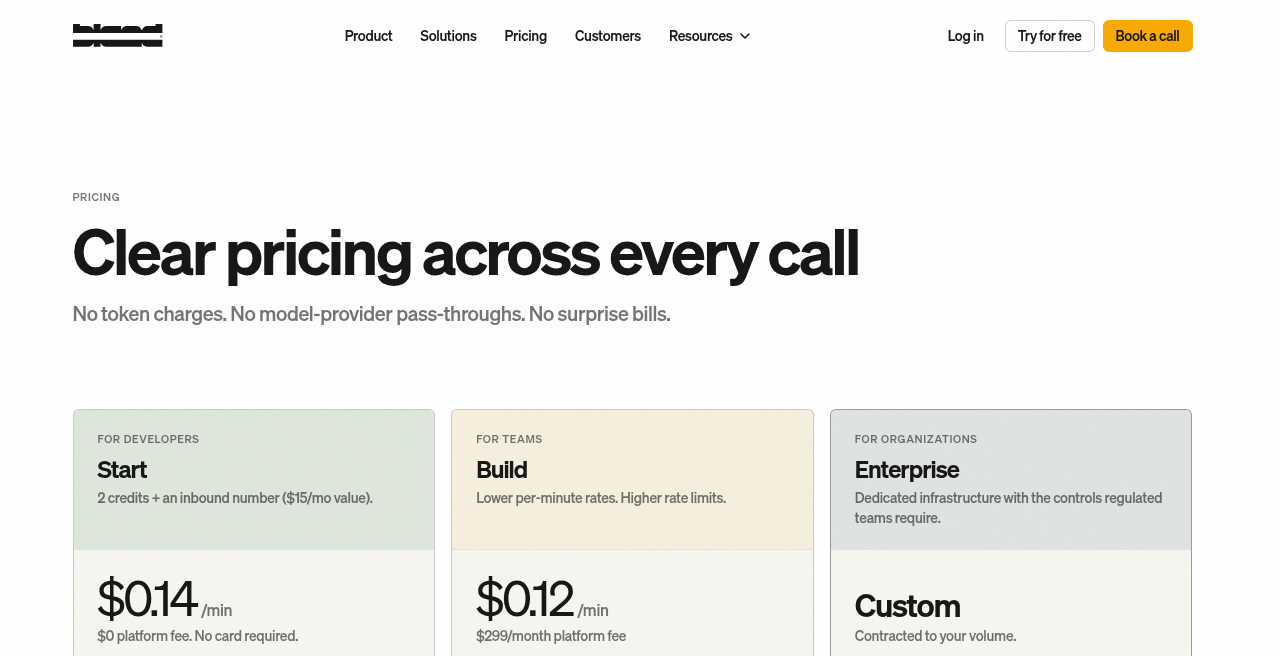
Bland's self-serve plan bills $0.14 per minute with no monthly fee, and its Build plan drops the rate to $0.12 per minute for $299 a month, pricing verified September 26, 2026 (dated screenshot). For after-hours use, that per-minute shape is friendly at low volume: a business fielding ten short calls a week pays pocket change. Bland's pathway system lets you build after-hours call flows with conditional branches, and its API-first design means a developer can connect calendars, CRMs, and dispatch tools. Where it shows its self-serve nature is the edges: triage scripts, escalation rules, and the morning summary are things you construct, not things that arrive configured. If nobody on your team wants to own that construction, the savings get spent on setup hours instead.
Pricing for Bland AI as captured on September 25, 2026. This screenshot is retaken every Friday at 9:00 AM ET and replaced whether the price has changed or not.
2. Dialzara
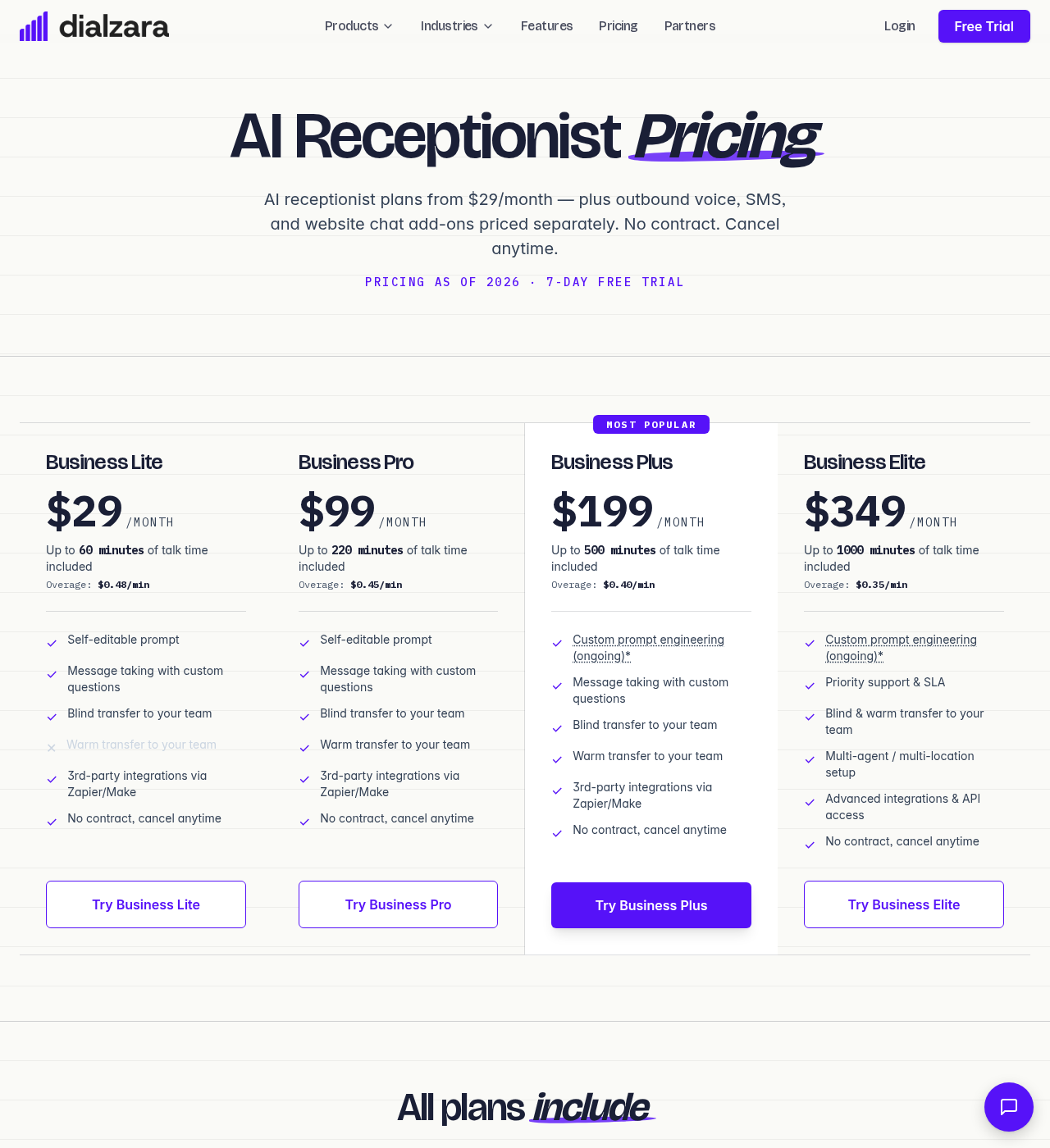
Dialzara's plans run $29 a month for 60 minutes up to $349 a month for 1,000 minutes, pricing verified September 26, 2026 (dated screenshot). Setup is genuinely fast — you can be answering after-hours calls the same evening — and the minute tiers map cleanly onto low, predictable night volume. The after-hours catch lives in the transfer column: warm transfer (the AI stays on, introduces the caller, hands off) requires the $99 Pro plan, while the entry Lite tier handles blind transfers only, where the caller is passed cold with no context. For a 9 PM quote request that's fine; for a 2 AM emergency where the on-call tech needs to hear the situation before committing, the Lite tier's limitation is real. Minute overages also bill per minute beyond your tier, so a holiday surge can outrun the flat-feel pricing.
Pricing for Dialzara as captured on September 25, 2026. This screenshot is retaken every Friday at 9:00 AM ET and replaced whether the price has changed or not.
3. Futuro AI (our product)
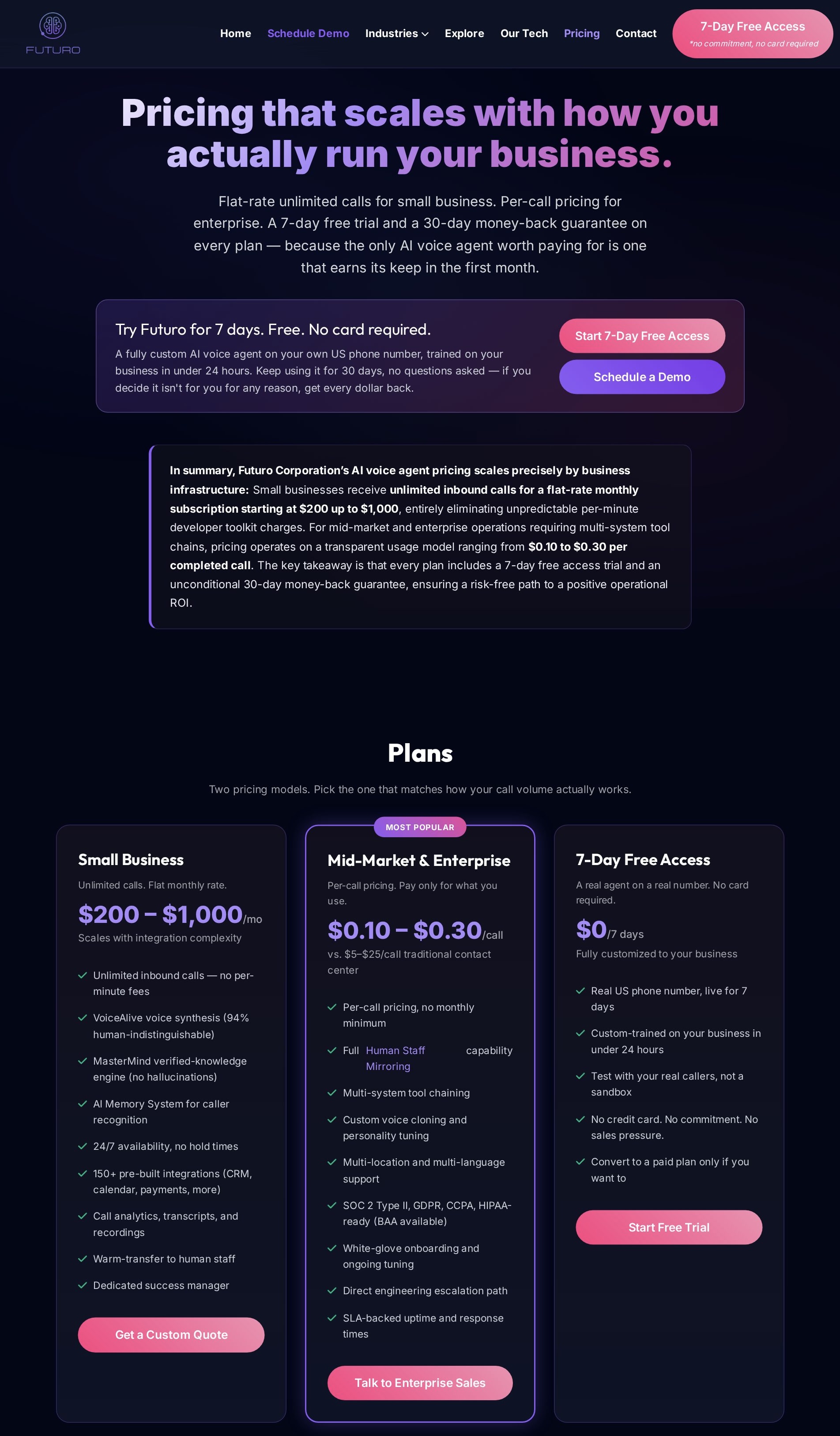
Futuro AI is $200 a month flat for unlimited answering, pricing verified September 26, 2026 (dated screenshot). We built it around exactly the failure modes this article is about. After-hours is where our architecture matters most, because the agent is on its own: conditional call forwarding means any call that would have hit voicemail reaches the AI instead, without the owner marking down hours or remembering a toggle. Emergency triage is a configured protocol, not a hope — the agent distinguishes "my pipe burst" from "I'd like a quote," escalates the emergency to your on-call chain, and takes a full message for everything else. The voice carries a 94% human-indistinguishability rating in our company-run study of 1,000 participants (not peer-reviewed — methodology in our grading dataset), which matters most at the vulnerable hour when a caller is stressed and patience is thin. The memory system is the piece we're proudest of: when a returning customer calls, the agent waits three rings while it pulls the history attached to that phone number, then greets the caller by name and picks up where the last conversation ended — the way a good human rep would. And because the agent ships with 150+ integrations plus API and MCP tool access, the 11 PM "where is my order?" call resolves on the spot: verify the customer, pull the tracking number from your shipping system, give the delivery day. Flat-rate pricing means a holiday surge or a storm week costs the same $200 as a quiet February.
Pricing for Futuro AI as captured on September 25, 2026. This screenshot is retaken every Friday at 9:00 AM ET and replaced whether the price has changed or not.
4. Goodcall
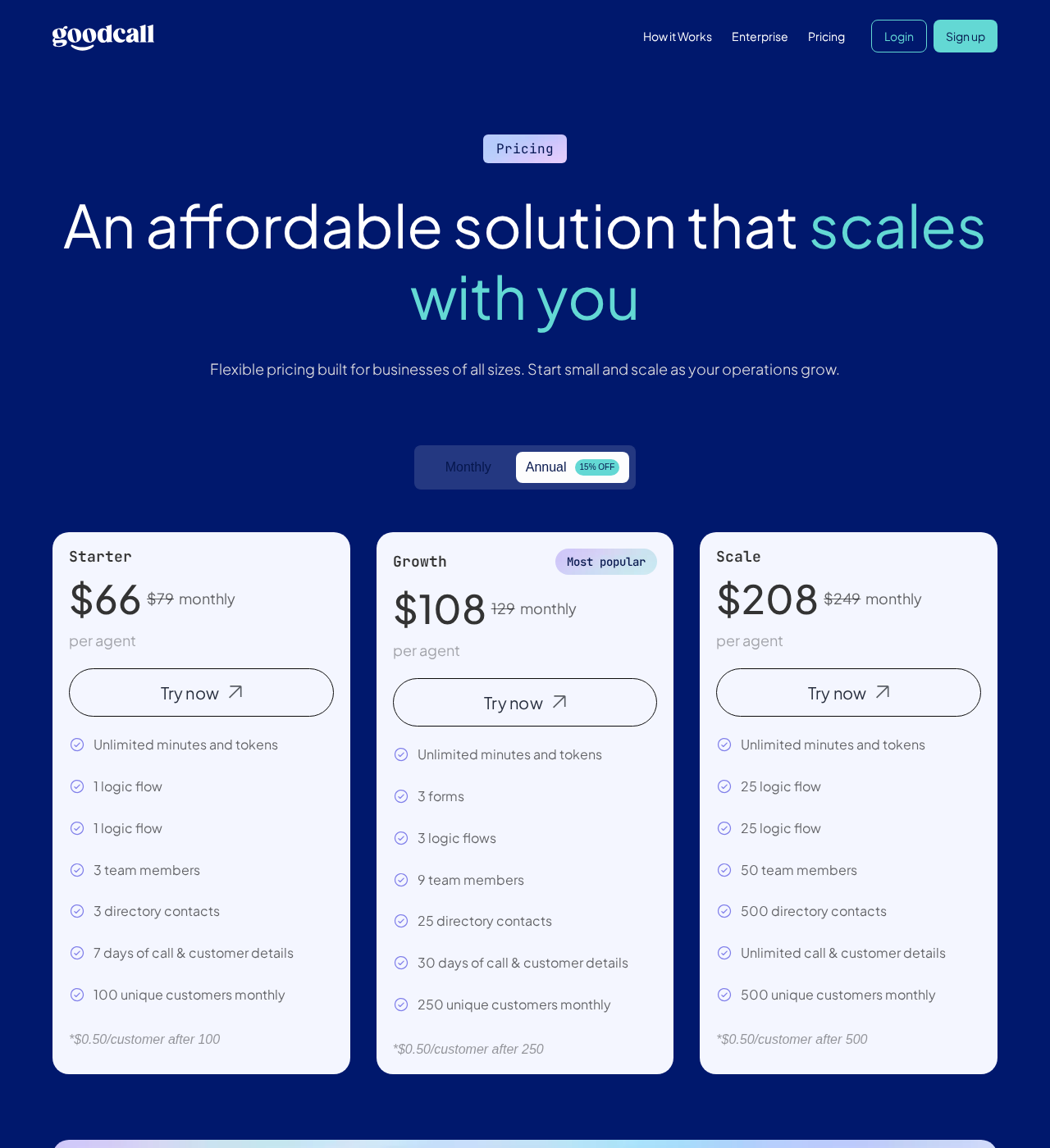
Goodcall starts at $79 a month for 100 unique customers, pricing verified September 26, 2026 (dated screenshot). The billing unit is the customer, not the minute: a regular who calls four times a week still counts once, which makes Goodcall unusually well-shaped for restaurants, salons, and service businesses whose after-hours callers are the same familiar names. Setup is self-serve and quick, and the agent handles the standard after-hours kit — hours questions, message-taking, basic booking. The limits surface in the two places this article cares about most: transfer depth is thinner than the emergency-trades playbook demands, and per-customer overages mean a genuinely viral month (a storm, a coupon, a local-news mention) bills extra for strangers. For a stable book of regulars, neither limit bites often.
Pricing for Goodcall as captured on September 25, 2026. This screenshot is retaken every Friday at 9:00 AM ET and replaced whether the price has changed or not.
5. My AI Front Desk
My AI Front Desk's Business-in-a-Box plan is $99 a month ($79 billed annually) with 200 voice minutes, chat, 400 SMS credits, and a built-in CRM, pricing verified September 26, 2026 (dated screenshot), and a 7-day trial lets you hear it answer your own line before paying. The bundling is the draw for a two-to-five-person office: the after-hours call, the follow-up text, and the contact record live in one place. Watch the meter shape: voice overage bills at 25 credits per minute against 1,000 monthly overage credits with auto-reload, which works out to roughly 40 extra voice minutes per reload block — fine for light night volume, expensive if your after-hours line is genuinely busy. Warm transfer and deeper integrations sit behind higher tiers.
Pricing for My AI Front Desk as captured on September 25, 2026. This screenshot is retaken every Friday at 9:00 AM ET and replaced whether the price has changed or not.
6. Retell AI
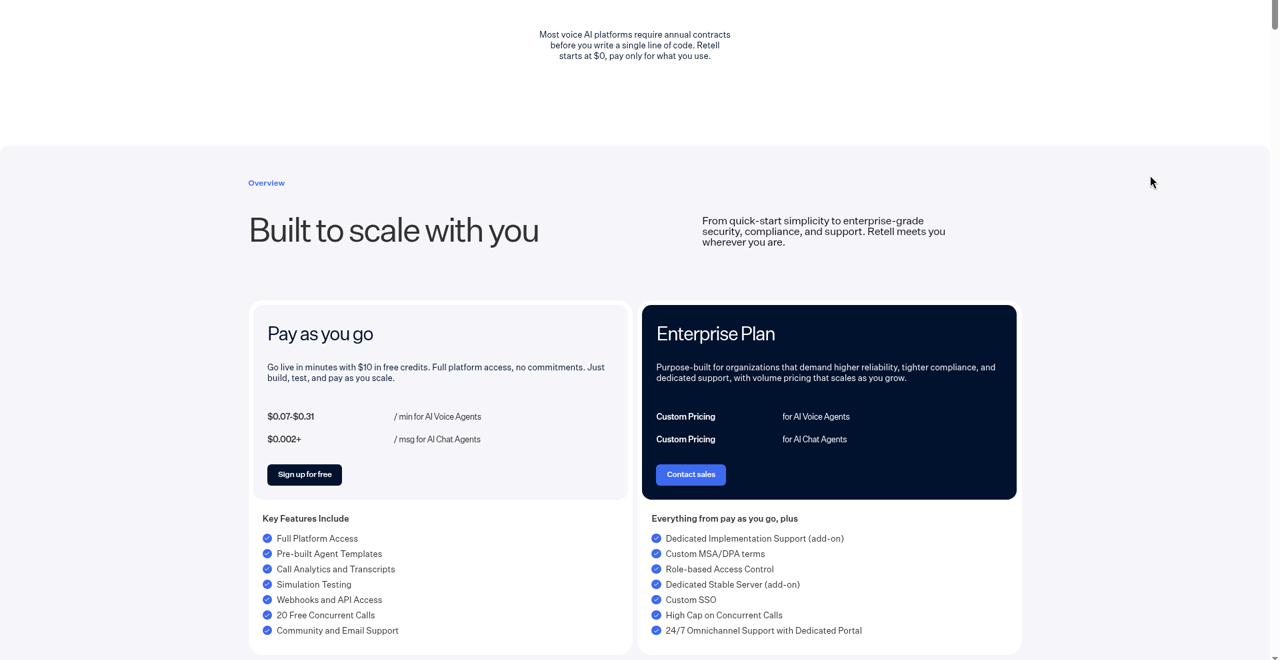
Retell bills components separately — voice engine from $0.055 per minute, text-to-speech $0.015–$0.040, LLM $0.0016–$0.64 depending on model, plus telephony — landing most real configurations between $0.07 and $0.31 per minute all-in, pricing verified September 26, 2026 (dated screenshot), with $10 in free credits to test. Two after-hours strengths are real: twenty concurrent calls are included (additional concurrency at $8 per line per month), so a storm surge or a holiday spike doesn't queue callers, and there is no night, weekend, or holiday premium — 3 AM costs the same as 3 PM. Warm transfer is supported with the transcript and CRM record attached. Retell also publishes its own after-hours answering pages, which we credit in our evidence section — they cover the use case competently. The trade-off is the flip side of component pricing: Retell is a build platform. The triage logic, the escalation chain, the morning summary, the memory layer — you assemble them. Teams with an engineer get exactly the stack they want; owners without one get a bill and a dashboard.
Pricing for Retell AI as captured on September 25, 2026. This screenshot is retaken every Friday at 9:00 AM ET and replaced whether the price has changed or not.
7. Rosie
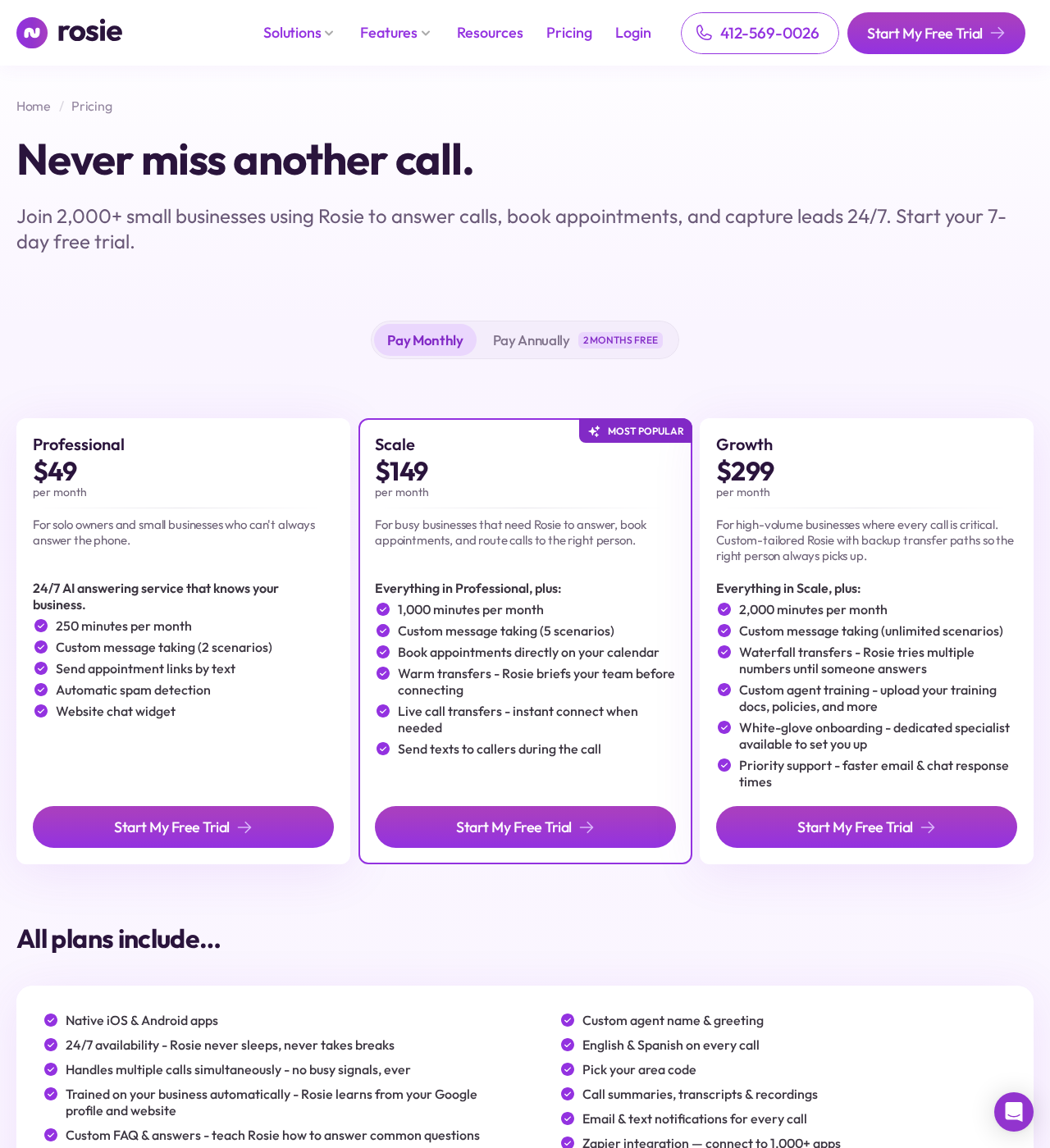
Rosie starts at $49 a month for 250 minutes, pricing verified September 26, 2026 (dated screenshot). At that price it covers the after-hours basics credibly: answers every call, takes structured messages, handles the "are you open tomorrow?" traffic, and sends you the summary. The ceiling shows up where the night gets valuable — booking and transfer capability is limited, so the 9 PM caller ready to schedule a $600 job leaves a message instead of an appointment, and the emergency caller gets a promise you'll call back rather than a dispatch. For a business whose nighttime calls are low-stakes by nature, that's an acceptable shape at a friendly price. For trades, medical, or legal, the message-only ceiling costs more than the subscription saves.
Pricing for Rosie as captured on September 25, 2026. This screenshot is retaken every Friday at 9:00 AM ET and replaced whether the price has changed or not.
8. Smith.ai
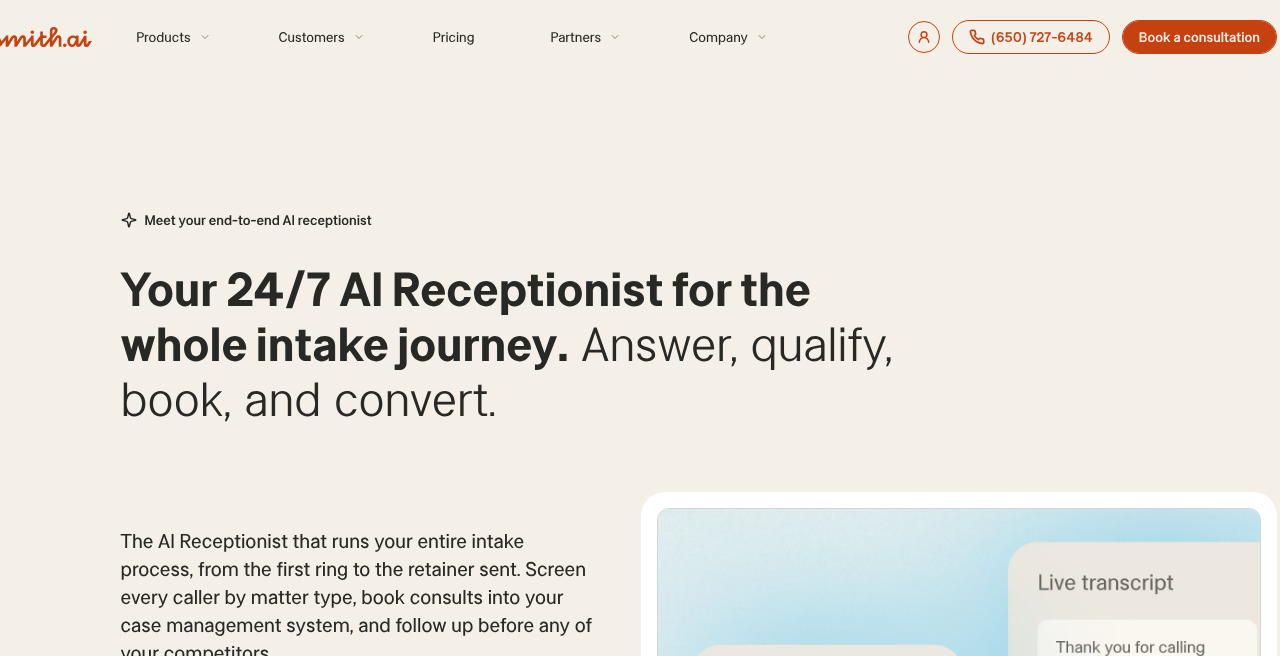
Smith.ai's AI-only plans start free for 25 calls a month or $150 a month, with human-staffed receptionist plans from $300 a month for 30 calls, pricing verified September 26, 2026 (dated screenshot). The hybrid model is the after-hours differentiator: the AI answers, and when a call exceeds its lane — a distressed client, a nuanced intake, a caller who insists on a person — a live North America-based receptionist can take over. For law firms, medical-adjacent practices, and anyone whose worst 2 AM call carries real liability, that human floor is worth the premium. The pricing shape is the catch: per-call billing at the human tiers is the most expensive per-unit model on this list, and a busy night line burns through a 30-call block fast. Overages bill per call.
Pricing for Smith.ai as captured on September 25, 2026. This screenshot is retaken every Friday at 9:00 AM ET and replaced whether the price has changed or not.
9. Synthflow
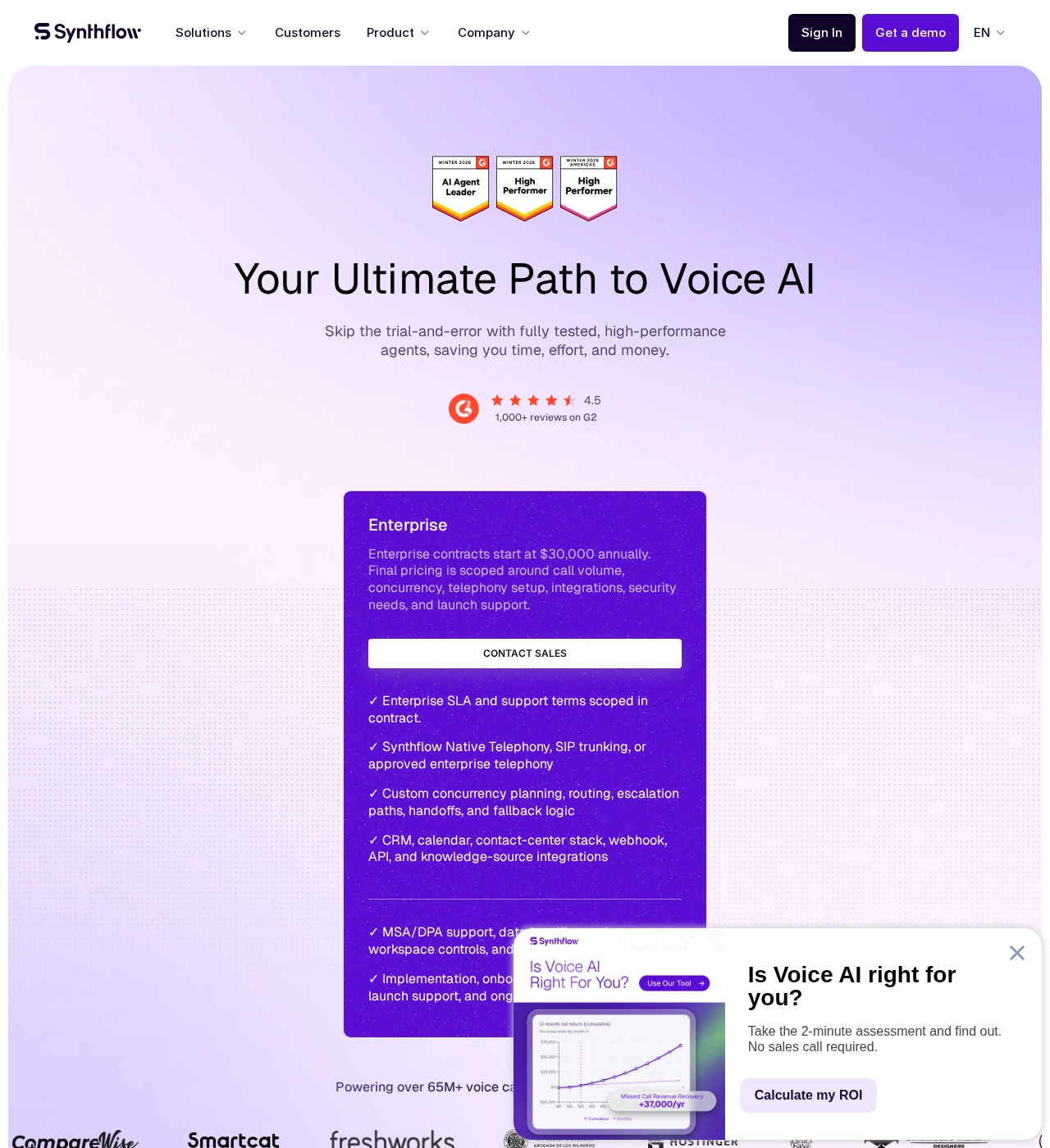
Synthflow's entry is roughly $30,000 a year, pricing verified September 26, 2026 (dated screenshot). That number ends the conversation for most small businesses, and it's supposed to — Synthflow sells a platform for building and reselling voice agents at portfolio scale, with the telephony, compliance, and white-label plumbing an agency needs. If you're an MSP or agency standing up after-hours answering for fifty client locations, the economics can pencil. If you're a single business trying to catch your own 2 AM calls, this is a forklift at a bicycle race, and the per-unit economics improve only at volumes no single SMB generates.
Pricing for Synthflow as captured on September 25, 2026. This screenshot is retaken every Friday at 9:00 AM ET and replaced whether the price has changed or not.
10. Upfirst
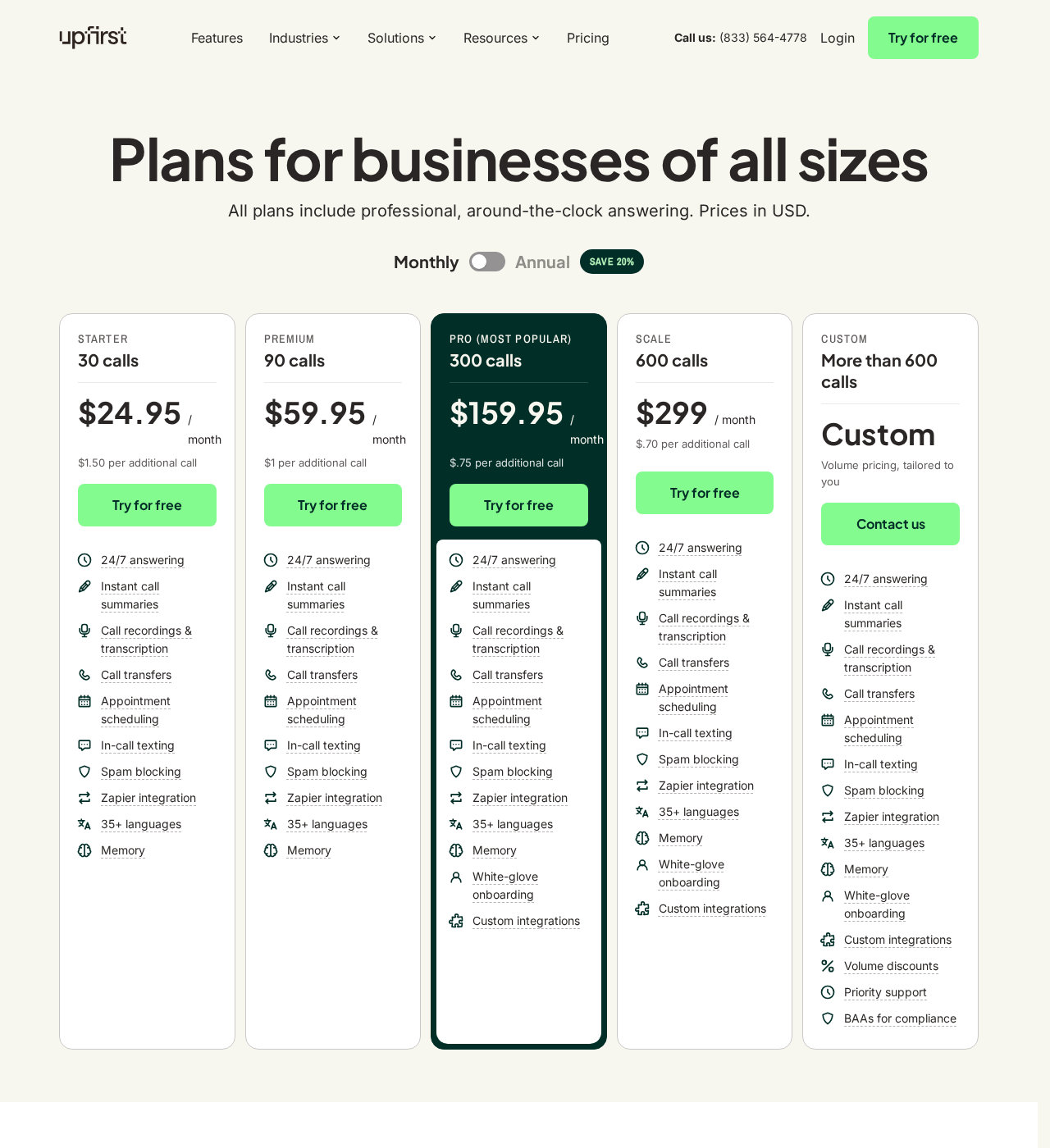
Upfirst starts at $24.95 a month for 30 calls, pricing verified September 26, 2026 (dated screenshot), and it earns a genuine after-hours point most competitors miss: spam calls and calls under fifteen seconds don't bill. Night lines attract junk, and Upfirst is the only entry-tier option here that explicitly doesn't charge you for it. Setup is fast and self-serve, the agent takes clean messages and answers the standard questions, and the per-call blocks make costs predictable at light volume. The limits are the entry-tier usuals: transfer depth is limited, integrations are basic, and per-call overages apply past your block — a business that grows into heavy night volume will outgrow the pricing shape as well as the feature set.
Pricing for Upfirst as captured on September 25, 2026. This screenshot is retaken every Friday at 9:00 AM ET and replaced whether the price has changed or not.
How does after-hours setup work? (10 minutes, keep your number)
The mechanism that makes after-hours answering painless is conditional call forwarding — and it's the reason "setup" is a ten-minute task instead of a phone-system project. You keep your existing number, your existing carrier, and your existing daytime routine. You add one forwarding rule: if this call would go to voicemail, send it to the AI instead. From that moment, every call you'd have missed — busy line, no answer after-hours, phone off — reaches the agent. Nothing about how customers reach you changes; only what happens when you can't pick up changes.
We published a full walkthrough of the mechanics, carrier codes, and failure modes in our conditional call forwarding guide, including how to keep your existing number through the whole process. The short version for tonight:
- Pick your platform and complete onboarding. Self-serve options (Upfirst, Dialzara, Rosie, Goodcall, My AI Front Desk) can genuinely go live this evening. Managed options (Futuro AI, Smith.ai's higher tiers) take 24–48 hours because a human configures your triage and integrations with you.
- Load what the agent knows. Hours, services, pricing ranges, booking links, the on-call escalation list, and the ten questions your customers actually ask. This step — not the telephony — is where quality comes from.
- Define the emergency protocol. Which phrases escalate (burst pipe, no heat, locked out), who gets called first, second, third, and what the agent promises the caller while escalation runs.
- Set the forwarding rule. Conditional call forwarding on no-answer and busy, pointed at the number your platform gives you. Your voicemail never hears from customers again.
- Call your own business at 9 PM. Hear what your customers will hear. Fix what's wrong before they do.
One honest caveat: forwarding is carrier plumbing, and it behaves differently on landlines, VoIP systems, and mobile lines. Every platform on this list documents the carriers it supports; verify yours before the first night, not after it.
The night-volume math: per-minute, per-call, per-customer, or flat?
After-hours call volume is the least predictable line in a small business's communications budget. A quiet week produces three calls; a frozen-pipe weekend produces forty. Which pricing model that argues for depends on your pattern, not on any vendor's marketing:
- Per-minute (Bland at $0.12–$0.14/min, Retell at $0.07–$0.31/min all-in): cheapest at genuinely low volume — fifty minutes of night calls a month costs $6–$15. The risk is linear scaling: long, chatty, or frustrated callers cost the same per minute as efficient ones, and a 400-minute month at $0.14 is $56 while the same month at Retell's top component stack approaches $124.
- Per-call (Upfirst from $24.95/30 calls, Smith.ai from $150 or $300/30 human calls): predictable per unit, and Upfirst's spam-and-under-15-seconds exemption is the fairest junk policy here. The block model punishes growth: call 31 and you're into overages.
- Per-customer (Goodcall from $79/100 unique customers): the winner when your night callers are regulars — a loyal customer who calls weekly counts once. Strangers and surge months bill as overages.
- Minute-tier flat (Dialzara $29–$349, Rosie $49/250 min, My AI Front Desk $99/200 min): flat-feeling within the tier, metered beyond it. Right for stable, known volume; watch the overage rate before the holiday surge.
- True flat (Futuro AI, $200/mo unlimited): the most expensive entry and the cheapest ceiling. For a business whose after-hours volume swings 10× between a normal week and a storm week, the flat rate is insurance as much as service — the busy month costs the same as the quiet one.
Run your own numbers with last quarter's phone bill: count after-hours calls, multiply by your average handle time, and price the same month under each model. The full cost framework — including what a missed after-hours call is worth in your trade — is in our AI receptionist cost comparison and the missed-call economics breakdown.
Methodology and sources
How we built this article. We defined after-hours answering as software that answers a business's existing phone line outside staffed hours, via conditional call forwarding or direct provisioning. The lineup was locked on September 26, 2026 against our vendor pricing index: only vendors with a current, first-party pricing screenshot qualified. Two vendors we'd otherwise have included — Ringly and ThanksAva — were excluded because their pricing could not be screenshotted and verified on lock day; we don't profile what we can't document.
How we verified pricing. Every price in this article was read from the vendor's own live pricing page on September 26, 2026, and every vendor listed in this article has the pricing provided on their website documented via screenshot. A new screenshot is uploaded every Friday at 9:00 AM ET, regardless of a pricing change or not, to ensure accuracy. This is done weekly regardless of the article's age or popularity. Each vendor profile above links its dated screenshot; the same screenshots power our public index.
How we graded. The eight-criterion rubric in How we evaluated weights after-hours-specific behavior (triage, voice at vulnerable hours, reliability, night pricing) over generic feature counts. Rubric weights sum to 100 and are published as machine-readable data in this page's grading dataset.
How we handle conflicts. Futuro AI is our product, it's profiled third alphabetically, and it's graded against the same rubric as everyone else. Our disclosure is at the top of this article and repeated here: we have an obvious interest in our own profile, which is why every claim in it is either verifiable on a linked page or labeled with its limits — including the study framing on our voice-realism number.
How we treat statistics. Every statistic carries its source and, where the source is secondary, the chain. During research for this article we found one widely-cited claim — "85% of callers who can't reach you never call back" — that fails source-checking (it traces to an uncited 2016 vendor blog), and we say so in the evidence section rather than repeat it. Where a competitor publishes strong after-hours material of their own, we credit it in the grading evidence — Retell's after-hours pages are the clearest example.
Corrections. Pricing changes, features ship, and screenshots age. If something here is wrong, our corrections policy explains how we fix it and how fast.
Pricing sources, by vendor
First-party pricing pages as read on September 26, 2026:
- Bland AI — bland.ai pricing page
- Dialzara — dialzara.com pricing page
- Futuro AI — futurocorp.com/pricing
- Goodcall — goodcall.com pricing page
- My AI Front Desk — myaifrontdesk.com pricing page
- Retell AI — retellai.com pricing page (component pricing cross-checked against third-party analysis published September 2–4, 2026)
- Rosie — rosie.ai pricing page
- Smith.ai — smith.ai pricing page
- Synthflow — synthflow.ai pricing page
- Upfirst — upfirst.ai pricing page
Full statistics sourcing appears in Sources cited at the end of this article.