The dental front-desk trilemma
Every dental office runs on a contradiction nobody designed. The person responsible for answering the phone is the same person checking in the patient at the counter, verifying that patient's insurance, and collecting the copay from the one who just left. Three jobs, one human, colliding dozens of times a day. When they collide, one degrades, and it is almost always the phone, because the patient in front of you can see your face and the caller cannot.
The volume behind the collision is real even if the measurement is imperfect. Vendor-collected estimates put a typical dental office at 40 to 60 inbound calls a day, and DenteMax, citing the American Dental Association, puts it at up to 50 daily calls. We say plainly that no peer-reviewed study has measured dental call volume, so treat every precise number here as an estimate and pull your own phone system's logs before doing revenue math. What is not an estimate is the staffing side. The Bureau of Labor Statistics counted 83,950 receptionists working in U.S. dental offices as of May 2023, at a mean wage of $20.41 an hour, $42,460 a year before taxes, benefits, and replacement costs. And they leave: the ADA Health Policy Institute's workforce research found vacant positions have cut dental practice capacity by an estimated 11% nationally, with nine in ten dentists who recruited calling it extremely or very challenging. ADA News reported more than 70% of hiring owner dentists found recruiting administrative staff extremely or very challenging, a figure that has barely moved since.
Multiply the trilemma across the market and the scale snaps into focus: the ADA, drawing on Census Bureau County Business Patterns data, counts 135,665 dental practice establishments in the United States, nearly all running some version of the same one-or-two-person front desk. That is the environment an AI receptionist walks into. Not a call center. A single human doing three jobs while the phone rings.
8:15 on a Monday morning
Monday at 8:15 AM is the stress test every front desk knows by heart. Weekend toothaches have stacked up two days deep, the week's first patients are at the counter with insurance cards out, three lines are ringing, and one is a new patient who found the practice on Google ten minutes ago and will not call twice. Vendor analyses of dental call patterns consistently flag Monday mornings, the lunch hour, and late afternoon as the windows where coverage collapses. The caller who reaches voicemail in that window does not leave a message: DenteMax reports only about 14% of new patients leave a voicemail when their call goes unanswered. The rest dial the next practice on the list.
Saturday afternoon toothache
The second scenario is worse because nobody is there at all. A patient cracks a molar on a Saturday, calls the office, gets a recording, and hangs up in pain. One vendor analysis of dental call timing estimates 28% of appointment requests arrive outside business hours, a vendor claim rather than a measurement, but consistent with what after-hours answering services have charged premiums to catch for decades. The Saturday caller is not comparison-shopping; they are in pain, they book with whoever answers, and they often become the highest-margin same-day production on next week's schedule. An office with no after-hours answer is not saving the cost of coverage; it is donating emergency production to the practice down the street.
“Do you take my insurance?” in twenty seconds
The third scenario looks small and is not. A caller asks whether the practice takes Delta Dental PPO. The right answer is a configured fact: which plans, in-network or accepting assignment, and what to say if the answer is no. The wrong answers are a forty-second hold while someone finds the list, a guess, or a confident improvisation that becomes a billing dispute three weeks later. Insurance questions are the purest test of whether an AI agent answers from your verified information or invents plausible-sounding coverage, and that distinction, retrieval from your documents versus generation from general training, is testable in a single phone call.
How did we test AI receptionists for dental offices?
Generic AI-receptionist reviews test whether an agent can take a message and pronounce the business name. That bar is useless in a dental office, where the calls that pay for the system require procedure-aware scheduling, insurance precision, and emergency judgment inside strict guardrails. So we built five tests around the five call types a dental front desk cannot afford to fumble. Each names the scenario, what a pass looks like, and what a failure sounds like, so you can run the identical battery against any vendor during a trial or demo call.
Methodology box: how this guide was built
Evidence level: vendor-published documentation and pricing pages (verified live September 17–18, 2026), one hands-on product review by our team (Tuulip), government and trade-association data (BLS, ADA, Census, HHS, FCC, FTC, WHO), peer-reviewed dental-attendance literature (PMC), and trade-press benchmarking (Dental Economics, DenteMax). We did not run live patient calls through all five products; where a capability comes from a vendor's own claim rather than our testing, the text says so. Futuro is our product and is labeled “(our product)” at every mention. Prices change; verify before purchase.
Test 1: Procedure-aware scheduling
The scenario: a caller needs a crown prep. A pass requires the agent to know a crown prep is not a cleaning: it books the right duration (ninety minutes, not thirty), the right provider (the dentist, not the hygienist), the right chair, and respects the practice's scheduling templates rather than dropping the appointment into any open gap. A failure sounds like a polite agent booking a 90-minute procedure into a 30-minute hygiene slot, which the front desk then untangles by phone the next day. This test is where PMS integration stops being a buzzword: an agent reading a live schedule through a native Dentrix or Open Dental connection can place the appointment correctly; an agent working from a synced calendar shadow cannot see operatory or provider rules at all. Ask the vendor to book a crown prep live, in your PMS, in the demo.
Test 2: The new-patient call
The scenario: the highest-value call the practice receives all week. A new patient calls with a toothache, no chart, and an insurance card. A pass means the agent captures name, callback number, reason for the visit, and insurance information, then books a slot matching the practice's new-patient block rules, all in one call, with the record landing in the PMS rather than an email inbox. A failure means any of: “hold for someone who handles new patients,” details taken as a message for a Monday callback the caller will never receive, or a booking in a side calendar the front desk has to re-key. Dental Economics frames the stakes: first-year production value for a new patient runs approximately $850 to $1,300, so fumbling this call is a revenue event, not a customer-service blemish.
Test 3: Emergency triage inside guardrails
The scenario: a caller reports a knocked-out tooth, or swelling, at 9 PM. A pass has three mandatory parts. The agent recognizes the emergency category. It responds with the practice's own configured triage script, covering what the office wants said and where the patient should go. And it books or routes per the practice's rules: a reserved same-day slot, the on-call number, or urgent-care instructions, exactly as configured. A failure is any improvisation: diagnosing, advising on medication, or guessing at severity. The ADA's patient-facing emergency guidance (keep a knocked-out tooth moist, handle it by the crown, see a dentist immediately) is the kind of source material a practice can hand a vendor as approved script content.
Test 4: The insurance question
The scenario: “Do you take Delta Dental?” A pass is the agent answering from the practice's configured insurance list exactly as written: which Delta products, in-network versus accepting assignment, and the approved fallback when the answer is no. The pass also includes knowing what it does not know: “I can confirm we work with Delta Dental PPO plans; the front desk can verify your specific benefits” is a good answer, because eligibility verification is genuinely not the agent's job. A failure is improvisation of any kind, because an invented “yes, we take that” becomes a billing dispute, a one-star review, and a lost patient. This is why we weight knowledge architecture so heavily: an agent that retrieves from your verified list cannot freelance past it, and an agent generating from general training eventually will. Our zero-hallucination retrieval explainer covers the design choice.
Test 5: Recall and confirmation behavior
The scenario: hygiene recare, the quiet revenue engine. A pass means the agent handles inbound reschedule and confirmation calls cleanly, and, where the product supports it, runs outbound recall to patients due for hygiene using the practice's cadence and language. One flag we raise every time outbound comes up: outbound AI calling is regulated. The FCC ruled in February 2024 that AI-generated voices in robocalls are illegal under the Telephone Consumer Protection Act without proper consent, with implications detailed in the Federal Register, and the FTC's Telemarketing Sales Rule separately governs marketing calls. Reminders to existing patients with documented consent occupy different ground than cold outreach, but treat outbound recall as a product-and-legal configuration, reviewed by your attorney, not a toggle you flip.
How we scored
Each product is assessed against the five tests using what we could verify: published feature documentation, pricing pages, named case studies, integration lists, and, in Tuulip's case, our team's own hands-on review. We score capabilities as verified (documented and specific), claimed (advertised by the vendor, not independently confirmed by us), or absent (no evidence found). Where a vendor does not publish something, like Arini's pricing, we say so rather than estimate.
What we did not test
Four things, stated plainly. We did not run live patient calls through all five systems, so voice-quality judgments beyond our Tuulip review rest on public demos and third-party reviews. We did not independently audit any vendor's PMS integration, which is why the demo-against-your-own-PMS instruction recurs throughout this guide. We did not verify any vendor's HIPAA posture beyond what they publish. And we did not test outbound recall at scale, because doing that responsibly requires consent infrastructure a review cannot shortcut.
Which AI receptionists handle dental calls best?
Five products made the cut, chosen to cover the decision space: two built specifically for dentistry, one established hybrid service, one budget generalist, and one voice-first generalist (ours). We include smaller, newer companies as standing practice when they clear the evidence bar, and Tuulip, founded in 2025, earned its slot on the strength of a hands-on review and the deepest published PMS integration list we found. The scorecard shows the shape; profiles follow, and nothing here is ranked as a winner.
| Product | Dental-specific | Published pricing | Live PMS booking | Setup time | Best fit |
|---|---|---|---|---|---|
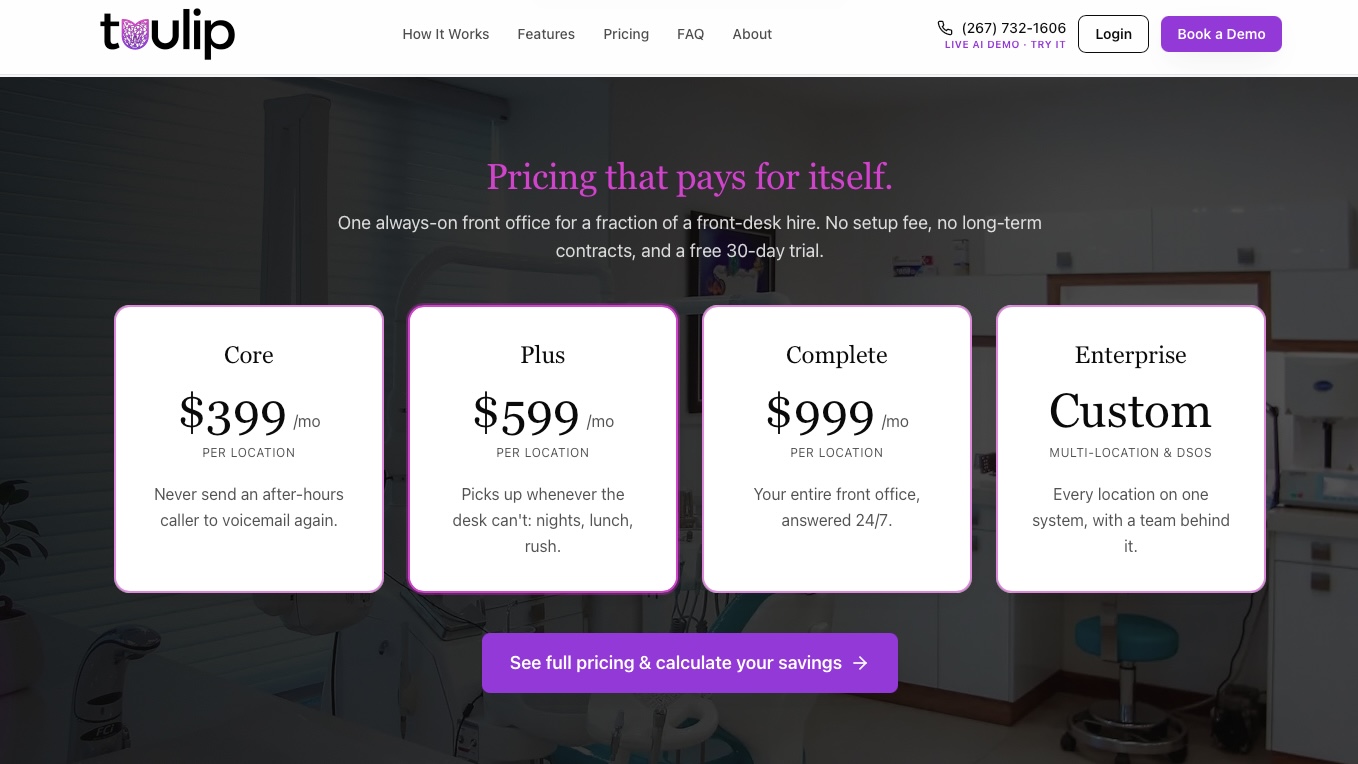
| Tuulip | Yes | $399–$999/mo per location | Yes: Dentrix, Eaglesoft, Open Dental, Curve, Denticon, Tracker, MOGO, MacPractice | ~30 days (vendor-stated) | Practices wanting the deepest dental-specific stack |
| Arini | Yes | Not published (demo/contact) | Claimed: Open Dental, Dentrix, Eaglesoft | “Deployed in days” (vendor-stated) | DSOs and multi-location groups |
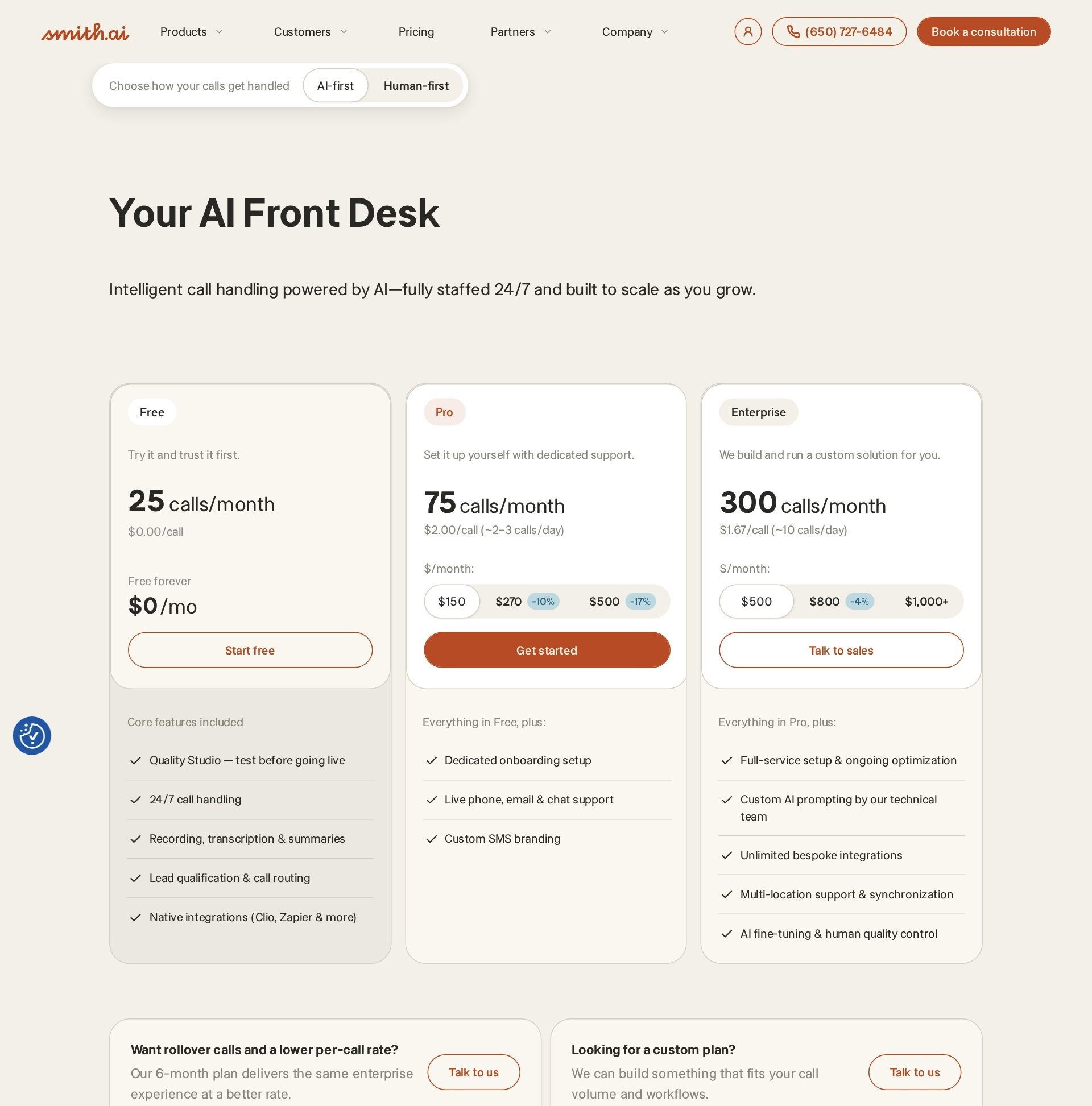
| Smith.ai | No (generalist) | AI from $150/mo; humans from $300/mo | No (calendar booking) | Days | Overflow + after-hours with human escalation |
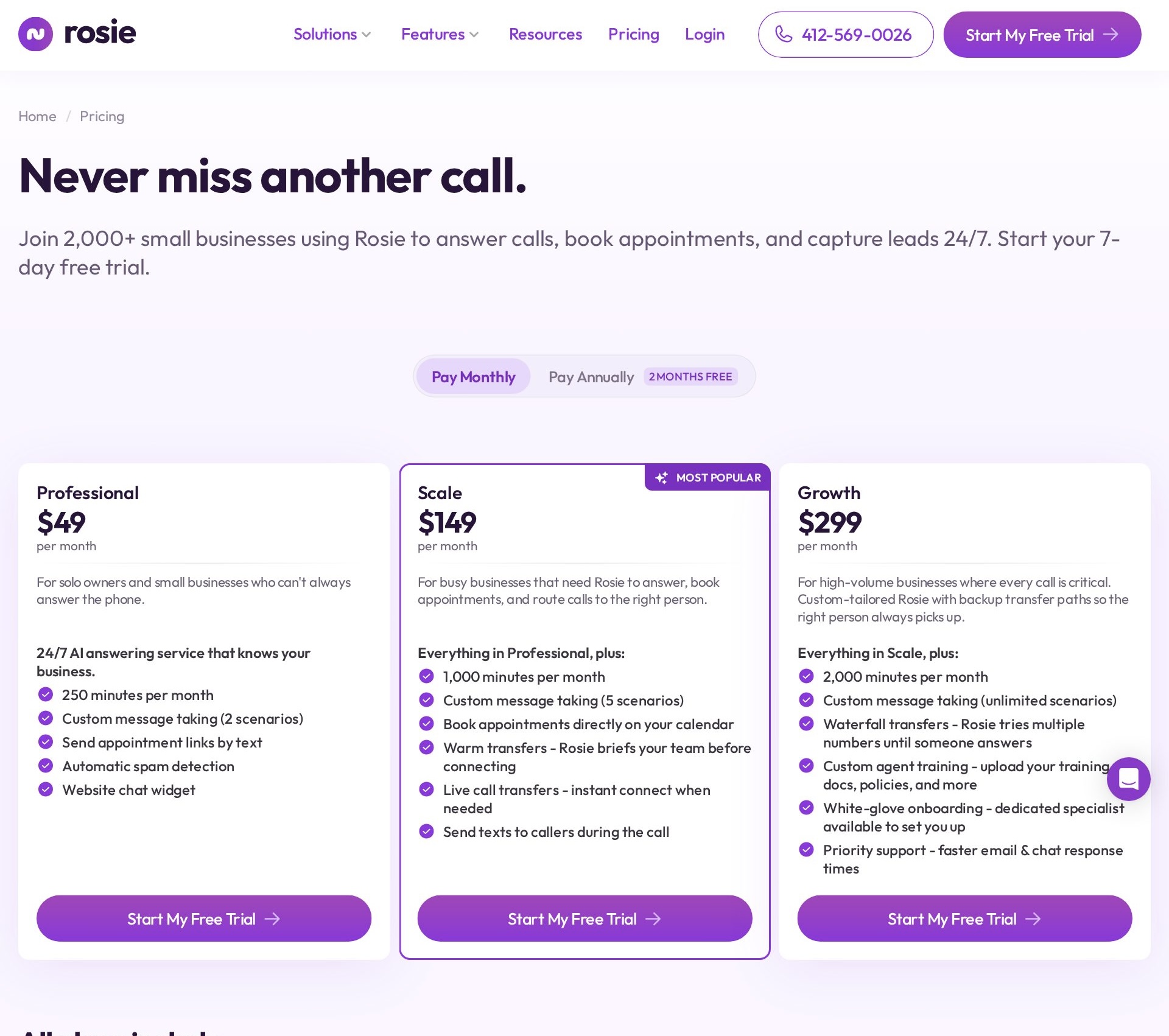
| Rosie | No (generalist) | $49–$299/mo | No (booking links + transfers) | “Minutes” (vendor-stated) | Budget message capture |
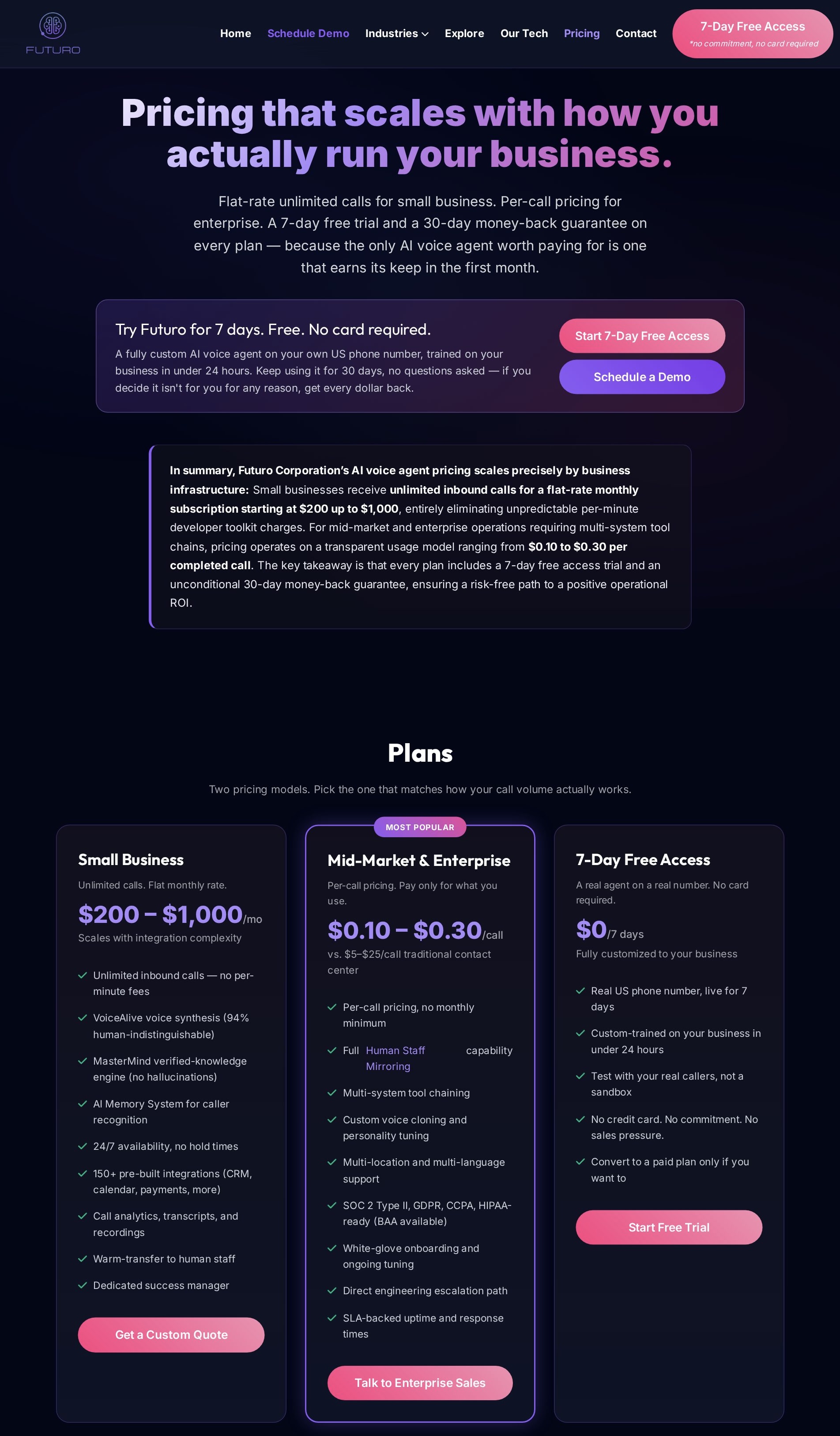
| Futuro (our product) | No (generalist) | $200/mo flat | Via 150+ integrations (verify yours) | About 1 week | Voice-first offices wanting an owned, flat-fee agent |
Tuulip: the dental-native stack with the widest integration list
Tuulip is the most dental-specific product we tested, and the reason this article exists: a quality solution from a small, young company that most roundups would skip because it lacks brand gravity. Founded in 2025, it positions itself not as a phone answerer but as a front-desk suite: the AI receptionist books into the live PMS schedule, and around it sit add-on modules for outbound hygiene recall, no-show recovery, patient reactivation, insurance verification, and billing. That “extensive tech suite around the agent” matches what our team found in hands-on review, along with voice quality good enough that callers are unlikely to notice the agent at all, and we confirmed the published integration list directly: Dentrix, Eaglesoft, Open Dental, Curve, Denticon, Tracker, MOGO, and MacPractice, eight of the most common dental systems in North America, booked as live two-way connections rather than calendar syncs. The company also states it signs a HIPAA BAA on every plan and displays a real-time counter of calls handled, 1,265 during our September 2026 verification, an impressively transparent and appropriately modest figure for a company this young.
Pricing is published plainly: Core at $399 per month per location, Plus at $599, Complete at $999, and an Enterprise tier with custom pricing, with no setup fee, a 30-day free trial, and two months free on annual billing. The honest downside, and it is real: the rollout takes about 30 days. Tuulip's own copy says you're live in 30 days and promises customers they will be “up and running within 30 days”. That is an eternity next to tools advertising same-day activation, and for a practice hemorrhaging new-patient calls today, it is the strongest argument against Tuulip. We read it as a deliberate trade: the onboarding that deep PMS integration and suite configuration require. A testimonial on the site, attributed to “Dr. Patel, Practice Owner”, says We tried three different AI receptionists before Tuulip. The difference is that it actually knows dentistry. It books cleanings with our hygienists and keeps our dentists open for procedures. We could not independently verify the quote, and the attribution is first-name-level, so treat it as a founder-published testimonial, not a case study. Best for: single or multi-location practices willing to trade a month of rollout for the deepest dental-native stack. Watch for: the 30-day runway, young-company risk, and whether your PMS is on the list.
Arini: dental-specific with DSO traction and unpublished pricing
Arini is the other dental-native contender, focused on answering every call and booking into practice management systems. Its published case studies read well: one DSO customer is quoted saying the agent answers “100% of the calls” across locations, and a practice administrator reports their office “immediately saw an additional 2-3 new patients a week”, with a multi-location group citing an 11x ROI within the first month. We flag all three as vendor-published case studies, the marketing kind rather than audited results. Arini advertises onboarding measured in days and integration with Open Dental, Dentrix, and Eaglesoft, and positions toward DSOs and multi-location groups. What it does not publish is pricing: the pricing page returns a 404, and the site routes buyers to a demo. For a 2026 buyer's guide that is a disclosure problem, so we say it plainly: Arini's pricing is not published, we do not estimate it, and you will need to talk to sales. Best for: multi-location groups that want dental-specific answering with fast deployment. Watch for: unpublished pricing, and case-study claims that deserve a reference call.
Smith.ai: the hybrid safety net
Smith.ai is not dental-specific; it is the established generalist with a decade of service history, and it earns its slot on breadth. The AI Receptionist tiers run $150 to $500 a month (with a free 20-call tier and per-call pricing beyond), while human virtual receptionists run $300 to $2,100 a month, letting a practice blend AI for routine calls with trained humans for the rest, including bilingual answering, 24/7. In dental terms: Smith.ai books into calendars (Calendly-class tools), not into Dentrix, so a human re-keys the appointment; emergency handling is escalation to a human or a transfer, not a dental triage script; and insurance answers come from call instructions you write, not a structured knowledge base. Per-call pricing also means a busy office's busiest month costs the most. Best for: practices that want AI as overflow behind human receptionists, or generalist intake with human escalation. Watch for: the PMS gap, and per-call economics at volume.
Rosie: the budget answer with honest limits
Rosie is an AI answering service priced for the smallest offices: $49 to $299 a month, with a free trial and minute-based tiers. It answers 24/7, takes structured messages, sends booking links, transfers urgent calls, and advertises setup in minutes. What it does not do is book into a PMS; scheduling flows through booking links and transfers, so the dental workflow tests (procedure-aware chair time, provider rules) are out of scope by design. Best for: a one-operatory practice that mostly needs after-hours capture and a professional answer. Watch for: minute ceilings, and the gap between message-taking and scheduling.
Futuro (our product): voice-first with an owned knowledge architecture
Disclosure: Futuro is our product, so read this profile accordingly, and hold us to the same demo standard as everyone else. Futuro builds AI voice agents under a model we call Human Staff Mirroring: the agent learns a specific staff member's role, scripts, and judgment boundaries, then covers that role on the phones. The architecture is bounded retrieval: the agent answers from your configured knowledge (insurance lists, triage scripts, scheduling rules) and escalates rather than improvise outside it, the design behind our zero-hallucination work. Pricing is flat at $200 a month, with integration coverage across 150+ business systems and typical setup of about a week. For the dental tests specifically: we are not dental-native, our integrations connect through the systems themselves rather than a prebuilt PMS module, so the demand-a-live-demo rule below applies to us exactly as it applies to Tuulip and Arini. We make no HIPAA claims in this article; any healthcare-adjacent deployment should be scoped as administrative communication with your compliance counsel. Our positioning data: 94% human indistinguishability across a 1,000-participant double-blind study, methodology published here. Best for: offices that want a flat-fee, voice-first agent they own outright. Watch for: verify your PMS path before signing.
Also evaluated: My AI Front Desk, Dentina, and the all-in-ones
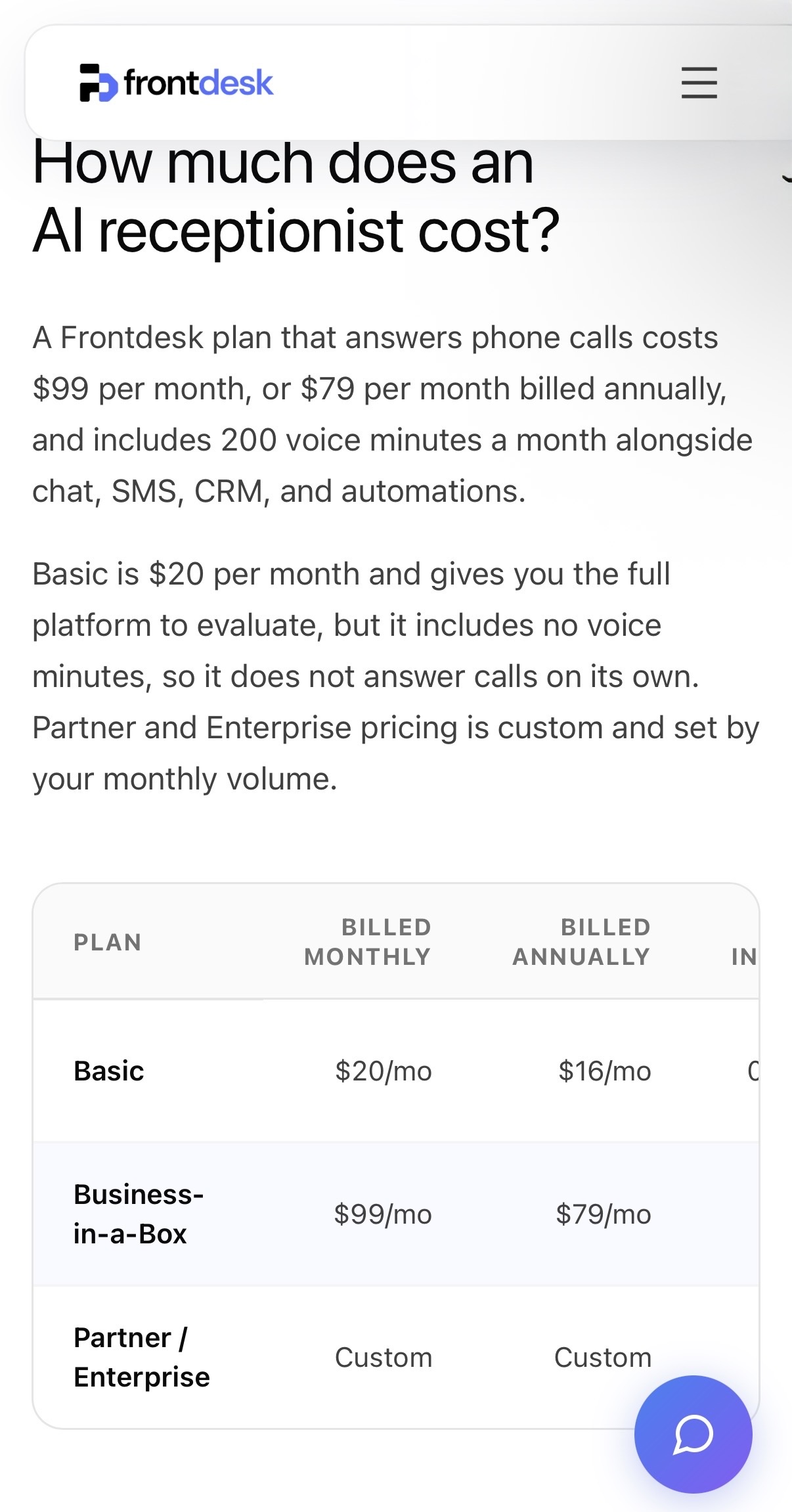
My AI Front Desk ($99 a month on annual billing) is a capable generalist and publishes a dental page, but its dental scheduling runs through booking links rather than PMS writes. Dentina is dental-focused but early, with thin public documentation beyond its content library. The all-in-one practice platforms (Weave, Adit, NexHealth, RevenueWell) bundle AI reception with texting, forms, and payments; consolidation deals like Patterson Dental's planned Weave rollout across 48,000-plus accounts make them a force, but a bundled add-on is a different buying decision than a dedicated agent, and this guide covers the dedicated kind.
How to read the scorecard
Three honest notes. First, “live PMS booking” means the vendor publishes named integrations and describes writing into the schedule; we verified the claims exist, not each integration, which is your demo's job. Second, setup time is the vendor's own number in every row. Third, no row wins: the right pick depends on your PMS, your call volume, and whether you need a suite (Tuulip), DSO-scale answering (Arini), a human safety net (Smith.ai), the lowest honest price (Rosie), or a flat-fee voice agent (us).
When you should skip AI entirely
The honest-fit paragraph, because it builds more trust than any feature list. If your practice has two career front-desk staff who have been there for years, a culture where patients love that “Donna always answers”, and no measurable missed-call problem in your phone logs, an AI receptionist solves a problem you do not have, and the honest move is to buy nothing and re-run the call-volume math after your next front-desk turnover. Sometimes the answer is staffing: a second hire, better scheduling of lunch coverage, or an overflow arrangement for Mondays. AI earns its cost when calls go unanswered or the front desk burns out, not as a default purchase.
Why does PMS integration decide everything?
Practice management software is the system of record a dental office actually lives in: the schedule, the chart header, the ledger, the recall list. It is also a fragmented market. Mordor Intelligence sizes the dental PMS market at $2.62 billion in 2026, growing to $4.44 billion by 2031 at an 11.12% CAGR, spread across dozens of vendors: Henry Schein's Dentrix, Patterson's Eaglesoft, the open-source Open Dental (which claims more than 12,000 practice installations), plus Curve, Denticon, Tracker, MOGO, MacPractice, and a long tail. Market analyst Medix Dental notes that the most commonly cited installation figures “trace back to no survey at all”, which is why we cite vendor-reported numbers as vendor-reported.
For an AI receptionist, that fragmentation defines the product. An agent that cannot write into your PMS is a message-taker with good manners. Three connection patterns dominate, and the differences matter. Native integration is a vendor-built connector to specific systems: Tuulip's eight-name list, Arini's Open Dental/Dentrix/Eaglesoft claims. The agent reads the live schedule, applies procedure templates, and writes the appointment, the highest-fidelity pattern and the narrowest coverage. Middleware or API integration connects through an integration layer or the PMS's own API: broader coverage, more configuration, and the pattern most generalists (including us) use. Schedule-fallback integration books into a calendar or sends a booking link for staff to re-key: fine for salons, the failure mode for dentistry, because the front desk ends up re-entering everything and the labor saving evaporates. The pattern matters more than the logo count.
So the buying rule is absolute: before you sign with anyone, us included, demand a live demo against your actual PMS, on your version, in your environment. Watch the agent read your schedule's openings, book a crown prep with the right provider and chair time, and write the appointment into your system, not a demo tenant. Ask which integration pattern yours uses. A vendor that will not demo against your PMS has told you what integration with your PMS means to them.
What is a missed new-patient call worth?
The economics section is where dental math gets blunt. Dental Economics puts first-year production value for a new patient at roughly $850 to $1,300, with lifetime value commonly cited in the $8,000 to $10,000 range. The same analysis, drawing on industry data, estimates dental offices miss 30–38% of inbound calls during business hours; call-analytics vendor Peerlogic, cited by Dentina, analyzed 4,280 dental practices, found an average 38% miss rate, and counted an average of 26 missed calls per practice per week. DenteMax's framing lines up: missed calls are a practice's largest single revenue leak. None of this is peer-reviewed; it is trade-press and vendor analytics, and we label it that way.
Now the arithmetic, with assumptions stated. Suppose your office misses ten new-patient calls a month, a modest fraction of a 38% miss rate on a typical call volume. At the midpoint first-year value of about $1,000 per new patient, that is $10,000 a month in first-year production you never see, $120,000 a year, before any lifetime-value multiplier. Haircut it however you like: convert half those callers some other way, and it is still $60,000. The BLS wage baseline for the human alternative is $42,460 a year in wages alone, and humans cannot answer two phones at once or work Saturdays. This is why the ROI conversation for dental AI starts at the missed-call logs, not the feature list. Our missed-call economics breakdown and AI receptionist cost comparison work the general small-business versions of this math.
| Missed new-patient calls / month | At $850 each | At $1,000 each | At $1,300 each |
|---|---|---|---|
| 5 | $51,000 | $60,000 | $78,000 |
| 10 | $102,000 | $120,000 | $156,000 |
| 15 | $153,000 | $180,000 | $234,000 |
Two caveats keep the table honest. Not every missed call is a new patient; many are existing patients who call back, so the table is a ceiling, not an expectation. And first-year value is gross production, not profit. Even so, at any plausible conversion haircut, the midpoint row clears every product's annual subscription in this guide within the first month or two of recovered calls.
Can an AI receptionist handle a dental emergency call?
Carefully, and only inside guardrails the practice itself defines. The correct mental model: the agent is a dispatcher, not a clinician. Its job on an emergency call is to recognize the category, deliver the practice's approved script, and route the patient to the right next step, nothing more. The ADA's MouthHealthy emergency guidance is a good illustration of the kind of vetted, plain-language content a practice can adapt into its script: handle a knocked-out tooth by the crown, keep it moist, see a dentist immediately; rinse and use cold compresses for a cracked tooth. The agent repeats what the practice configured; it never diagnoses, never recommends medication, never assesses severity.
What a good emergency configuration looks like
Triggers: configured keywords and phrases (knocked-out, broken tooth, swelling, bleeding, severe pain). Behavior: reads the practice's written triage script verbatim for that category. Hard boundaries: no diagnosis, no medication advice, no severity judgment, no improvisation. Escalation: reserved same-day emergency slot, on-call number, or urgent-care direction, per the practice's rules. Logging: full transcript and summary to the front desk before the next morning.
How the five products map: Tuulip and Arini build dental emergency triage into their pitch (vendor-stated in both cases). Smith.ai escalates to its human receptionists, a genuinely different and defensible pattern. Rosie transfers or takes a message, which is honest about its limits. Futuro (our product) handles emergencies exactly this way: the practice's script, the practice's routing rules, bounded so the agent cannot freelance. One compliance note with no exceptions: emergency configuration is administrative communication, and any workflow touching patient information belongs under the same HIPAA privacy and security review as the rest of your phone handling. We make no HIPAA certification claims for any product in this guide, ours included; ask every vendor for their BAA terms and have your counsel review them.
How does recall change the math?
Everything above is inbound: the calls that ring. Recall is the quiet outbound engine, and for many practices it is the bigger number. The peer-reviewed evidence is thinner than vendor decks imply, but real: a 2022 study in PMC on dental appointment attendance found overall attendance of about 42.68% in its studied population, and a 2018 study found a 52% attendance rate with a 48.3% no-show pattern in its cohort, reminders being the strongest modifiable factor. Dental operations consultants put it more commercially: Rework's recall library describes typical practice recall rates in the 65–72% range against an 82–88% achievable range with systematic follow-up, treating 85% as the benchmark and crediting pre-appointment hygiene scheduling with 15–20 point lifts.
Recall leakage worksheet (state your own assumptions)
Assumptions: 2,000 active patients; hygiene recall due twice a year; your current recall rate is 10 points below the achievable range. A 10% gap = 200 overdue hygiene visits per cycle. At $150–$250 per hygiene visit (exam, cleaning, X-rays), that is $30,000 to $50,000 in deferred production per cycle, plus the treatment diagnosed in those visits that never gets scheduled. Adjust the four inputs to your practice's actual numbers before repeating the math anywhere.
Product mapping: Tuulip's outbound recall and reactivation modules are the most dental-native execution we reviewed. Arini's focus is inbound answering. Smith.ai's humans can run outbound campaigns at per-call rates. Rosie and most budget tools do not do outbound. Futuro (our product) supports outbound campaigns with the consent posture below. And here it is again, because it matters: outbound calling with AI voices is regulated. The FCC's February 2024 ruling made AI-generated-voice robocalls without proper consent illegal under the TCPA, with the implications laid out in the Federal Register, and the FTC's Telemarketing Sales Rule governs the marketing side. Recall reminders to existing patients with documented consent are a different category than cold outreach, but the configuration belongs in a conversation with your attorney, not a marketing page.
What does setup actually involve?
The difference between a same-day activation and a 30-day rollout is not vendor speed; it is how much of your operation the agent has to learn before it can be trusted with patients. In order, here is what a real dental deployment requires, whichever product you pick.
1. Start from your call data, not the brochure
Pull three months of call logs from your phone system: volume by hour, missed-call counts, after-hours share. Every vendor pitch assumes your pain; the logs prove or disprove it and give you the before picture you will measure ROI against.
2. Run the live PMS demo
Per the rule above: your PMS, your version, your schedule, a live booking. This single step eliminates more bad purchases than any feature comparison.
3. Write down your scheduling rules
The agent needs what your front desk carries in their head: procedure durations, which provider does what, new-patient blocks, emergency holds, the 48-hour cancellation policy. Practices that skip this step get agents that book like strangers.
4. Map providers, chairs, and templates
Dentist versus hygienist columns, operatory constraints, template blocks. This is the configuration work that separates procedure-aware booking from calendar Tetris, and most of why deep deployments take weeks.
5. Load the insurance list
Every plan you take, in-network versus accepting assignment, and the approved sentence for “no”. Then test it by phone: ask for your most common plan and your most commonly confused one.
6. Configure the emergency script
Adapt from a vetted source like the ADA's emergency guidance, have your clinicians approve the language, and set the routing: same-day slot, on-call number, or urgent care. Test with a Saturday-night call before you trust it.
7. Set the recall cadence and consent posture
If you enable outbound, define cadence, language, and opt-outs, and have counsel review consent documentation against the FCC's AI-voice ruling before the first call goes out.
8. Bring the front desk along
The adoption failure mode is not technical; it is a front desk that hears “AI receptionist” as “your replacement”. The frame that works is the coverage layer: the agent answers the second ringing line, the lunch hour, the Saturday toothache, so the humans at the counter can do the job that requires a human. In the hiring market the ADA has documented, most offices are not choosing between AI and a second hire; they are choosing between AI and unanswered phones, because the second hire does not exist.
Methodology: how we researched this guide
This guide was researched September 17–18, 2026 and last reviewed September 18, 2026. Vendor capabilities and prices were verified against live vendor pages on those dates; screenshots of pricing pages are archived below. Dental-market context comes from the BLS, the ADA Health Policy Institute, Census Bureau County Business Patterns data, and peer-reviewed literature indexed in PubMed Central; regulatory framing from the FCC, the Federal Register, the FTC, and HHS; industry benchmarks from Dental Economics, DenteMax, and vendor-published analytics, each labeled as such in line. Global context on health-workforce shortage pressures: the WHO's State of the World's Nursing and related workforce analyses document the same labor economics in adjacent health fields.
Evidence level, stated plainly
Verified by us: every price and integration claim quoted from a live vendor page (September 17–18, 2026); Tuulip's product, via our team's hands-on review. Vendor-published, unverified: Arini's case-study results and deployment timeline; call-volume and miss-rate figures from vendor analytics (Peerlogic, Dentina, Aria). Independent: BLS wage/employment counts, ADA workforce research, Census establishment counts, PMC attendance studies, FCC/FTC/HHS rules. What we did not do: run live patient calls through all five products, audit integrations against a live PMS, verify any HIPAA posture, or test outbound recall at scale. Where this article cannot verify, it says so rather than guessing.
Corrections: if a vendor or reader spots a stale price or an overclaimed capability, email editorial@futurocorp.com; our editorial standards and corrections policy govern how we update. Smaller and newer companies appear in our comparisons as a matter of standing practice when they clear the evidence bar; Tuulip's inclusion follows that policy, not any commercial relationship. No vendor paid for placement, and Futuro (our product) receives no ranking preference.