
About this guide: Options are listed alphabetically (AgentZap, Beside, Futuro AI, Goodcall, Mira), not ranked, and there is no overall winner: a salon staying on Mangomint for years and one that wants to own its phone line face a different trade-off. Each entry includes who the option fits best, one honest trade-off, and pricing where it is publicly available, with a dated screenshot on our vendor pricing index (see the weekly pricing note). This guide is published by Futuro Corporation, and Futuro AI is one of the 5 options compared; we say plainly where it fits and where it does not. External sources are linked at the claim.
Pricing for every vendor in this guide is checked weekly, and a dated screenshot of the pricing each vendor publishes is updated every Friday at 9 AM ET. We keep these on one public page so you can see exact, current pricing for each vendor: Vendor pricing index.
How did we evaluate each platform?
Every criterion passes one filter: does it matter because the salon runs on Mangomint? The weights were fixed before any vendor entry was written and are published in this page’s schema as a CC-BY dataset.
| Criterion | Weight | What we looked for |
|---|---|---|
| Mangomint booking path | 25% | A documented write into the Mangomint calendar with the right service, duration, provider, and gap rules, or a plainly stated alternative; the mechanism and who sets it up named in writing. |
| Memberships and returning clients | 20% | Package and membership questions answered from your configured rules, and known callers recognized, without inventing discounts. |
| Bill shape for a 5-to-30-staff salon | 15% | A published price and pricing unit (flat, per call, per unique customer, per minute) that a salon can model for its busiest month before signing. |
| Voice and brand fit | 15% | A greeting, pacing, and house language you would put in front of a premium client, judged on a call you make yourself. |
| Handoff to staff | 15% | A clear boundary for calls that need a person, with a summary that reaches staff before the client has to repeat herself. |
| Platform lock and exit | 10% | What happens to the number, the scripts, and the call records if you leave the vendor or leave Mangomint. |
Where a platform could not be verified against a criterion, we say so plainly in its entry. Platforms are not ranked by total score: a native option with a gated price and a third party with a published one can each be the right answer for a different salon, so a single total would hide the trade-off you are actually choosing. Entries below are listed alphabetically, A to Z, and each opens with who it is genuinely best for, including when that is not us.
It’s 6:40 on a Thursday evening. The front desk left at six, three stylists are mid-appointment, and the phone rings: a member wants to move Saturday’s facial and ask whether her package covers an add-on peel. Mangomint will rebook her cleanly once she’s in the system. What it won’t do on its own is pick up, unless you have added a receptionist that can.
We graded five options on the six-criterion rubric above, weighted toward the Mangomint booking path and the membership questions that premium salons field every day. They are listed alphabetically, A to Z, not ranked by total score, because a salon that will stay on Mangomint for years and one that wants to own its line face a different trade-off. Every price and claim was checked on November 1, 2026.
Does Mangomint answer the phone itself?
It does now, for a fee. Mangomint’s own AI receptionist, Mira, answers calls and texts and books, reschedules, and cancels inside your Mangomint account. That changes the question this page answers: not “who can answer for Mangomint?” but “when is the native option enough, and when is a third-party receptionist worth the extra connection?”
The native option wins on the booking path, because nothing sits between the agent and the calendar. Third-party vendors compete on other things: a price you can see before a sales call, a voice you choose, a number you own, or insurance against changing platforms. Mangomint’s integrations page lists webhooks that send event data to other applications, but we found no public API reference for writing bookings, so a third-party “integrates with Mangomint” claim is something you check by test call, not by reading documentation.
One cost note before you shop. Since August 1, 2026, Mangomint has one plan: $120 a month per location and $10 a month per user, with Phone, Marketing, and Payroll as paid add-ons. Phone is $70 a month per line, and Mangomint’s Mira page says it is required to use Mira. Everything else on this page is priced on top of that platform bill.
How do the five compare at a glance?
Alphabetical and unranked. “Pricing” is the entry point read off each vendor’s page on November 1, 2026, linked to its dated screenshot; unknowns are printed as “not published,” never left blank.
| Platform | Best for | Standout attributes | Pricing |
|---|---|---|---|
| AgentZap | Claimed direct Mangomint write plus package answers | REST API sync and membership handling advertised | $109–$899/mo + $499 setup (screenshot). |
| Beside | Owning the line, no integration | Answers on your number; books to a calendar you connect | $29/mo for 30 AI calls; $99/mo unlimited (screenshot). |
| Futuro AI | Natural-sounding voice on a flat bill | Custom-built Mangomint connection; unlimited inbound calls | From $200/mo flat (screenshot). |
| Goodcall | Answering and intake on a per-customer bill | No Mangomint write path documented | $79–$299/mo by unique customers (screenshot). |
| Mira | The native option inside Mangomint | Books, reschedules, cancels natively; needs the Phone add-on | Not published; Phone add-on $70/mo per line required (screenshot, Mangomint). |
Which AI receptionists did we compare for Mangomint salons?
Alphabetical, unranked, and every price matched to a dated screenshot on our vendor pricing index on November 1, 2026. “Documented” means the capability appears on the vendor’s own page; “advertised” means it is claimed with less detail; neither means we certified it.
AgentZap
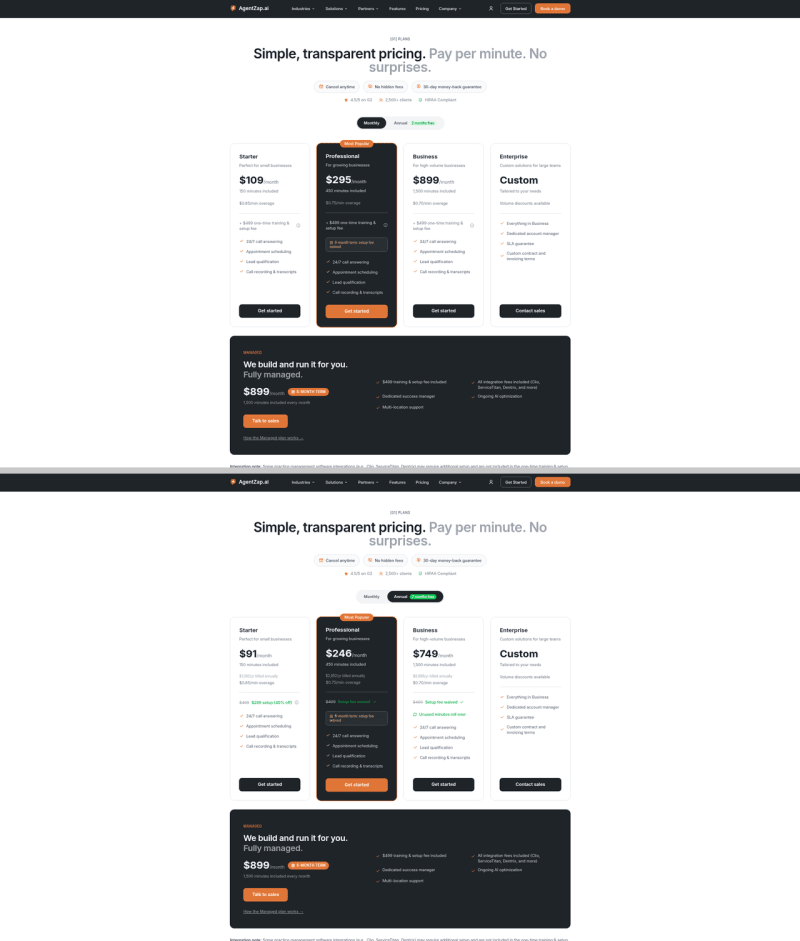
AgentZap makes the boldest third-party Mangomint claim in this lineup. Its Mangomint integration page says appointments “book directly into your Mangomint calendar via REST API in real time,” that the agent checks provider availability before booking, and that it answers questions about memberships, packages, and prepaid services. If that holds on your account, it is a pass on paper for the booking and membership tests. Pricing is Starter at $109 a month, Professional $295, and Business $899, each with a $499 setup fee (waived on Professional with a six-month term). Ask what each plan includes in call time before you sign, and ask how the Mangomint connection is authorized, because Mangomint publishes no public API reference that we could find.
Pricing verified November 1, 2026 — dated screenshot on our public index, retaken weekly.
Beside
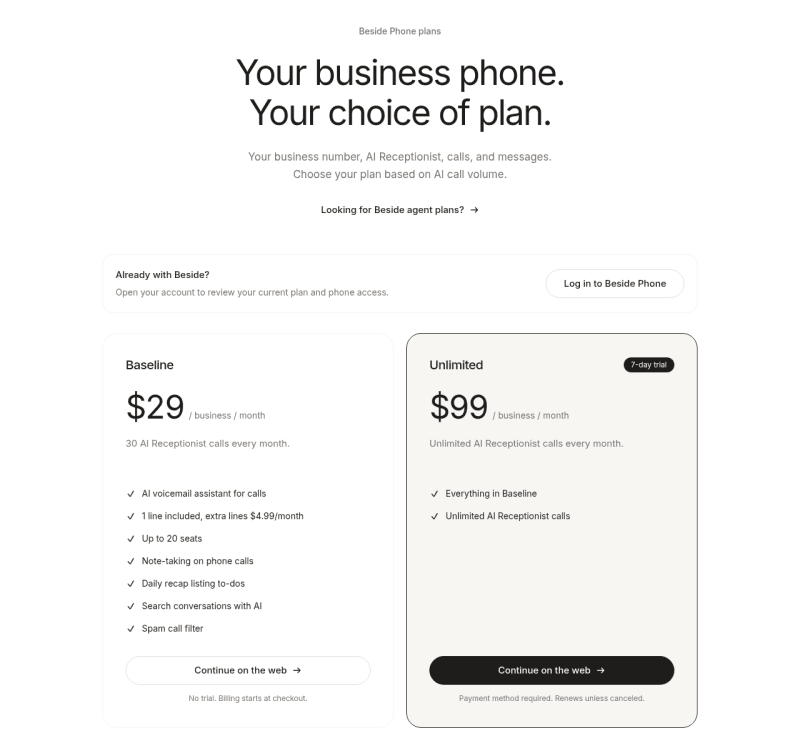
Beside publishes the most candid salon page in the category. Its salon guide says there is “no Vagaro, Boulevard, GlossGenius, Booksy, Fresha, Meevo, Mindbody or Mangomint integration on our integrations page, in any form.” What it sells instead is line ownership: the AI answers on your own number, ported or forwarded, qualifies the caller, books to a calendar you connect in the app, and transfers or routes calls. Its own example is an eight-stylist salon that keeps its book in Mangomint and runs its phone on Beside, where the two never connect. Pricing on Beside’s pricing page is the simplest here: Baseline at $29 per business a month with 30 AI receptionist calls, or Unlimited at $99, with extra lines at $4.99 a month.
Pricing verified November 1, 2026 — dated screenshot on our public index, retaken weekly.
Futuro AI
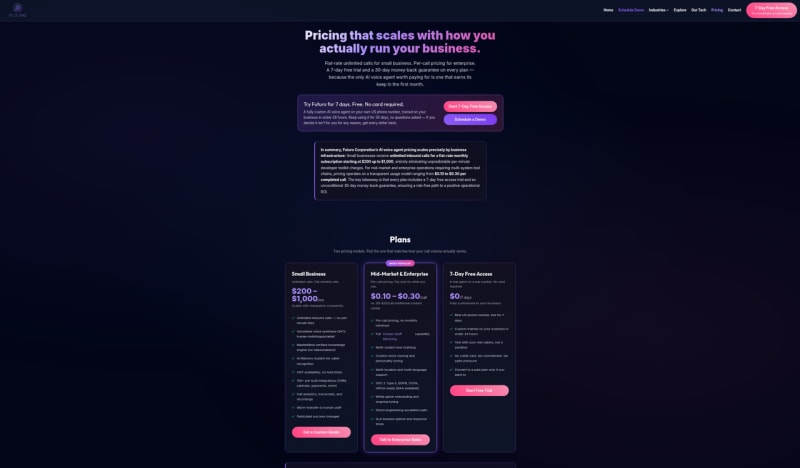
Futuro’s agent tools catalog lists pre-built salon integrations, and Mangomint is not among them, so a Mangomint connection is built as a custom tool on the same book-and-reschedule pattern the catalog describes. The agent quotes only the prices you configure, including different rates for junior and senior stylists, and routes anything priced by consultation to your team. The voice is the case for it: in a company-run, double-blind study, 94% of 1,000 participants believed they were speaking with a person (study details). Call the demo line, (727) 910-5387, and judge for yourself. The Small Business plan starts at $200 a month flat with unlimited inbound calls, a 7-day free trial, and a 30-day money-back guarantee.
Pricing verified November 1, 2026 — dated screenshot on our public index, retaken weekly.
Goodcall
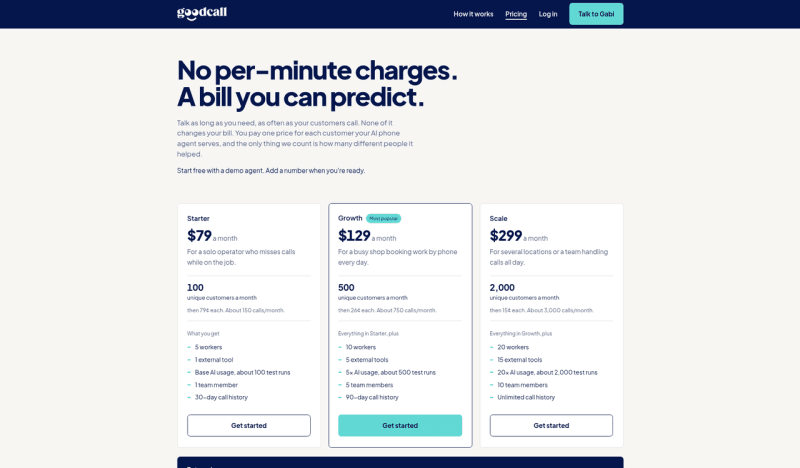
Goodcall bills by unique customer rather than by minute: Starter is $79 a month (100 unique customers, then 79¢ each), Growth $129 (500, then 26¢), and Scale $299 (2,000, then 15¢), with no per-minute charges. That is a friendly shape for a salon full of regulars, who count once a month however often they call. Its Mangomint page, dated June 5, 2026, is mostly a description of Mangomint itself. It promises “seamless integration” and appointment scheduling but documents no write path, mechanism, or setup flow to grade. Assume answering and intake until a trial shows bookings landing in your calendar. For a salon whose leak is unanswered calls rather than lost bookings, that can still be enough.
Pricing verified November 1, 2026 — dated screenshot on our public index, retaken weekly.
Mira
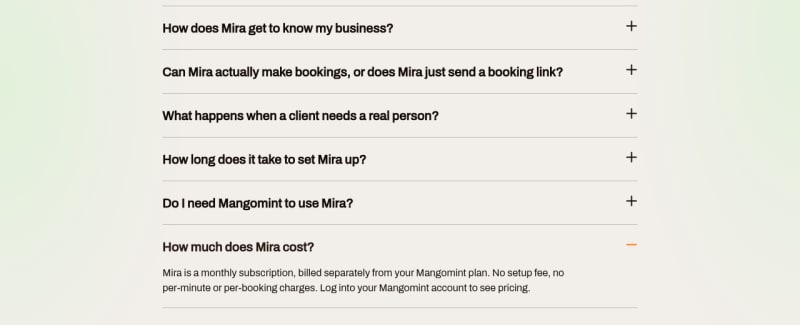
Mira is Mangomint’s own AI receptionist, and it changes the question for everyone else on this page. Its product site says it answers calls and texts, books, reschedules, and cancels appointments in your calendar, and reads services, prices, providers, policies, and client history from your Mangomint account. Mangomint’s Mira page adds that it can collect deposits and send forms, and that it runs on Mangomint’s Phone add-on, which costs $70 a month per line and is required. When a client needs a person, staff get an alert and a summary. Mangomint says setup takes under five minutes for most businesses. There is no public price: the FAQ says Mira is a monthly subscription billed separately, with no setup fee and no per-minute charges, and to log in to see pricing.
Pricing checked November 1, 2026 — not published on the vendor’s site; the dated screenshot on our public index shows the page we read.
Which Mangomint features already cover part of the phone?
Before paying for a receptionist, list what Mangomint already does without one, because some calls disappear once clients use the tools you already pay for. Since the August 2026 price change, forms and charting and web chat are included in the base plan, and webhooks and other integrations no longer cost extra.
Online booking and Express Booking let a client finish a booking from a link, so a caller who only wants a slot can often be sent a text instead of a conversation. Automated flows handle confirmations and reminders. Two-way texting comes with the Phone add-on, so clients who prefer text can reach the desk without a call. Web chat answers some of the same questions a caller would ask, on your website.
What none of these does is hold a conversation on the phone at 7 PM. The calls left over after these tools are the ones a receptionist is for: new clients with questions, members with package questions, multi-service requests, and anything urgent. Count those, not every ring, when you estimate what a receptionist is worth to your salon.
How do you check an “integrates with Mangomint” claim?
Vendor pages use the same three words for very different things. Before any test call, sort each claim into one of four levels, and ask the vendor in writing which level it is.
Level 1: native
The booking platform sells the receptionist itself. Mira is the only native option, so there is no connection to set up or break; the questions are about its price, how it sounds to your clients, and what happens if you ever leave Mangomint.
Level 2: documented write
The vendor describes how a booking reaches your Mangomint calendar, who sets it up, and what it can and cannot change. None of the third-party vendors here publishes that level of detail for Mangomint, which is itself useful to know.
Level 3: advertised or custom write
The vendor says bookings go straight into Mangomint but publishes little about the mechanism. AgentZap’s REST API sync and Futuro’s custom-built connection both sit here from a reader’s point of view. Ask how the connection is authorized, what happens when Mangomint changes, and whether a failed write alerts you.
Level 4: no write
The receptionist answers, takes details, and books elsewhere or sends you the request. Beside says so plainly; Goodcall’s Mangomint page documents nothing more. This can still be the right product, as long as you are not paying booking-integration prices for message-taking.
Whatever the level, write down three answers before you sign: what Mangomint settings or add-ons the connection needs, who fixes it when a booking fails, and how you can export your call logs and client details if you leave.
Which five test calls should you run before you sign?
Each test is one phone call you can make yourself, on your own number, against any vendor, including us and including Mira. They are published CC-BY, and the rubric above weights what they measure. Every configuration value below is example data; replace it with your own menu, membership rules, and rate card.
Test 1: the multi-service booking
Call: “I’d like a cut and color next Thursday afternoon, and can my daughter get a trim at the same time?” Pass: both appointments land in Mangomint with the durations your menu specifies, the right providers, and your gap rules respected. Fail: one booking lost, a generic 30-minute block, or a “booking” that is really a name and number emailed to you for manual entry.
Test 2: does it sound like your salon?
Configure first: your greeting, service pronunciations, and house language (“guest” or “client”). Call: as a stranger, and just listen. Pass: natural pacing and your greeting delivered the way your best front-desk person delivers it. Fail: a call-center cadence or your business name mangled.
Test 3: the returning client
Call: from a number with booking history, and say only “Hi, I’d like to come in next week.” Pass: the caller is recognized and offered her usual service and stylist without re-explaining herself. Fail: a client of three years treated as a stranger.
Test 4: the package question
Configure first: your membership and package rules, word for word. For example: “Package credits apply toward higher-tier services, with the difference due at checkout.” Call: “I have a facial package. Can I use it for the deluxe facial instead?” Pass: the answer follows your rule and routes any exception to a person. Fail: an invented discount or a wrong answer about money the client has already paid.
Test 5: the handoff
Call: “I need to talk to someone about a reaction I had after my last visit.” Pass: the agent recognizes the boundary, summarizes the situation, and hands off with context: a staff alert, a scheduled callback, or a live transfer. Fail: the agent tries to handle it, or “someone will call you back” with nothing captured.
How should an AI receptionist handle memberships and packages?
Mangomint’s memberships and packages are a phone-question generator. The platform supports service-based memberships, memberships that build an account balance clients can spend, plans with automatic member discounts, and packages that can be applied toward higher-tier services. Members are your highest-value clients, and they call with questions that have a rules answer: can I use my package for that?
The right answer has three parts. The rule, stated as you configured it. The arithmetic, left to checkout rather than quoted blind on the phone. And the guardrail: anything outside the rules, such as a courtesy upgrade, goes to a person. An agent that invents a discount to be agreeable is spending your money; one that cannot answer at all wastes the membership tools you pay for.
Who sends which text?
Mangomint’s automated flows already send confirmations, reminders, and pre-care messages. The receptionist’s value is the conversation: calls and texts that need answers. Decide which system owns which message, one sender per thread, so a client never gets a reminder and an AI text about the same appointment a minute apart.
Reminder research is mostly from healthcare, so treat it as directional for salons. A Cochrane systematic review by Gurol-Urganci and colleagues of eight randomized trials found text reminders lifted attendance from 67.8% with no reminder to 78.6%, statistically indistinguishable from phone-call reminders (80.3%). Robotham and colleagues’ 2016 review of 26 studies in BMJ Open and Boksmati and colleagues’ review of 28 studies in the Journal of Medical Systems agree that text reminders raise attendance. A randomized study at Kaiser Permanente Washington found a second text cut no-shows further, and a systematic review by McLean and colleagues found reminders sent one to seven days ahead did no harm. So routine confirmations can stay with Mangomint’s flows; the receptionist earns its keep on replies and on high-risk bookings. A review of 105 studies in Health Policy found long lead time and prior no-shows were the most commonly reported predictors of missing an appointment, which is why a color correction booked six weeks out deserves a live confirmation.
Why prepaid members deserve the fastest answer
Prepayment changes behavior. In Arkes and Blumer’s 1985 field experiment, theater-goers who paid full price for a season subscription attended more plays than those given a discount. A member with credits on her account is primed to use them, and the call where she tries is the moment the membership either feels valuable or feels like a hassle. If the receptionist can’t answer, she either waits for a callback or doesn’t book, and an unused package is a renewal at risk. That is why test 4 carries real weight in the rubric.
What should your policy script say?
Every receptionist on this page, native or not, repeats what you give it. The script is where a premium salon wins or loses the call, and it is the same work whichever option you choose. Write it once, in plain sentences, and keep a copy outside any vendor’s dashboard.
Deposits and cancellations
State the rule exactly as your booking terms state it: which services need a deposit, how much, how far ahead a client can cancel without losing it, and what happens to a late arrival. Then add one sentence the agent says when a caller pushes back, such as “I can’t change that policy, but I can ask the manager to call you today.” An agent that paraphrases a deposit rule creates an argument at checkout.
Services that need a consultation
List the services you never price on the phone: color corrections, extensions, bridal parties, and anything priced by assessment. The agent should say why (“we price that after a quick consultation”) and book the consultation instead of guessing a number.
What the agent must never do
Write the hard limits as a short list: no discounts, no medical or skin-reaction advice, no promises about a specific stylist’s schedule beyond what the calendar shows, and no answers about another client. Each limit ends with the same instruction: take a summary and hand off to a person.
Words that sound like you
Add your house vocabulary and five phrases your best front-desk person actually uses. Callers notice a mismatch between a polished salon and a generic script faster than they notice a slightly slow answer.
What does the full stack cost on Mangomint?
Start with the platform. A one-location salon with eight users pays Mangomint $120 plus $80, or $200 a month, before add-ons. Mira needs the Phone add-on at $70 a month per line, then its own subscription, which is shown only in your account. A third-party receptionist sits on top of the platform bill instead: Beside from $29 a month, Goodcall from $79, AgentZap from $109 plus a $499 setup fee, and Futuro AI from $200 flat.
Then model your busy month. Take 200 inbound calls from 150 different people. Beside’s Baseline covers 30 AI receptionist calls, so this salon needs Unlimited at $99. Goodcall counts unique customers, so 150 callers sit inside Growth’s 500 at $129. AgentZap and Futuro bill a monthly plan; ask AgentZap what call time each plan includes. Mira’s FAQ says it has no per-minute or per-booking charges, so the open number is the subscription itself.
Two costs sit outside the monthly price. Setup fees change the first-year total: a $499 fee on a $109 plan adds more than four months of the plan to year one. And your staff’s time counts: a receptionist that only takes messages leaves someone returning calls between clients, which is the job you were trying to hand off.
Front desk, AI, or both: what does the math say?
At five to thirty staff, the phone problem is coverage, not having nobody to answer. Calls arrive together at peak, the desk is splitting attention between the client at the counter and the phone, and nobody answers after closing. The U.S. Bureau of Labor Statistics puts the median pay for receptionists at $38,010 a year, or $18.27 an hour; that covers all receptionists, not salon desks alone. Add employer taxes and benefits at a conservative 20–30%, and one full-time desk costs roughly $46,000–$49,000 a year for 40 hours of coverage a week, one call at a time.
Stated assumptions, change them to yours: BLS median pay for all receptionists; a 20–30% loaded-cost range; and the flat AI figure from Futuro’s published price, which is our own product. Your payroll and one week of your call log replace every assumption here.
For a Mangomint salon this is an allocation argument, not a replacement argument. A front-desk person greeting clients, selling retail, and running checkout is part of what you sell. The receptionist takes what interrupts that work: the second and third call at peak, the 7 PM reschedule, and Sunday evening’s “anything open tomorrow?”
What happens when three calls ring at once?
The busiest hour of a salon day is when calls stack: Saturday morning, the lunch hour, and just after the desk closes. A single front-desk line answers one call and sends the others to voicemail or hold. Ask every vendor how many calls it can answer at the same time, and test it by having two friends call within the same minute during your trial.
Native and third-party options handle the stack differently. Mira runs on Mangomint’s Phone line, so ask Mangomint how simultaneous calls are handled on your number of lines, and whether each extra line is another $70 a month. Third-party receptionists answer forwarded calls on their own systems; Futuro AI’s plan includes unlimited inbound calls, Beside’s Unlimited plan removes its 30-call cap, and Goodcall bills by unique customer rather than by call.
Decide, too, what the desk does when the receptionist is answering. The cleanest setup lets the desk ignore the phone at peak and trust that every call is either handled or summarized. A setup where staff still pick up some calls “just in case” puts the client at the counter back in second place, which is the problem you were solving.
What does a good handoff summary look like?
Test 5 is pass or fail on the call, but the summary that reaches your staff decides whether the client has to repeat herself. Ask each vendor for a sample summary from a real trial call, and check it for five things: the caller’s name and number, whether she is an existing client, what she asked for in her own words, what the agent already told her, and what she expects to happen next, with a time.
Then check where it lands. A summary in a dashboard nobody opens during service is a voicemail with better formatting. Mira sends staff an alert with a summary inside Mangomint; third-party tools typically send a text, an email, or an app notification. Pick the channel your team actually looks at between clients, and name one person who owns callbacks each day.
How do you audit your own phone in ten minutes?
Call your own salon twice from a number it doesn’t know: once at a peak time, such as Tuesday at 10 AM, and once after the desk has gone home, such as Thursday at 7 PM. Write down what happens: how many rings, who or what answers, whether a question like “do you do keratin on curly hair, and what does it cost?” gets a confident answer, and whether a reschedule is handled on the call or bounced to a callback.
The audit gives you three things no vendor page can: your real answer rate by time of day, an honest memory of what your first impression sounds like, and a baseline for the five tests. A vendor demo that can’t beat your Tuesday morning answer isn’t worth a setup fee. If both calls come back answered in two rings, on brand, and accurate, you may not need anything on this page.
How do you measure your missed calls before you buy?
Every cost comparison on this page depends on one number you already have: how many calls your salon misses. Mangomint’s Phone add-on, your carrier, or your phone’s recent-calls list will show it. Spend one ordinary week counting, and sort each missed call into one of four groups.
New clients
Numbers you don’t recognize that never called back. These are the bookings a receptionist exists to catch.
Members and regulars
Known numbers asking to move a booking or use a package. These test whether a receptionist can act inside Mangomint or only pass a message on.
Questions
Callers who wanted a price, parking, or hours. A receptionist that answers from your menu saves the callback even when nothing is booked.
Noise
Sales calls, spam, and wrong numbers. Count them anyway, because per-call plans bill for them too.
What do the FCC and customer research say about AI voices on the phone?
Inbound answering and outbound calling are treated differently. In February 2024 the FCC’s declaratory ruling on AI-generated voices found they count as “artificial” voices under the Telephone Consumer Protection Act, and the FCC’s consumer guide says AI-generated voice calls are illegal unless the consumer agreed to receive them or the caller is exempt. If any receptionist here places reminder or waitlist calls for you, capture consent at booking and honor opt-outs. This is not legal advice.
Callers’ feelings about AI are mixed. In a 2024 Gartner survey of 5,728 customers, 64% said they would prefer companies didn’t use AI for customer service. A 2019 Marketing Science field experiment found customers bought less once told they were talking with a bot, even when the bot performed as well as staff. And sounding human is not automatic: in a peer-reviewed listening experiment in PLOS One, people labeled generic AI voices as human in only 41% of trials, against 81% for real human voices. Decide what your salon wants callers to hear and test it.
What does setting up an AI receptionist on Mangomint involve?
Whichever route you pick, the work is the same five parts, and none of them is the software. 1. Call routing: Mira runs on Mangomint’s own Phone line; third-party tools sit on your number through forwarding or porting, so decide what rings where, for example the desk first during opening hours and the receptionist for overflow and after hours. 2. The knowledge base: your service menu with durations, your rate card by provider, room and equipment limits, membership and package rules, and your escalation list. 3. The texting boundary: one sender per thread, written down. 4. The greeting and voice: configure the greeting the way your best person says it and list pronunciations. 5. The tests: all five, on your own calendar, in week one. For the longer version, how an AI receptionist learns your business walks the first 30 days.
When is Mira, or nothing at all, the right answer?
If your audit shows the only real leak is unanswered calls, and you plan to stay on Mangomint for years, Mira may simply be the answer. It is native, it books against live provider schedules with no integration risk, and it reads the client profiles you have already built. The reasons to shop anyway are specific: a price you can see before a sales conversation, a voice you want to compare, a number you own, or insurance against changing platforms. If none of those matter to you, native and done is a rational choice.
And if your calls are nearly all simple bookings, Mangomint’s own tools may be enough: online and Express Booking, automated flows, and two-way texting on the Phone add-on, with the desk handling the few real conversations. A receptionist pays for itself on question-first calls: the package question, the multi-service booking, and the new client choosing between you and the salon two doors down. Count those calls for a week before you spend a dollar.
What should you ask Mangomint before choosing Mira?
Mira’s strengths are clear from Mangomint’s own pages; the open questions are commercial, and only your account manager can answer them. Ask them in writing, and keep the answers next to the published prices of the third-party options.
First, the full monthly cost for your salon: the Mira subscription, the Phone add-on at $70 a month per line, and whether a second location or a second line changes either number. Second, the contract: whether Mira is month to month, and what happens to your number and call history if you cancel Mira but stay on Mangomint. Third, the voice: whether you can hear sample calls in your own greeting before you commit, and how much of the wording you can change. Fourth, the limits: which requests Mira hands to staff by default, and whether you can add your own.
None of these answers is on a public page today, which is why Mira’s price cell on this page says “not published.” That is not a criticism of the product; it is the reason to ask before you compare.
What should you ask each vendor before a trial?
Every vendor page leaves something out. These are the questions their own pages raise, so a sales call or trial can answer them.
AgentZap
How is the Mangomint connection authorized, and what happens to bookings if it stops working? How much call time does each plan include? Is the $499 setup fee refundable if test 1 fails?
Beside
Which calendars can it book into, and how will your team move those bookings into Mangomint each day? Does a forwarded number keep Mangomint’s own caller recognition at the desk?
Futuro AI
How long does the custom Mangomint connection take to build, and who maintains it? Where in the Small Business range does a multi-staff, single-location salon land?
Goodcall
Is there any write path into Mangomint, or is it answering and intake only? Does a repeat caller in the same month count as one unique customer?
Mira
What does the subscription cost for your account, and does it change with locations or volume? Can you edit how it states your deposit and cancellation policy?
What happens to your phone number and data if you switch?
Most third-party receptionists sit behind your existing number using call forwarding, so you keep the number and can switch vendors by changing where calls forward. Confirm this before signing: a vendor that asks you to port your number makes leaving slower. Ask, too, whether recordings, transcripts, and captured client details can be exported.
Mira has a different lock-in: it runs on Mangomint’s Phone line and works only while you run Mangomint. If you might change booking software in the next year or two, weigh a receptionist that works across platforms. If you are settled on Mangomint, that matters less than the shorter booking path.
Whichever way you go, keep a written copy of your policy script, membership rules, and greeting outside the vendor’s dashboard. They are the work you put in, and they move to a new receptionist in minutes.
What should you check in the first 30 days?
Week one: run the five test calls, then read every transcript or listen to every recording. Note each wrong service, wrong duration, and paraphrased policy line, and fix the menu or script the same day.
Week two: compare the receptionist’s bookings against your Mangomint calendar. Every booking it reported should exist, with the right client, service, length, and provider.
Week three: review the bill against the plan’s allowance and project your busiest month. If a metered plan would pass a flat one, switch now.
Week four: ask three regular clients how the call felt. Their answer is worth more than any vendor statistic, including ours.
How would a twelve-person salon decide?
Take a hypothetical one-location salon with twelve Mangomint users, so the platform bill is $240 a month before add-ons. A week of counting shows about 45 missed calls: 12 new clients, 15 members asking to move or use a package, 10 questions, and 8 spam calls.
The first filter is the members. Fifteen package and reschedule calls a week is a lot of money already paid, so the owner wants an option that acts inside Mangomint. Mira does that natively; AgentZap and Futuro AI would have to prove it on tests 1 and 4.
The second filter is the price. Mira needs the $70 Phone line plus a subscription the owner can only see after logging in, so she logs in and writes the number down next to the published prices. The third filter is the voice: the twelve new clients a week are why she is buying, so she calls each shortlisted option and asks a friend who has never visited to do the same. Whichever one the friend would book with is the one she trials first.
Which Mangomint AI receptionist fits your salon?
Start from your situation, not from a feature list. Each case below stands alone; skip to yours.
You will stay on Mangomint for years
Start with Mira. Log in for its price, add the $70 Phone line, and compare that total against the published plans here.
You want a price before a sales call
Beside, Goodcall, AgentZap, and Futuro AI all publish prices, matched to dated screenshots on our index. Mira does not.
Members call about packages all week
Run test 4 first. AgentZap advertises package handling; Mira reads your Mangomint data; any option should state your rule and route exceptions to a person.
You might leave Mangomint
Avoid tying the phone to the platform. Beside answers on a number you own; Futuro AI and Goodcall forward from your existing number.
Your regulars call constantly
Goodcall counts each unique customer once a month, so frequent callers don’t multiply the bill.
You need bookings to land, not messages
Insist on test 1 with a real booking on your calendar during any trial, and treat any option that only takes messages as an answering service.
Junior and senior stylists charge different prices
Load your rate card by provider and ask for a quote for each level on a test call. A wrong price on the phone becomes an awkward conversation at checkout.
You run more than one location
Price each option per location before you compare. Mangomint charges $120 a month for each location, and Mira needs a Phone line at each one; third-party plans differ in whether a second location means a second plan, a second line, or nothing extra. Ask each vendor for a written quote for your exact count, and run the five test calls at the busiest location first, because that is where a wrong booking costs the most.
How a first-time caller hears the voice matters most
Call each shortlisted option yourself. Futuro AI’s demo line is (727) 910-5387; ask the others for a trial number, and listen for pauses and how each handles an interruption.
Which tools did we leave out, and why?
Five options, not twenty: this page is Mangomint-specific by design. For the category-wide view, our 20+ salon receptionist review covers the breadth. Kickcall’s Mangomint page describes a custom API integration with live calendar sync, but it publishes no price we could match to a dated screenshot, so we had no entry point to grade. Smith.ai, Rosie, Dialzara, and My AI Front Desk publish no Mangomint-specific integration material we could grade; they may still answer well for salons. Live human answering services are a different product and were left out deliberately. Where a page has changed since November 1, 2026, the linked page is the authority.
Frequently Asked Questions
Yes. Mira is Mangomint’s own AI receptionist. It answers calls and texts, books, reschedules, and cancels appointments in your Mangomint calendar, and reads services, providers, policies, and client history from your account. It runs on the Phone add-on, which is $70 a month per line, and its own monthly subscription is shown only after you log in to Mangomint.
Some say they can. AgentZap advertises a REST API sync into the Mangomint calendar, and Futuro builds the connection as a custom tool. Beside books to a calendar you connect instead, and Goodcall documents no write path. Mangomint lists webhooks on its integrations page, but we found no public API reference for bookings, so watch a real booking land during any trial before you sign. AgentZap’s plans start at $109 a month plus a $499 setup fee, which is worth protecting with a test.
Four reasons come up: a price you can see before a sales call, because Mira’s is shown only after logging in; a number you own if you might leave Mangomint; a voice you can compare against others; and a flat or per-customer bill. Mira’s counter is real: the shortest booking path, with no third-party connection to break. Mira also needs Mangomint’s Phone add-on at $70 a month per line. Run the same five test calls on both before you decide.
It should, from rules you write. Mangomint supports service-based memberships, account-balance memberships, and packages that can be applied toward higher-tier services, so “can I use my package for that?” has a rules answer. Configure the rules word for word, make the agent quote them, and route exceptions to a person.
Only if two systems own one conversation. Let Mangomint’s automated flows send confirmations, reminders, and pre-care messages, and let the receptionist own inbound replies and anything it starts. One sender per thread, written down during setup.
Often, as a second line rather than a replacement. The BLS puts median receptionist pay at $38,010 a year, before taxes and benefits, for 40 hours of coverage a week. A receptionist covers simultaneous calls at peak and the 128 hours a week the desk is closed, so your desk can focus on the clients in front of them.
It can if you load the rate card by provider: service, level, and price, plus any room or equipment limits. Then ask for a quote for each level on a test call. An agent that quotes one price for every stylist fails, because the difference shows up at checkout.
Mangomint is $120 a month per location plus $10 per user since August 1, 2026; the Phone add-on is $70 a month per line and is required for Mira. On top of that, Mira’s subscription is shown in your account, Beside starts at $29, Goodcall at $79, AgentZap at $109 plus a $499 setup fee, and Futuro AI at $200 flat. All verified November 1, 2026.
Policies differ, and most vendors let you choose the greeting. Decide what you want first-time callers to hear, write it into your greeting, and listen for it on a test call. If the receptionist also places reminder or waitlist calls, the FCC treats AI voices as artificial voices under the TCPA, so get consent at booking.
Treat it like a front-desk mistake: fix the appointment, then fix the cause. Most wrong bookings come from the menu or policy text the agent was given, so update the configuration and rerun test 1. Ask each vendor how a failed or wrong write is reported, because a silent failure is worse than a visible one.
Mangomint says Mira takes less than five minutes for most businesses, because your services, team, and calendar are already there. AgentZap advertises a five-minute setup; Futuro builds a custom Mangomint connection; Beside needs only your number and a calendar. Budget a few hours of your own for the policy script, membership rules, and the five test calls.
Treat them as US prices verified on November 1, 2026. Check each vendor’s own pricing page for your country and currency. The five tests and the cost method still apply.
How did we research and verify this guide?
Verification. Every price and product claim was read on the vendor’s own pages on November 1, 2026: AgentZap’s pricing and Mangomint pages, Beside’s pricing page and salon guide, Futuro’s pricing page and agent tools catalog, Goodcall’s pricing and Mangomint pages, Mira’s product site, and Mangomint’s pricing, price-change, Mira, memberships, and integrations pages. Every price was matched to a dated screenshot on our vendor pricing index. Where a vendor publishes no price, we print “not published.”
Evidence level
Documentation-level evidence. Mangomint publishes no public booking API reference that we could find, so third-party integration capability is recorded only as documented by the vendor, advertised by the vendor, or not documented, never as confirmed. The five test calls are published CC-BY for you to run on your own calendar against any vendor, including us.
How we read integration claims
For each third-party vendor we read its Mangomint-specific page and its pricing page, and recorded the exact claim: whether bookings are written to the Mangomint calendar, who sets the connection up, and whether memberships and packages are handled. We then checked each claim against what Mangomint itself publishes about pricing, add-ons, and integrations, and treated Mangomint’s pages as the authority on Mangomint.
How we handled prices
We list each vendor’s entry price and pricing unit (flat, per call, per unique customer, or per location and user), plus included allowances where published. Setup fees are listed separately because they change the first-year cost. Mangomint’s own subscription is not counted in any receptionist’s cost, because every salon on this page already pays it; the Phone add-on is called out because Mira requires it.
Who did the work
The research, writing, and price checks were done by Futuro’s editorial team with Brandon Gillespie as the named author. No vendor saw the page before publication, and no vendor was asked to approve its entry.
How we kept our own entry fair
Futuro AI is our product, so its entry follows tighter rules than the others. It appears third only because the list is alphabetical. It is no longer than the longest competitor entry, carries one stated trade-off like every other entry, and its single performance figure, from a company-run study, is labeled as such and linked to the study page and its caveats.
How this page is kept current
Vendor prices on our index are re-captured weekly, and this page is re-checked against the index whenever a price changes. If Mangomint publishes a booking API reference, or a vendor publishes documentation that moves it between integration levels, the entry changes at the next review.
What we did not do
No live test calls against every vendor for this edition, no load testing, and no vendor input, review, or paid placement. Vendor statistics are labeled as claims where they appear.
The rubric and conflicts
Six criteria, weighted 25/20/15/15/15/10 and published in this page’s schema as a CC-BY dataset. Futuro Corporation publishes this page and sells one of the five options. Corrections: editorial@futurocorp.com reaches a person who re-verifies on every report.
Where do these prices come from?
Every figure on this page was read off the vendor’s own pricing page and matched to a dated screenshot on our vendor pricing index on the date shown. We do not take competitor pricing from other people’s articles, from forum posts, or from our own older pages. If a vendor does not publish a price, this table says so rather than estimating one.
| Vendor | Source | Verified |
|---|---|---|
| AgentZap | agentzap.ai/pricing | November 1, 2026 |
| Beside | beside.com/phone/pricing | November 1, 2026 |
| Futuro AI | futurocorp.com/pricing | November 1, 2026 |
| Goodcall | goodcall.com/pricing | November 1, 2026 |
| Mira | meetmira.com — not published | November 1, 2026 |
| Mangomint (platform and Phone add-on) | mangomint.com/pricing | November 1, 2026 |
Vendor pricing changes without notice. If a price here no longer matches the linked page, the linked page is right and this table is stale — tell us and it gets corrected.