
Disclosure: Futuro Corporation builds an AI receptionist with a pre-built Vagaro integration, and we say so wherever it matters below. Every Vera capability claim is sourced to Vagaro's own documentation and dated; every claim we could not independently verify is labeled as such. Where Vera wins, we say Vera wins.
Does Vagaro already have an AI receptionist?
Yes — and no, and the difference between those two answers is the entire point of this guide. Vagaro ships a real AI brand called Vera, and one piece of it, Connect AI, is pitched on Vagaro's own site as "your AI receptionist for bookings, messages" — a $10-per-month add-on that answers customer chats around the clock inside Connect by Vagaro (Vagaro pricing documentation; independent price cross-check). What Vera does not include, anywhere, is a product that picks up your telephone and speaks. We reviewed Vagaro's Vera product page, five support articles, its developer documentation, and its Customer Participation Agreement on August 11, 2026, and none of them describes a phone-voice capability. Competitors who build phone receptionists for Vagaro businesses say the quiet part directly: AgentZap states that "Vagaro does not include a built-in phone answering service."
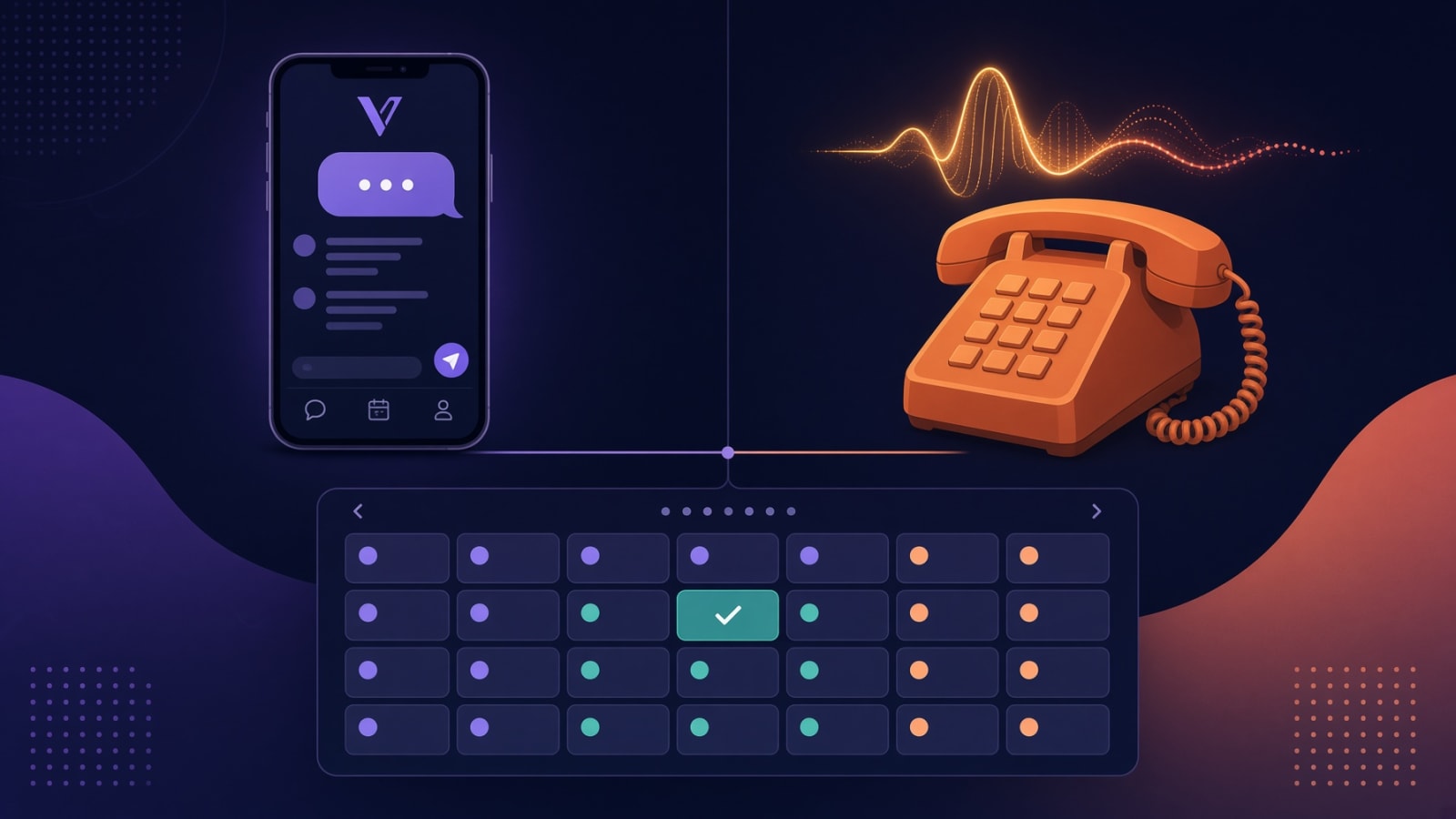
So the honest one-paragraph answer: Vagaro has a chat receptionist, a marketing AI, a copywriter, and a form builder — it does not have a voice on your phone line. Whether that gap matters to you depends on how much of your booking revenue still arrives by phone, and we documented the economics of a missed salon call separately. This article maps the rest: what Vera does, what a dedicated AI receptionist adds, what the integration between the two actually looks like, and which salons can stop reading after Vera.
A quick orientation for where this guide sits in our library. If you have not chosen your booking software yet — or you want the ten-platform market graded head-to-head — start with our broad comparison of conversational AI for beauty salons; the platform-by-platform native-AI landscape across Fresha, GlossGenius, Zenoti, and Vagaro is mapped in our top-20 beauty and wellness hub. This article assumes you already run Vagaro and asks the narrower question nobody has answered carefully: is Vera enough?
| Your three front doors | Covered natively by Vagaro? | Covered by a dedicated AI receptionist? |
|---|---|---|
| The phone line (voice calls) | No — no Vagaro product answers calls with a voice | Yes — this is its core job |
| Connect by Vagaro chat messages | Yes — Connect AI, $10/month add-on | Usually out of scope (phone-first) |
| Marketplace discovery (new clients finding you) | Yes — Vera Fill My Books, per-booking fee | No — receptionists answer demand, they don't create it |
Why does this decision matter more for salons than for most small businesses?
Because of who's on the other end of the phone and what your team costs while they're not answering it. The trade the U.S. Census Bureau classifies as NAICS 812112, Beauty Salons — cutting, coloring, and styling hair, facials, makeup — is overwhelmingly a small-staff, appointment-driven business, and a large share of its operators work alone: the Census Bureau's Nonemployer Statistics program exists precisely to count the millions of U.S. businesses with no paid employees, a category personal-care services dominate. Meanwhile the people doing the work are modestly paid: the Bureau of Labor Statistics Occupational Outlook Handbook projects about 89,400 openings a year for barbers, hairstylists, and cosmetologists over the decade, and its wage estimates for OES 39-5012 put the median hourly wage for hairdressers, hairstylists, and cosmetologists in the high teens. Every hour a skilled stylist spends playing phone tag is an hour not generating chair revenue — and a dedicated human receptionist is a payroll line many two-chair shops simply can't carry.
It's also a licensed, regulated trade — establishments answer to state boards (California's Board of Barbering and Cosmetology, for instance, fields consumer complaints about sanitation, unlicensed practice, and false advertising) — which is why "the AI said the wrong thing to a client" is not a trivial risk here. And the software these businesses run on is consolidating: Vagaro alone claims a base of over 90,000 businesses (third-party count, 2026), which is why a question like "is its built-in AI enough?" now affects a meaningful slice of the industry. The answer, per the rest of this guide: sometimes entirely, sometimes nowhere close.
What does Vera actually do? (Verified August 2026)
The most common mistake in coverage of Vagaro's AI is treating Vera as one assistant. It is a brand stretched over four separate tools with separate jobs, separate prices, and separate limits — a distinction the independent analysis at usecarly.com documented well. Everything in this section was re-verified against Vagaro's own documentation on August 11, 2026, and every claim is dated because Vera's scope is moving fast: the tool now called Fill My Books was a different product ("Get Featured") as recently as June (Vagaro's transition notice).
Vera — Vagaro's umbrella AI brand covering four tools: Vera Fill My Books (marketplace demand generation), Connect AI (chat receptionist), an AI copy generator ("Enhance with AI"), and an AI Form Builder. None of the four answers the business's phone line with a voice, per Vagaro's own documentation as of August 2026.
Vera Fill My Books — demand generation, not reception
Fill My Books is Vera's headline, and it is genuinely useful — as long as you understand what it is. When you turn it on, Vera builds promotions for your open slots and pushes them across the Vagaro Marketplace, email campaigns, and push notifications: your business appears as a sponsored listing, ranks higher in local search, gets Daily Deals created with a discount you cap, and is marketed by email to Vagaro users within 25 miles who haven't visited you before (Vagaro support). A "Fill Last-Minute Calendar Openings" mode promotes availability inside the next 72 hours.
The pricing is performance-based, and the terms matter. There is no monthly fee; instead Vagaro takes 20% of the booking amount when a brand-new customer books, and 5% for an existing one, with a $1.00 minimum per booking, collected as a deposit at the moment of booking (Participation Agreement, Section 10). The fee applies to the whole cart after discounts — services, add-ons, memberships, packages — excluding tips, taxes, and products. Vagaro refunds the fee to the customer only if the appointment is canceled at least 24 hours out, or longer if your own policy requires more notice (Vagaro support). UK businesses should read the fine print twice: there, an active Marketplace listing itself triggers the 20% new-client fee on marketplace bookings even with Fill My Books switched off. Read it as what it is — an advertising channel aimed at Vagaro's consumer audience, not a receptionist and not a lapsed-client win-back tool.
Connect AI — the chat receptionist
Connect AI is the piece that earns the word "receptionist." It lives inside Connect by Vagaro and answers customer chat messages 24/7: questions about your services and policies, appointment lookups, cancellations, past purchases, and membership status, escalating to your team when it's stuck (third-party walkthrough; Vagaro). It reads your live Vagaro data, so its answers about availability and pricing are grounded rather than guessed. It costs $10 per month as an add-on (Vagaro pricing documentation; independent cross-check). For a solo operator who cannot touch a phone mid-service, a chat front door that never sleeps is real value at a genuinely low price. What it is not: it does not answer your phone number, it does not speak, and it does not monitor messages outside the Connect channel.
The AI copy generator
The third Vera is a writing assistant. An "Enhance with AI" button sits on business descriptions, service and class descriptions, bundle and add-on descriptions, membership and package copy, product descriptions, refund and cancellation policies, appointment-reminder emails, employee bios, Daily Deal fine print, and email/text marketing campaigns (Vagaro support). You give it rough notes, pick a tone and length, and it drafts. Limits: 50 generated responses per field per day, free with any Vagaro subscription. Unremarkable in 2026 — the same class of output you'd get from a general chatbot — but conveniently located inside the fields where the copy actually lives.
The AI Form Builder
The quietest Vera converts uploaded PDFs, Word documents, or images of paper forms into working digital forms — intake questionnaires, waivers, consultation records — with no prompting required (usecarly.com). If your consultation process still lives on a clipboard, this may save more admin hours than the rest of Vera combined. It has nothing to do with client communication, which is exactly why it gets ignored in reviews.
Does Vera answer your phone line?
No — and we want to be precise about how we know, because this article will be read by Vagaro and the claim deserves receipts. As of August 11, 2026: Vagaro's own AI page describes Vera as an "AI scheduling assistant" for promoting openings and generating client communication. The Connect AI description covers customer chats. The support library's Vera articles cover deals, copy, and forms. The developer documentation (docs.vagaro.com) exists precisely so that other software can connect to Vagaro — including the phone-answering software Vagaro doesn't build. And the companies selling that phone layer state the gap plainly (AgentZap). If Vagaro ships a voice product after our review date, we'll update this section — Vera's July 2026 expansion shows how fast the ground moves.
Why does the phone line deserve its own product category at all? Because the caller who phones a salon is usually the highest-intent lead you'll get all day — they want to book now, not browse. The revenue math of answering versus missing that call is laid out in our missed-call economics analysis, so we won't re-derive it here; the short version is that an unanswered phone doesn't pause the caller's intent, it redirects it to the next salon on the list.
There's also a quality argument, and the research is less flattering to chat than vendors admit. In a series of experiments published in the Journal of Marketing, Crolic, Thomaz, Hadi and Stephen (2022) found that when customers arrive angry, an anthropomorphized chatbot actually makes things worse — the human-like presentation raises expectations the bot then can't meet. Think about who phones a salon mid-morning: someone whose color went wrong, someone whose sitter canceled, someone who needs tomorrow moved. Those are emotionally loaded calls, and Huang and Rust's widely cited framework in the Journal of Service Research (2018) explains why they're hard: service work splits into mechanical, thinking, and feeling tasks, and AI handles them in that order of reliability. A chat widget covers the mechanical tier well. The phone is where the feeling tier shows up.
What does a dedicated AI receptionist add that native AI structurally can't?
"Structurally" is the load-bearing word. Nothing below is a criticism of Vera's execution — these are gaps that follow from what a native, in-app assistant is, and no update to Connect AI's chat model closes them.
First, a voice on the phone line. A dedicated receptionist answers your actual business number — forwarded conditionally (busy, no-answer, after-hours) or full-time — and holds a spoken conversation. This is only possible because speech recognition got boringly reliable: OpenAI's Whisper, trained on 680,000 hours of audio (arXiv:2212.04356), is the public benchmark for how far noisy, real-world speech understanding has come. Voice-first platforms (AgentZap, Brilo, Goodcall — all three publish Vagaro integrations) answer, converse, and write the result into your calendar.
Second, conversation quality on the calls that aren't simple. A rebook is easy for anyone. The hard calls are negotiations under policy pressure: "I have to cancel tomorrow morning — am I getting charged?" — where the right answer references your cancellation window, the deposit on file, and whether a waitlisted client can take the slot, delivered in a tone that keeps the client. That's a configured, tested behavior in a dedicated layer, not a chat flow. (Our hair-salon scoring guide stress-tests five hair-specific calls against ten platforms if you want to hear what pass and fail sound like.)
Third, memory that isn't trapped inside one app. Vera sees what happens inside Vagaro. A dedicated receptionist can connect what happens across the channels it runs — the caller who texted your website widget last night and phones today is one continuous relationship, not two tickets. Caveat, honestly stated: that memory only spans channels you route through the layer, and our pillar guide's discussion of client recall and personalization covers what mature recognition looks like, so we won't repeat it here.
Fourth, independence from your software vendor. If you move off Vagaro in two years, Connect AI stays behind — it's a feature of the platform. Your phone layer moves with you, because it was never Vagaro's. That sounds abstract until you price the alternative: re-recording greetings, re-teaching policies, and re-building client-facing habits on a new native tool while also migrating your book. The switching-cost section below puts mechanics around this.
The overlap matrix: Vera vs. a dedicated receptionist, row by row
Eleven capabilities, one honest winner per row — including the four rows Vera wins outright, because fairness cuts both ways. This matrix is built to be cited: if you publish salon-software reviews, link to it rather than paraphrasing, and note that we re-verify it quarterly (next scheduled pass: November 2026).
| Capability | Vera (native) | Dedicated AI receptionist | Honest winner |
|---|---|---|---|
| Answers the phone line with a voice | No — no phone product exists | Yes — core function | Dedicated layer |
| Booking write depth into Vagaro | Native — zero integration, zero sync lag | Via gated API/webhooks ($10/month, approval required) | Vera |
| Marketplace demand generation | Yes — Fill My Books, 20%/5% per-booking fee | No — receptionists don't create demand | Vera |
| Marketing copy and descriptions | Yes — free with subscription, 50/field/day | No | Vera |
| Intake forms and waivers | Yes — AI Form Builder | No | Vera |
| After-hours coverage | Chat only | Phone and (usually) SMS | Dedicated layer |
| Complex call handling (policy negotiations, consult triage) | Not applicable — takes no calls | Configured and testable behavior | Dedicated layer |
| Memory across channels | Vagaro-internal only | Spans the channels routed through it | Dedicated layer, with caveats |
| SMS follow-up | Inside Connect channel | Post-call texts, consent-gated | Split |
| Survives a switch off Vagaro | No — platform feature | Yes — independent of your PMS | Dedicated layer |
| Price | $10/month (Connect AI); Fill My Books is per-booking | $29–$109+/month entry tiers | Vera |
The four rows Vera wins outright
Native calendar write depth is real, and we won't hand-wave it: when Connect AI confirms a booking, there is no webhook, no approval queue, no sync lag, no API fee — the appointment simply exists in the system of record. Marketplace demand generation is unopposed — no receptionist product brings you strangers, and Fill My Books does, at a defensible performance price. The copy and form tools are free-with-subscription conveniences that remove real admin friction. And on price, $10 a month against $29–$109-plus entry tiers (category price spread, July 2026) isn't a rounding error; it's an order of magnitude. If your entire problem is unanswered chats, Vera solves it for the cost of two coffees.
The five rows the dedicated layer wins
The phone line is the whole row set: voice answering, after-hours phone coverage, and complex-call handling are one capability seen from three angles, and Vera simply isn't in the room. Cross-channel memory and software independence follow from architecture — a layer that sits above your tools can see across them and outlive any one of them; a feature inside one app can't. The SMS row is genuinely split: both sides can text, but post-call follow-ups from a dedicated layer must respect consent rules — the FCC requires prior express written consent for commercial autodialed texts — and Vera's messaging stays inside its own walled channel.
Is Vera enough for you? Eight honest scenarios
The right answer is a function of your book, your budget, and how your clients actually reach you. Find yourself below — and note the first scenario, where the honest advice is to spend $10 and stop reading.
1. The solo suite renter watching every dollar
Vera is probably enough. Your clients already text and DM; your Vagaro base plan runs $23.99 for one calendar (Vagaro support); Connect AI at $10 answers chats while your hands are in a foil. The cheapest credible phone layers start around $29–$49 a month (verified entry tiers), and if your phone rings twice a week, that money is better spent on inventory. Revisit when you're turning clients away.
2. The two-to-four-chair salon with a working front-desk rhythm
Start with Vera, add phone overflow when evidence says so. If someone usually catches the phone, your gap is the late-morning Saturday pile-up and the Tuesday-evening caller. Turn on Connect AI for chat, then measure missed calls for a month before buying anything — most carriers and phone systems can report them, and conditional forwarding (busy/no-answer only) is how you add a voice layer later without changing how the shop runs.
3. The color-led book where the phone sets the average ticket
Dedicated layer. High-ticket color is consult-driven: the caller asking about a correction is deciding between you and the salon across town in real time, and the answer quality on that call sets the ticket. This is the exact call class our hair-salon platform test scores — read it for the pass/fail shape, then insist any vendor performs it live in your account.
4. The salon living on marketplace discovery
Vera, and do the fee math honestly. Fill My Books is your tool — but price it as advertising, not reception. A $120 new-client color booking costs you $24 plus the discount you set (fee mechanics). If that client rebooks four times, the fee was a bargain; if they came once for the deal, you paid 20% to rent a stranger. Track rebooking of marketplace clients for ninety days before scaling the discount cap.
5. The book that fills after hours
Split coverage: Vera for chat, a voice layer for the phone. Evening and weekend contact is where chat and call volume both spike, and Connect AI only covers half of it. For what six months of after-hours phone answering actually does to a salon's numbers, one salon owner documented her own experiment in this first-person account — the honest version, friction included.
6. The two-to-ten-location group
Both, deployed deliberately. Connect AI per location ($10 each) standardizes chat answers across sites; a phone layer with location routing decides which site's calendar takes the booking. Multi-location economics and per-site pricing discipline are mapped in our top-20 hub's group section — the trap is per-location fees compounding invisibly.
7. The owner who might leave Vagaro within two years
Weight independence heavily. Anything you build on Vera evaporates at migration; a dedicated phone layer is the one client-facing system that survives the move untouched. Read the switching-cost section below before assuming the exit is cheap either way.
8. The high-volume front desk, ten-plus calls a day
Dedicated layer, full-time forwarding. A human answers one call at a time; callers two through five hear ringing. At this volume the question stops being Vera-versus-third-party and becomes which phone platform — our salon buyer's guide compares them at a glance. (Nail salons and med spas have their own dedicated guides — nail and med spa — and we keep them separate deliberately.)
How deep do third-party Vagaro integrations really go?
"Integrates with Vagaro" is a marketing sentence, not a specification. What it can mean ranges from a real-time, two-way sync down to a nightly email digest. Here's the machinery as it actually exists in August 2026, because the machinery is what you should quiz vendors on.
The access gauntlet
Vagaro's API and webhook access is real but request-gated — not self-serve, not partner-only. From a desktop browser (the mobile app doesn't expose it), you go to Settings → Developers → APIs & Webhooks, hit "Contact Us," and submit a request naming the webhook types you need — Appointments and Customers — plus a plain-language description of your use case (documented request flow). Vagaro's team reviews manually; the published expectation is about five business days (independent walkthrough). Prerequisites that trip people up: an active paid plan, Vagaro Credit Card Processing enabled, and no free trial. On approval you receive OAuth 2.0 client credentials — a region, a client ID, and a client secret (docs.vagaro.com). Vagaro bills $10 per month for the access itself, including 5,000 API calls, then $0.002 per call — a fee that appears on your Vagaro invoice, not your receptionist vendor's (AgentZap setup guide).
What actually syncs
Through that pipe, a properly built integration reads your service menu, staff availability, and client records, and writes appointments, updates, cancellations, and new-client records in real time — webhook events fire the moment a booking changes (AgentZap). The scoped-permissions model an independent integration guide lays out is the right mental picture: read access to menu, availability, clients, and memberships; write access to bookings, waitlist entries, and client notes (Ainora integration guide). One hard limit worth knowing before you dream up analytics projects: the API does not offer historical data export — it's a live pipe, not an archive (AgentZap FAQ).
The failure modes to test before you sign
Three, all discoverable in a demo if you insist on the right evidence. Create-modify-cancel: watch the vendor's AI create a booking in your Vagaro account, then move it, then cancel it — a platform that can only create is a message-taker with delusions of depth (our top-20 hub makes the same demand of every platform it lists). Price drift: some integrations copy your service prices at setup and never re-sync them — change a price in Vagaro in March and the AI quotes the old number in June; ask exactly how menu changes propagate. Silent sync failure: webhooks fail quietly; ask what reconciliation looks like when the pipe drops for an afternoon. The serious vendors run a structured test-call protocol before go-live — one independent guide recommends 20–30 scripted calls covering a new-client booking with deposit, a member booking, a full-class waitlist add, a cancellation-and-fill, and a membership-status question, verifying every artifact in Vagaro afterward (Ainora). Any vendor who can't walk that gauntlet live isn't an integration; they're a forwarding number.
What are the switching costs — and what data actually leaves Vagaro?
Nobody evaluates a receptionist layer while planning to leave their booking software, and then two years later the migration conversation happens and every choice made along the way shows up in the invoice. The honest ledger, as of August 2026:
What exports cleanly
Your customer list is yours: Vagaro's owner-only export produces the full list as an Excel or PDF file, filterable by employee and customer type (Vagaro support). Reports, appointment summaries, inventory, and service lists have their own export paths. In practical terms: the core asset — your book of clients — is portable, and a migration is annoying, not fatal. This is to Vagaro's credit and worth saying plainly in an article that criticizes other parts of the package.
What doesn't export
Three things stay behind. Connect chat histories: we found no documented export path for Connect message threads (checked August 11, 2026) — the relationship context accumulating in that channel is effectively on deposit with Vagaro. API history: the developer pipe carries live state only, no historical export (AgentZap FAQ). The marketplace relationship: clients who found you through Fill My Books do land in your customer list after booking — they're yours — but the discovery engine that produced them stays Vagaro's, and in the UK the marketplace listing itself carries the 20% new-client fee while it's active (Participation Agreement). And anything you built on Vera — the chat behaviors, the form automations — is a platform feature that evaporates at migration. An independent phone layer is the one client-facing system that packs up with you.
The membership rules shifting under everyone
Salons sell memberships and packages on auto-renewal, and the regulatory ground under those is moving. The FTC's 2024 "click-to-cancel" rule was vacated by the Eighth Circuit in July 2025 on procedural grounds; on March 11, 2026 the FTC opened a new Advance Notice of Proposed Rulemaking on negative-option plans, with comments closing April 13 (SBA Office of Advocacy). Meanwhile the Restore Online Shoppers' Confidence Act still requires a "simple mechanism" for stopping recurring charges (15 U.S.C. § 8403), and roughly thirty states run their own automatic-renewal laws, some stricter than the vacated federal rule (Jones Day analysis, May 2026). Why does this belong in a receptionist comparison? Because "I want to cancel my membership" is a phone call your front line will field this month, and who answers it — Vera's chat (which can cancel appointments but was never described as handling membership cancellations), a dedicated AI with a scripted, compliant path, or a human — now carries legal texture. Whichever layer you choose, write the cancellation script yourself and test it quarterly.
Can you run Vera and a third-party receptionist together?
Yes — and for most growing salons it's the architecture that makes the most sense, because the two products barely touch. Vera covers the in-app surfaces: Connect AI answers chats, Fill My Books promotes open slots to the marketplace, the copy generator polishes your booking page. The dedicated layer covers the phone line: it answers calls, holds the conversation, and writes the outcome into the same Vagaro calendar through the webhook pipe. Both roads end at one system of record, which is exactly what a booking platform is for. There's no double-answering conflict — chats ring Vera, calls ring the voice layer.
Do the full cost stack before committing, because it has more moving parts than either vendor's page shows. A three-calendar salon running the hybrid pays: Vagaro base $23.99, plus two extra calendars at $10 each, plus Connect AI $10, plus the API/webhook add-on $10 — that's $63.99 to Vagaro (Vagaro support; AgentZap) — before the receptionist subscription itself ($29–$109+ at entry tiers, category spread). Call it $95–$175 a month all-in. Against a single missed high-ticket color booking a week, the math usually isn't close — but against a quiet book, it's real money, which is why scenario 1 above tells solo operators to stop at Vera.
One compliance note for the hybrid stack: post-call follow-up texts from the voice layer are commercial messages. The FCC bars autodialed marketing texts without prior express written consent — informational texts sit under a lighter standard, but keep your follow-ups transactional (booking confirmations, directions) and let marketing stay in channels where you collected consent.
Where does Futuro fit in all this?
Honestly, and only where the evidence supports it. Futuro (our product) is a dedicated voice layer, and Vagaro is one of our pre-built integrations — a Futuro agent writes the confirmed booking directly into your Vagaro calendar, not a note for a human to re-enter, per our published tools and integrations documentation. The voice quality is the part we're known for: the VoiceAlive engine behind Futuro agents (our product) was rated human-indistinguishable by 94% of listeners in our double-blind, 1,000-participant study (methodology and limits on the VoiceAlive engine page), and the MasterMind knowledge layer trains on your actual service menu, policies, and pricing bands rather than generic salon templates.
Now the trade-offs, because they decide whether we're the right call. We're a premium phone layer, not the cheapest answer. If your problem is unanswered chats, Vera's Connect AI solves it for $10 a month and we'd be an expensive way to fix a $10 problem — scenario 1 in the framework above is us telling you not to buy our category at all. We don't create demand. Fill My Books puts you in front of marketplace strangers for a performance fee; a Futuro agent (our product) answers the demand you already have — if your book is empty because nobody knows you exist, answer Vera first. And the integration-depth rules from two sections up apply to us exactly as to AgentZap, Brilo, or Goodcall: the $10 Vagaro API fee, the approval wait, the create-modify-cancel test. On that last one — we'll do it live. Book a demo, bring your Vagaro login, and watch the agent create, move, and cancel a real booking in your account before you spend anything.
What did we verify — and what couldn't we?
What we did. On August 11, 2026, we reviewed Vagaro's AI product page; five support articles covering Fill My Books, the Get Featured transition, the copy generator, plans and premium pricing, and customer-list export; the Customer Participation Agreement (itself updated August 5, 2026); the Fill My Books release notes (July 1, 2026); and the developer documentation. We cross-checked pricing and access mechanics against three independent sources (usecarly.com, Twizzlo, AgentZap) and dated every Vera claim to this review. Evidence level: strong for "what Vera's documentation says its scope is"; moderate for real-world performance, which we did not measure.
What we did not do. We did not run Vera hands-on inside a live Vagaro account — our test access lacks the credit-card-processing prerequisite the API gate requires, and rather than fake it we documented the boundary: every capability claim above traces to Vagaro's own pages or a labeled third party, not to our own testing. We did not measure Connect AI's answer quality, uptime, or escalation behavior. We did not repeat — and you should not repeat — the unsourced salon-phone statistics circulating on some vendor blogs (62% of calls unanswered, $126,000 lost per year), which we could not trace to any real study. And we did not re-grade the ten platforms in our beauty-salon pillar — this article compares one native AI against a category, full stop.
When this gets stale. Vera's scope changed materially in July 2026 (transition notice), and it will change again. We re-verify this page quarterly — next pass November 2026 — and we date every load-bearing claim so you can discount it appropriately if you're reading this after that. Last reviewed August 11, 2026, per our editorial standards.