
Walk into any busy nail salon on a Saturday afternoon and you will notice something almost immediately: the phone is ringing, nobody is answering it, and the person at the front desk is checking in a client, processing a payment, and scheduling the next appointment — all at once. In that moment, the caller on the other end is not just hearing a ringtone. They are hearing lost revenue. The beauty industry operates on thin margins, high appointment volume, and deeply personal client relationships — which means a missed call is not just a missed booking, it is a client who may never call back. The stakes are different here than in IT support or real estate. A single missed manicure booking might only be a $35 transaction, but that same client books every three weeks, buys retail products, and tells her friends. The lifetime value makes that one ring a $3,000–$5,000 question.
This guide takes a different approach from nearly every other list you’ll come across on the subject. Run a search for “best conversational AI for beauty salons” and you’ll find a parade of articles, each written by a company that—what a coincidence—places itself at the top, usually with a side helping of why its competitors are quietly terrible, written with all the warmth of a cease-and-desist letter. Any vendor claiming to dominate every corner of a field this wide—booking for independent stylists, HIPAA-compliant messaging for medical spas, enterprise management for national chains, smart upselling, no-code voice automation, after-hours lead capture—is either fooling themselves or counting on fooling you. Rather than hand you one more leaderboard built to flatter its author, this guide does the more useful thing: it lays out which platform actually comes out ahead for which specific job in the beauty space, and it recognizes that a solo nail tech renting a single chair has wildly different needs than a medispa chain booking ten thousand appointments a month.
About this guide: Platforms are listed alphabetically — Asisto, CloudTalk, Emitrr, Futuro, Kordless, My AI Front Desk, Qlient.ai, Smith.ai, Trillet, Zenoti — not ranked. Each entry includes what the platform genuinely does best for beauty salons, nail salons, and spas, one honest trade-off, and pricing where publicly available. This guide is published by Futuro Corporation, and yes, Futuro is one of the ten. We will tell you plainly where it is the right choice and where it is not. External sources cited throughout.
00 What Is Conversational AI for Beauty Salons?
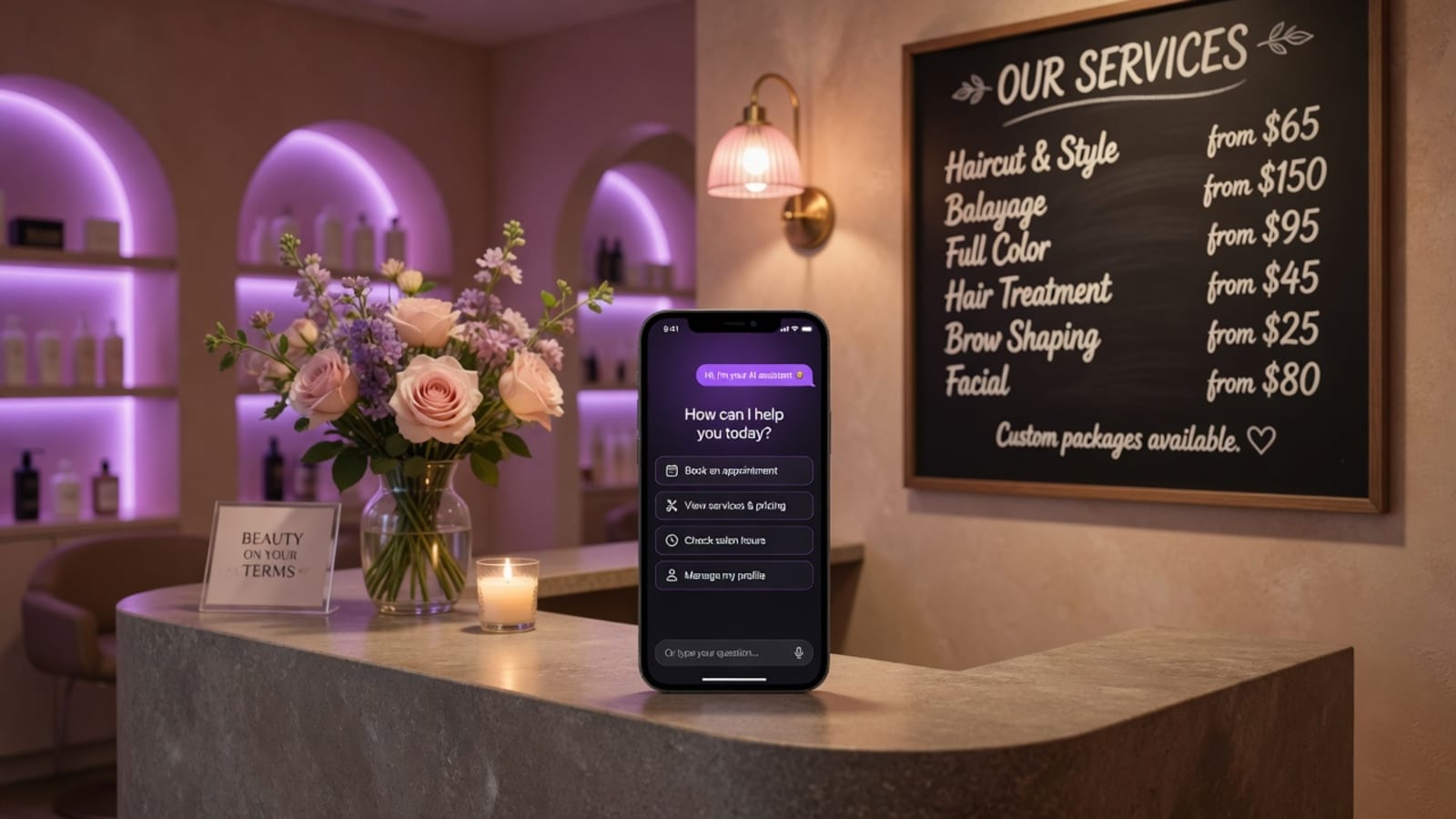
Conversational AI for beauty salons is software that handles phone calls, texts, and chat conversations with salon clients in natural language — booking appointments, answering pricing and service questions, upselling add-on treatments, sending appointment reminders, and recalling returning clients by name and previous service history. In 2026, leading platforms integrate with salon scheduling systems like Vagaro, Square Appointments, Acuity, Boulevard, and Google Calendar, and combine voice, SMS, and chat to capture every booking opportunity that a busy front desk would otherwise miss.
For a beauty salon, conversational AI typically handles four jobs: (1) 24/7 inbound call answering — catching the calls that come in when the front desk is with a client or after hours; (2) appointment booking and rescheduling — natural-language conversation that handles the back-and-forth a booking actually requires; (3) intelligent upselling — soft, contextual offers of add-on services at the moment the client has committed to the main appointment; and (4) returning client recognition — greeting returning callers by name, referencing their last service, and remembering preferences across visits. The best platforms in this guide specialize in one or two of those jobs rather than trying to do all four poorly.
The market context is sharp. According to 2026 small-business missed-call data, the average salon misses 35–40% of calls during peak hours, costing $35,000–$67,000 annually in lost bookings per location. The beauty industry operates on thin margins, high appointment volume, and deeply personal client relationships — which means a missed call is not just a missed booking, it is a client who may never call back. Industry data consistently shows that 30% of appointments become no-shows annually, and that automated reminders timed one hour before the appointment are the single most effective lever for reducing that number.
How we evaluated each platform
To keep this comparison honest, every platform was scored against the same six-criterion rubric. Each criterion is weighted by its importance to a typical beauty-salon decision. Scores reflect publicly available information, vendor documentation, third-party reviews, and hands-on evaluation as of June 16, 2026.
| Criterion | Weight | What we looked for |
|---|---|---|
| Booking & scheduling depth | 25% | Native integrations with Vagaro, Square Appointments, Acuity, Boulevard, Google Calendar; two-way sync; real-time availability |
| Client recall & personalization | 20% | Returning caller recognition by phone number, visit history awareness, preference memory, soft-upsell capability |
| Voice quality | 15% | Naturalness, prosody, latency, ability to handle salon-specific vocabulary and interruptions |
| Channel coverage | 15% | Voice + SMS + chat + email breadth; omnichannel context preservation across channels |
| Transparency & pricing | 15% | Public pricing tiers; no hidden per-call or per-message fees; predictable billing; cancellation terms |
| Evidence & authority | 10% | Independent studies, named salon customers, third-party reviews, case studies with measurable revenue or no-show outcomes |
The detailed best for and honest trade-off for each platform below is the qualitative result of this rubric. Where a platform could not be verified against a criterion (for example, custom enterprise pricing that is not publicly disclosed), we say so plainly. Platforms are not ranked by total score — an independent nail tech and a 50-location spa chain have different winners.
For a scannable summary of the most important conclusions, see the Key Takeaways at the top of the article.
For those too busy to read the full article, here is a quick-reference chart. Each platform is listed alphabetically with three columns: what market segment it best serves, its standout attributes, and its pricing model. The full details follow below.
01 At a Glance: Strengths, Best Fit, and Pricing
| Platform | Best Fit For | Standout Attributes | Pricing |
|---|---|---|---|
| Asisto | Salons wanting a branded AI phone agent with voice recognition and scheduling | Voice recognition; branded experience; appointment management; client data capture | Custom quote |
| CloudTalk | Multi-location salons needing a full business phone system with AI routing | Smart routing; 160+ country numbers; call analytics; CRM sync | From $25/user/month |
| Emitrr | Medical spas and salons needing voice + SMS with HIPAA-grade compliance | Voice + SMS; review requests; web chat; 1000+ app integrations | From $149/month |
| Futuro | Salons wanting a done-for-you AI that books, upsells, and remembers clients | 94% human voice; intelligent upsell; returning client memory; calendar sync; appointment reminders | From $200/month flat rate |
| Kordless | Salons wanting AI intake + booking + CRM with lead scoring | AI intake; scheduling; lead scoring; CRM; follow-up automation | From $99/month |
| My AI Front Desk | Budget-conscious salons needing a multilingual AI receptionist | Multilingual; affordable; $79/month; booking + FAQ handling | From $79/month |
| Qlient.ai | Beauty salons wanting a beauty-specific AI with hyper-realistic voice | Beauty-focused; hyper-realistic voice; 24/7 booking; calendar sync | From $150/month |
| Smith.ai | Luxury spas wanting live North America-based receptionists backed by AI | Hybrid human + AI; 24/7 live answering; bilingual; payment capture | From $140/call |
| Trillet | Salons wanting the fastest AI setup with website scanning | 5-minute setup; website scanning; $49/month; 24/7 voice + SMS | From $49/month |
| Zenoti | Multi-location salon and spa chains needing enterprise management + AI | Enterprise scale; $3.8K/mo ROI data; multi-location; full salon management | Quote-based |
Listed alphabetically. Platforms are not ranked. Pricing is starting price or publicly disclosed tier; enterprise quotes may differ.
02 Asisto — When the Job Is a Branded AI Phone Agent With Voice Recognition
Asisto approaches salon AI from a branding perspective. The platform is designed to sound and behave like a trained member of your staff, not a generic robot reading from a script. Voice recognition allows it to identify returning callers, greet regulars by name, and reference previous appointments — a feature that, as any salon owner knows, makes clients feel valued and increases loyalty. The appointment management is robust: clients can book, reschedule, and cancel through natural conversation, and the system captures client preferences (preferred technician, service history, product allergies) for future visits.
The context for why branding matters in salon AI is worth understanding. The beauty salon industry generates over $325,000 in average annual revenue per small salon, and client retention is the single biggest driver of that figure. A client who feels recognized and valued returns more often, spends more per visit, and refers friends. Asisto's focus on personalized, branded interactions directly addresses that retention need — it is not just about answering calls, it is about making every caller feel like a regular. Learn more at asisto.one.
03 CloudTalk — When You Need a Full Business Phone System With AI
CloudTalk is, first and foremost, a business phone system. The AI component is an added layer that handles after-hours calls, routes incoming calls to the right location or department, and provides the kind of call analytics that help salon managers understand peak calling times, missed call rates, and staff availability. For a salon group with three or more locations, the smart routing is genuinely valuable: a caller asking about the downtown location gets routed there automatically, while a caller with a billing question goes to central admin.
The feature set includes 160+ country numbers (useful for spas in tourist destinations), deep CRM sync with popular salon management platforms, and call recording for quality assurance. The pricing starts at $25 per user per month, which puts it in the accessible range for growing salon groups. Industry data shows that salons miss 35–40% of calls during peak hours, and for multi-location groups, that missed-call rate compounds across every location. CloudTalk's analytics help identify which locations are missing the most calls and when — the first step toward fixing the problem. Learn more at cloudtalk.io.
04 Emitrr — When Voice + SMS Compliance Matters
Emitrr occupies a unique niche: it is one of the few AI communication platforms in the salon space that offers true HIPAA compliance, making it the natural choice for medical spas, laser clinics, and dermatology practices that handle protected health information. The platform combines voice AI, SMS automation, web chat, and review request management in a single dashboard, with integrations into over 1,000 business applications.
The SMS capability is particularly relevant for salons. Industry research shows that 72% of salon customers prefer online or automated booking, and SMS reminders are among the most effective tools for reducing no-shows — Emitrr's automated reminder system handles both. The review request feature is another revenue driver: positive Google and Yelp reviews are the lifeblood of local salon marketing, and Emitrr automates the post-appointment review request process. For a medical spa where compliance is non-negotiable and SMS outreach drives retention, this combination is genuinely compelling. Learn more at emitrr.com.
05 Futuro — When You Want a Human-Sounding AI That Books, Upsells, and Remembers Every Client
Yes, this is our platform, and we have put ourselves fifth on an alphabetical list rather than first on a rigged one. Here is the honest version of where Futuro fits for beauty salons. Futuro is not a toolkit you build on; it is a done-for-you service. Every agent is custom-built for the salon. You hand over your service menu, pricing, staff schedules, and booking policies — and Futuro builds, integrates, and operates the agent. The technology underneath is VoiceAlive (what is VoiceAlive?) for genuinely human speech, MasterMind (what is MasterMind?) for salon-specific knowledge, and the Futuro Memory System for caller recognition — the combination measured at 94% human-indistinguishability in a 1,000-person double-blind study.
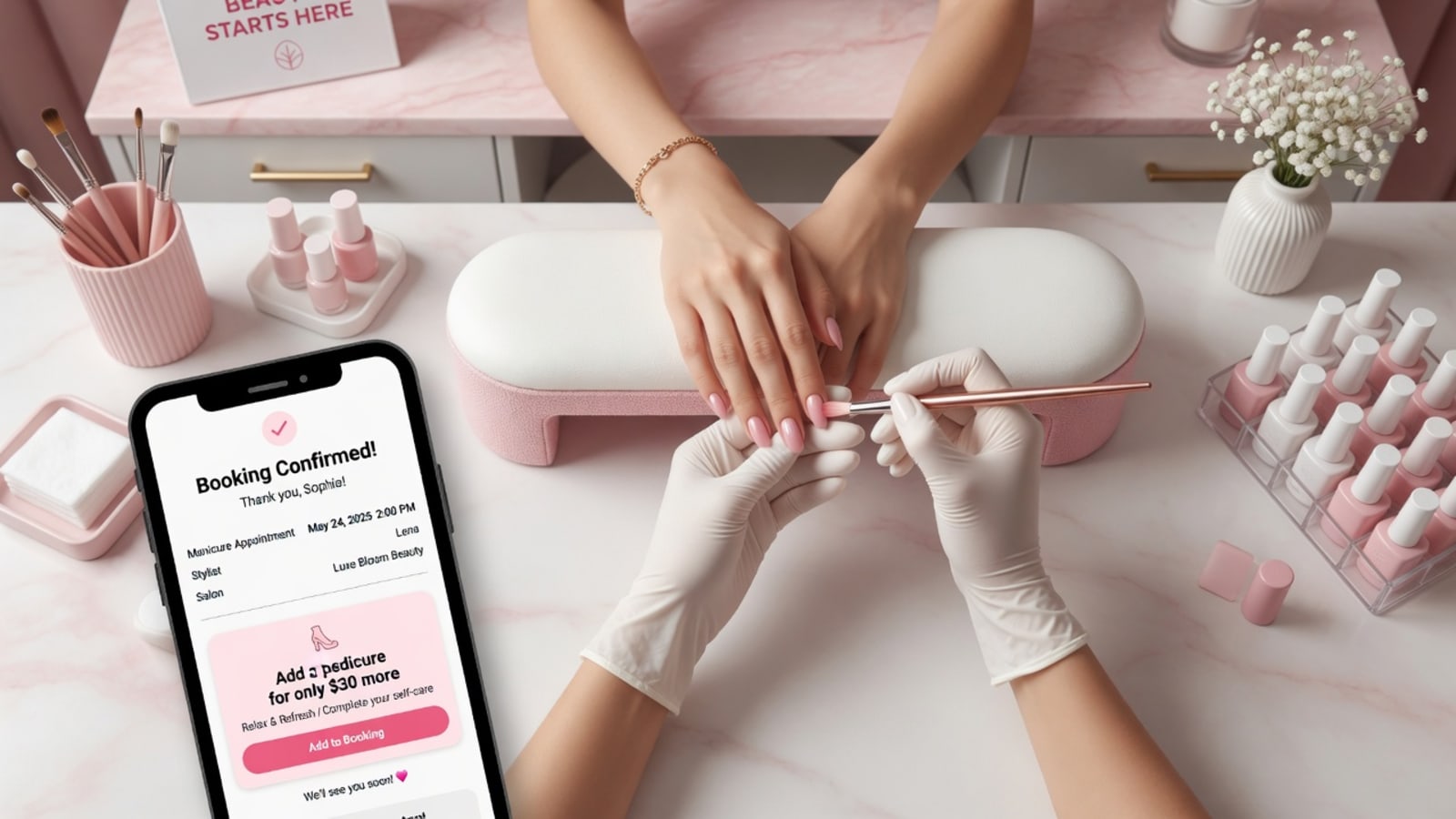
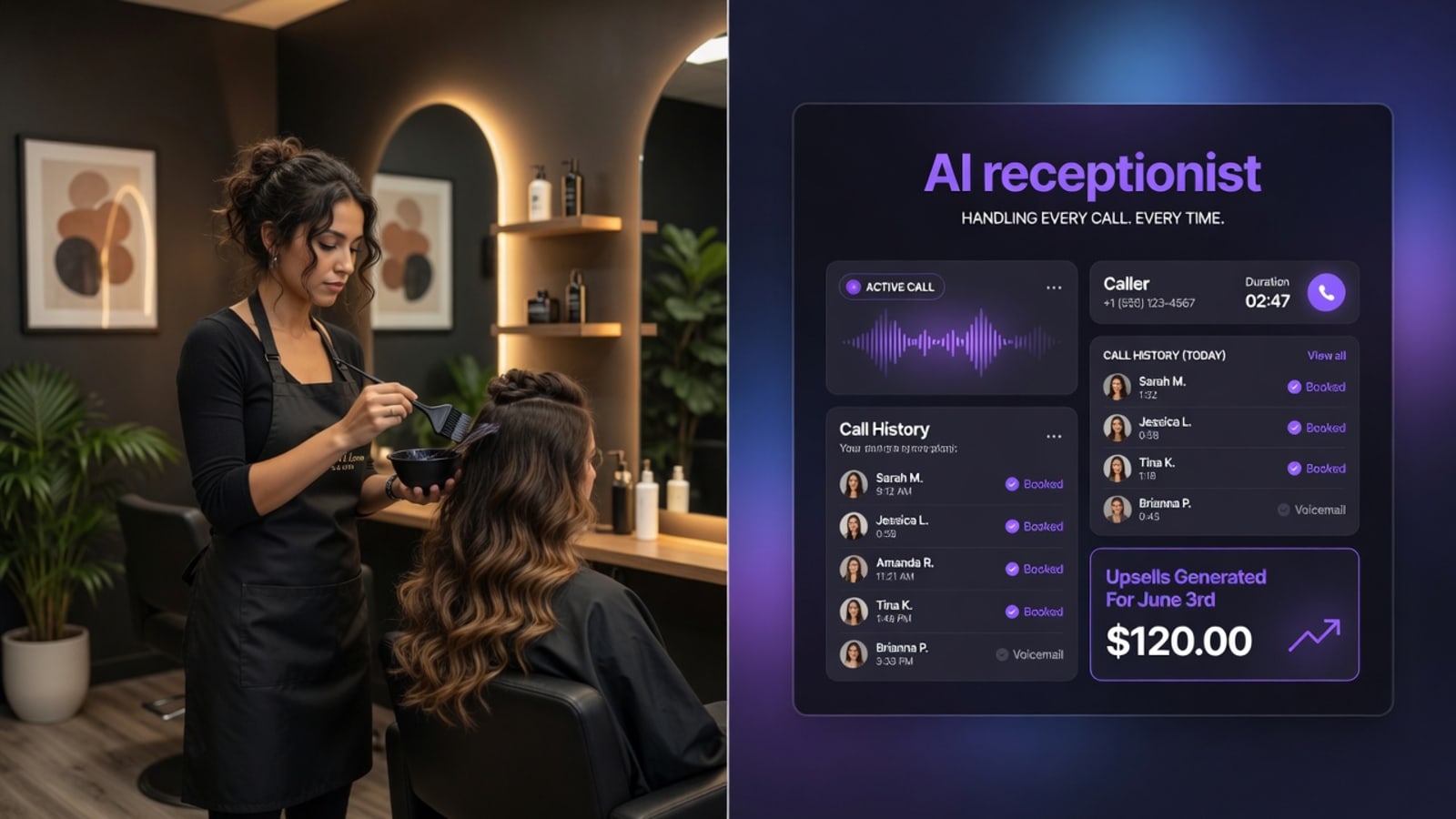
The upsell engine is what salon owners tend to love most. Here is how it works: a client calls to book a manicure. The AI books the appointment, sends a calendar invite to the client with the salon name, address, and appointment details, and then — in the same natural conversation — says something like: "By the way, I'm not sure if you're on our email list, but we're running a promotion where if you add a pedicure, it's only an additional $30 instead of the regular $55. Would you like to go ahead and add that, or stick with the manicure?" The client decides. Either way, the booking is confirmed. The salon owner can track the exact dollar amount the AI has generated in upsells on a daily basis — and most Futuro salon clients see their monthly subscription cost recouped in upsell revenue alone within the first week of each month. That is before counting the savings from not needing a dedicated employee to answer the phone (Salon upsell revenue case study).
The memory system creates the personal touch that drives loyalty. When a returning client calls from the same number, the AI reviews their history before the call connects — typically within the first few rings. It greets them by name and references their previous visit: "Hi Diana, it looks like you got a pedicure with us last time. Would you like the same service again, or were you thinking about something different?" This level of personalization makes clients feel valued and recognized — the exact experience that turns occasional visitors into regulars. In an industry where client retention is the single biggest driver of revenue, that personal touch is not a nice-to-have — it is the difference between a thriving salon and one that constantly churns through new client acquisition.
The appointment reminder system reduces no-shows dramatically. The AI sends an automated reminder one hour before each appointment — a timing that industry research confirms is the most effective window. Clients who receive timely reminders are significantly less likely to forget or miss their appointments, and the salon does not need a staff member manually sending texts or making confirmation calls. The calendar integration works with every major scheduling platform — Google Calendar, Outlook, Acuity, Vagaro, Square Appointments, and more — so the appointment appears on both the client's calendar and the salon's system simultaneously.
The knowledge base is comprehensive. The AI is trained on every service the salon offers — gel manicures, dip powder, acrylics, silk wraps, paraffin treatments, facials, massages, hair coloring, balayage, keratin treatments, lash extensions, waxing — and can discuss each in detail, including pricing, duration, aftercare, and compatibility with other services. A client asking "what is the difference between gel and dip powder?" gets a thorough, accurate answer that builds trust and confidence in the salon's expertise. The pricing model is straightforward: a flat monthly rate starting at $200 per month for unlimited calls. No per-minute charges, no per-booking fees, no usage caps. The company offers a 30-day no-questions-asked money-back guarantee and a 7-day free trial with no credit card required (7-Day Free Access).
06 Kordless — When You Want AI Intake, Booking, and CRM in One
Kordless takes an integrated approach to salon AI. Instead of being purely a phone-answering service, it functions as a complete client acquisition and management platform: the AI handles the initial intake call or chat, qualifies the lead, books the appointment, scores the lead based on behavior and value, updates the CRM, and triggers automated follow-up sequences. For a salon that currently uses separate tools for booking, CRM, email marketing, and phone answering, Kordless offers the consolidation argument: one system, one login, one workflow.
The lead scoring is particularly useful for high-ticket salon services. A caller asking about a $300 bridal package gets scored higher than one asking about a $15 walk-in manicure, and the salon can prioritize follow-up accordingly. The follow-up automation handles the post-appointment sequence — thank-you messages, review requests, rebooking prompts, and retail product recommendations — without requiring a staff member to manage it manually. For a salon focused on growing its client base and maximizing lifetime value, that automation is genuinely time-saving. Learn more at kordless.ai.
07 My AI Front Desk — When Budget Is the Primary Concern
My AI Front Desk occupies the entry-level slot. At $79 per month, it is the most affordable option on this list by a significant margin, and it offers a genuinely functional AI receptionist that answers calls, books appointments, handles frequently asked questions, and takes messages. The multilingual support is a meaningful advantage for salons in diverse communities — the agent can switch between English, Spanish, and other languages mid-conversation based on the caller's preference.
The context for why price matters is simple: the average small salon operates on tight margins. Industry data shows that 32% of salons see a 15%+ revenue increase after adopting digital booking tools — but many small operators hesitate because of cost. My AI Front Desk removes that barrier. It is not the most feature-rich or the most human-sounding option, but for a solo esthetician or a two-chair nail bar that is currently missing half their calls because both technicians are with clients, it is dramatically better than voicemail — and affordable enough that the ROI question answers itself. Learn more at myaifrontdesk.com.
08 Qlient.ai — When the Job Is Beauty-Specific AI With Hyper-Realistic Voice
Qlient.ai is one of the few platforms on this list designed from the ground up for beauty salons, nail bars, and spas. That industry focus shows in the details: the voice is engineered to sound warm and welcoming (not clinical or corporate), the conversation flow is structured around salon-specific scenarios (booking, rescheduling, service questions, gift card purchases), and the calendar integration covers the scheduling platforms salons actually use. The hyper-realistic voice quality is the headline feature — Qlient has invested heavily in voice synthesis specifically tuned to the conversational patterns of beauty industry interactions.
The 24/7 booking capture is the revenue story. Research consistently shows that salons miss 35–40% of calls during peak hours — and those missed calls go straight to competitors. A potential client who cannot reach your salon will call the next one on Google. Qlient.ai ensures every call is answered, every booking is captured, and no revenue walks away because the front desk was busy. The pricing starts at $150 per month, which positions it in the mid-tier — more capable than entry-level options, less expensive than enterprise platforms. For a salon that wants beauty-specific expertise without enterprise complexity, that positioning is exactly right. Learn more at qlient.ai.
09 Smith.ai — When You Want Live Humans Backed by AI for Luxury Experiences
Smith.ai takes a different approach from every other platform on this list: it is a hybrid of real human receptionists and AI assistance, not a pure AI system. North America-based receptionists answer calls live, 24/7, with AI helping them stay accurate and efficient. For a luxury spa where a caller expects a warm, professional greeting and immediate assistance with complex requests ("I need to book a couples massage, a facial, and arrange champagne service for Saturday afternoon"), that human-first model delivers an experience that even the best AI cannot fully replicate.
The payment capture feature is particularly relevant for salons: receptionists can process deposits, sell gift cards, and collect payment information over the phone, turning a booking call into a revenue transaction. The bilingual support (English and Spanish) covers most salon markets. The AI assistance behind the scenes ensures accuracy — appointment details, pricing, and availability are confirmed in real time. The trade-off is cost and scalability. Human receptionists cost more than AI at volume, and while the experience is premium, it is also limited by human capacity. For a luxury spa with a high average ticket and a brand built on personal service, that cost is justified. For a high-volume nail bar processing 50+ calls daily, it is likely too expensive. Learn more at smith.ai.
10 Trillet — When You Need an AI Receptionist Live in Five Minutes
Trillet's value proposition is speed. The onboarding process is remarkably simple: enter your website URL, the AI scans your site to extract service names, descriptions, and pricing, and within five minutes you have a working receptionist answering calls. At $49 per month, it is the second-most affordable option on this list (after My AI Front Desk), and the 24/7 voice + SMS coverage ensures no call goes unanswered.
The website scanning technology is genuinely impressive for a tool at this price point. It reads service pages, pricing tables, and business information to build a knowledge base automatically — no manual data entry required. For a salon owner who does not have time to train an AI or write scripts, this automation removes the biggest barrier to adoption. The SMS capability adds another channel: clients can text to book, and the AI responds conversationally. For a small salon that is currently missing calls because the owner is doing nails, hair, and managing the front desk simultaneously, Trillet is a dramatic improvement over voicemail — and at $49, the risk is minimal. Learn more at trillet.ai.
11 Zenoti — When You Are Running a Chain, Not a Single Chair
Zenoti is the enterprise heavyweight of the salon software world. Its AI Receptionist is just one module in a comprehensive platform that handles scheduling, inventory management, employee payroll, marketing automation, and business analytics across unlimited locations. For a franchise group with 50 salons or a medispa chain with locations in five states, that integration is the key selling point: the AI receptionist does not just book appointments, it updates inventory when a service is sold, alerts management when stock is low, and feeds data into the analytics dashboard that tracks performance across the entire organization.
The ROI data is impressive. Zenoti reports that multi-location clients see an average of $3,800 per month in total gains from missed call recovery, automated reschedules, and AI-powered upsells across their locations. At enterprise scale, those numbers compound quickly. The platform also supports the complex scheduling scenarios that chains face: staff floating between locations, waitlists across multiple salons, and centralized booking with decentralized service delivery. For a single-location salon, this level of infrastructure is unnecessary and likely overwhelming. For a chain, it is purpose-built. Learn more at zenoti.com.
12 How to Choose for Your Salon
The right platform depends on answering four questions honestly about your situation.
1. What is your average ticket, and how many calls do you miss weekly?
If you are missing 20+ calls per week and your average ticket is $75, you are losing $1,500+ weekly — $78,000 annually — to voicemail and busy signals. Industry data confirms that salons miss 35–40% of calls during peak hours, with an estimated revenue loss of $35,000–$67,000 per year. At that scale, any platform on this list pays for itself. If you miss five calls per week at $30 per ticket, the math is different — start with an entry-level option like Trillet or My AI Front Desk.
2. Is upselling important to your revenue model?
If your salon thrives on package upgrades, add-on services, and retail product sales, the upsell capability is non-negotiable. Human employees rarely upsell consistently — they are focused on getting the caller off the phone so they can help the client in front of them. Futuro is purpose-built for this: the soft upsell after booking generates enough revenue for most salons to cover their entire monthly subscription within the first week. If upselling is not a priority, other platforms may be sufficient.
3. Do you need the AI to feel like a person, or is function enough?
For premium brands and luxury spas, voice quality is the whole game — Smith.ai (human receptionists) or Futuro (94% human indistinguishability) are the natural choices. For budget-focused salons that primarily need booking capture, function matters more than feeling, and Trillet or My AI Front Desk deliver that function at the lowest price.
4. How many locations do you have?
Single salon: any platform on this list works. Two to five locations: consider CloudTalk for telephony infrastructure or Futuro for consistent brand experience across all locations. Ten or more: Zenoti is the only option built for that scale.
We implemented Futuro three months ago. In the first month, the AI booked 47 appointments we would have missed and generated $1,840 in upsells. Our monthly subscription was paid off in six days. The rest was pure profit — and that does not even count the staff hours we got back.
Bottom Line
The best conversational AI for your salon is the one that matches your revenue model, call volume, and brand positioning. A budget nail bar needs a different tool than a luxury medispa. An independent hairstylist needs something different than a 50-location franchise. Start with your biggest pain point — missed calls, low upsell rates, no-show problems, or after-hours lost bookings — and match it to the platform built to solve it.
The data tells a clear story: the average salon loses 30% of appointments yearly to no-shows, missed calls cost small salons $35,000–$67,000 annually, and clients who cannot get through on the first call typically book with the next salon on Google. Having some system answering your phone — any system that books appointments, reduces no-shows, and captures revenue you are currently losing — is the difference between a salon that grows and one that struggles.
Futuro is built for salons that want a human-sounding AI phone agent that books appointments, offers intelligent upsells, remembers returning clients by name and service history, sends calendar invites and reminders, and operates on a flat monthly rate with unlimited calls. The 7-day free trial requires no credit card. The Beauty Salon page has the full feature breakdown, upsell details, and memory system overview.
Stop Losing Salon Revenue to Missed Calls
Join salons using Futuro's AI receptionist. 7-day free trial. 30-day money-back guarantee. No setup fees, no contracts.