Disclosure: Futuro is our product and appears in this comparison. Every price, rating, and statistic below is sourced from the providers' own pages or the cited third-party data, verified July 2026 and re-swept 5 September 2026 — and Futuro is evaluated against the same criteria as every competitor, including where a cheaper tool is the better fit. See our Ethics Policy and Publishing Principles for how we handle this conflict.
Here's the direct answer before anything else. If you run an established nail salon with steady call volume, the best AI receptionist for most of you is a flat-rate unlimited service — Futuro at $200/month is the strongest option in that tier, with all 53 languages included and bookings written directly into your calendar with the correct duration per service. If you're a solo tech or a two-chair shop fielding under ~60 calls a month, a budget per-minute tool — Dialzara ($29/mo) or Goodcall ($79/mo) — is the smarter buy; you won't use the volume that justifies flat-rate. If you run a high-volume or luxury salon where some callers genuinely need a human, look at the hybrid services — Smith.ai or Ruby — and accept the higher per-call cost as the price of that safety net. Everything below is the evidence for those three sentences.
The reason this category exists at all is simple physics: nail technicians cannot answer the phone while holding a drill, mid-gel-cure, or elbow-deep in a pedicure. Salons miss 35–40% of incoming calls during peak hours, 46% of salon bookings happen outside operating hours, and 85% of callers who can't reach you never try again — they call the salon one search result below yours. An AI receptionist answers every one of those calls in under a second, books the appointment, and sends the confirmation text. The question isn't whether to have one; it's which pricing model and feature set fits your shop.
The 7 best AI receptionists for nail salons at a glance
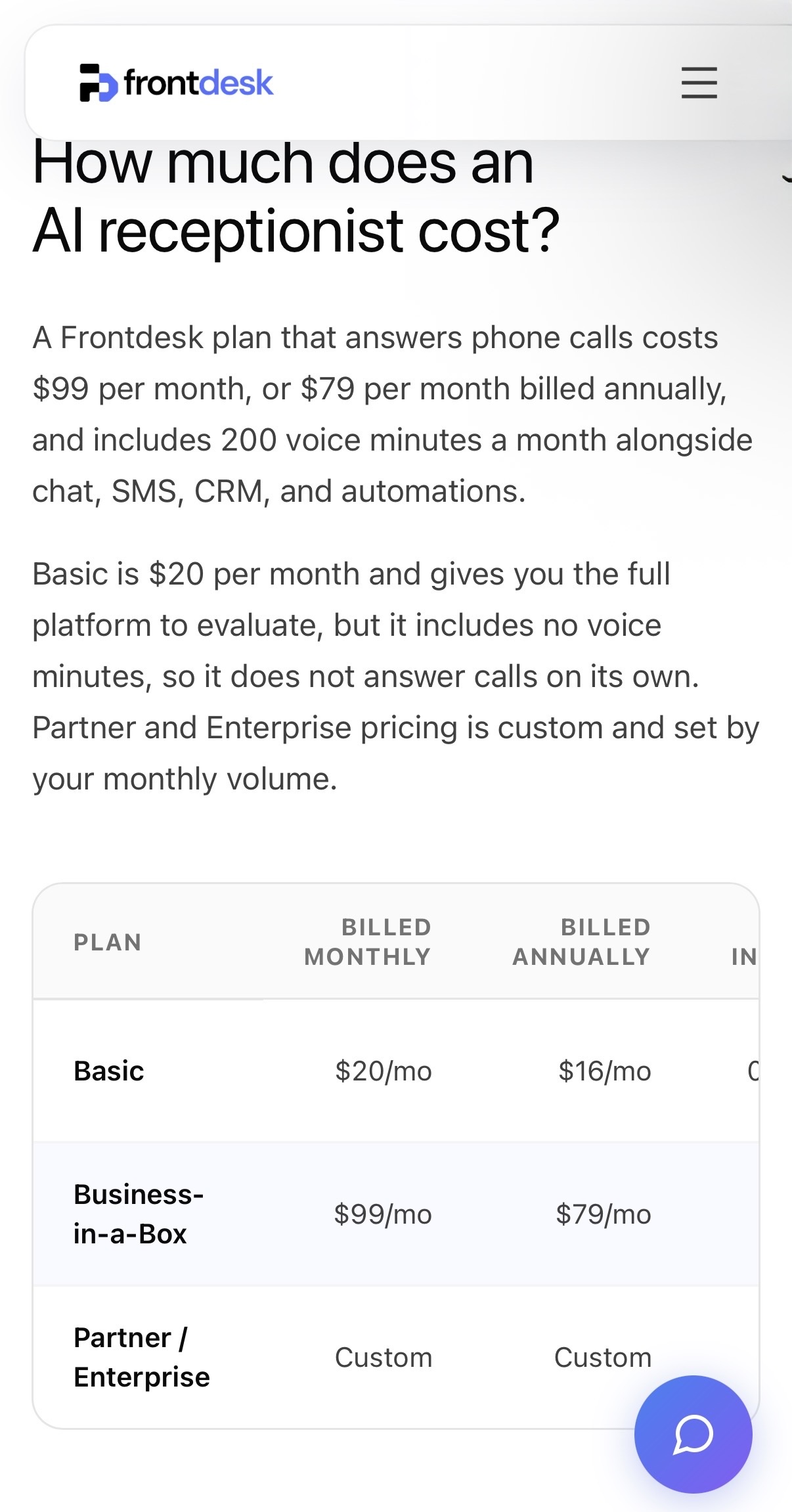
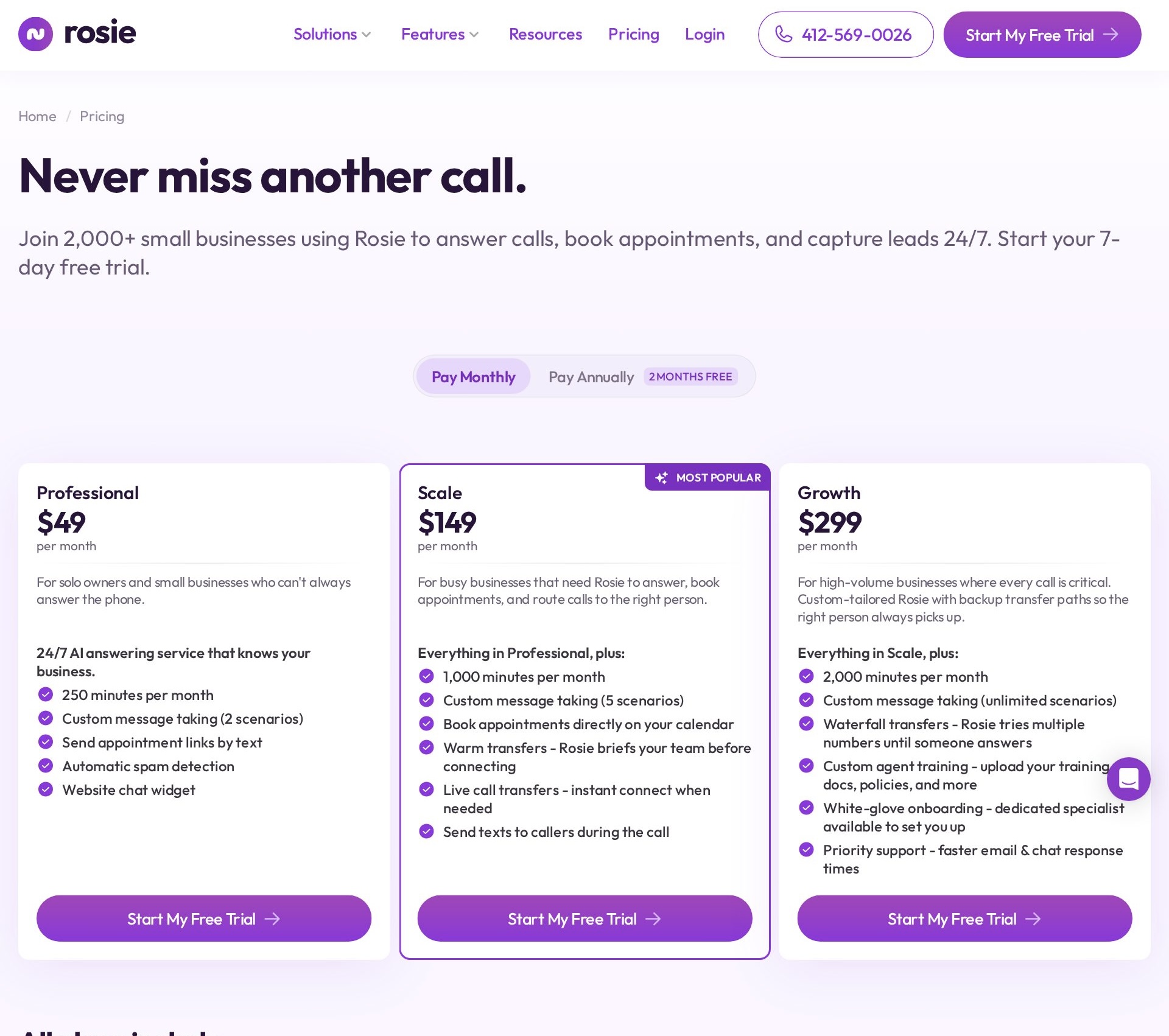
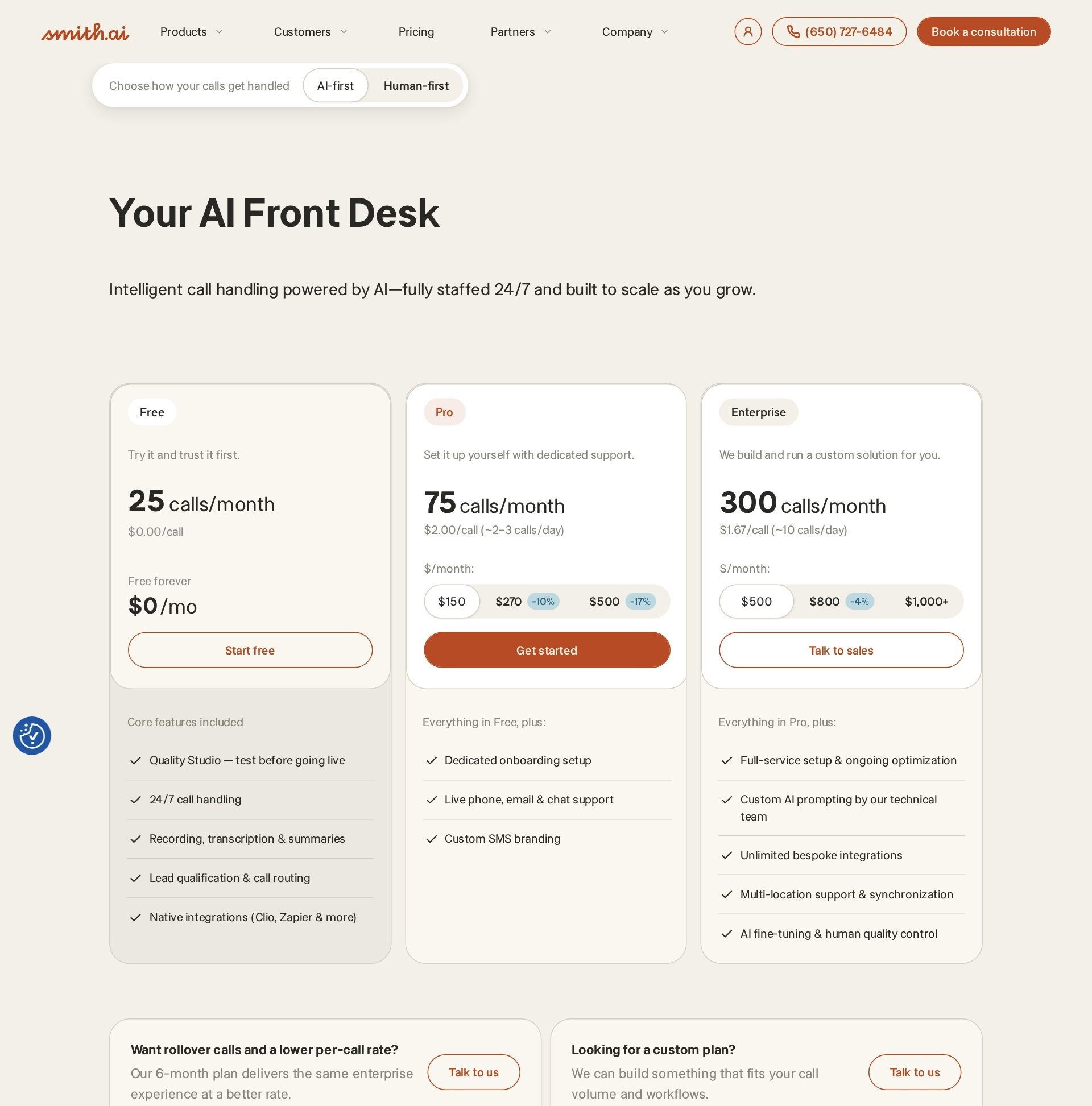
Seven services, ranked by nobody — they're sorted alphabetically, because the "best" one genuinely depends on your call volume, your booking platform, and whether your client base needs bilingual answering. Prices verified July 2026, with Smith.ai re-verified 5 September 2026. Screenshots of six of these seven pricing pages are collected below.
| Service | Entry price | Billing model | Spanish | Books into your calendar | Best for |
|---|---|---|---|---|---|
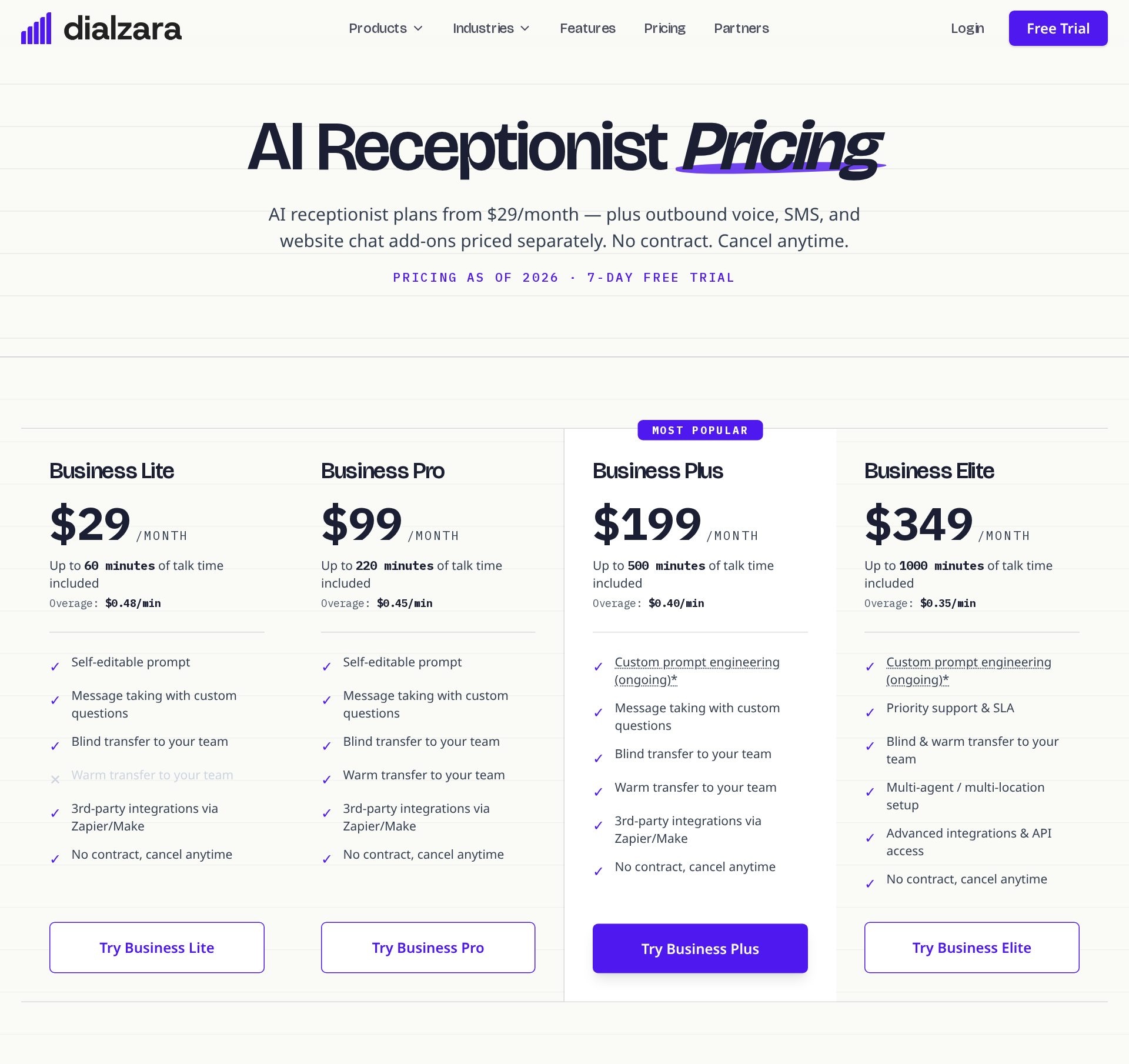
| DialzaraVerified Jul 2026 | $29/mo (60 min) | Per-minute + overage | Limited — verify | Via integrations | Solo techs, light volume |
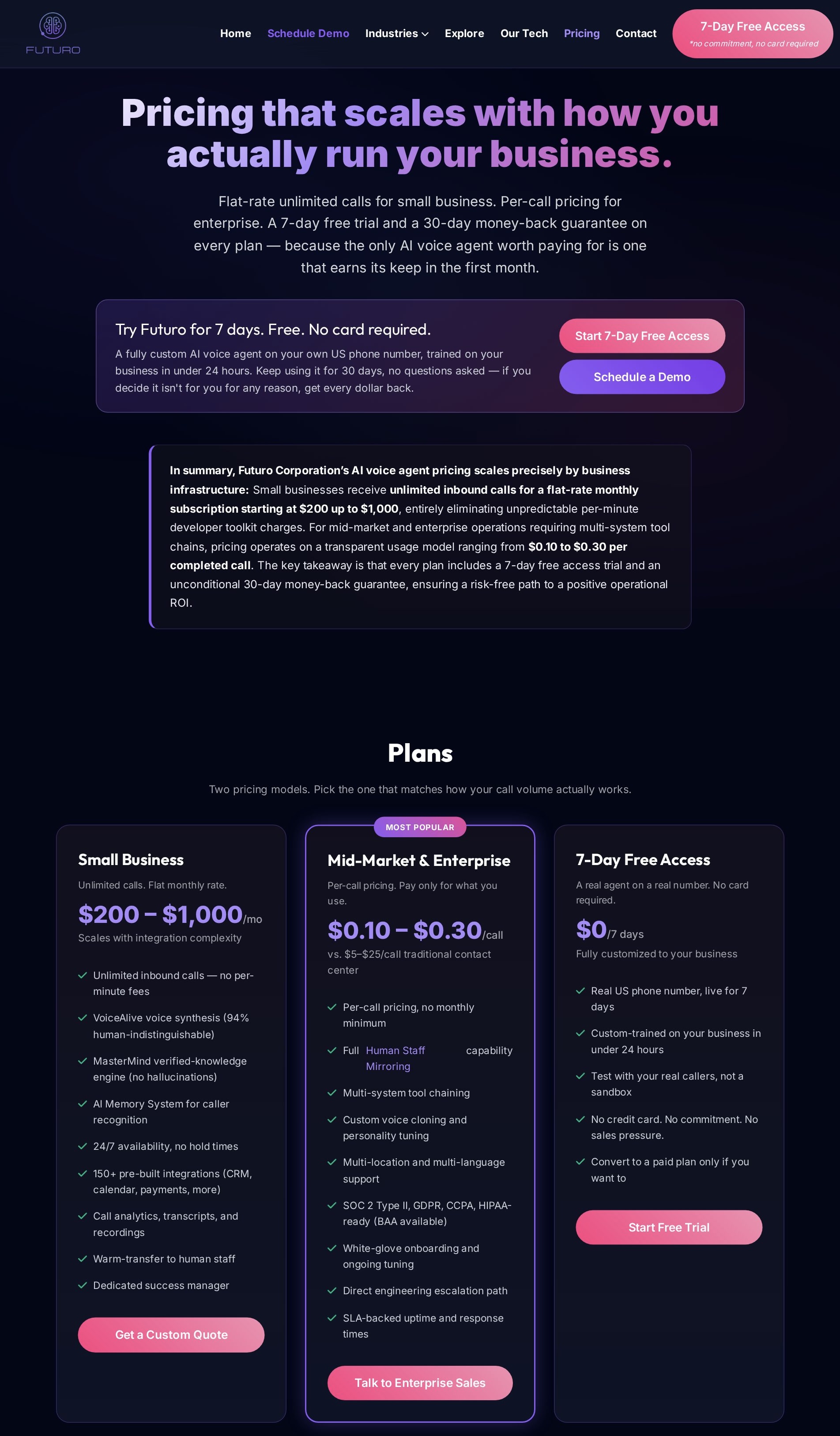
| Futuro (our product)Verified Jul 2026 | $200/mo unlimited | Flat rate, no overages | Yes — one of 53 languages included | Yes — direct, with service durations | Established salons, steady volume |
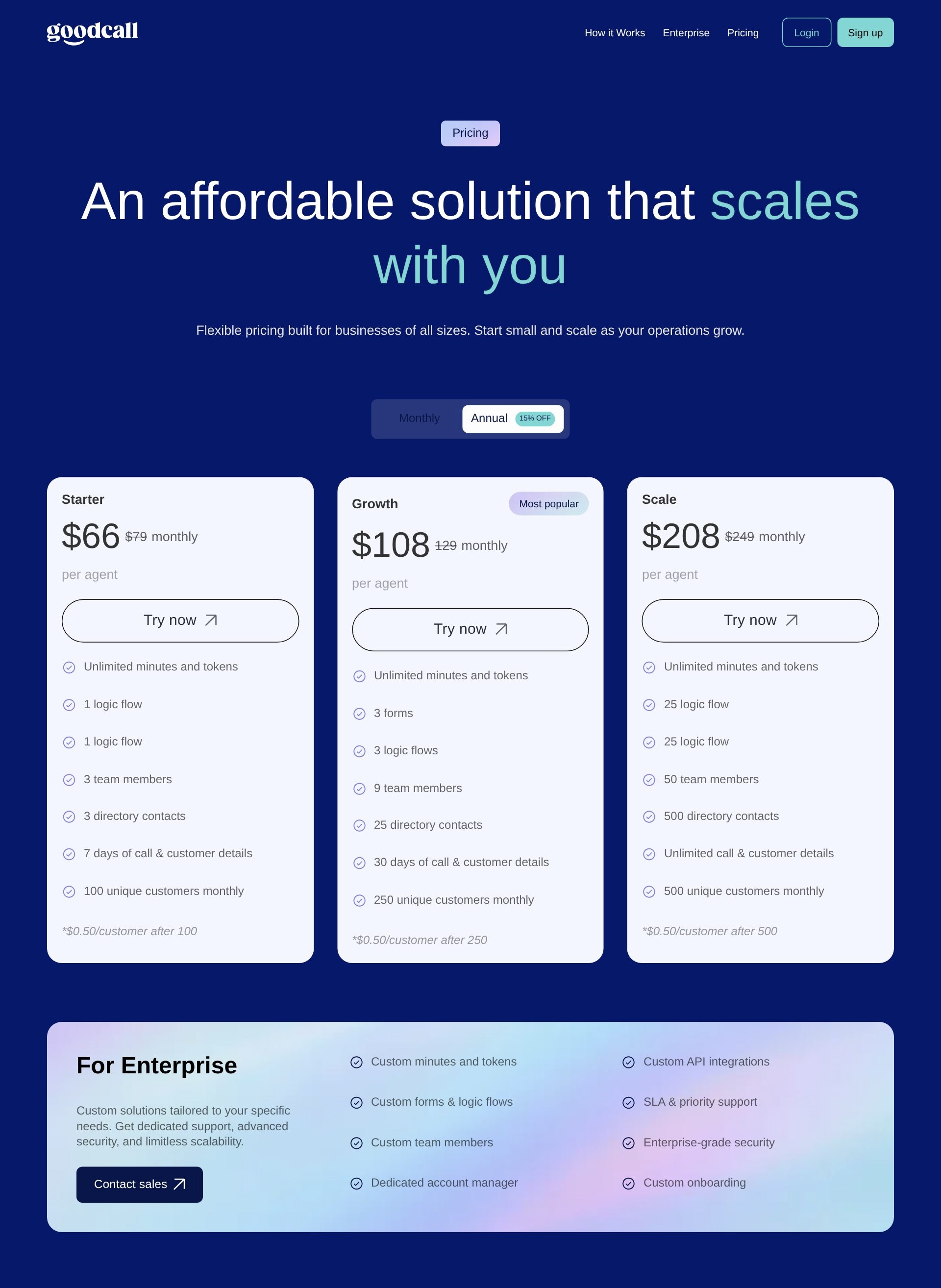
| GoodcallVerified Jul 2026 | $59/mo | Per-customer / usage tiers | Limited — verify | Via integrations | Small shops, simple needs |
| My AI Front DeskVerified Jul 2026 | $99/mo (200 min) | Per-minute + $0.25/min overage | Multiple languages claimed | Via integrations | Shops wanting calls + texts bundled |
| RosieVerified Jul 2026 | $49/mo (250 min) | Per-minute tiers | Limited — verify | Via integrations | Budget per-minute, home services roots |
| RubyVerified Jul 2026 | ~$250/mo (50 min) | Human receptionists, per-minute | Yes — bilingual receptionists | Takes messages / warm transfer | Luxury salons, human-only preference |
| Smith.aiVerified Sep 2026 | $150/mo AI; $300/mo human | Per-call, AI or human tiers | Yes on human tier | Via integrations (7,000+) | High-volume salons wanting human backup |
Entry prices are the cheapest published plan, not the plan most salons will land on — the real math at salon call volumes is in the cost section. "Via integrations" means bookings are passed through Zapier, webhooks, or a native connector rather than written natively with service-duration logic.
Why nail salons miss more calls than almost any other business
Every service business misses calls. Nail salons miss them for a structural reason that most "missed call" advice ignores: the person who would answer the phone is the product. A receptionistless shop — which describes the majority of the roughly 55,000 nail salons in the U.S., most of which run 4–5 technicians and no front desk — has nobody whose job is answering. The tech nearest the phone is mid-service, hands occupied, for 45 minutes to three hours at a stretch.
The numbers compound from there:
- Salons miss 35–40% of calls during peak hours. Peak call times and peak chair times are the same times — Saturday mornings (when salons run ~80% capacity), lunch hours, pre-holiday weeks.
- Walk-ins are roughly 40% of nail appointments, which means a huge share of your inbound calls are time-sensitive questions — "do you have room right now?" — that are worthless if answered two hours later.
- 46% of salon bookings happen outside operating hours, when your phone goes straight to voicemail.
- 80–86% of callers who reach voicemail hang up without leaving a message, and 85% of callers who don't get through never call back. With a dozen salons in any search radius, they don't have to.
Do the napkin math for a typical shop: 30 missed calls a week, a $45–$65 average ticket, and even a conservative one-in-five conversion rate on recovered calls. That's $1,100–$1,700 a month in bookings that currently evaporate — against a software cost of $29–$200. This is why the category has exploded, and why the interesting question isn't "should I get one" but "which one's economics fit my volume."
How much does an AI receptionist cost for a nail salon?
Bottom-line answer
Budget AI tools run $29–$99/month for small minute or call allowances; mid-market AI runs $49–$200; flat-rate unlimited AI is $200/month (Futuro); human-answered services start around $250–$300/month for tiny allowances. At 100 calls/month most salons pay $150–$350; at 300 calls, per-minute and per-call services typically run $500–$900 while flat-rate stays $200. The breakeven where flat-rate beats metered billing for a nail salon is roughly 150–250 calls a month, depending on call length.
Sticker prices lie in this category because every vendor's entry plan is sized for a business smaller than yours. What matters is the total monthly bill at your real call volume. The table below models three volumes a nail salon actually sees — a quiet solo operation (100 calls), a healthy 3–4 tech shop (300), and a busy multi-chair salon (500) — assuming an average call length of 2.5 minutes, which is typical for booking-and-question calls.
| Service | 100 calls/mo (~250 min) |
300 calls/mo (~750 min) |
500 calls/mo (~1,250 min) |
|---|---|---|---|
| Dialzara ($29/60 min + per-min overage) | ≈ $29–$120 | ≈ $250–$500 | ≈ $550–$900 |
| Goodcall ($59 entry) | ≈ $59–$150 | ≈ $200–$400 | ≈ $400–$700 |
| My AI Front Desk ($99/200 min + $0.25/min) | ≈ $112 | ≈ $236 | ≈ $361 |
| Rosie ($49/250 min) | ≈ $49–$99 | ≈ $200–$400 | ≈ $450–$750 |
| Smith.ai AI (30 calls, then per-call) | ≈ $235–$305 | ≈ $900–$1,100 | ≈ $1,700–$2,100 |
| Ruby (human, ~50 min entry) | ≈ $400–$800 | ≈ $2,000+ | ≈ $3,500+ |
| Futuro (flat unlimited) | $200 | $200 | $200 |
Ranges reflect published allowances and overage rates as of July 2026; per-call services are converted at 2.5 min/call. Where a vendor publishes multiple tiers, the cheapest tier covering the volume is shown. These are models, not quotes — get each vendor's current rate card before signing.
Two patterns stand out. First, per-minute pricing punishes chatty callers — and nail salon calls are chatty. "Do you do dip powder? How much for a full set with art? Can I bring my daughter? Is parking easy?" A 90-second booking in a medical office is a 4-minute conversation in a nail salon, and per-minute meters run the whole time. Second, flat-rate looks expensive at the low end and cheap at the high end — which is why the honest recommendation splits by volume rather than crowning one winner.
Can an AI receptionist actually handle nail salon booking?
Bottom-line answer
Yes — if (and only if) the system supports service-duration stacking and technician assignment. A gel fill and a full acrylic set with art are not interchangeable 60-minute blocks. Basic AI tools that book generic slots will corrupt your calendar within a week; systems that learn your service menu, each tech's specialties, and per-service durations book accurately. Verify this specific capability in a live demo before buying — it's the single biggest quality gap between providers for nail salons.
Nail scheduling is quietly one of the hardest booking problems in local services. A hair salon books roughly uniform hour-long cuts. A nail salon books a 20-minute polish change, a 45-minute gel manicure, a 75-minute spa pedicure, and a two-and-a-half-hour acrylic full set with custom art — sometimes for the same client in one visit, often with a specific tech who does the art, occasionally for a bridal party of six who all need to finish by 2pm. A booking system that can't model durations and tech specializations doesn't save you time; it generates a daily cleanup job.
What "good" looks like for a nail salon, concretely:
- Service-duration stacking. The AI books the block the service actually needs — 45 minutes for the gel, two hours for the full set — including buffer time between appointments so a tech isn't perpetually running behind.
- Technician-based assignment. Clients ask for their tech by name. The system should know that Linh does the intricate art, that Maria's book is full on Saturdays, and route accordingly.
- Walk-in triage. With walk-ins at ~40% of appointments, "do you have room right now?" is your most common call. A good system checks real-time availability and either books the slot or quotes an honest wait time — converting a maybe into a scheduled client.
- Group and party bookings. Bridal parties and birthday groups are high-value, high-complexity bookings that generic tools fumble. Confirm the system can hold multiple simultaneous stations.
- Upsell on the call. The difference between a $45 booking and a $75 booking is often one sentence — "would you like to add a gel pedicure to that?" Futuro's agent is trained on your service menu to make that suggestion naturally; most message-takers never attempt it.
On the flip side, the honest limitation: an AI receptionist is not a front-desk person. It can't hold a nervous first-timer's hand through a Russian manicure explanation the way your best tech can at the chair, and it can't judge that a regular sounds upset and needs the owner to call back personally. What it does is make sure those judgment calls reach you as detailed, instant notifications instead of dying in voicemail — where 85% of callers leave nothing at all.
The language advantage most nail salons are leaving on the table
Nail salons serve some of the most linguistically diverse clienteles in local services — and the industry's own workforce is famously multilingual. In much of the country, a meaningful share of your callers are more comfortable booking in Spanish. Yet answering in a second language is one of the rarest features in this product category: most budget AI tools are English-only, some offer additional languages as paid add-ons, and even the human services gate bilingual receptionists behind higher tiers.
This is one of Futuro's genuine differentiators, so we'll be precise about it: 53 languages are included on the standard $200 plan — not an add-on, not a premium tier, and not two languages. Spanish is simply the one that decides the purchase for most nail salons. The agent detects the caller's language and continues naturally in it, including booking, service questions, and confirmation texts, with a cloned native voice rather than an accent applied to an English model. For salons in Florida, Texas, California, Arizona, and much of the Northeast, this alone can be the deciding factor. Whichever service you choose, if any meaningful share of your clientele prefers Spanish, test the Spanish call yourself before signing — "supports Spanish" on a pricing page ranges from flawless to embarrassing.
The 7 best AI receptionists for nail salons, reviewed
Alphabetical order, same criteria each time: what it is, what it costs (verified July 2026), how it fits a nail salon specifically, and where it falls short. Ratings are from the named review platforms with counts.
1. Dialzara — best budget entry for solo techs
What it is: A pure-AI answering service positioned at the budget end, popular with solo operators and very small shops. Pricing (verified Jul 2026): from $29/month for 60 minutes, with per-minute overages above the allowance. Nail salon fit: If you're a one- or two-chair operation fielding maybe 40–60 calls a month, Dialzara's entry tier is genuinely hard to argue with — it answers instantly, takes bookings through integrations, and costs less than a single gel manicure. Limitations: the 60-minute allowance evaporates fast with chatty booking calls (that's roughly 24 average calls), voice quality and language support are entry-level, and booking is integration-based rather than duration-aware — verify it books the right block lengths for your services before relying on it.
2. Futuro — best for established salons (our product)
What it is: A flat-rate conversational AI receptionist built around Human Staff Mirroring — the agent is trained on your specific business: your service menu, your techs' specialties and schedules, your pricing, your upsell logic. VoiceAlive voice technology measured 94% human indistinguishability in a 1,000-participant double-blind study. Pricing (verified Jul 2026): $200/month flat, unlimited calls, 24/7. Pricing scales toward $1,000/month only for complex integrations, custom workflows, or custom API builds. No per-call or per-minute charges, no setup fees, month-to-month, 30-day money-back guarantee. Nail salon fit: the three things that decide this purchase for a nail salon are all standard here — 53 languages including Spanish, service-duration-aware booking written directly into your calendar (with a free scheduling platform syncing Google/Outlook/Apple if you don't have one), and flat pricing that doesn't punish chatty callers. Salons using Futuro report ~28% more after-hours bookings and ~32% fewer no-shows via automated confirmations. Limitations, honestly: at under ~60 calls a month the $200 flat rate is overkill — a budget per-minute tool is the rational buy, and we'd tell you the same on a demo call. There's no human escalation tier; complex callers get a detailed instant summary and a commitment window instead of a patch to a live operator. Setup of full integration takes about five days (24 hours for quick-start), so it's not same-afternoon instant.
3. Goodcall — simple per-customer pricing for small shops
What it is: An AI phone agent aimed at local small businesses, with a pricing model built around customers rather than raw minutes. Pricing (verified Jul 2026): from $59/month. Nail salon fit: a reasonable middle step for a 2–3 tech shop whose call volume has outgrown Dialzara's tiny allowance but doesn't justify $200 flat. Setup is quick and the product is deliberately simple. Limitations: simplicity cuts both ways — booking logic is basic for duration-stacked nail services, bilingual support is limited, and usage tiers still move with volume, so model your real call count rather than the entry price.
4. My AI Front Desk — best bundled calls + texts for the price
What it is: A small-business AI receptionist that bundles call answering with texting and broad integration support. Pricing (verified Jul 2026): $99/month including 200 minutes, then $0.25/minute overage. Nail salon fit: the bundled SMS matters for nail salons — confirmations and "running 10 minutes behind" texts are half the communication workload. The $0.25/minute overage is also one of the more forgiving meters in the category; our model puts a 300-call month around $236, the cheapest metered option at that volume. Limitations: 200 included minutes is ~80 average calls — most established salons will live in overage territory, and like the other budget tools, booking is integration-based; pressure-test duration handling on the demo.
5. Rosie — budget per-minute with generous included minutes
What it is: An AI answering service that grew up in home services and prices aggressively: $49/month including 250 minutes (verified Jul 2026). Nail salon fit: 250 included minutes covers roughly 100 average booking calls — the most generous entry allowance in the budget tier, and a real fit for a small shop that wants predictability without a $200 commitment. Limitations: the product's home-services DNA shows — scripts and workflows lean toward "the sink is leaking" urgency calls rather than appointment-heavy beauty booking; nail-specific duration stacking and bilingual support need verification before you commit.
6. Ruby — the human-only option for luxury salons
What it is: The established premium human receptionist service — real people, professionally trained, bilingual receptionists available. Pricing (verified Jul 2026): from roughly $250/month for just 50 minutes, with per-minute rates around $3.45–$5. Nail salon fit: if your brand is a high-end studio where a $120 Russian manicure client expects a polished human on every call, Ruby is the credible human option — and for a handful of calls a week, the economics work. Limitations: the math breaks hard at salon volume: 300 typical calls a month models at $2,000+, humans still can't answer five simultaneous Saturday-morning calls, and after-hours coverage costs more. Ruby receptionists take messages and warm-transfer; they don't book duration-aware slots into your calendar.
7. Smith.ai — best human-backup hybrid for high-volume salons
What it is: The category's best-known hybrid: AI-first answering with the ability to escalate to live North American receptionists, backed by 7,000+ integrations and strong ratings (G2 4.9/5 across 115 reviews; Trustpilot 4.4/5 across 334+). Pricing (verified Sep 2026): a free 25-call AI tier, then AI from $150/month and live receptionists from $300/month, with per-call overages above each allowance. Smith.ai raised these figures between our July and September checks — the older $95 AI and $292.50 human tiers are gone. Nail salon fit: for a multi-location operation or a luxury salon where some calls genuinely need a human — complaint resolution, high-value party bookings — the escalation path is the best in the business, and the integration library covers virtually any booking platform. Limitations: per-call billing at nail salon volume is the most expensive model in this guide (300 calls models at $900–$1,100 on the AI tier), and review complaints cluster on billing predictability, not quality. If escalation isn't a must-have, the premium is hard to justify.
Which booking platforms do AI receptionists work with?
Your AI receptionist is only as good as its connection to your calendar. Nail salons run on a handful of platforms, and each one changes what "integration" has to mean before a booking is actually useful to you. Below is what to expect from each, what we verified, and what we did not.
For Vagaro salons
Vagaro runs roughly $24–30/month and is the strongest fit for shops with one to ten staff, which covers most nail salons. Because Vagaro carries technician assignments natively, the thing to test is whether the answering service books to the right tech rather than to the first open slot. Ask any vendor — Futuro (our product) included — to book a full acrylic set with a named technician during the demo, and watch where it lands.
For Booksy salons
Booksy runs $29.99/month plus $20 per added tech and includes a client marketplace that generates bookings you did not source yourself. That marketplace traffic is exactly the volume most likely to arrive as a phone call while every tech is mid-service, which makes after-hours and mid-service coverage the deciding feature rather than a nice-to-have. Confirm what happens when a marketplace client calls to change a booking they made through Booksy rather than through you.
For GlossGenius salons
GlossGenius runs $24–28/month and is the cleanest option for solo techs. If you are a one-chair shop your calendar has no slack, so a booking written as a generic 60-minute block instead of a 90-minute full set does not just misprice the appointment — it double-books you. Service-duration awareness is not optional at this size. Test it with your longest service, not your shortest.
For Fresha salons
Fresha is the cheapest of the four at $19.95/month with a marketplace included. The low subscription cost means the economics of an answering service dominate your total spend, so at low call volume a per-minute tool will beat a flat-rate plan on cost alone. Work out your monthly call count before comparing features — the pricing model matters more than the feature list at this end of the market.
For Square Appointments, Acuity, Mangomint, Meevo and Phorest salons
We did not verify these. Our July 2026 checks covered Vagaro, Booksy, GlossGenius and Fresha, which is where the nail-salon market concentrates. Futuro states that its integration library covers virtually any booking platform, and full integration setup takes about five days against 24 hours for quick-start — but we have not independently tested a write into these five, and no vendor in this guide publishes documentation confirming native two-way sync with them. If you run one of these, treat integration as the first question on your demo call rather than an assumption, and ask for it in writing.
If you do not use a booking platform at all
You are not behind — a large share of small nail shops still run on paper books and Instagram DMs. Futuro (our product) includes a scheduling platform with Google, Outlook and Apple calendar sync at no extra charge, so you do not have to buy and learn a booking system first just to get your phone answered. That is the one case where starting with the answering service rather than the calendar is the right order.
What "integration" actually means — three questions to ask any vendor
- Does it write bookings directly, or send me a notification? "Integration" ranges from native two-way calendar sync to a Zapier webhook that emails you a note. The first books clients; the second creates homework.
- Does it respect service durations and tech assignments? A booking written as a generic 60-minute block corrupts a nail calendar. Ask to see a full acrylic set booked in the demo.
- What happens to my existing platform? You should keep it. Any vendor asking you to migrate your calendar to win your phone business is selling you a second problem.
How to test integration before you commit
Every service in this guide offers either a free trial or a money-back window, so the test costs nothing but a week. Forward your line for seven days, then check three things in your actual calendar: whether every booking landed with the correct duration, whether it landed with the correct technician, and whether anything had to be re-entered by hand. A service that fails any of those three is creating work, not removing it — regardless of how the call sounded.
Which AI receptionist should your nail salon choose?
Not one answer — four, matched to the shop you actually run:
Solo tech or two chairs, under ~60 calls/month
Choose Dialzara ($29/mo) or Rosie ($49/mo, 250 min). At your volume, flat-rate is overkill — spend the savings on your booking platform.
Established salon, 3–8 techs, steady call volume
Choose Futuro ($200/mo flat). Unlimited calls, a voice 94% of a 1,000-participant double-blind panel could not tell from a human, 53 languages standard, duration-aware booking into your calendar, and the bill never moves when Saturday does.
High-volume or luxury salon needing human escalation
Choose Smith.ai (human tier) for AI-plus-live-agent backup, or Ruby if you want humans only — and budget accordingly; per-call economics dominate at volume.
Budget-conscious shop wanting calls + texts bundled
Choose My AI Front Desk ($99/mo, $0.25/min overage) — the friendliest meter at mid volume, with SMS included.
The through-line: match the billing model to your volume curve before comparing features. Metered pricing wins under ~150 calls a month, flat-rate wins above it, and language coverage plus duration-aware booking are the two features that separate a nail-salon-ready tool from a generic one at any price.
How to switch (or start) in one afternoon
- Count your calls. Pull last month's call log from your phone provider. You need two numbers: total inbound calls and how many went unanswered. That second number is your revenue leak — and it sizes which pricing model fits.
- Call the demo lines. Every credible service has one. Call it the way your pickiest client would: ask about a full set with art, ask in Spanish, ask for Saturday at 9am. Ten minutes tells you more than any feature page.
- Run a parallel week. Keep your number exactly as it is — you always keep it. Set conditional call forwarding so the AI picks up overflow and after-hours calls while your team answers what it can. Compare what gets captured.
- Verify the calendar. Watch the first week of bookings for duration accuracy — gel fills in short blocks, full sets in long ones, right tech assigned. Fix the service menu mapping before you trust it with Saturdays.
- Flip to full coverage. Once the calendar runs clean, forward everything. Your techs do nails; the phone handles itself.
Most salons complete this in under a week. Futuro's quick-start path is 24 hours for basic forwarding, about five days for full calendar integration with testing — and both include a 30-day money-back guarantee, so the parallel-week test costs you nothing.
Screenshots For Pricing Details Per Vendor
Click on each image to enlarge if needed. Screenshots are captured from each vendor’s live pricing page on the verification date and hosted on our own CDN. These six were read on 5 September 2026; Smith.ai had raised both tiers since our July check, which is why its figures above differ from earlier versions of this guide. Every price here is drawn from our vendor pricing index, not retyped from memory.
Ruby is not yet in our screenshot index. Its figures here come from its own published pricing page and keep a July 2026 verification date until the next sweep captures it.