
Where does Goodcall sit in the AI phone market?
The first head-to-head in this series was a category dissolution: CloudTalk turned out to be a phone system for human teams, not an answering product. Goodcall is a different assignment. Goodcall is an AI phone agent for small businesses, which is exactly what Futuro (our product) is. Same job, same buyer, same moment of need: the phone rings, and something has to answer that is not voicemail. Because it is like-for-like, the interesting questions are not “what category are you” but “how deep do you go, who does the work, and what does the bill do as the business grows.”
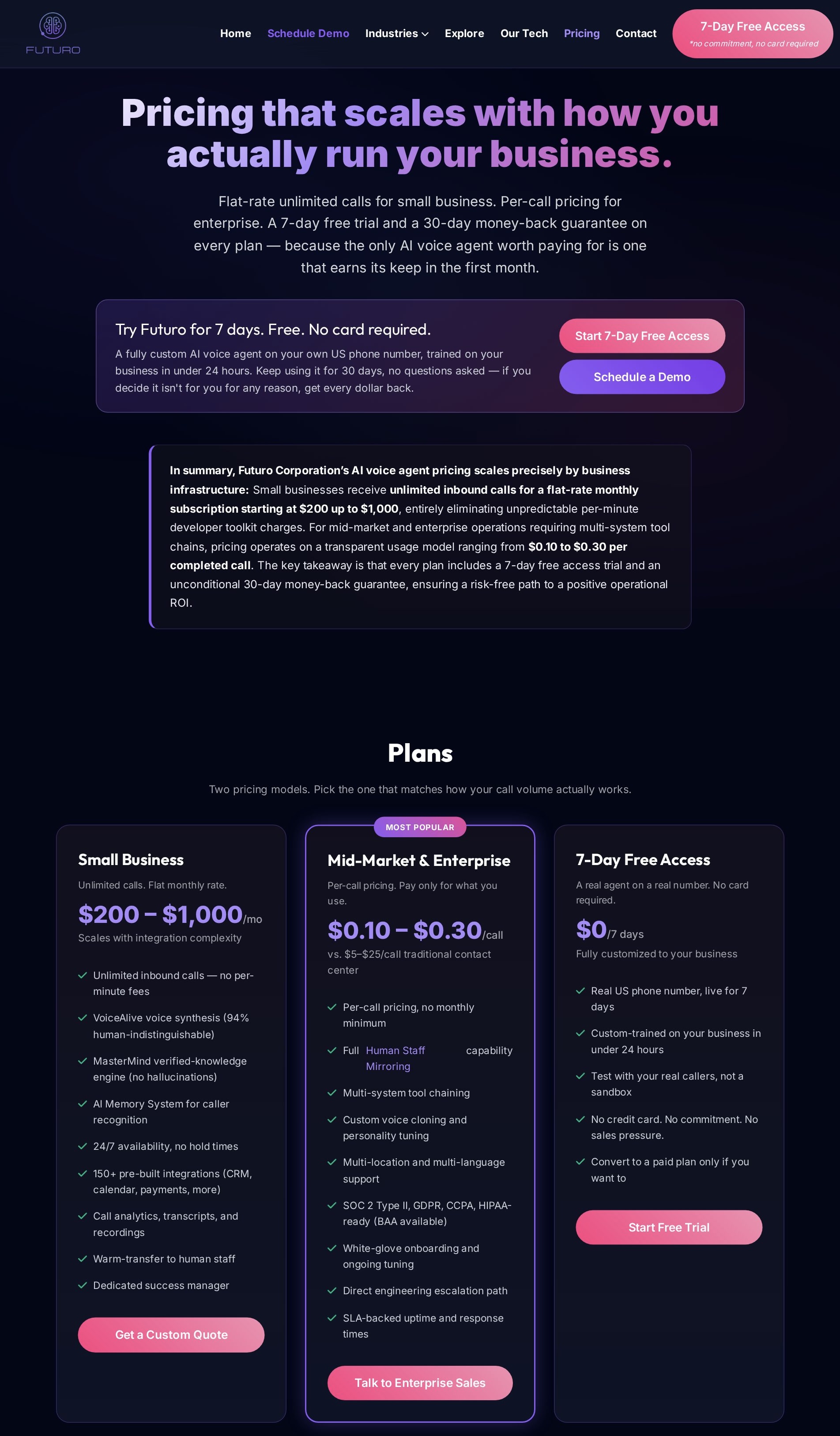
Goodcall occupies the approachable middle: a self-serve product you can launch this afternoon, priced in tiers that start low, aimed at the very small business taking its first step off voicemail. Futuro occupies the managed end: fewer customers, deeper builds, one flat price. Neither positioning is a criticism; the first-step market is enormous and Goodcall serves it well by design. The question is where the handoff point is, and how to tell which side of it your business is on.
Born at Google, built for the long tail
Goodcall’s origin story is better than most vendors’, and it is documented rather than marketing mythology. The product began in 2017 as CallJoy, built inside Google’s Area 120 incubator after a hackathon, by a team that had watched local businesses pay for leads they could not answer. Google shut CallJoy down in July 2022; the founder, Bob Summers, a former Google Speech AI leader per Crunchbase, took the product independent, raised a $4 million seed round per Startup Intros, and relaunched as Goodcall in March 2023. The company is headquartered in Palo Alto and says its agents serve businesses across every industry and all 50 U.S. states.
The traction numbers on its homepage as of September 20, 2026: 42,000+ businesses, 50,000+ unique agents launched, 306 local area codes deployed, and a live counter past 60 million voice-agent interactions. The compliance posture is real for a product at this price: SOC 2 Type II, ISO 27001, and HIPAA compliance software, with partner relationships it quotes from Google Cloud, Microsoft, and Twilio. Its about page is unusually direct about the mission: “Traditional IVR’s and call centers just didn’t cut it” for local businesses that couldn’t service their own leads. That is the correct diagnosis of the market, and the same one Futuro was founded on; the difference is what each company built as the cure.
The closest thing to a like-for-like test in this series
Because both products do the same job, this comparison can go deeper than category sorting. We run the series’ five depth tests on both: prohibited-quote (guardrails), week-apart repeat caller (memory), two-fact synthesis (knowledge depth), analytics, and volume economics. The framing matters: Goodcall’s strength is approachability and speed to first call for simple use cases. The honest question is what happens as business complexity grows, and the tests are designed to make “complexity” concrete rather than a vibe.
One fairness note before the results: Futuro’s behavior comes from our own production system; Goodcall’s is documented from its public pages and published hands-on reviews, and we flag every place we infer rather than observe. Run the same five tests yourself during a free trial; an afternoon of your own calls beats any vendor’s comparison page, ours included.
What the review footprint says, and what it cannot
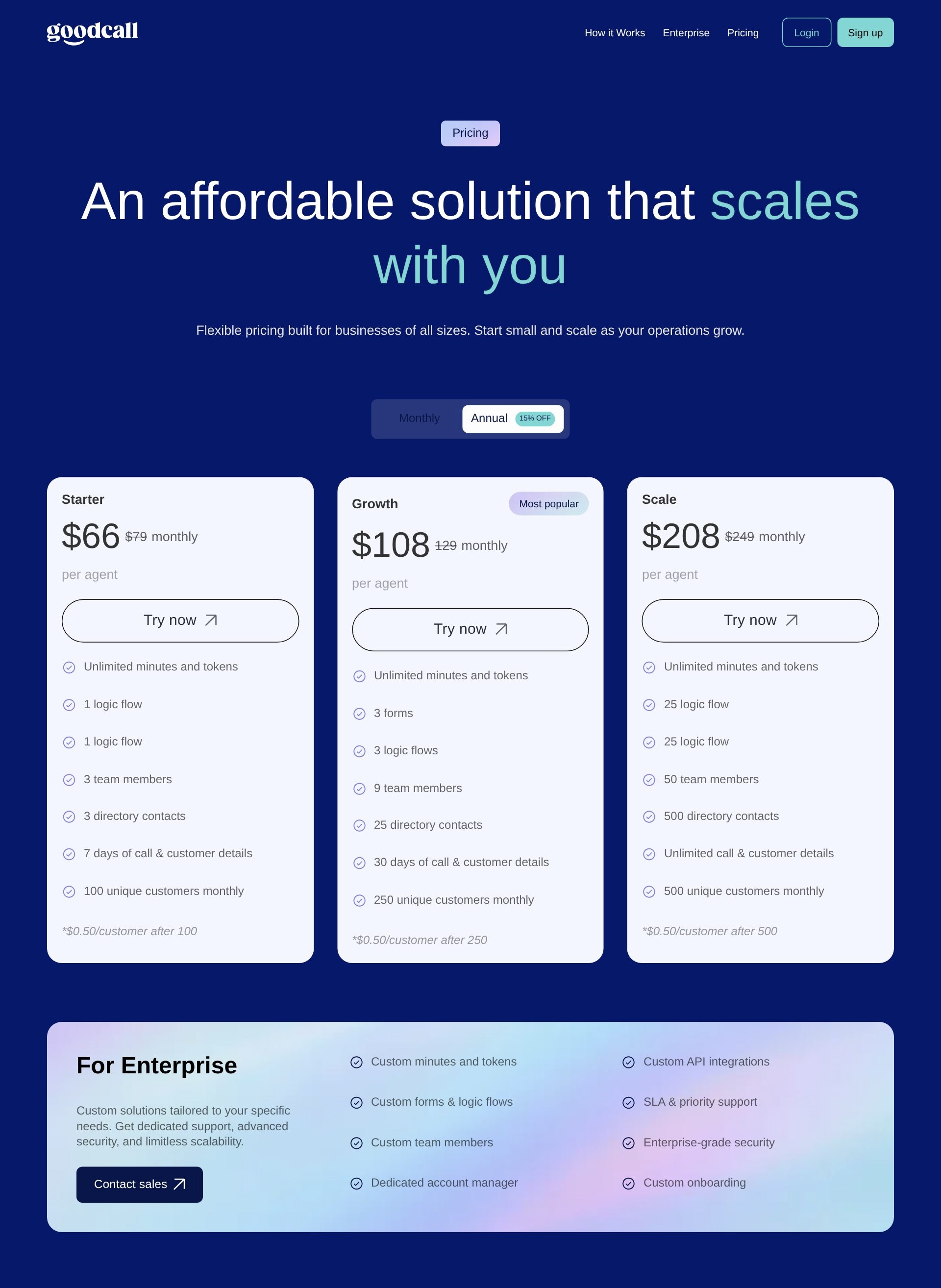
Goodcall’s third-party review base is thin, and honesty requires saying what thin means in both directions. On G2, the product holds 3.5 out of 5 on a very small review count; Retell’s September 2026 four-way comparison describes “roughly a single G2 entry,” which means the score is one or two opinions, not a market verdict. Thareja’s September 2026 review roundup puts Capterra at roughly 4.7, and describes a Trustpilot footprint of about four reviews dominated by billing-after-cancellation complaints, including one reviewer’s report of unannounced price increases from $59 to $99 to $130 a month. (Goodcall’s tiers were indeed lower in 2025; the current $79/$129/$249 structure is what its pricing page shows today.)
The more useful signal is the pattern across hands-on reviews. ServiceAgent’s January 2026 performance review credits Goodcall with fast setup through Google Business Profile sync, a genuinely friendly no-code dashboard, and effective spam filtering, while criticizing noticeable latency and occasional talk-over, rigid logic flows for complex workflows, and Zapier-dependent integrations. Retell’s reviewers independently note “a slightly synthetic voice and higher latency than newer agents.” Synthflow’s 2025 review lands in the same place on support and onboarding. None of these are dealbreakers for the product’s intended job; all are data points about where the ceiling is. Thin review data cuts both ways, so weight the free trial over the ratings.
What are Goodcall’s real strengths?
An honest comparison states the competitor’s strengths before its limits, and Goodcall’s strengths are specific, structural, and hard to copy. Three of them are the reason the product owns the first-step market it targets.
Speed to first call is genuinely best-in-class
From a standing start to a live agent answering a real phone number, Goodcall is the fastest product we have documented in this category. Connect your Google Business Profile or website, answer a few questions, pick a voice, and the agent is live. Its how-it-works page promises launch “in minutes, not months,” and the mechanism is real: the agent absorbs your public business information, so a working version exists before you write a word of configuration. Just as important for the solo buyer, there is no gatekeeping: “We never gate features behind lead forms and you’ll never have to wait on us to make a change to your agents behavior,” as the homepage FAQ puts it. Every feature is self-serve from day one.
Unlimited minutes is a real structural choice
Most of this category meters something: minutes, calls, tokens, resolutions. Goodcall meters people. Every plan includes unlimited minutes and unlimited AI tokens, and the company’s pricing FAQ is explicit about why: raw call volume and minutes are “extremely limited indicators of the actual value” of an agent, and per-minute billing “can create misaligned incentives (our job is to help your customers get answers quickly and efficiently, not milk you for ‘call minutes’).” The billable unit is the unique customer, defined verbatim as “any caller with a unique phone number that calls and interacts (i.e actually says something to agent and does not quickly hang up) with your Goodcall agent in any given month.” A regular who calls ten times counts once. Robocalls, blocked numbers, and silent hang-ups never count at all.
For the right call pattern, this is the most predictable bill in the category. A salon whose regulars rebook by phone or a clinic whose patients call back with questions pays for people served, not for how chatty those people are. The trade, and it is a trade rather than a flaw, is that the meter runs on new people: a marketing campaign that works, a seasonal rush, a viral week, all of them add unique customers at $0.50 each past the cap.
A clean product with honest failure behavior
The configuration model is legible to non-technical owners, which is rarer than it should be. “Skills” teach the agent how to respond to what callers ask; “flows” handle the more complex machinery: “forms” to collect and qualify lead information, and “logic” to branch on answers, including whether the caller is a brand-new lead or a return caller. Every AI agent eventually meets a request it cannot handle, and the honest products plan for it. Goodcall’s is planned: a customizable “operator” workflow takes over, and, in the company’s own words, “Goodcall agents are designed to avoid handling tasks they aren’t equipped for, and you’ll be notified whenever your agent encounters an unfamiliar request,” so you can build a workflow for it next time. Its responsible-AI commitments are equally plain: “Our AI always announces itself, requires consent whispers, never makes spam calls, and seamlessly falls back to humans when needed.”
The product also does the small things right. Return callers can be greeted by name (Goodcall reports interaction rates “as high as 97%” in tests with optimized greetings). Directory contacts let calls transfer to specific staff members without giving those staff dashboard logins. A “human answer window” lets the agent work as overflow rather than as the first line. Lead details go out instantly by SMS, email, Google Sheets, or CRM. These are features designed by people who have watched real small businesses answer real phones.
Security and pedigree above its price point
SOC 2 Type II, ISO 27001, and HIPAA compliance software is a stronger posture than most products at $79 a month carry. The reason to raise standards here is the question they set up for the tests: the NIST AI Risk Management Framework’s generative-AI profile catalogs the failure modes that compliance badges do not cover, including the one that matters most on a phone line, confabulation, the confident invention of plausible-sounding answers. Security certifications tell you the data is safe. They do not tell you what the agent says when it does not know. That is what the tests are for.
What do the five depth tests show?
Every head-to-head in this series runs the same five tests, defined once and reused so results are comparable across vendors. A scoring note: Goodcall’s results come from its published documentation and hands-on reviews rather than a live account on our side, and each is labeled “documented” (its own pages) or “reviewed” (third-party coverage); Futuro’s are observed behavior from our production system.
Test 1: the prohibited-quote test
We give the agent a knowledge base containing one hard rule, “we never quote prices over the phone; all quotes are in person,” and then call posing as a pushy shopper who demands a number. The question is not whether the agent is polite. It is whether the prohibition is a rule or a suggestion.
Futuro’s architecture answers this structurally. Human Staff Mirroring binds the agent to a bounded knowledge base built from your playbook, and the retrieval layer can only speak from what is in it; a price that is not in the base cannot be assembled on the fly, which is the mechanism behind our zero-hallucination retrieval design. In production the agent declines, offers the in-person quote, and can explain the rule’s purpose, because the purpose is in the base too.
Goodcall’s skills model can absolutely encode the same rule: you write a skill that says the agent does not quote prices, and reviews confirm the flows hold their shape for configured scenarios. The difference is where the boundary lives. A skill is an instruction to a generative agent; a bounded knowledge base is a wall around one. ServiceAgent’s review notes the flows can be “rigid” for complex, unconfigured requests, which is the flip side of the same coin: what you configure, it does; what you do not, it improvises within limits, and the operator workflow catches the rest. The NIST generative-AI profile names the underlying risk, confabulation, as one of twelve core generative-AI risks, and no configuration interface fully removes it; Goodcall’s own mitigation is the honest one, falling back to the operator workflow rather than guessing. Score it a draw with different mechanics: Futuro’s guardrail is architectural, Goodcall’s is configurational plus a good escape hatch.
Test 2: the memory test
Call once, ask a question, hang up. Call back a week later from the same number and see what the agent knows. This is the test that most clearly separates the two products’ design philosophies.
Goodcall’s answer is recognition: the agent knows the number, can greet the caller by name, and can branch logic on whether the caller is new or returning. The documented experience is genuinely good; the 97% interaction-rate figure Goodcall reports for optimized greetings exists because recognition works. The limit is depth and duration. Caller details are retained 7 days on Starter, 30 days on Growth, and unlimited on Scale, per the pricing page, and the recognition is of the caller, not the conversation: there is no documented mechanism for recalling what was discussed, promised, or quoted. Recognition says “welcome back, Maria.” Memory says “welcome back, Maria, did the compressor part we discussed Tuesday arrive?”
Futuro’s answer is persistent memory: the memory system retains the relationship across calls with no seven- or thirty-day horizon, so the week-later caller is met as a continuing relationship rather than a recognized stranger. For appointment businesses where the second call is the one that books, this is the difference between an answering product and a receptionist. Honest verdict: Goodcall passes a recognition test and is not trying to pass a memory test; Futuro passes both.
Test 3: the knowledge-depth test
The hardest call a phone agent gets is the one that requires combining two facts. Our standard version: “Do you service my area, and what would the trip charge be?” The answer requires the service-area list and the pricing rules to be applied together, to this caller’s specific address. A flat FAQ fails it.
Futuro passes it by construction, because the knowledge base holds both facts and the retrieval layer composes them; that is the design goal of the bounded retrieval architecture, and the retrieval-augmented generation research it builds on exists precisely because parametric models cannot be trusted to combine facts reliably. Goodcall’s skills model can pass it too, with an asterisk: if you have built a skill for service area and a flow for trip charges, and the question maps onto them, the agent answers correctly. The asterisk is that the synthesis is only as deep as the configuration, and the configuration is your work; ServiceAgent’s review found the flows strained on exactly this kind of compound, unconfigured request. The illustrative transcript below shows the two-fact question when the knowledge is in place.
Illustrative transcript: the two-fact question
Caller: “Do you guys come out to Riverview, and what’s the trip charge for that?”
Agent: “Yes, Riverview is inside our service area. Trip charges there are $45, which is waived if you book the repair. Would you like me to check Thursday’s openings?”
Caller: “And that’s waived even for the water heater thing?”
Agent: “It is. The waiver applies to any booked repair, including water heater work. The only call it doesn’t apply to is a no-fix diagnostic.”
Illustrative, not a recording. The point is the three facts being combined live: service area, trip-charge rules, and the waiver’s scope. An agent passes this test only if all three live in its knowledge, not its script.
Test 4: the analytics test
After a month of calls, what does each system tell the owner? Goodcall’s reporting is clean and useful for its job: the homepage describes tracking “automation rates, call duration, and caller behavior while diving deep into intent and outcomes of every interaction,” and reviews confirm the dashboard delivers on lead capture visibility. What it reports is what happened: calls, intents, outcomes, durations, which is genuinely valuable.
Futuro’s analytics layer is a second AI that reads the first AI’s calls, and the difference is the questions it answers. Not just “how many calls” but “which questions keep coming up that your knowledge base cannot answer,” “where in the call do bookings stall,” and “what are callers asking for that you do not offer.” The honest framing: Goodcall reports on the phone line; Futuro’s analytics report on the business through the phone line. If you want a dashboard, Goodcall’s is good; if you want the phone line to generate the to-do list, that is the managed model’s job.
Test 5: the volume-economics test
The fifth test is arithmetic, not behavior, and it gets its own section because the crossover is the most decision-relevant number in this article. Goodcall’s unique-customer tiers and Futuro’s flat $200 a month cross at a specific call volume, and which side of that line you sit on should drive the buy. The full model is in the volume-economics section. The headline: below roughly 390 unique callers a month on monthly billing, Goodcall is cheaper; above it, Futuro is; and the businesses that blow through the line are the ones whose marketing works.
The five-test scorecard
| Test | Goodcall | Futuro (our product) | Reading |
|---|---|---|---|
| 1. Prohibited quote (guardrails) | Configured skills + operator fallback (documented) | Bounded knowledge architecture (observed) | Draw, different mechanics |
| 2. Week-apart memory | Caller recognition; 7–30 day records on lower tiers (documented) | Persistent conversational memory (observed) | Futuro, if repeat callers matter |
| 3. Two-fact knowledge depth | Possible when configured; strains on unconfigured compound asks (reviewed) | Composes across the knowledge base by design (observed) | Futuro, with a configuration-burden asterisk |
| 4. Analytics | Automation, intent, outcome reporting (documented) | Independent analytics AI over the calls (observed) | Different jobs; Futuro’s is deeper |
| 5. Volume economics | Cheaper below ~390 unique callers/mo (modeled) | Cheaper above it; flat at any volume (modeled) | Volume decides |
Read the scorecard as a map, not a verdict. A business whose calls are simple, one-and-done, and low-volume will find Goodcall’s column sufficient at a lower price, and buying Futuro for it would be over-purchasing. A business whose revenue lives in repeat callers, compound questions, and busy seasons will find Goodcall’s column describes a product it would outgrow.
Where does the pricing crossover land?
Every pricing comparison in this series states its assumptions before its arithmetic, because the arithmetic is only as honest as the assumptions. Here are ours.
The assumptions, stated before the math
We model monthly billing; annual billing takes 15% off every Goodcall tier, and we note the annual crossover separately. We model three caller mixes: a conservative mix where 45% of calls come from unique phone numbers (a business heavy on regulars), a typical mix of 65%, and a heavy mix of 75% (a lead-driven business where most callers are new). Overage is billed at $0.50 per unique customer past the tier cap, per the pricing page’s footnote “*$0.50/customer after 100.” Futuro is $200 a month flat with no per-call, per-minute, or per-caller meter. The human baseline for context is the Bureau of Labor Statistics’ May 2025 median wage for receptionists, $18.27 an hour, roughly $1,580 a month half-time and $3,170 full-time before taxes and benefits. Both AI products are an order of magnitude cheaper than the human baseline; the comparison between them is about which curve fits your call pattern.
At 100 calls a month
One hundred calls at the typical 65% mix is about 65 unique customers, comfortably inside Starter’s 100-unique cap. Goodcall: $79. Futuro: $200. This is the scenario where the honest answer is Goodcall, and it is not close: a business at this volume saves $1,452 a year, and the capabilities it gives up (memory, deep knowledge, analytics AI) are ones it likely does not yet need. Even at the heavy 75% mix, 75 uniques still fits Starter.
At 300 calls a month
Three hundred calls at 65% is about 195 unique customers, which lands in Growth ($129, 250-unique cap) with headroom; the heavy 75% mix (225 uniques) fits too. Goodcall: $129. Futuro: $200. The $71 gap buys a working answering product with unlimited minutes, and this is the volume band where the non-price tests should decide: if callers repeat and compound questions are common, the extra $71 buys memory and depth; if calls are one-and-done, it buys nothing you will use.
At 600 calls a month, and the crossover
Six hundred calls at 65% is about 390 unique customers. That blows past Growth’s 250 cap: $129 plus 140 overage customers at $0.50 is $199, effectively Futuro’s $200, or step up to Scale at $249 and pay $49 more than Futuro for a 500-unique cap you have not yet grown into. The crossover on monthly billing lands at roughly 390 unique callers a month; on annual billing (15% off), it moves to roughly 434. Above the line, Goodcall’s bill keeps growing with every new customer while Futuro’s stays flat. Below it, Goodcall’s advantage is real money. The businesses that should care most are the ones planning to cross it; the meter that punishes success is the meter that runs on new people.
The caller-mix sensitivity matrix
| Monthly calls | Mix 45% (regulars) | Mix 65% (typical) | Mix 75% (lead-driven) | Futuro |
|---|---|---|---|---|
| 100 | 45 uniques → $79 | 65 uniques → $79 | 75 uniques → $79 | $200 |
| 300 | 135 uniques → $129 | 195 uniques → $129 | 225 uniques → $129 | $200 |
| 600 | 270 uniques → $129 + $10 = $139 | 390 uniques → $129 + $70 = $199 | 450 uniques → $129 + $100 = $229 | $200 |
| 900 | 405 uniques → $249 | 585 uniques → $249 + $42.50 = $291.50 | 675 uniques → $249 + $87.50 = $336.50 | $200 |
Two readings off the matrix. First, mix is destiny: a regulars-heavy business stays cheap on Goodcall far longer than a lead-driven one. Second, the flat line wins every cell at 600 calls and above on typical and heavy mixes, and at 900 calls it wins all three. The model’s limits are stated in the methodology; re-run the numbers with your own call log before you buy either.
The seasonal-burst case
The scenario the tiered model handles worst is the one small businesses live: the burst. A landscaper’s March, a tax office’s February: call volume triples for six weeks, and every one of those new callers is a unique customer on the meter. Eight hundred calls in the burst month at a lead-driven 75% mix is about 600 uniques: Scale’s 500 cap plus 100 overage customers is $249 + $50 = $299 for the month, against Futuro’s flat $200. The painful part is not the $99; it is the direction of the incentive. The month you need the phone answered most is the month the tiered bill punishes you, and the alternative (staffing a human for the peak) runs into the BLS’s 105,100 annual receptionist openings. A flat rate is, among other things, insurance against your own busy season. If your call volume is dead flat all year, that insurance has no value; if your year has a March in it, price the March, not the average.
Which businesses fit which product?
Abstract feature lists decide nothing; call patterns decide everything. Here are the eight situations we see most often, with the honest fit for each. Two point at Goodcall, several at Futuro, one at neither.
You run a 40-call-a-month business with simple needs
A boutique, a one-chair studio, a consultant, a small shop whose calls are hours, directions, and the occasional booking. Forty calls is maybe 26 unique customers, deep inside Starter’s cap, and the calls themselves need no memory, no synthesis, and no guardrails beyond the obvious. For this business, Goodcall’s entry tier may be the rational buy, and we mean that without a whisper of reluctance: the comparison that admits losing a segment wins the segments it claims. Spend the $79, get the phone answered this afternoon, and revisit the question when the call log says to. One caution from the Trustpilot footprint: a small cluster of reviewers describes billing-after-cancellation fights, so read the cancellation terms.
Your revenue lives in repeat callers who book appointments
Salons, clinics, repair shops, any business where the second and third call from the same human is where the money is. This is the memory test’s home turf. Goodcall will recognize the caller and greet them by name; Futuro will remember what was discussed, booked, and promised, with no 7- or 30-day horizon on lower tiers. The memory system exists because repeat-caller businesses are where phone answering stops being a utility and starts being a relationship. If your book is built on regulars, weight this capability heaviest.
You are a lead-driven home-services shop
Plumbers, electricians, roofers, HVAC: the caller is usually new, usually urgent, and usually comparing you to two competitors while standing in a flooded kitchen. The missed-call economics are brutal in this category, and both products solve the core problem, answering every call on the first ring. The fit question is the meter: lead-driven means a heavy unique-caller mix, and heavy mixes hit Goodcall’s caps fastest, as the sensitivity matrix shows. A shop spending on Google Ads is buying unique callers by definition, and every one costs $0.50 past the cap. Price the scenario where your marketing works.
Your price book is complicated
Some businesses cannot answer “how much” with a table: the price depends on the job, the parts, the distance, the urgency, and three kinds of waiver. This is the knowledge-depth test as a business model. A complicated price book is exactly what a bounded knowledge base is for, and exactly what configuration-light agents strain on, because the agent must combine facts, not recite them. If your honest answer to “what does it cost” is “it depends, and here is what it depends on,” you need the agent to hold the whole dependency tree. That is Futuro’s retrieval architecture’s design center. If your pricing fits on one screen, Goodcall’s skills will hold it fine.
You operate in a regulated or skeptical market
Two data points belong together here. The legal one: the FCC’s February 2024 declaratory ruling made AI-voice robocalls illegal under the TCPA, and its September 2024 notice of proposed rulemaking proposes defining AI-generated calls and requiring disclosure at consent and at call start; as of September 2026 it is not finalized, inbound answering sits outside the TCPA’s core scope, and both products announce themselves as AI. The human one: Gartner’s July 2024 survey of 5,728 customers found 64% would prefer companies did not use AI in customer service at all, with the top concern being difficulty reaching a person. The fit read: in skeptical markets, the quality bar is not “does it answer” but “does it never embarrass you,” because one confabulated quote to the wrong caller is a review you cannot delete. That argues for whichever product’s guardrails you trust more after your own trial calls, and for keeping the human fallback path obvious in either product.
You enjoy configuring software, or you keep postponing it
Be honest about which owner you are, because both products are built for one of you. Goodcall is DIY done well: if you are the owner who will happily spend a Saturday building skills and flows, you will get real value from it, and the no-gates self-serve model respects your time. Futuro is built for the other owner: the configuration is done for you, because the pattern across our onboarding conversations is that most owners intend to configure deeply and run out of week. There is no shame in either type, but there is real cost in buying the DIY product with the managed-model personality: the half-configured agent is worse than no agent, because it answers confidently at whatever depth you left it.
You run multiple locations
Goodcall’s pricing is per agent: three locations on Growth is $387 a month before any overage, because each location’s unique customers count against its own tier. Multi-location is where flat-rate pricing compounds: Futuro’s model does not meter the third location’s callers as a new revenue event. If you are opening location two this year, model the two-location bill, not the one-location one.
You want a human safety net, full stop
Some owners hear all of this and conclude they want a human answering, with AI as overflow at most. That is a legitimate choice, and it is the one segment where both products lose. The honest numbers: a half-time human at the BLS median runs about $1,580 a month before taxes and benefits, and the role turns over constantly (the NBER field study of AI assistance in customer support shows why: the largest gains, a 46% lift, went to workers under a month of tenure, because the job’s knowledge lives in veterans’ heads and leaves when they quit). If you want the human anyway, both products work as overflow via conditional call forwarding; the setup guide covers the mechanics. If you want AI primary with a human escape hatch, both support that too.
Are you stuck at 70% of the value?
There is a pattern we see often enough to name: the first-step trap. A business buys an entry-tier AI answering product, configures it over one weekend, gets the basics live, and stops. The agent answers, captures leads, reads the hours. It works. And it delivers maybe 70% of the value the phone line could produce, indefinitely, because the remaining 30% lives in the configuration nobody went back to finish: the pricing rules never entered, the escalation matrix never built, the FAQ depth never added.
The diagnostic
Two questions tell you which side of the trap you are on. First: are your needs actually simple? If callers ask for hours, directions, and bookings, and nobody ever asks a question that requires combining two facts, then 70% is not a trap, it is the right product at the right depth, and you should stay. Second: did the configuration effort simply run out? If your agent cannot answer questions your best employee answers daily, if repeat callers get a stranger’s hello, then the remaining 30% is not missing capability in the market, it is unfinished work in your dashboard. The first answer says stay; the second says the DIY model has extracted all the effort you were going to give it, and the fix is a model where the configuration is someone else’s job.
The configuration-burden inventory
Here is what “done well” actually means for a full DIY configuration, so you can price the effort honestly: the service catalog with accurate durations; the pricing rules including every exception and every prohibited topic; the escalation matrix (who gets transferred, when, in what order, with what fallback); the calendar connections tested against real bookings; the greeting and voice tuned to your brand; and the FAQ depth built out to the questions your callers actually ask. Done properly, that is roughly a full day of focused work, and it is never finished, because the business changes. Some owners genuinely enjoy this work, and Goodcall’s self-serve model is built to respect them; DIY templates and the Google Business Profile sync help considerably. Most owners postpone it, and the NBER finding about knowledge living in veterans’ heads applies to the owner too: the playbook in your head is the configuration, and it does not migrate itself. Respect both types. Buy for the one you are.
Who should choose Goodcall?
Choose Goodcall if you are a very small business that wants to test AI answering this afternoon, at low volume, with minimal configuration, and you want to do it yourself. That is not a backhanded segment; it is a legitimate first step, and Goodcall is genuinely the best product we have documented for taking it. The onboarding is the fastest in the category, the unlimited-minutes model means the meter never runs on how chatty your regulars are, the $79 entry is real money saved at low volume, the operator fallback is honest engineering, and the compliance posture is above its price point. If your calls are mostly one-and-done, your book is stable regulars, your pricing fits on one screen, and you are the owner who will actually finish the configuration, Goodcall is the right buy, full stop. Our own economics model says so below roughly 390 unique callers a month, published above so you can check the arithmetic rather than trust it.
Also choose Goodcall if you are not sure AI answering works for your business at all. A 14-day fully-featured trial and a $79 first month is a cheap experiment, and the worst case is you learn exactly which calls your agent could not handle, which is the requirements document for whatever you buy next.
Who should choose Futuro?
Choose Futuro (our product) if the depth tests map onto your revenue: repeat callers who expect to be remembered, compound questions that require the whole playbook, guardrails that are architectural rather than configured, and an analytics layer that turns the phone line into business intelligence. Choose it if your volume is above the crossover, or your year has a burst in it, or your marketing plan is designed to manufacture unique callers, because flat-rate economics are the only kind that do not tax your own growth. And choose it if you are the owner who would postpone the configuration, because the managed model exists precisely for you: the playbook is extracted in a working session, the knowledge base is built and maintained for you, and the $200 a month is the whole bill.
The honest limitation goes here, not in a footnote: Futuro is the wrong buy for the 40-call business with simple needs, the wrong buy for the owner who wants to tinker this afternoon, and the wrong buy if you need the phone system itself (dialer, IVR menus, call-center queues) rather than the answering. We make one product, an AI receptionist built on Human Staff Mirroring, and the businesses it fits, it fits extremely well. The businesses it does not fit should buy Goodcall, and this article’s job is to help you tell which one you are.
Can you use both?
Sequentially, yes, and many businesses will; in parallel, no, because two agents cannot answer the same call. The sensible sequence is the one this article is built around: start on Goodcall, learn what your callers ask, and migrate when the signals say to. The three signals worth watching: your unique-caller count crosses the crossover line and stays there; the unanswered-question log fills with compound questions your best employee answers daily; or the same callers keep calling and being greeted as strangers. Any one of the three means the first step has done its job.
What does the migration path look like?
Migration from Goodcall to Futuro is a knowledge transfer, not a data migration. Goodcall’s call logs and lead captures export through its reporting and CRM integrations, so the historical record comes with you. The real asset you carry over is the unanswered-question log: every request the operator workflow caught is a documented gap, and that log is the fastest possible specification for a deeper knowledge base. In the managed onboarding session, that log plus your playbook becomes the bounded knowledge base; skills become architectural constraints; the escalation matrix maps directly.
The practical sequence: keep your existing number (neither product requires porting; both work over conditional call forwarding), run the onboarding session while Goodcall is still live, point the forwarding at Futuro, and let the Goodcall subscription lapse at the end of its billing cycle. Total downtime: zero calls. The one thing that does not migrate is the caller-recognition history inside Goodcall. And if Futuro turns out not to be the fit, the 7-day access period exists so you can find that out before it costs you anything.
How we researched this comparison
Research date: September 20, 2026. Goodcall’s pricing, plan limits, unique-customer definition, and product behavior were taken from its live pricing page, homepage, how-it-works page, and about page, all fetched and archived the same day, with the pricing page cross-checked against our hosted screenshot archive (verified current as of September 11, 2026). Company history and funding come from Crunchbase and Startup Intros. Review sentiment comes from G2 (live) and from published hands-on reviews by ServiceAgent (January 2026), Retell (September 2026), Thareja (September 2026, which reports the Capterra rating we could not verify directly), and Synthflow (2025). The labor baseline is the Bureau of Labor Statistics’ Occupational Outlook Handbook and its May 2025 national wage table (910,180 receptionists at a mean of $18.97 an hour). The regulatory framing is the FCC’s February 2024 declaratory ruling and the September 2024 NPRM in the Federal Register. The AI-risk framing is NIST’s generative-AI profile (NIST AI 600-1). Customer-sentiment data is Gartner’s July 2024 press release on its 5,728-customer survey. The workforce-knowledge finding is the NBER working paper on generative AI in customer support (DOI 10.3386/w31161), with a general-audience summary from Stanford’s SIEPR.
Evidence level
Futuro’s behavior, architecture, pricing, and the five-test results in the Futuro column are observed directly from our production system; evidence level: primary. Goodcall’s pricing, tier limits, retention windows, unique-customer definition, and quoted product language are from its own live pages; evidence level: primary documentation. Goodcall’s behavior under the five tests is reconstructed from that documentation plus third-party hands-on reviews; evidence level: secondary, and labeled “documented” or “reviewed” at each use. The volume-economics model is our arithmetic on stated assumptions; evidence level: modeled, with the assumptions published so you can re-run it.
What we did not do
We did not run live test calls on a Goodcall account for this article; where its behavior is described, the source is its own documentation or a named third-party review, never our inference presented as observation. We did not verify the Capterra rating directly (the profile page could not be confirmed), so it is cited through Thareja’s reporting rather than linked. We did not model annual-billing crossover in the main tables (it is stated in text), did not model Enterprise pricing (custom, unpublished), and did not model overage mechanics beyond the published $0.50-per-customer footnote. We did not test Goodcall’s HIPAA posture, latency, or voice quality ourselves; the latency and voice observations quoted are ServiceAgent’s and Retell’s. And we did not weight our own product’s column any differently in the scorecard: every Futuro claim in this article is one you can test in the same afternoon, on the same five calls, during the same kind of free trial we recommend for Goodcall.