

Editorial Disclosure & Results Disclaimer: This guide is published by Futuro Corporation, which sells a flat-rate AI receptionist and is one of the ten providers compared. Futuro has no financial, affiliate, or referral relationship with the other nine providers. We did not accept payment, sponsorship, or in-kind consideration for inclusion in this guide. All provider descriptions are based on publicly available information as of September 27, 2026; where a provider blocks automated reading of its pricing page, the figure carries a dated third-party verification and says so. Capabilities attributed to Futuro AI (94% human-indistinguishable voice, the Memory System, 150+ integrations with API and MCP tools) are published company claims, date-stamped September 2026; individual results will vary based on call volume, configuration, and carrier setup. Pricing shown is the publicly listed starting rate or the lowest disclosed tier; enterprise quotes, annual discounts, and promotional pricing may differ. Always verify pricing on the provider's own page before budgeting — ours included.
“Virtual receptionist” is one term hiding three products: a remote human answering from a call center, an AI agent answering with a natural voice, and a hybrid of both. They're priced so differently — and so deliberately difficult to compare — that most buyers pick a brand before they pick a billing model, which is backwards. This guide is the neutral teardown: every pricing structure explained with its failure mode, a full volume matrix from 50 to 800 calls a month with the arithmetic shown, the hidden line items vendors bury, the five-year total cost of ownership including the missed-call variable, and a worksheet that runs the comparison on your call log, not industry averages.
At a glance: the ten providers, alphabetically
Ten providers, A to Z, no ranking games. “Entry pricing” is the lowest published tier; “standout” is what each genuinely does best on cost. Full profiles with dated pricing screenshots are in the provider section; prices verified September 27, 2026.
| Provider | Entry pricing | Standout attribute | Best for |
|---|---|---|---|
| Abby Connect | $165/mo (50 min) | Dedicated human pod; AI-answered calls count at half rate | Businesses wanting named humans with an AI cost release valve |
| AnswerFirst | $30/mo + $1.60–$1.95/min | True one-second billing — no rounding, no overage fees, no contract | Low or unpredictable volume that wants human answering without bundles |
| Futuro AI (our product) | $200/mo flat, unlimited | 94% human-indistinguishable voice realism; the busy month costs the same as the quiet one | Businesses where call volume swings and every call should resolve, not queue |
| Moneypenny | $99/mo (30 min) | Global human brand with a low published entry | Businesses wanting a big-name human service at small volume |
| Nexa | $149/mo (50 min) | Industry-specialized human agents (insurance, home services, legal) | Regulated or specialized intake that justifies trained humans |
| PATLive | $49/mo pay-go + $2.99/min | Nine published tiers up to 5,000 minutes with sliding overage | Businesses that want human answering with a visible scaling curve |
| Posh | ~$130/mo (50 min) | Per-second billing on a premium human service | Short, transactional call patterns |
| ReceptionHQ | $25/mo + $1.99/call | Cheapest legitimate human entry; choice of per-call or per-minute | Solo operators and micro-businesses testing live answering |
| Ruby | $250/mo (50 min) | The premium human brand; bilingual 24/7 included on every plan | High-touch businesses where a named human voice is the product |
| Smith.ai | $300/mo (30 calls); AI from $0 | Human-first or AI-first under one roof, published add-on menu | Firms wanting a human fallback behind AI front-line answering |
Entry pricing as published September 27, 2026. “Min” = receptionist minutes. In-house hiring is covered in the five structures — it isn't a vendor, so it isn't a row.
How we evaluated
Every provider is graded against the same eight-criterion rubric, built for a cost guide rather than a feature list: transparency and billing mechanics carry the weight, because that's where this category hides its money. Weights sum to 100 and are published as machine-readable data in this page's grading dataset.
| Criterion | Weight | What it measures |
|---|---|---|
| Published price transparency | 20% | Can a buyer see real prices on a public page, or does the funnel end at “talk to sales”? |
| Entry price accessibility | 15% | The lowest real monthly cost to start, including mandatory base fees. |
| Cost behavior at volume | 15% | What the bill does between a quiet month and a busy one; overage fairness. |
| Hidden-fee exposure | 15% | Setup fees, surcharges, add-on menus, rounding — the line items the pricing page doesn't headline. |
| Contract flexibility | 10% | Lock-in, cancellation terms, downgrade friction. |
| Coverage hours | 10% | Whether 24/7 is included, gated, or surcharged. |
| Billing-unit fairness | 10% | Per-second vs 60-second rounding; whether spam and wrong numbers bill. |
| Evidence & verifiability | 5% | Whether claims survive a dated screenshot and a third-party cross-check. |
The evidence, including our competitors'
This query is currently owned by vendor-authored content, and two of those vendors deserve credit for doing it well. CloudTalk's Ruby pricing teardown (August 31, 2026) is the most exhaustive public documentation of Ruby's ten tiers, overage rates, and surcharges we found — we cite it directly, because their research team did the work. NextPhone's virtual receptionist cost guide (September 2, 2026) publishes a clean dated verification set across Ruby, AnswerConnect, Smith.ai, PATLive, Posh, and ReceptionHQ. Both articles recommend their own product at the end — as ours does, with our name on it — but their pricing research is solid enough to build on, and a neutral teardown should say so.
Where we relied on third-party verification instead of a provider's own page — Moneypenny, Nexa, and Posh, whose sites block automated reading — the figure carries its source and date inline, and our Friday screenshot cadence replaces it with first-party evidence on the next cycle. Every other price in this guide was read from the provider's own pricing page on September 27, 2026. Last reviewed September 27, 2026.
The five pricing structures (and how each one fails)
Every virtual receptionist — human, AI, or hybrid — bills one of five ways. Choose the structure before the brand: the same 50 calls a month can cost $124 or $720 depending on which meter is attached.
1. Per-minute (the legacy model)
The answering-service industry's original meter: a monthly bundle of receptionist minutes plus an overage rate. Budget human services quote $0.75–$1.50 per minute (Nextiva, September 23, 2026); premium human brands run $3.15–$5.00 per in-bundle minute (Ruby's ten tiers, documented by CloudTalk, August 28, 2026). Its failure mode: the bill punishes exactly the thing you hired the service for. A chatty caller, a complex intake, and a surge month all cost more — and rounding rules (covered in hidden fees) quietly inflate every nominal minute by up to a factor of six on short calls.
2. Per-call
A fixed price per answered call regardless of duration: Smith.ai's human tier at $300 for 30 calls ($11.50 per additional call), ReceptionHQ's MessageExpress at $25 plus $1.99 per call. Its failure mode: the five-minute intake call and the 40-second message bill identically, which makes long-call businesses subsidize short ones — and “calls” need defining. Does a wrong number count? A robocall? Ask, because at some providers it does.
3. Minute-tiered bundles
The per-minute model dressed as SaaS tiers: 50/100/200/500-minute plans at improving effective rates (PATLive publishes nine, from $49 pay-as-you-go to $6,899 for 5,000 minutes). Its failure mode: bundles force over- or under-buying. Minutes almost never roll over — two quiet months on Ruby's 50-minute tier means $500 paid for service never consumed — and the upgrade/downgrade rules (Ruby requires three consecutive periods before a downgrade) catch you in both directions.
4. Flat-rate AI
One monthly price, unlimited calls: Futuro AI at $200 a month. The meter doesn't exist, so the busy month costs the same as the quiet one, and 3 AM costs the same as 3 PM. Its failure mode: at very low volume you pay for capacity you never use — under roughly ten calls a week, pay-as-you-go human services are genuinely cheaper, and we show that math in which model fits rather than hide it.
5. In-house salary
The benchmark every virtual service prices against. The median receptionist wage is $38,010 a year (BLS Occupational Employment and Wage Statistics, May 2025), and fully loaded with payroll taxes, benefits, and overhead a full-time hire runs $4,600–$5,800 a month (NextPhone's estimate, checked September 22, 2026). Its failure mode: coverage, not cost per se. Forty hours a week means 128 hours a week uncovered — and the 30–42% of calls that arrive outside 9-to-5 (CallSphere, June 2026) hit voicemail at the most expensive hourly rate in this guide.
The volume tables: every model priced at 50, 100, 300, and 800 calls a month
This is the asset the rest of the article hangs on — the full matrix, priced on each provider's own published plans, at a 90-second average call (the category norm for small-business inbound). Where a provider's tiers force a plan-fit choice, we fit the smallest covering plan and show the overage math where the plan can't cover. Figures marked est. interpolate published rates where tier detail isn't public; everything else is arithmetic on published numbers, verified September 27, 2026. We refresh this table quarterly — the market repriced sharply through 2025–2026 and it will move again.
| Provider (model) | 50 calls/mo (75 min) | 100 calls/mo (150 min) | 300 calls/mo (450 min) | 800 calls/mo (1,200 min) |
|---|---|---|---|---|
| ReceptionHQ (per-call human) | $124.50 | $224 | $622 | $1,617 |
| AnswerFirst (per-minute human, pay-go) | ~$176 est. | ~$308 est. | ~$795 est. | ~$1,950 est. |
| PATLive (minute bundles, human) | $189 | $349 | $759 | $1,837 |
| Abby Connect (minute bundles, human + half-rate AI) | $329 | $599 | $1,380 | ~$3,312 est. |
| Moneypenny (minute bundle, human) | ~$234 est. | ~$458 est. | ~$1,355 est. | ~$3,597 est. |
| Nexa (minute bundles, human) | ~$175–$225 est. | ~$300–$400 est. | $799 | ~$1,600–$1,900 est. |
| Posh (per-minute human, per-second billing) | ~$198 est. | ~$350–$480 est. | ~$1,050–$1,400 est. | ~$2,600–$3,400 est. |
| Ruby (minute bundles, premium human) | $395 | $720 | $1,725 | $4,080 |
| Smith.ai (per-call human) | $530 | $915 | $2,100 | $6,350 |
| Futuro AI (flat-rate AI) | $200 | $200 | $200 | $200 |
| In-house hire (salary benchmark) | $4,600–$5,800/mo fully loaded — at every volume, covering 40 of 168 weekly hours | |||
Plan-fit math: 75 min fits PATLive's 100-min tier ($189), Ruby's Call Ruby 100 ($395), Abby's 100-min tier ($329). 150 min fits PATLive 200 ($349), Ruby 200 ($720), Abby 200 ($599). 450 min fits PATLive 500 ($759), Ruby 500 ($1,725), Abby 500 ($1,380), Nexa's 500-minute tier ($799). 1,200 min exceeds every published bundle under 2,000 minutes, so those rows add overage at the published rate (PATLive: $1,499 + 200 × $1.69; Ruby: $3,350 + 200 × $3.65; Abby: 500-min plan plus ~700 min at its $2.76 effective rate). Smith.ai is per-call, so minutes don't apply: $300 + 20 × $11.50 at 50 calls; $810 + 10 × $10.50 at 100; $2,100 flat at 300; $2,100 + 500 × $8.50 at 800. ReceptionHQ is $25 + calls × $1.99 at every volume. AnswerFirst and Posh use midpoint published rates. Moneypenny per Nextiva's September 23, 2026 reading; Nexa per Sonant's September 2, 2026 review; Posh per OnceHub's September 9, 2026 comparison.
How to read this table
Three patterns jump out. First, the spread at low volume is 6×: the same 50 calls cost $124.50 at ReceptionHQ and $720 at Ruby — before rounding and surcharges. Second, metered human services scale linearly forever: every provider's 800-call column is roughly 8–16× its 50-call column, because minutes and calls are meters. Third, flat rate is the only row that doesn't move, which is why the crossover question — “at what volume does flat win?” — has a clean answer: against human services, immediately at every volume tested; against metered AI, around 30 calls a month (the AI-only math lives here).
The honest caveat, again: at the lowest volumes the difference between $124.50 (ReceptionHQ) and $200 (flat-rate AI) is $75 a month — real money, but not transformative. The table's job isn't to crown a winner; it's to make the trade-off visible at your volume. The worksheet runs it on your actual call log.
Total cost of ownership: the five-year math, with the missed-call variable
A subscription price is not a cost. The cost is the subscription, plus the hidden line items from the previous section, plus the revenue value of the calls the service fails to answer. That last term dominates the other two, and it's the one no pricing page mentions: across the 2025 CallRail survey, 82% of callers who can't reach a business say they'd call a competitor instead (via Ainora's compilation) — the full framework is in our missed-call economics hub. The cheapest service that misses calls is the most expensive one.
The assumptions (stated so the math is auditable)
- Volume tiers: 20, 60, and 150 calls per week — 87, 260, and 650 calls a month, or 130, 390, and 975 minutes at the category-standard 90-second average.
- Human-only: representative mid-market minute-bundle pricing (PATLive plan-fit: 200-minute plan at 20 calls/week, 500-minute at 60, 1,000-minute at 150), plus a 10% hidden-fee adjustment for overage, rounding, and add-ons — conservative against Ruby's documented surcharge stack.
- Hybrid: AI front-line answering with a human escalation block — Smith.ai's AI-first plan ($150) plus its 30-call human Starter block ($300), assuming a 10% escalation rate; overage at $11.50/call when escalations exceed the block.
- AI flat-rate: Futuro AI at $200 a month, unlimited — no adjustment, because there's no meter to adjust.
- Prices as verified September 27, 2026; five-year figures are simple multiplication with no inflation or repricing assumed — see when prices change for why that cuts both ways.
Five-year TCO, three models, three volumes
| Model | 20 calls/week (87/mo) | 60 calls/week (260/mo) | 150 calls/week (650/mo) |
|---|---|---|---|
| Human-only (minute bundle + 10% hidden-fee adj.) | $349/mo → $23,034 | $759/mo → $50,094 | $1,499/mo → $98,934 |
| Hybrid (AI front-line + human escalation block) | $450/mo → $27,000 | $450/mo → $27,000 | ~$853/mo → ~$51,150 |
| AI flat-rate (Futuro AI, unlimited) | $200/mo → $12,000 | $200/mo → $12,000 | $200/mo → $12,000 |
| For contrast: in-house hire (fully loaded) | $4,600–$5,800/mo → $276,000–$348,000 over five years — covering 40 of 168 weekly hours at any volume | ||
The missed-call variable doesn't appear as a row because all three virtual models answer 24/7 at every tier — its effect is zero for each. It appears the moment coverage isn't 24/7: an in-house hire missing the 30–42% of calls that arrive outside staffed hours (CallSphere, June 2026) forfeits a share of 20+ weekly callers at the 82% competitor-defection rate above. At one real opportunity in ten callers and a $300 average ticket — both illustrative, both yours to change in the worksheet — that's roughly $25,000 a year of revenue at risk, more than the entire five-year cost of the AI row.
The worked example: 60 calls a week, line by line
The brief version of everything above, at the volume most established small businesses actually run:
| Line item | Human-only | Hybrid | AI flat-rate |
|---|---|---|---|
| Base plan | PATLive 500-min: $759 | Smith.ai AI-first: $150 | Futuro AI: $200 |
| Escalation / overage | $0 (plan covers 390 min) | 30-call human block: $300 (26 needed at 10% escalation) | $0 (no meter) |
| Rounding & surcharges | +$0–$75 (provider-dependent) | $0 | $0 |
| Setup fee (amortized year one) | $0 | $0 | $0 (managed onboarding included) |
| Effective monthly cost | $550–$800 (budget per-minute to mid-market bundle) | $350–$500 | $200 |
The ranges are honest, not hedged: human-only lands at $550–$800 depending on whether you buy budget per-minute minutes or a premium bundle, and hybrid lands at $350–$500 depending on how often your callers actually need the human block. Both ranges sit above the flat $200 — at this volume. The volume where that stops being true is the next section's whole point.
Which pricing model fits which shop
Seasonal and spiky businesses: flat rate wins
If your call volume swings 5–10× between your slow month and your peak — HVAC in a heat wave, tax prep in March, landscaping in April — every metered model bills your peak at its worst effective rate, and bundle tiers force you to either over-buy the quiet months or pay overage through the busy ones. Flat rate was built for exactly this shape: the August spike costs the same $200 as the February lull.
Steady low volume: per-minute or per-call can win — honestly
Under roughly 30 calls a month, the math flips. ReceptionHQ's MessageExpress at $25 plus $1.99 a call costs about $85 at 30 calls; AnswerFirst's pay-as-you-go lands near $120–$150; a $200 flat-rate plan is the most expensive option on the table at this volume, and a well-configured voicemail at $0 is cheaper still. We say that as the flat-rate provider: if your phone rings twice a day, don't buy our plan — buy the per-call human service, pocket the difference, and revisit when the ring count changes. This is also why “cheapest virtual receptionist” has no single answer: it's volume-dependent arithmetic, not brand loyalty.
Growth-stage: avoid the per-minute trap
The dangerous position is 50–150 calls a month and climbing. Metered pricing punishes growth precisely when you're generating it: every marketing win raises your phone bill, and per-minute providers collect their best margins from businesses outgrowing their bundle mid-contract. If your volume doubled in the last year, price every model at next year's volume — the worksheet below does this in one extra line.
When the human premium is worth paying
High-stakes, high-empathy intake — criminal defense, hospice, crisis-adjacent services — can justify Ruby's $3.60-minute or Smith.ai's human tier, because a mishandled call costs more than revenue. The honest framing: you're not buying answering, you're buying judgment. Price it against the value of one mishandled caller, not against an AI plan, and consider the hybrid structure so routine calls stop paying the judgment premium.
Run your own numbers in ten minutes: the fill-in worksheet
Industry averages are how vendors sell you the wrong model. Your call log is the only dataset that matters. Pull last month's phone records — your carrier or phone system exports them — and fill in four numbers:
| Step | Your number | Where to find it |
|---|---|---|
| 1. Total inbound calls last month | ____ calls | Call log or phone-system report |
| 2. Total inbound minutes (or calls × your average duration) | ____ min | Same report; if unknown, use calls × 1.5 |
| 3. Calls outside your staffed hours | ____ calls | Timestamp filter; 30–42% is the SMB norm if unmeasurable |
| 4. Average value of a converted caller | $____ | Average ticket × close rate on inbound calls |
Now price your month under each model: per-call human = line 1 × $1.99 + $25 (ReceptionHQ). Per-minute human = line 2 × your quoted rate + base fee (AnswerFirst $30 base, mid-rate ~$1.75). Bundle human = the smallest published tier covering line 2 + overage on the excess (PATLive table above). Flat-rate AI = $200, full stop. In-house = $4,600–$5,800, and line 3 still goes to voicemail. Finally, the missed-call term: line 3 × 82% × your conversion share × line 4 — that's what answering nothing costs, and it's usually the biggest number on the page. If you want the after-hours side of this math in depth, our after-hours comparison and missed-call economics hub pick up where this worksheet ends.
The ten providers, profiled: human, AI, and hybrid
Alphabetical, no ranking games. Each profile opens with who it fits, gives the honest trade-off, and closes with a dated pricing screenshot we retake every Friday at 9:00 AM ET. Every provider listed in this article has the pricing provided on their website documented via screenshot, uploaded weekly regardless of this article's age or popularity.
1. Abby Connect
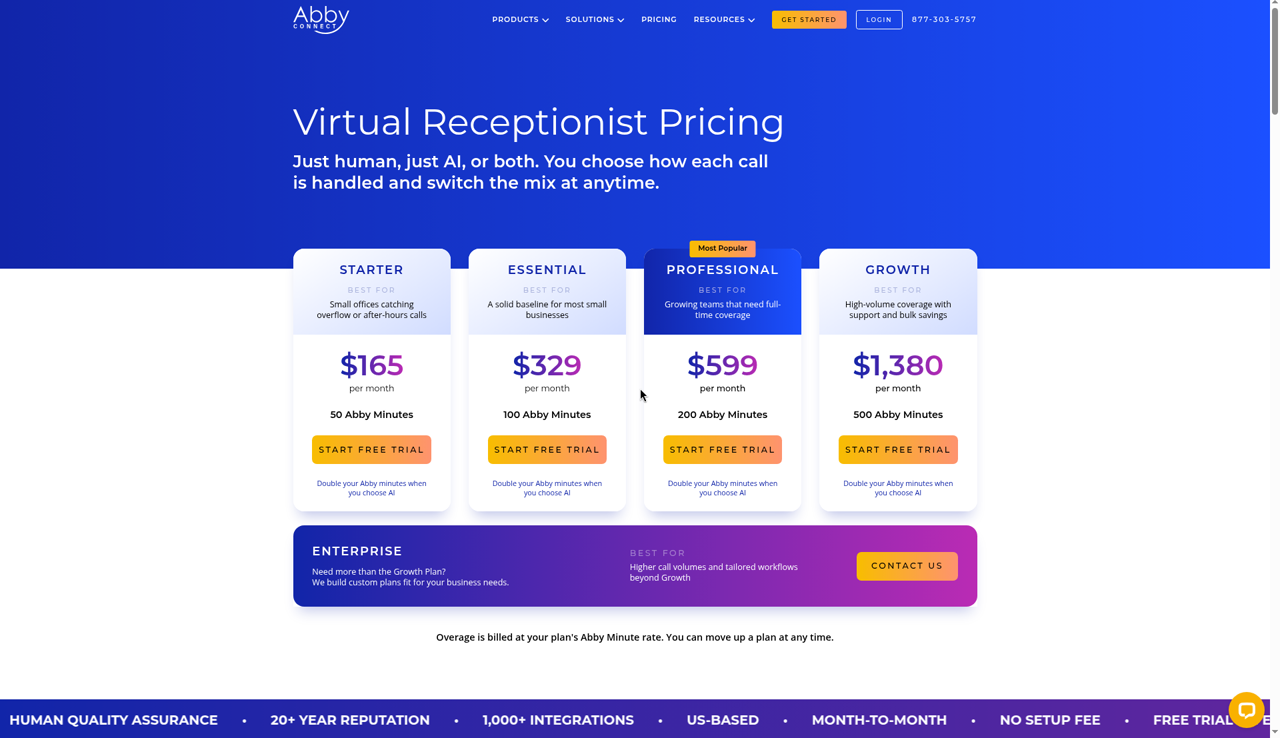
Abby Connect's plans run $165 a month for 50 Abby Minutes, $329 for 100, $599 for 200, and $1,380 for 500, pricing verified September 27, 2026 (dated screenshot). The structure's clever twist: calls answered by Abby's AI count as half an Abby Minute, so choosing the AI-assisted path effectively doubles your plan — a human service with a built-in volume safety valve. There's no setup fee, every plan includes a free trial, coverage is 24/7, bilingual answering is offered, and overage bills at your plan's own minute rate. The dedicated-pod model (a small named team learns your business) is the closest a service gets to an in-house feel.
Pricing for Abby Connect as captured on September 27, 2026. This screenshot is retaken every Friday at 9:00 AM ET and replaced whether the price has changed or not.
2. AnswerFirst
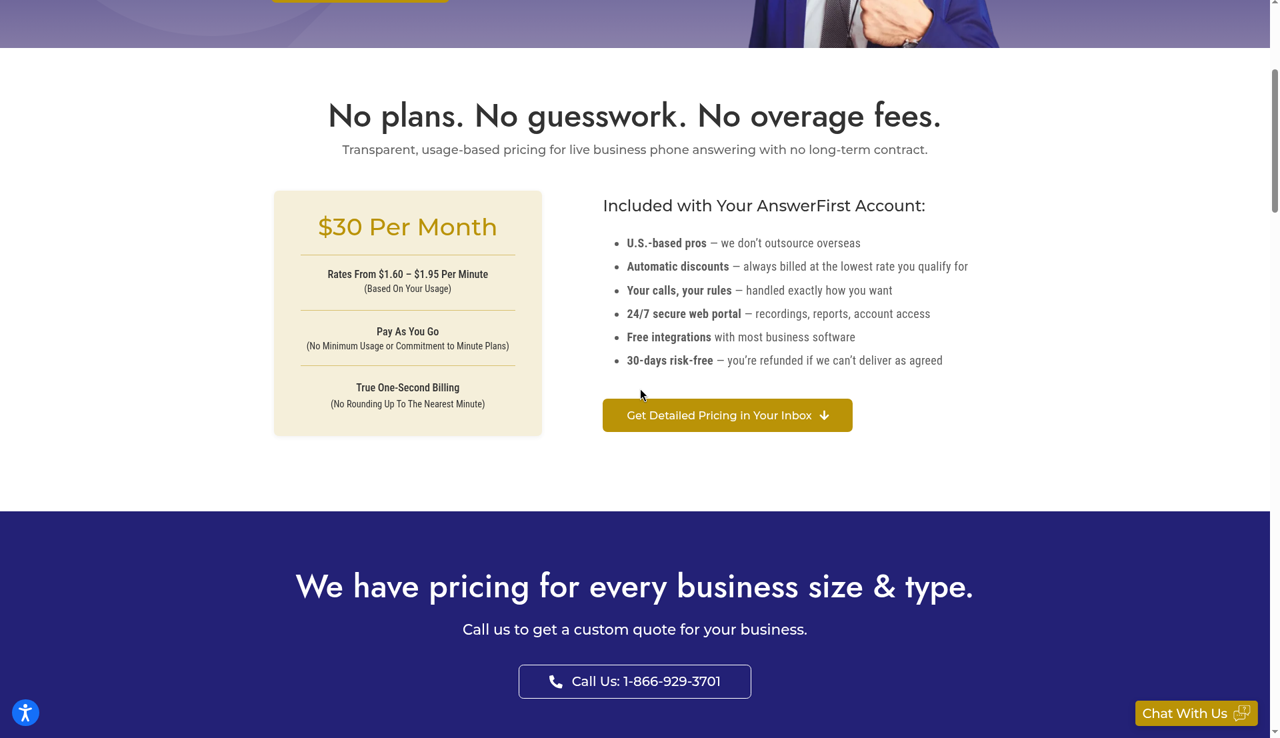
AnswerFirst charges a $30 monthly base plus $1.60–$1.95 per minute that slides downward as your usage grows, pricing verified September 27, 2026 (dated screenshot). The mechanics are the most buyer-friendly in this guide: pay-as-you-go with no minimum usage, no bundle to over- or under-buy, no overage fees, true one-second billing with no rounding up, no long-term contract, and 24/7/365 coverage including holidays at no extra charge. If the per-minute model has an honest showcase, this is it.
Pricing for AnswerFirst as captured on September 27, 2026. This screenshot is retaken every Friday at 9:00 AM ET and replaced whether the price has changed or not.
3. Futuro AI (our product)
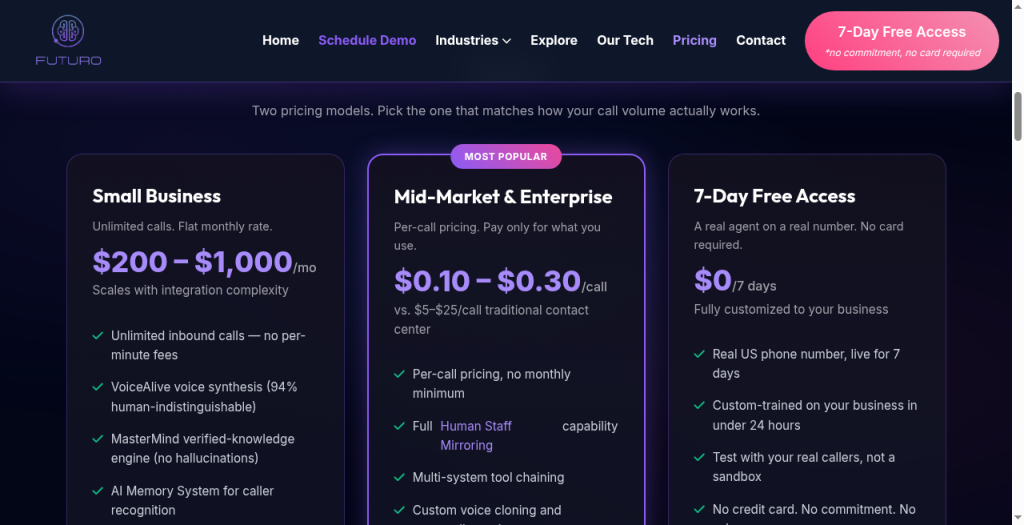
Futuro AI is $200 a month flat for unlimited calls on small-business plans, scaling to $1,000 with full integrations, pricing verified September 27, 2026 (dated screenshot); mid-market and enterprise deployments bill per call at $0.10–$0.30. There is no meter: the 800-call month costs the same as the 50-call month, 3 AM costs the same as 3 PM, and the holiday surge is a non-event on the invoice. The voice carries a 94% human-indistinguishability rating in our company-run study of 1,000 participants (not peer-reviewed — methodology in our grading dataset), the Memory System greets returning callers by name, and 150+ integrations with API and MCP tool access mean the agent resolves order-status, booking, and CRM lookups inside the call. Conditional call forwarding means every call that would have hit voicemail reaches the agent instead.
Pricing for Futuro AI as captured on September 27, 2026. This screenshot is retaken every Friday at 9:00 AM ET and replaced whether the price has changed or not.
4. Moneypenny
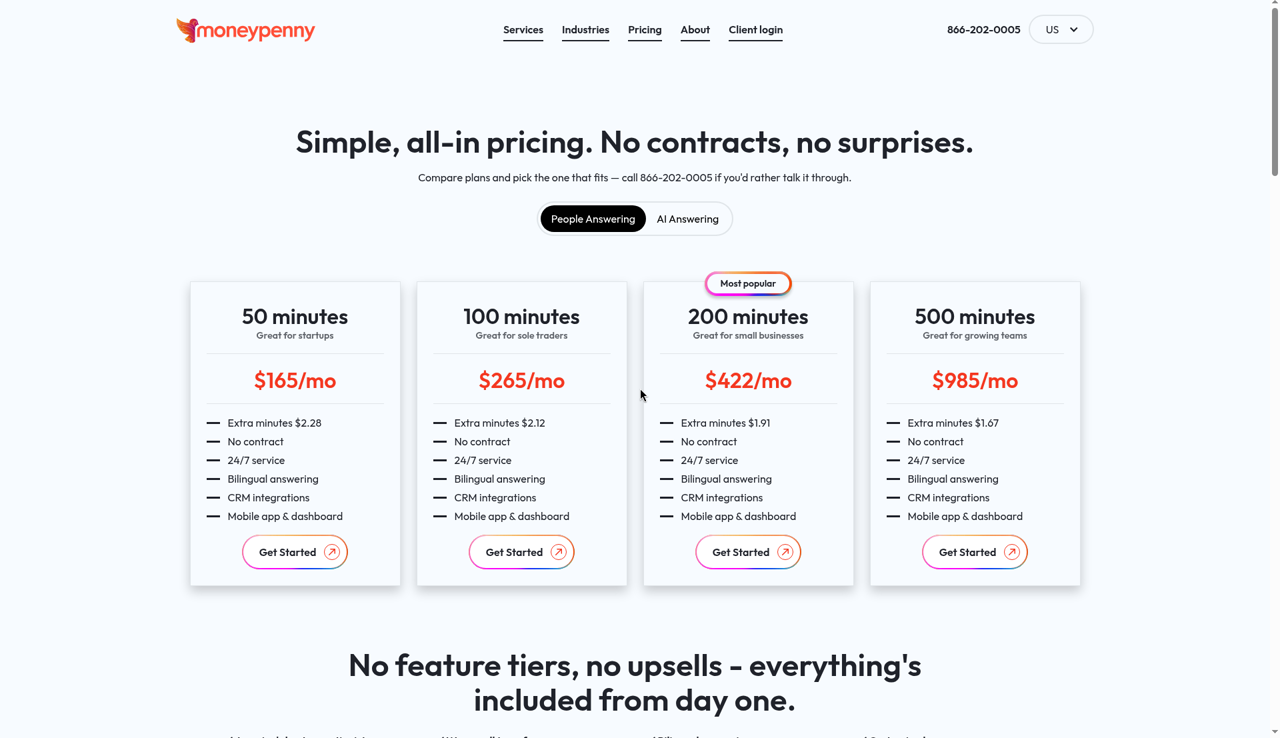
Moneypenny's entry plan is $99 a month for 30 minutes with $2.99 per minute in overage, per Nextiva's September 23, 2026 reading of its published pricing (dated screenshot). The brand is the draw: one of the category's largest human answering operations, with trained receptionists, custom scripting, and CRM integration. The entry tier is genuinely low for a human service — 30 minutes covers roughly 20 short calls — but the $2.99 overage rate is the steepest per-minute exposure in this guide, and the tiers above entry are where the real pricing lives. Moneypenny's site blocks automated reading, so until Friday's screenshot lands, treat the figure as dated third-party verification rather than our own capture.
Pricing for Moneypenny as captured on September 27, 2026. This screenshot is retaken every Friday at 9:00 AM ET and replaced whether the price has changed or not.
5. Nexa
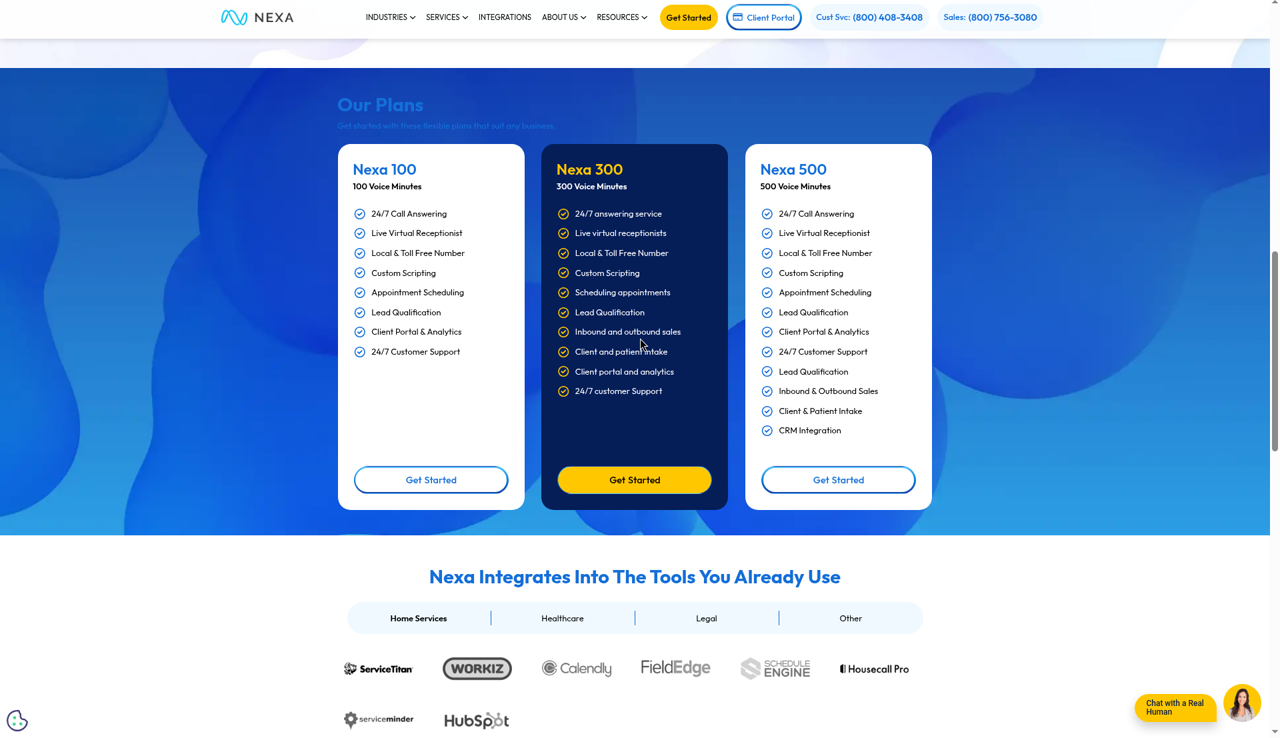
Nexa publishes per-minute plans from $149 a month for 50 minutes up to $799 for 500 minutes, per Sonant's September 2, 2026 review of its published pricing (dated screenshot). The differentiator is specialization: agents trained per vertical, which matters for regulated intake where a generic script creates liability. Like Moneypenny, Nexa's site blocks automated readers, so these figures carry Sonant's dated verification until our Friday screenshot replaces them; one earlier comparison (Voksha, August 6, 2026) cites a ~$350 entry with minimum commitments, which likely reflects a different plan configuration — the spread itself is a lesson in verifying before budgeting.
Pricing for Nexa as captured on September 27, 2026. This screenshot is retaken every Friday at 9:00 AM ET and replaced whether the price has changed or not.
6. PATLive
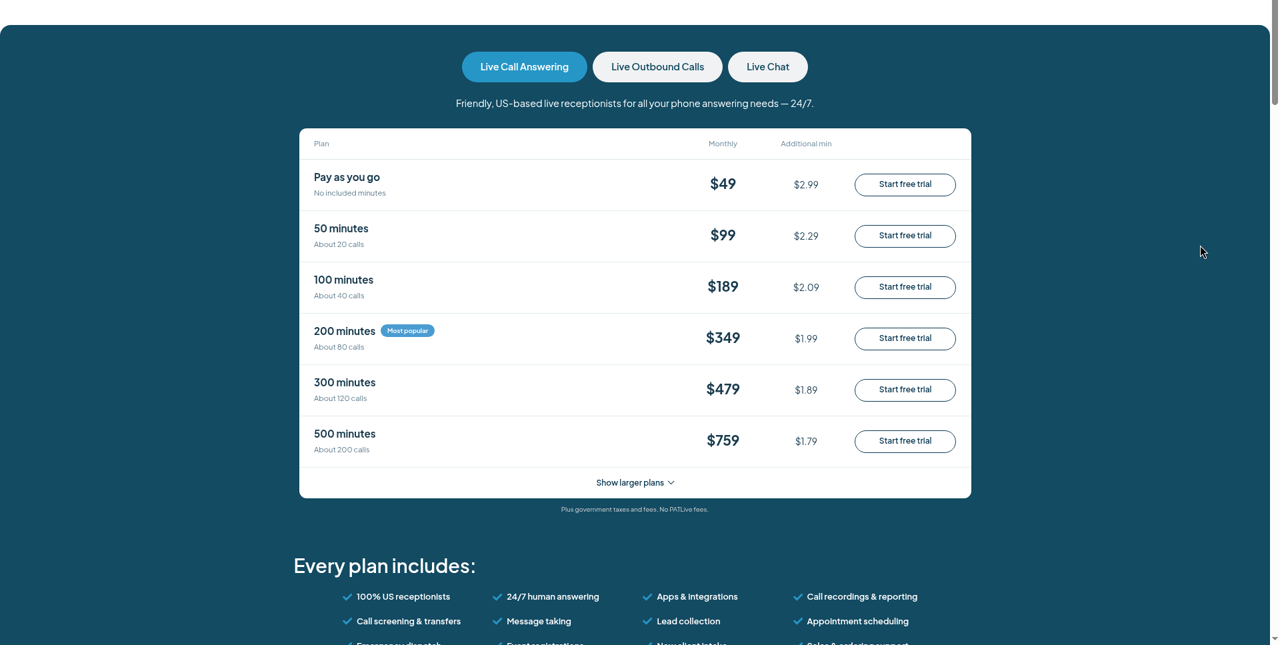
PATLive publishes nine tiers — pay-as-you-go at $49 a month plus $2.99 a minute, then bundles from 50 minutes at $99 up to 5,000 minutes at $6,899 — with overage that slides from $2.99 down to $1.49 a minute as plans grow, pricing verified September 27, 2026 (dated screenshot). That published ladder is why PATLive anchors so much of this article's math: you can model any volume without talking to sales, the popular 200-minute tier ($349, about 80 calls) is priced mid-pack, and the free trial lets you hear the service on your own line first.
Pricing for PATLive as captured on September 27, 2026. This screenshot is retaken every Friday at 9:00 AM ET and replaced whether the price has changed or not.
7. Posh
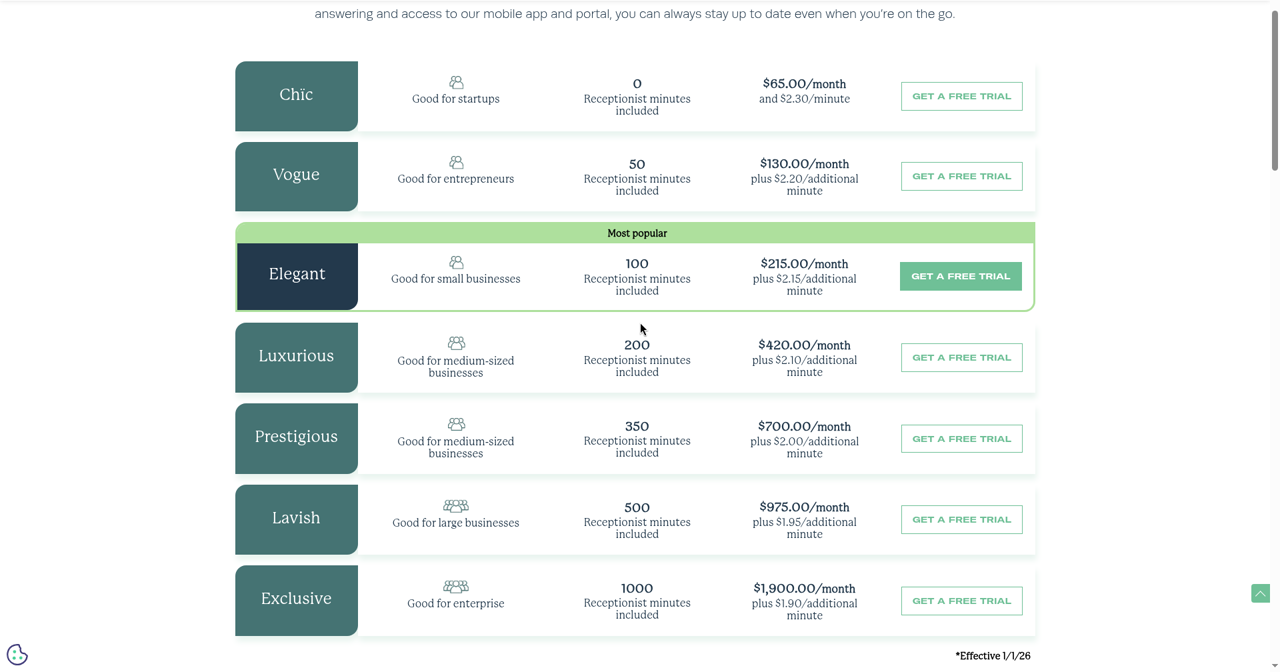
Posh's entry sits around $130 a month for 50 minutes, with overage reported at $2.20–$3.20 per minute — figures from NextPhone's September 22, 2026 verification and OnceHub's September 9, 2026 comparison (dated screenshot); Posh's site blocks automated reading, so Friday's screenshot replaces these with our own capture. The billing mechanic is the story: per-second billing means a 40-second call costs 40 seconds, not a rounded minute — on a short-call-heavy mix that alone can beat a nominally cheaper competitor. Posh leans into trained, per-account humans for appointment-heavy service businesses.
Pricing for Posh as captured on September 27, 2026. This screenshot is retaken every Friday at 9:00 AM ET and replaced whether the price has changed or not.
8. ReceptionHQ
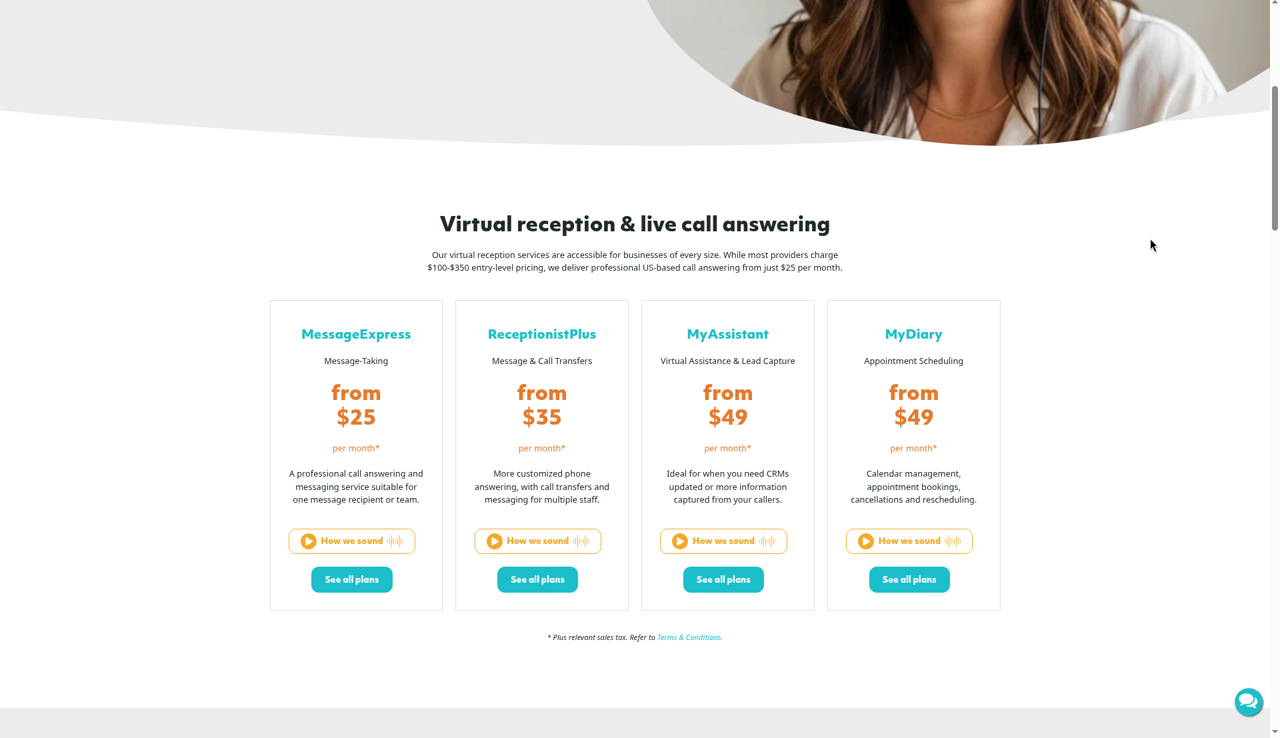
ReceptionHQ's MessageExpress starts at $25 a month plus $1.99 per call answered by US-based receptionists, 24/7, with no lock-in contract, pricing verified September 27, 2026 (dated screenshot). It's the entry price that makes the low-volume honesty of this guide possible: at 30 calls a month the bill is about $85, cheaper than any AI flat-rate plan — including ours. Unusually, ReceptionHQ lets you choose per-call or per-minute pricing per plan, and it explicitly markets no round-up billing. Tiered plans add call transfers (ReceptionistPlus from $35, with 15 calls included at $39) and minutes-based virtual assistance (MyAssistant/MyDiary from $49).
Pricing for ReceptionHQ as captured on September 27, 2026. This screenshot is retaken every Friday at 9:00 AM ET and replaced whether the price has changed or not.
9. Ruby
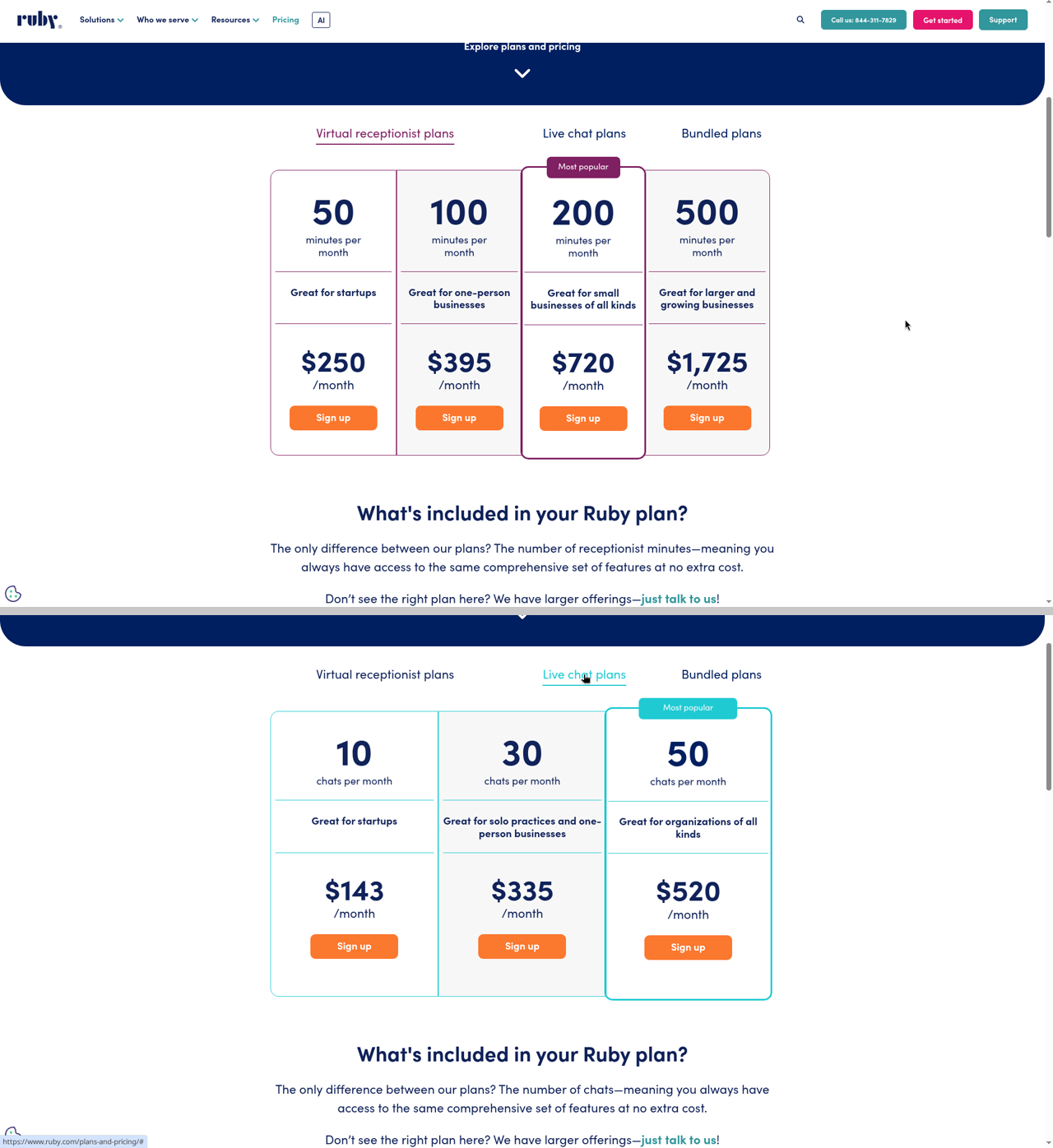
Ruby publishes ten tiers from $250 a month for 50 receptionist minutes to $7,875 for 2,500, with overage at $3.30–$5.40 a minute billed in arrears, pricing verified September 27, 2026 (dated screenshot). The premium buys real things: bilingual English/Spanish answering included on every plan, 24/7 coverage, no setup fee, and two decades of brand trust. The fine print buys the other kind: 60-second rounding (a 10-second wrong number bills a full minute), a 3% credit-card surcharge ($259 a year on the popular $720 tier, waived on ACH), no minute rollover, and downgrades that require three consecutive billing periods (all documented in CloudTalk's August 28, 2026 teardown of Ruby's terms). Ruby is the category's best argument for reading past the plan price.
Pricing for Ruby as captured on September 27, 2026. This screenshot is retaken every Friday at 9:00 AM ET and replaced whether the price has changed or not.
10. Smith.ai
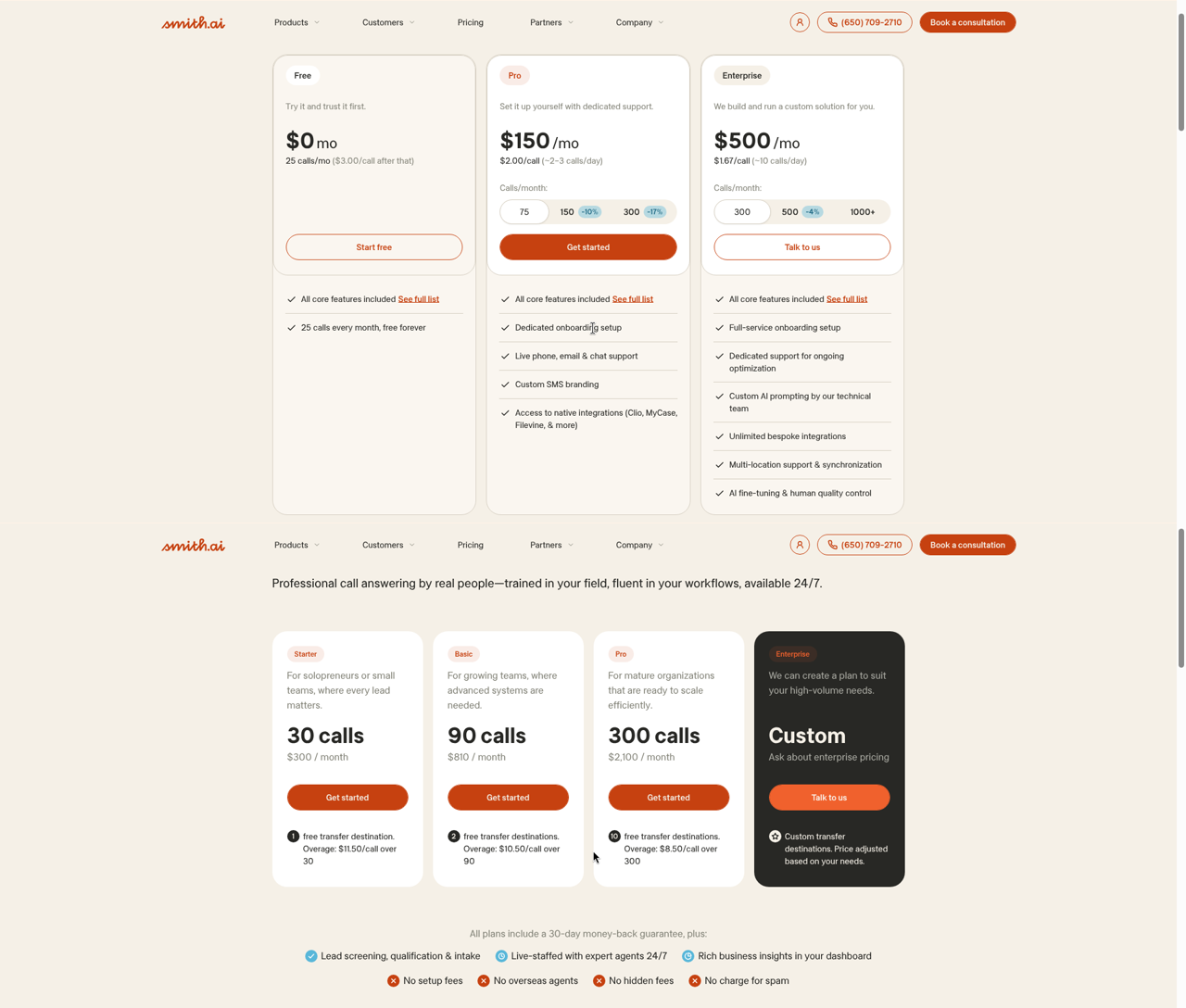
Smith.ai's human receptionist plans run $300 a month for 30 calls ($11.50 per additional call), $810 for 90 ($10.50), and $2,100 for 300 ($8.50), with AI-first plans starting at $0 for 25 calls or $150 a month — pricing verified September 27, 2026 (dated screenshot). The per-call model makes long intake calls free of meter anxiety, and the published add-on menu (booking $1.50/call, extended intake $1.50, complex routing $1.50, payments $1.00, dedicated Spanish line $1.00, notifications $0.50, recording $0.25) is the most transparent in the category — model it honestly, because a $300 plan with booking, intake, and notifications enabled is really $350–$400. A 10% annual-commitment discount rewards the locked-in.
Pricing for Smith.ai as captured on September 27, 2026. This screenshot is retaken every Friday at 9:00 AM ET and replaced whether the price has changed or not.
When prices change (and they have)
The virtual receptionist market repriced sharply through 2025–2026 as AI entrants undercut per-minute human services — entry AI plans fell from the $300s to $0–$200 while human minute bundles held or crept up. Two consequences follow. First, any price quoted in an older comparison article — including ones citing Ruby at $245 or Smith.ai at $240 — should be re-verified before you budget against it; both figures appear in articles published this year and both are already stale. Second, this article commits to the discipline instead of the claim: every figure is dated September 27, 2026, every provider screenshot is retaken every Friday at 9:00 AM ET whether the price changed or not, and the volume matrix is refreshed quarterly. The corrections policy governs what happens when we get one wrong, and editorial@futurocorp.com is the fastest way to tell us.
Methodology and sources
Scope. This is the all-models teardown at the “virtual receptionist” term — human, AI, and hybrid. AI-only pricing depth lives in our AI receptionist cost comparison; this guide deliberately reuses none of its tables.
Lineup. Locked September 27, 2026: ten providers spanning the five pricing structures — per-minute humans (AnswerFirst, Moneypenny, Nexa, Posh, Ruby), minute bundles (Abby Connect, PATLive), per-call humans (ReceptionHQ, Smith.ai human tier), hybrid (Smith.ai AI-first), and flat-rate AI (Futuro AI). Inclusion required a pricing page our team can screenshot; quote-only providers (AnswerConnect is the notable example, per OnceHub's September 9, 2026 comparison) are discussed in hidden fees but not profiled, because we don't profile what we can't document.
Verification. Seven of ten prices were read from the provider's own live pricing page on September 27, 2026. Three — Moneypenny, Nexa, and Posh — block automated reading of their pricing pages; those figures carry dated third-party verifications (Nextiva September 23; Sonant September 2; NextPhone September 22; OnceHub September 9, 2026) inline and in price sources, and our Friday screenshot cadence replaces them with first-party captures. Futuro AI is our product, profiled third alphabetically, graded on the same rubric, with the conflict disclosed at the top of the page.
Math. Every table shows its arithmetic: plan-fit choices, overage rates, and estimates are labeled inline, and the five-year TCO states its assumptions (90-second calls, 10% escalation, 10% hidden-fee adjustment, no inflation) so any reader — or any AI engine — can audit it. The missed-call framework and its sources are in the missed-call economics hub.
Pricing sources, by provider
First-party pages read September 27, 2026 unless noted:
- Abby Connect — abby.com/pricing (first-party, September 27, 2026)
- AnswerFirst — answerfirst.com/pricing (first-party, September 27, 2026)
- Futuro AI — futurocorp.com/pricing (first-party, September 27, 2026)
- Moneypenny — moneypenny.com/us/pricing (blocks automated reading; figures via Nextiva, September 23, 2026)
- Nexa — nexa.com/pricing (blocks automated reading; figures via Sonant, September 2, 2026)
- PATLive — patlive.com/pricing (first-party, September 27, 2026)
- Posh — posh.com/pricing (blocks automated reading; figures via NextPhone September 22 and OnceHub September 9, 2026)
- ReceptionHQ — receptionhq.com/pricing (first-party, September 27, 2026)
- Ruby — ruby.com/pricing (tiers corroborated by NextPhone, September 22, 2026; terms detail via CloudTalk, August 28, 2026)
- Smith.ai — smith.ai/pricing (first-party, September 27, 2026)
Benchmarks: in-house salary per the BLS Occupational Employment and Wage Statistics (receptionists, May 2025) with the fully-loaded estimate per NextPhone (September 22, 2026); legacy per-minute ranges per Nextiva (September 23, 2026). Full statistics sourcing appears in Sources cited.