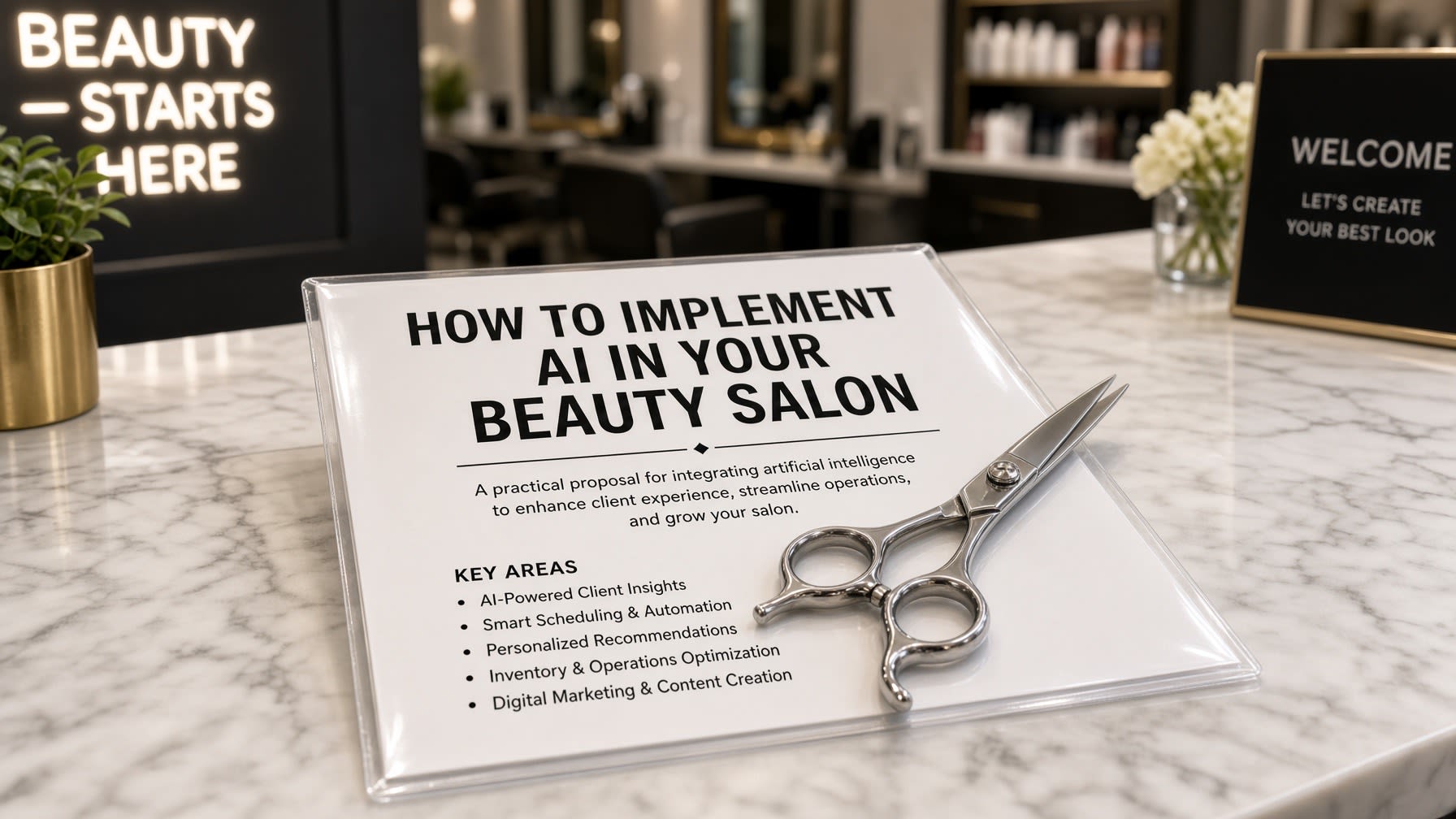
Editorial Disclosure: Futuro Corporation publishes this page and sells an AI receptionist, Futuro AI. This article explains how the three no-show levers work, not why you should buy from us. The evidence comes from peer-reviewed trials, federal regulators, and named salon-software platforms, each labeled at the claim. Futuro AI appears in one section near the end, which also says where a different tool is the better buy. Our own price is on the vendor pricing index, with a dated screenshot.
A salon doesn't sell haircuts; it sells chair-hours. And chair-hours are the most perishable inventory in small business. A retailer with an unsold jacket can discount it tomorrow. A stylist with an empty 2 p.m. slot on Thursday owns that loss forever — the hour expired while the rent, the wage, and the light bill kept running. Every no-show is a tiny expiration event, and they compound.
What does a no-show actually cost a salon?
How big is the leak? It depends who's counting, and honest benchmarking matters here more than anywhere else in this playbook. According to Zenoti's 2025 Benchmark Report — platform data across thousands of beauty and wellness businesses — salons average an 8% cancellation rate and a 3% no-show rate, with the same report noting that automated reminders and prepaid booking are the most effective tools for reducing both. On its cancellation-policy guidance, Zenoti puts it slightly differently: up to 5% of beauty appointments end in a no-show, costing the average salon $6,864 a year. Some industry surveys put the figure far higher — we trace the widely quoted 30% number and its provenance in our guide to the best AI receptionists for salons — and the gap between 3% and 30% is mostly definitions: whether late cancellations count, whether the denominator is booked or confirmed appointments, and who's self-reporting. (For the broad platform comparison behind that pillar, see the guide itself — this article is the playbook, not the buyer's guide.)
So run your own math before you trust anyone's benchmark. A three-stylist salon with 18 bookable hours a day, a five-day week, and an $85 average ticket has 90 chair-hours and $7,650 of potential revenue per week. At Zenoti's platform-average 3% no-show rate, that's about $230 a week — roughly $11,900 a year — evaporating. At 8% cancellations on top, with none of those slots refilled, the exposure roughly triples. The point isn't which number is "true." It's that every point of no-show rate is a known quantity of money, and three levers move it.
1 · Prevent. Reminders that do more than remind — they confirm, and they let the client reschedule inside the conversation. A rescheduled client is not a no-show.
2 · Protect. Deposits and cancellation policies, collected conversationally at booking so the revenue is protected even when prevention fails.
3 · Refill. A waitlist engine that turns a cancellation into a rebooked chair inside the hour, instead of an empty one tomorrow.
Most salons work lever one — passively, with a one-way text blast — and never touch levers two and three, because asking for money is awkward and working a waitlist is labor. That's precisely where AI changes the economics: all three levers are conversations, and conversations are exactly what a good AI receptionist automates. One scope note before the details: this playbook is written for hair salons and color-led businesses. Nail salons run a different rhythm — more walk-ins, shorter services — and get their own guide in this cluster; med spas are out of scope entirely.
Lever 1: how do reminders that can reschedule a client work?
Appointment reminders are one of the most rigorously studied interventions in service operations — because healthcare has been randomizing them for two decades. The flagship evidence is a Cochrane systematic review by Gurol-Urganci and colleagues: eight randomized controlled trials covering 6,615 participants, finding that text-message reminders lifted attendance from 67.8% with no reminder to 78.6% — statistically indistinguishable from phone-call reminders (80.3%) — at 55% and 65% lower cost per attendance in the two studies that measured cost. Two later meta-analyses agree: Robotham and colleagues’ 2016 review of 26 studies in BMJ Open found clients who got a text were 23% more likely to attend (67% vs 54%) and 25% less likely to no-show (15% vs 21%), and Boksmati and colleagues’ review of 28 studies in the Journal of Medical Systems put the pooled odds of attendance with SMS reminders at 1.62×. The mechanism transfers directly to salons: the most common reason clients miss appointments isn't malice or emergency — it's forgetting.
How many touches? At least two. In a randomized study by Ulloa-Pérez and colleagues at Kaiser Permanente Washington covering 158,669 visits flagged as high no-show risk, adding a second text reminder cut no-shows a further 7% in primary care (9.1% → 8.4%) and 11% in mental health (20.1% → 17.9%). And on timing, McLean and colleagues' systematic review and realist synthesis found strong evidence that reminder timing anywhere between one and seven days before the appointment does no harm — so the common salon cadence below is safe to adopt. Two honesty notes. First, these trials are healthcare; salons aren't clinics, so treat effect sizes as directional, not guaranteed. Second, the specific salon cadence (48h + 24h + day-of) is practitioner consensus, not randomized evidence — what the trials establish is that reminders work and that two beats one.
| Touch | Channel | Its job | What good looks like |
|---|---|---|---|
| At booking | Voice (in the booking call) + instant text | Confirm the details, state the policy, take the deposit (Lever 2) | Client repeats the time back; policy acknowledged, not just mentioned |
| 48 hours before | Text | Catch conflicts while there's still time to refill | One-tap confirm or "I need to move" reply path |
| 24 hours before | Voice conversation for high-ticket or high-risk; text otherwise | Confirmation request, not a notice — and a live reschedule option | Client says "confirmed" or rebooks in the same conversation |
| 1 hour before | Text | Day-of nudge: parking, timing, "reply if running late" | Short, friendly, zero friction — this touch prevents late arrivals more than no-shows |
Evidence supports reminders generally and two touches over one; the specific four-touch cadence is practitioner consensus. Anything beyond three or four touches courts reminder fatigue and opt-outs — make each touch do different work.
Confirmation requests vs. passive reminders
Here's the distinction that separates salons that cut no-shows from salons that merely notify them. A passive reminder says "see you Thursday." A confirmation request asks "are you still coming Thursday?" — and, critically, offers a way out that isn't disappearing. The McLean review quantified the difference: patients who received a phone reminder cancelled or rescheduled 17–26% of the time, versus 8–12% with no reminder — and the same review found strong evidence that one-way SMS reminders produce almost no cancellations or reschedules at all, because they're not designed to. Read that again, because it's the key insight of this entire playbook: a rescheduled client is not a no-show. The reminder's job isn't to defend the original slot. It's to surface the conflict early enough to do something about it — move the client, refill the slot, or both. McLean's own conclusion says it plainly: cancellations and rescheduling should be treated as desirable outcomes of a reminder system, not failures.
Voice vs. SMS — and when a call beats a text
For raw attendance, the Cochrane verdict is text and voice are a wash, and text is cheaper — so routine confirmations should be texts. Voice earns its keep where the stakes or the risk are higher. Three situations: high-ticket services (color corrections, extensions, bridal parties) where one empty chair is a $200–400 hole; long lead times — Dantas and colleagues' systematic review of 105 studies in Health Policy found "the most commonly reported significant determinants of no-show were high lead time and prior no-show history," so a balayage booked six weeks out deserves a live confirmation; and clients with prior no-shows, for the same reason. And clients themselves point the same direction: according to Zenoti's 2025 consumer survey, 77% of salon and spa regulars say calling is the easiest way to change an existing appointment — and Zenoti's 2024 survey found 52% of spa customers hang up after three minutes on hold (vendor survey data). The bottleneck was never client willingness to reschedule by phone. It's that your front desk can't pick up mid-balayage. An AI receptionist removes that bottleneck: the 24-hour touch becomes a real conversation in which "I can't make it" turns into "how about Saturday at 11?" — booked, confirmed, and off the no-show ledger.
Lever 2: how do you take deposits without the awkwardness?
Reminders reduce forgetting. Deposits reduce everything else — the casual booking, the double-booked client, the "something came up" that would have become a same-day ghost. The evidence here is platform data rather than randomized trials, and we label it that way: according to Phorest's platform data, appointments booked online see 49% fewer no-shows than those booked by phone or in person, deepening to as much as 65% fewer when a deposit is collected (vendor platform data). Zenoti's benchmark guidance reaches the same conclusion from the other side, naming prepaid booking one of the most effective no-show tools and recommending salons secure payment info upfront, with late-cancellation fees of 50–100% of the service price or a flat fee, disclosed before the appointment (vendor platform data). Nobody has run the salon-deposit RCT; the mechanism, though, is well documented. In Arkes and Blumer’s 1985 field experiment, theater-goers who paid full price for a season subscription attended more plays than those given a discount — a client with money in the chair has made a commitment, and people honor commitments they’ve paid for.
Industry norms: $10–25 flat for routine services, or 20–50% of the service price for high-ticket work — full balayage, extensions, keratin, bridal. New clients and high-ticket services are where deposits earn their keep; your Tuesday-afternoon regular of six years doesn't need one, and asking would cost you goodwill worth more than the risk.
So why do so many salons have a deposit policy they don't enforce? Because the ask is awkward. Front-desk staff skip it for clients they like, apply it to clients they don't, and the policy becomes a favoritism machine that generates exactly one outcome: the client who gets asked feels accused, and the client who doesn't is your next no-show. This is the quiet case for letting AI carry the conversation. A good AI receptionist asks every new client the same way, in the same warm tone, at the same point in the booking call — no awkwardness, no exceptions, no accusations. Consistency isn't a compromise on hospitality; for policies, consistency is hospitality.
The scripts: words that don’t scare clients
“Perfect — I have you down with Marisol this Saturday at 11 for the full balayage, about three hours. To secure that slot we take a $50 deposit, and it comes straight off your total on the day. I’ll text you a secure link to place it now, and your confirmation comes with it — does that work?”
Why it works: “secure” frames the deposit as something the client gets, not something the salon takes. “Comes straight off your total” answers the unspoken objection before it forms. And the link matters: no one, human or AI, should ask a client to read card numbers aloud on a phone call — the client pays on a payment page instead.
"We'll keep a card on file to hold the appointment — nothing is charged today, and nothing is charged at all unless the appointment is missed or cancelled inside 24 hours. You'd just be confirming the slot is really yours."
Why it works: "nothing is charged" twice, upfront. The fee appears only as a consequence of the client's own choices, and "confirming the slot is really yours" positions the card as a mutual commitment.
"Quick heads-up on our policy so there are no surprises: life happens, and you can move or cancel anytime up to 24 hours before — the deposit moves with you, no penalty. Inside 24 hours, the deposit covers part of the time our stylist held for you."
Why it works: leads with permission ("life happens") before the consequence, and "the deposit moves with you" makes rescheduling — the outcome you want — feel free and easy. The fee is framed as covering the stylist's held time, not punishing the client.
"No problem at all — let's find you a better time rather than lose it. I have Friday at 2 or Saturday at 10 with Marisol, and your deposit just moves with you. Which suits you?"
Why it works: this is Lever 1 and Lever 2 shaking hands. The reschedule is offered before the cancellation, two concrete alternatives replace an open-ended "when works?", and the deposit moving with the client removes the last reason to just ghost instead.
Two legal-ish housekeeping notes that aren't legal advice: disclose the policy before taking any payment (a texted confirmation that restates it is good practice), and make forfeiture apply only to genuine no-shows and inside-window cancellations — a deposit that punishes a client who gave you three days' notice is a review-bomb waiting to happen, whatever your rights technically are.
Lever 3: how does waitlist auto-fill refill a cancelled chair?
Levers one and two shrink the number of empty chairs. Lever three is different in kind: it recovers chairs that are already lost. A cancellation at 4 p.m. today for a 10 a.m. slot tomorrow is not yet a loss — it's 18 hours of opportunity, if anyone works it. In most salons, nobody does: the stylist texts a couple of regulars between clients, gets no reply, and the chair sits empty. This is the highest-ROI lever in the playbook and the least covered anywhere in salon content, because doing it manually is genuinely hard labor. It's exactly the kind of labor AI exists for.
The payoff is documented in the reminder research. In the studies McLean's review synthesized, clinics that actively worked their cancellations re-allocated 27–40% of cancelled slots to other patients (peer-reviewed) — with staff phoning waitlists one by one, during office hours. And the demand side is proven: Zenoti's survey data shows 81% of salon regulars manage their appointments outside business hours at least sometimes, and its benchmark data shows top-earning salons rebook clients within 24 hours at three times the average rate (vendor platform data). An automated cascade does at 4:01 p.m. what a busy front desk can't do at all — and reaches clients in the evening, exactly when they can actually talk.
The cascade, step by step
- Cancellation lands. Any channel — phone call, text reply to a reminder, online portal, or a reschedule inside an AI reminder conversation. The slot (10 a.m. tomorrow, 90 minutes, Marisol, color) is flagged open instantly.
- Waitlist gets sorted by your rules. Priority order you set once: clients who asked for that day-part first, then longest waiting, then service fit — a 90-minute gap goes to a 90-minute service, not a 30-minute bang trim.
- Wave one goes out. The top three to five clients get a call or text simultaneously: "Marisol had a 10 a.m. open tomorrow — want it? First to confirm takes it." Genuine urgency, no pressure tactics.
- First yes books the slot. The client confirms in the same conversation — by voice or reply text — the booking is written to your calendar, the confirmation and policy go out, and the cascade stops for everyone else.
- No takers in 20 minutes? Wave two. The next priority batch gets the offer. The window matters: tomorrow-morning slots decay by the hour, so the cascade runs fast and tight rather than polite and slow.
- Still open? Escalate to humans. The slot goes to the front desk or the stylist's own regulars list with full context — who's been asked, who declined, who's left. No client gets asked twice.
- Log everything. Offers sent, responses, time-to-fill, and the final outcome feed your refill rate — the metric that tells you Lever 3 is paying for itself (next section).
This list is the piece of the playbook most worth lifting into your own operations doc. Step 3 has a legal boundary if the offer is an AI-voiced call — see when this playbook doesn’t pay off.
Two design rules make or break the cascade. Match the slot, don't just fill it: a 90-minute color gap offered to a 30-minute trim client fills 33% of the hole and blocks a better fit. Guard the client's trust: cap how often any client gets cascade offers (once a week is plenty), and always give a one-tap "take me off the list" — a waitlist that feels like spam is a churn machine.
What should you measure, and what does good look like?
You can't improve a leak you haven't metered. Before changing anything, pull eight weeks of appointment history and compute your own baseline — because as the benchmarking discussion above shows, published no-show rates range from 3% platform averages to the double-digit survey figures our pillar guide traces, and none of them is your salon. Then track five numbers weekly:
| Metric | How to compute it | What good looks like |
|---|---|---|
| No-show rate | No-shows ÷ booked appointments — sliced by service type, new vs. returning client, and day-part | Under 5% overall; Zenoti's platform average is 3% (vendor platform data). Watch the slices: Saturday mornings and new-client high-ticket bookings are where it hides |
| Cancellation rate + notice given | Cancellations ÷ booked appointments; separately, median hours of notice | Zenoti's average is 8% (vendor platform data) — but notice is the real tell. Rising cancellations with 48h+ notice is the system working (that's a rescheduled client, not a no-show) |
| Refill rate | Cancelled slots rebooked before the time passed ÷ all cancelled slots | 27–40% is what manually-worked waitlists achieved in the clinical studies (peer-reviewed); an automated cascade should meet or beat it. Below 15%, your priority rules or wave timing need work |
| Reminder response rate | (Confirmations + reschedules) ÷ reminders sent, per touch | No universal benchmark exists — establish your own in week one, and treat any touch under 50% response as a message problem, not a client problem |
| Deposit compliance | Bookings with deposit/card on file ÷ bookings where policy required one | 95%+ — anything lower means the ask is being skipped, which is the consistency problem Lever 2 exists to solve |
Two of these deserve extra comment. Day-part slicing matters because no-shows cluster: the Dantas review's predictors — long lead time and prior no-show history (peer-reviewed) — tell you who to watch, but your own data will tell you when, and the fix is often cadence, not policy (an extra 24-hour voice touch for Monday-morning color bookings, say). And rising cancellations are not failure — if reminder response and refill rate climb with them, your system is converting ghosts into rebookings, which is the entire point. The Kaiser team took this logic furthest, using a prediction model to aim the extra reminder only at the riskiest 40% of visits (peer-reviewed); you can approximate it with nothing fancier than a no-show-history flag in your booking software.
The tracking template
Copy this into a spreadsheet and fill it every Friday — ten minutes, one row per week. It is deliberately boring; boring is what survives past week three.
| Week of | Booked | Showed | No-shows | Late cancels | Refilled | No-show % | Refill % | Reminder resp. % |
|---|---|---|---|---|---|---|---|---|
| Oct 12 | 132 | 121 | 6 | 5 | 2 | 4.5% | 18% | 71% |
| Oct 19 | — | — | — | — | — | — | — | — |
Example row uses a hypothetical week. Split rows by service category once the habit sticks — color, cuts, treatments — because aggregate numbers hide exactly the pockets the three levers fix.
Which lever should your salon start with?
The three levers are the same for every salon; the order you pull them in is not. Find the situation closest to yours.
If you work alone or rent a booth
You are the front desk, which means every reminder you skip and every cancellation you don’t chase comes straight out of your own chair-hours. Plenty of stylists are in this position: the U.S. Bureau of Labor Statistics counts 48% of barbers, hairstylists, and cosmetologists as self-employed, and notes that some lease booth space from a salon owner. Start with Lever 1 — a two-way 24-hour confirmation — and a deposit rule for new clients only. Your waitlist can be a pinned note on your phone until the volume justifies more.
If you run a three-to-six-chair salon with a front desk
Your front desk can send reminders; what it can’t do is phone a waitlist at 4 p.m. while checking out two clients and answering a third. That makes Lever 3 your biggest gap. Run the Thursday fake-cancel drill from the checklist before you buy anything: if your current setup refills the slot inside an hour, you’re fine; if the slot is still empty at close, that hour is what automation buys back.
If your book is color-led and high-ticket
One empty balayage chair is a $200–400 hole, and those bookings are often made weeks ahead — exactly the long lead time the Dantas review found most predictive of a no-show. Deposits of 20–50% belong here, plus a 24-hour voice confirmation rather than a text. Match the cascade to the gap, too: a three-hour color slot should go to another color client, not three trims.
If most of your bookings are new clients
New clients have no history with you and nothing invested yet, which is why deposits earn their keep here. Steer new clients toward online booking where you can: Phorest’s platform data shows online bookings carry 49% fewer no-shows than phone or walk-in bookings, rising to 65% fewer with a deposit (vendor platform data). For the new clients who still phone, the deposit-ask script above is the one to adopt word for word.
If your book is mostly long-standing regulars
Skip deposits for your regulars — the goodwill is worth more than the risk, as noted above. Your leak is more likely late cancellations than ghosts, so watch the notice-given number in the tracking table, keep one light reminder, and put your effort into Lever 3: a regular who cancels on Tuesday frees a slot another regular would happily take.
If you already run Zenoti, Phorest, or another platform’s built-in tools
Turn those on before you buy anything else. Zenoti’s Automated Waitlist Management says it fills appointment cancellations “without front desk intervention,” and Phorest automates SMS and email reminders with risk-based deposits. If your clients book online and rarely phone, those built-ins cover all three levers and you do not need an AI receptionist — ours or anyone’s. What they don’t do is hold the phone conversation: the client who calls to move a booking, or the 24-hour voice confirmation.
If your clients speak more than one language
A confirmation request the client doesn’t fully understand is a no-show waiting to happen. Reminders, the policy statement, and the deposit ask should reach each client in the language they book in. The McLean review notes that reminder systems can cater for different languages. When you test any tool, run the reschedule save in your clients’ second language, not just English. Futuro AI is sold in 53 languages; that’s our own figure, so test it rather than take it on trust.
If Saturday is where your no-shows pile up
Slice your baseline by day-part before you change anything. If Saturday mornings carry the leak, the fix is usually cadence, not policy: add a Friday-afternoon voice confirmation for Saturday color bookings, and fire the waitlist cascade on Friday evening, when clients can actually answer, rather than at 8 a.m. Saturday, when the slot is already lost.
How do you install the whole system in one salon week?
Everything above installs in five working days alongside normal operations. Here's the week:
Monday — Baseline
- Pull 8 weeks of appointment history
- Compute no-show % by service, client type, day-part
- Count cancelled slots that got refilled (your honest refill rate)
- Write the dollar number on the whiteboard — that's the prize
Tuesday — Policy & scripts
- Set deposit rule: which services, which clients, how much
- Set the notice window (24 or 48 hours) and the late-cancel fee
- Adapt the four scripts above to your salon's voice
- Publish the policy on your site and booking confirmations
Wednesday — Reminder cadence
- Configure the four touches: booking, 48h, 24h, 1h
- Turn on two-way confirmations — "reply C to confirm, R to reschedule" is the minimum viable version
- Route high-ticket and long-lead bookings to the voice touch
- Test-fire the whole sequence on your own phone
Thursday — Waitlist engine
- Build the waitlist if you don't have one (a column in your booking software counts)
- Write your priority rules: day-part match, longest waiting, service fit
- Set wave size and timing; cap offers at one per client per week
- Run a live drill: fake-cancel a slot, watch the cascade work
Friday — Train & launch
- Walk the team through what the AI says and when humans take over
- Go live on next week's bookings only — never retroactively on existing ones
- Set the standing Friday 30-minute metrics review
- Expect a couple of grumbles in week one; consistency outlasts them
When does this playbook not pay off?
The levers aren’t free, and four situations are where they stop paying for themselves.
Your baseline is already low. If eight weeks of history show almost no no-shows and your cancelled slots already refill, the levers have little left to recover. Keep the tracking table and spend your money elsewhere.
You don’t have consent for automated calls. In February 2024 the FCC ruled in its declaratory ruling on AI-generated voices that they count as “artificial” voices under the Telephone Consumer Protection Act. The FCC’s consumer guide puts it plainly: “AI-generated voice calls are illegal unless the consumer has agreed to receive them or the caller is exempt.” An AI-voiced reminder or waitlist call should go only to clients who agreed to receive one, so capture that consent at booking and honor opt-outs immediately. This is not legal advice; ask your attorney how it applies to your salon and state.
Your clients don’t pick up. McLean’s review found that successful contact rates for telephone reminders run only 30–60% in most healthcare settings. A voice confirmation nobody answers is worth less than a text that gets read, so the voice touch is for high-ticket and high-risk bookings, with text as the fallback.
The waitlist is empty. A cascade can only offer the slot to people who asked for one. If nobody is on your list, Lever 3 has nothing to work with — build the list first, from booking requests you couldn’t fit.
How do you test a no-show tool, ours included?
A word on tooling, kept honest. Everything in this playbook can be duct-taped with booking-software reminders and a disciplined front desk — salons did it for years. What AI changes is the labor economics: the confirmation conversation, the deposit ask, the reschedule save, and the waitlist cascade all happen on every booking, not on the bookings someone had time for. When you evaluate tools — any vendor, ours included — the three questions that matter are the three levers: Can it reschedule inside the reminder? Can it collect a deposit during the booking call without anyone reading card numbers aloud? Can it refill a cancelled slot against my actual calendar? Integration with your booking software is the make-or-break; our integrations matrix shows what that looks like for one platform, and any serious vendor should answer the same way.
Fifteen minutes, run against every finalist, ours included. Write down what happens; a vendor that won’t let you run it has answered the question.
- Book a high-ticket service as a new client. Does the deposit ask come at the right point, in words like the script above, and arrive as a payment link rather than a request to read your card number?
- Call back and say you can’t make it. Are you offered two concrete alternatives before anyone mentions a fee, and does the deposit move with you?
- Fake-cancel a slot in your own calendar. Time how long until someone on the waitlist is offered it, and check that the offered service fits the gap.
- Change one rule and test again. Raise a deposit amount or the notice window, then rebook. Does the tool quote the new rule, or the old one?
- Ask it something it can’t know. “Is Marisol running late today?” The right answer is an honest “I’ll check and text you,” not a guess.
Futuro AI answers the salon line, writes bookings into Vagaro, Fresha, Boulevard, or Mindbody, sends text reminders including an hour-before reminder, places outbound confirmation calls where you enable them, and collects deposits by texting a unique payment link through Stripe or Square — clients pay on the payment page, never by reading a card number to the agent. When a client cancels, the slot is immediately open for booking again, so the next caller can take it. In Futuro’s own 1,000-participant double-blind study (the Futuro Corporation Human Indistinguishability Double-Blind Study, company-run and not peer-reviewed), 94% of participants couldn’t tell it from human staff, which matters here because a deposit ask only works if the call doesn’t feel like a robocall. It is $200 a month flat; the dated screenshot is on our vendor pricing index.
The stale rule is ours. The agent applies exactly the deposit amount, notice window, and policy wording you gave it at setup. If you raise the balayage deposit and don’t tell us, it will keep asking for the old amount — politely, consistently, on every call. That is the system working as designed and still costing you money, which is why test step 4 exists.
A link is not a payment. A client who never opens the payment link leaves the deposit uncollected; your desk still has to follow up, or the booking stands unsecured.
Lever 3 is only half ours. A cancelled slot is immediately open for booking again, but offering it to your waitlist in priority order — the right client for the right gap, first — is what Zenoti’s built-in Automated Waitlist Management does natively. If refilling cancelled slots is your main problem and your clients book online, Zenoti is the more direct buy for Lever 3.
Frequently Asked Questions
Quick answers on salon no-shows, reminders, deposits, and waitlist auto-fill — each written to stand alone, so answer engines can lift any one of them cleanly.
On large booking platforms, salons average roughly a 3% no-show rate and an 8% cancellation rate, and no more than about 5% of beauty appointments end in a no-show, according to Zenoti's benchmark data. Industry surveys that count late cancellations as no-shows run much higher. A realistic 2026 target is under 5% no-shows, with a refill rate above 30% on the slots that do cancel.
Yes. A Cochrane systematic review of eight randomized controlled trials with 6,615 participants found that text message reminders lifted attendance from 67.8% with no reminder to 78.6% — about as effective as phone call reminders and 55 to 65 percent cheaper per attendance. The evidence comes from healthcare, but the mechanism — forgetting is the most common reason people miss appointments — applies directly to salons.
For pure attendance they perform about the same, and texts cost less. The difference shows up when the client cannot make it: phone conversations produce cancellation-and-reschedule rates of 17 to 26 percent, while one-way texts rarely produce any reschedule at all. The practical answer is both — text for routine confirmations, and a voice conversation for high-ticket services, long lead times, and clients with a history of no-shows.
The evidence supports at least two touches: a Kaiser Permanente Washington randomized study of more than 158,000 visits found that adding a second text reminder cut no-shows a further 7 to 11 percent among high-risk visits. Common salon practice is a booking confirmation, a 48-hour reminder, a 24-hour confirmation request, and a one-hour day-of nudge. Beyond three or four touches you risk reminder fatigue and opt-outs, so make each touch do different work.
Industry norms cluster around $10 to $25 flat for routine services, or 20 to 50 percent of the service price for high-ticket work like color corrections, extensions, and bridal parties. Zenoti's policy guidance suggests late-cancellation fees of 50 to 100 percent of the service price or a flat fee, disclosed upfront. Whatever you choose, consistency matters more than the number — the same rule for every client, every time.
It adds a small amount of friction, and that is partly the point: a client unwilling to put $20 toward a $200 color appointment is statistically your most likely no-show. Phorest's platform data shows appointments booked online see 49% fewer no-shows than phone or walk-in bookings, deepening to as much as 65% fewer when a deposit is collected. Framing does the heavy lifting — “it secures your slot and comes off your total” reads as a benefit, while “we charge a fee if you don't show” reads as a threat.
When a cancellation lands, the system flags the open slot, sorts the waitlist by rules you set — who asked for that day and time, who has waited longest, whose service fits the gap — then calls or texts clients in order until one confirms and books. The first yes takes the slot and the cascade stops. Healthcare clinics working waitlists by hand re-fill 27 to 40 percent of cancelled slots; an automated cascade does the same work in minutes instead of hours.
Yes, where the reminder is a call or a two-way text — that is the single biggest upgrade over blast reminders. When the reminder is a two-way conversation, the client who says “I can't make Thursday” can be offered Friday at 11 or Saturday at 2 and booked on the spot. In the reminder research, phone conversations produced cancellation-and-reschedule rates of 17 to 26 percent versus 8 to 12 percent with no reminder — and every one of those reschedules is a no-show that never happened.
Track five numbers weekly: no-show rate by service type, client type, and day-part; cancellation rate and how much notice was given; refill rate, meaning the share of cancelled slots rebooked before the time passed; reminder response rate, meaning confirmations and reschedules per reminder sent; and deposit compliance. Your own eight-week baseline matters more than any industry benchmark.
About one working week for a single salon: one day to audit your no-show baseline, one to write policies and scripts, one to configure the reminder cadence, one to build waitlist rules and test the cascade, and one to train the team and go live. The full day-by-day checklist is in the implementation section of this playbook.
Yes, for AI-voiced calls. The FCC ruled in 2024 that AI-generated voices count as artificial voices under the Telephone Consumer Protection Act, and its consumer guide says such calls are illegal unless the consumer has agreed to receive them or the caller is exempt. Capture consent at booking, honor opt-outs immediately, and ask your attorney how the rules apply in your state. This is not legal advice.