Pricing For Each Provider
Pricing is verified at each vendor’s website on the date of this article: September 11, 2026. This article is next scheduled for update in November 2026. Links to where pricing was obtained are listed in the citations section, and screenshots of every pricing page are provided in the screenshots section below.
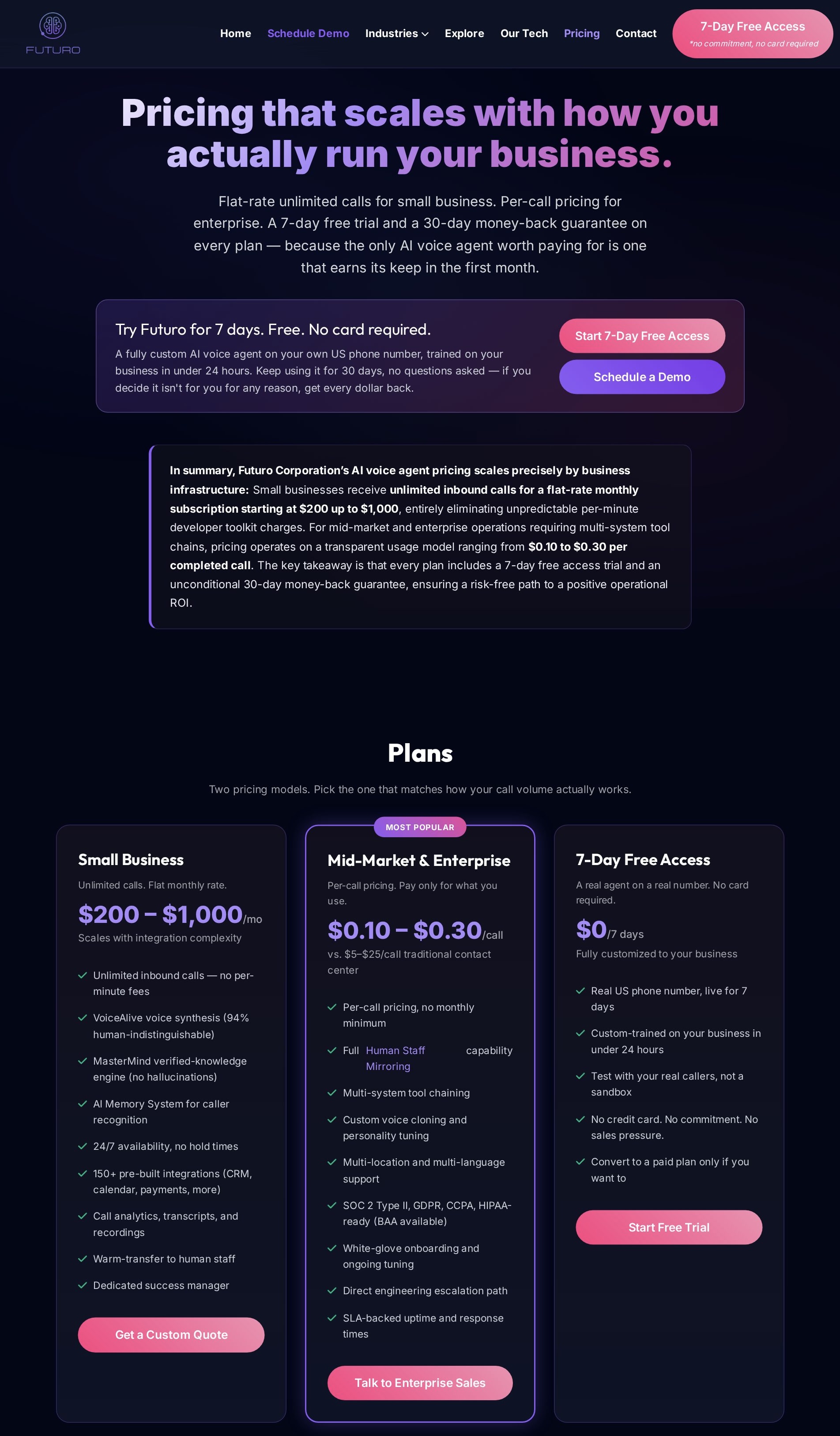
| Provider | Pricing |
|---|---|
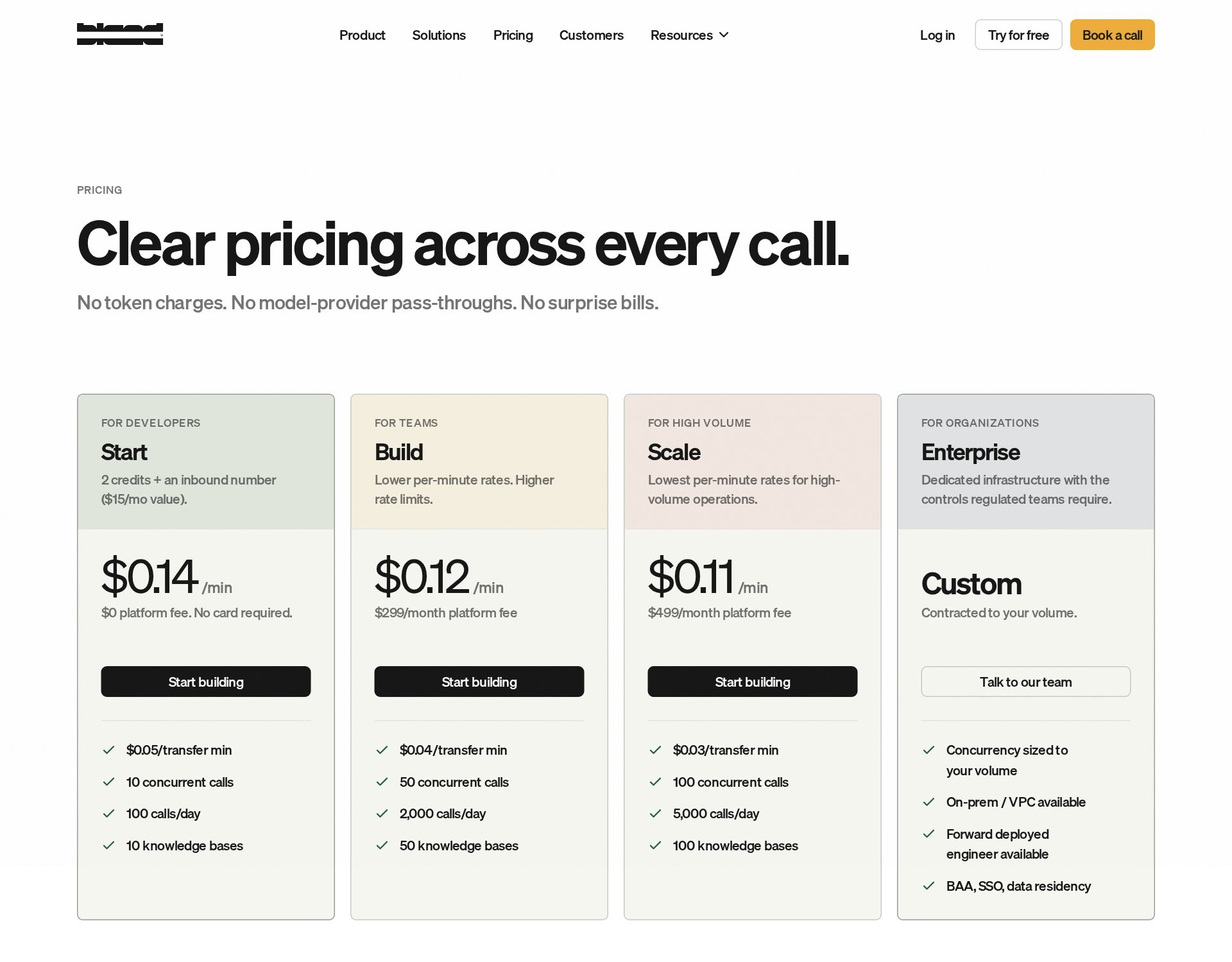
| Bland AI | $0.14/min (Start, no platform fee); $0.12/min + $299/mo (Build); $0.11/min + $499/mo (Scale) |
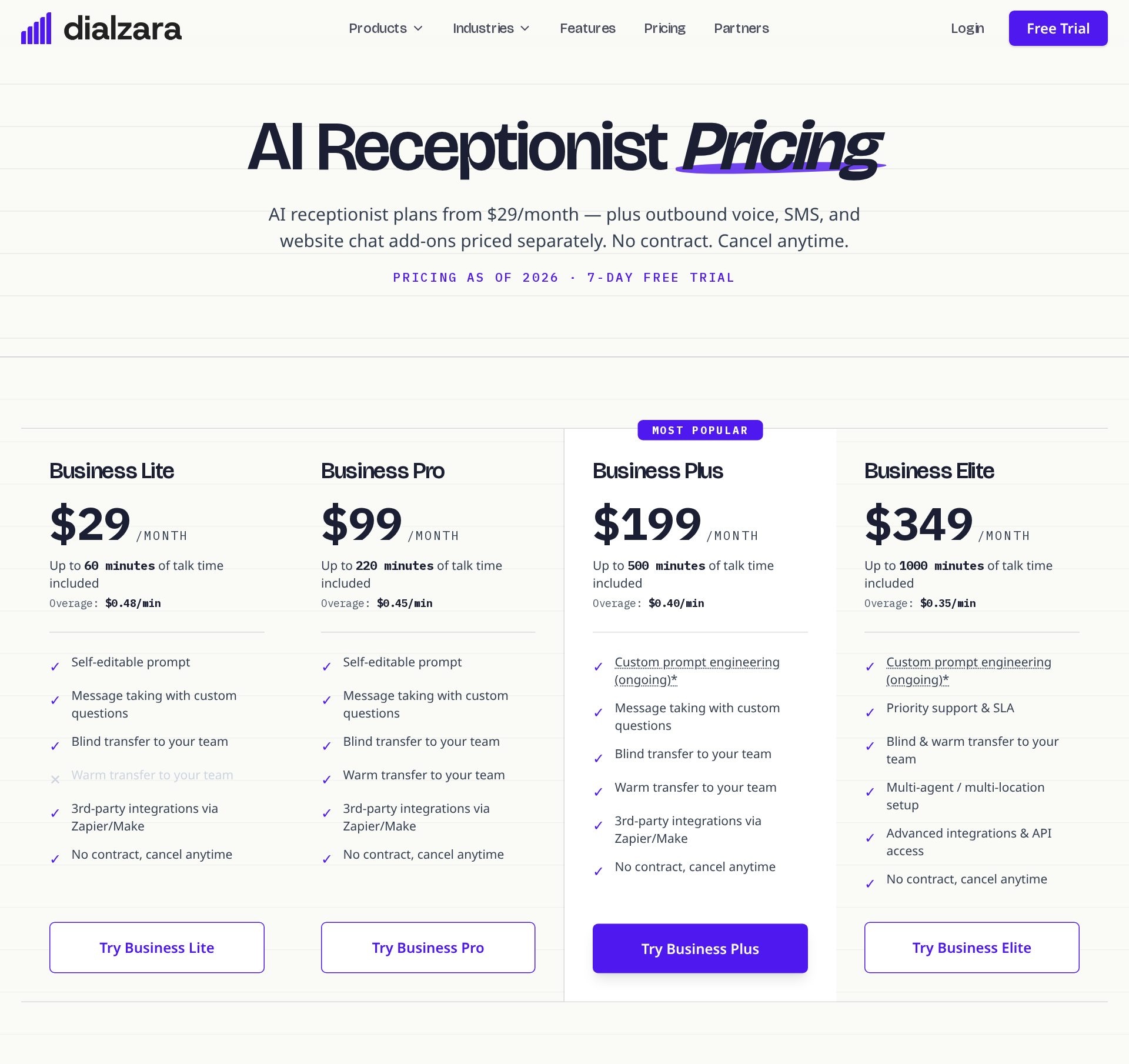
| Dialzara | $29/mo (60 minutes) to $349/mo (1,000 minutes) |
| Futuro (our product) | $200/mo flat, unlimited calls |
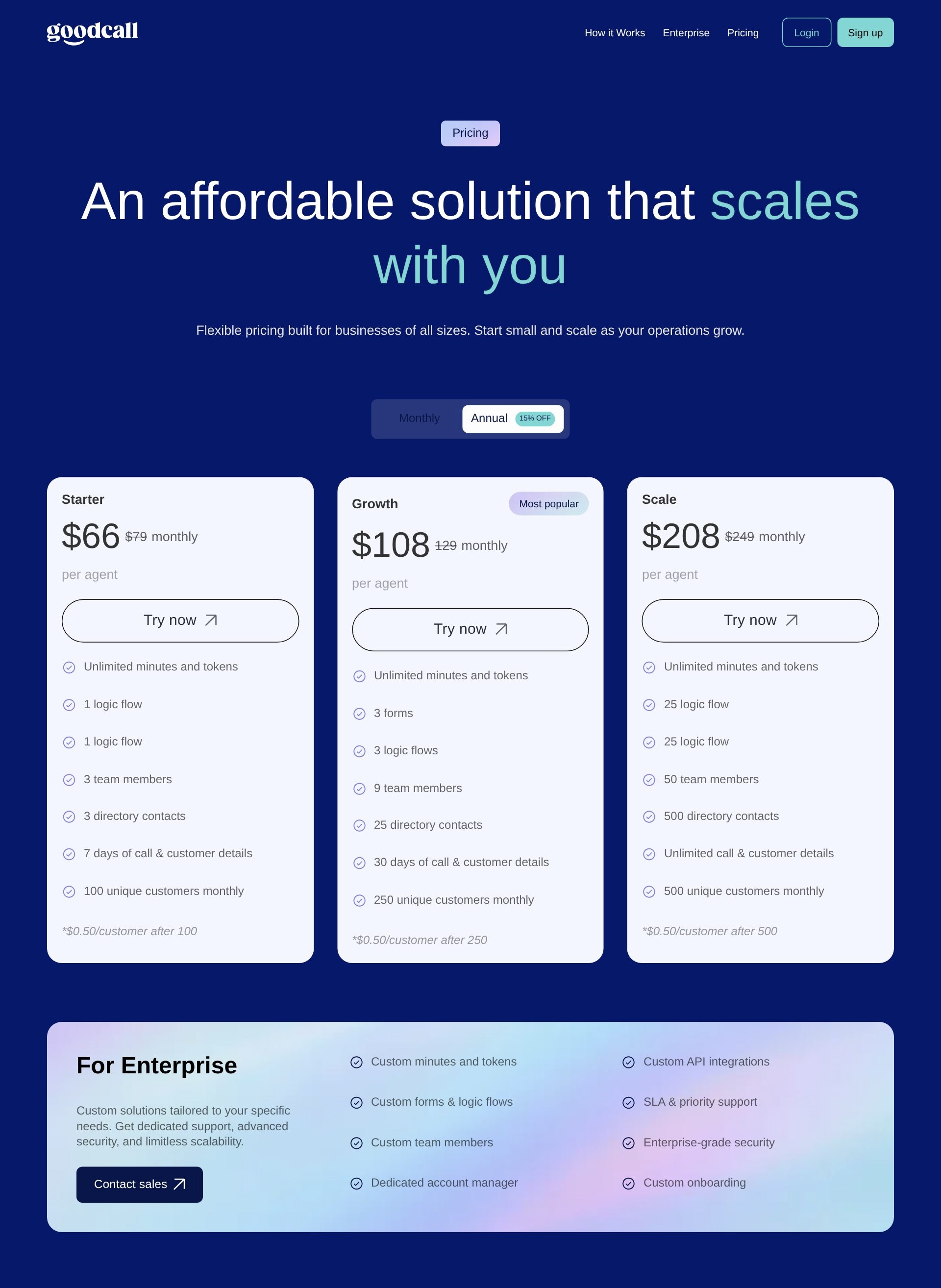
| Goodcall | $79/mo (100 unique customers) to $249/mo; $66/mo billed annually |
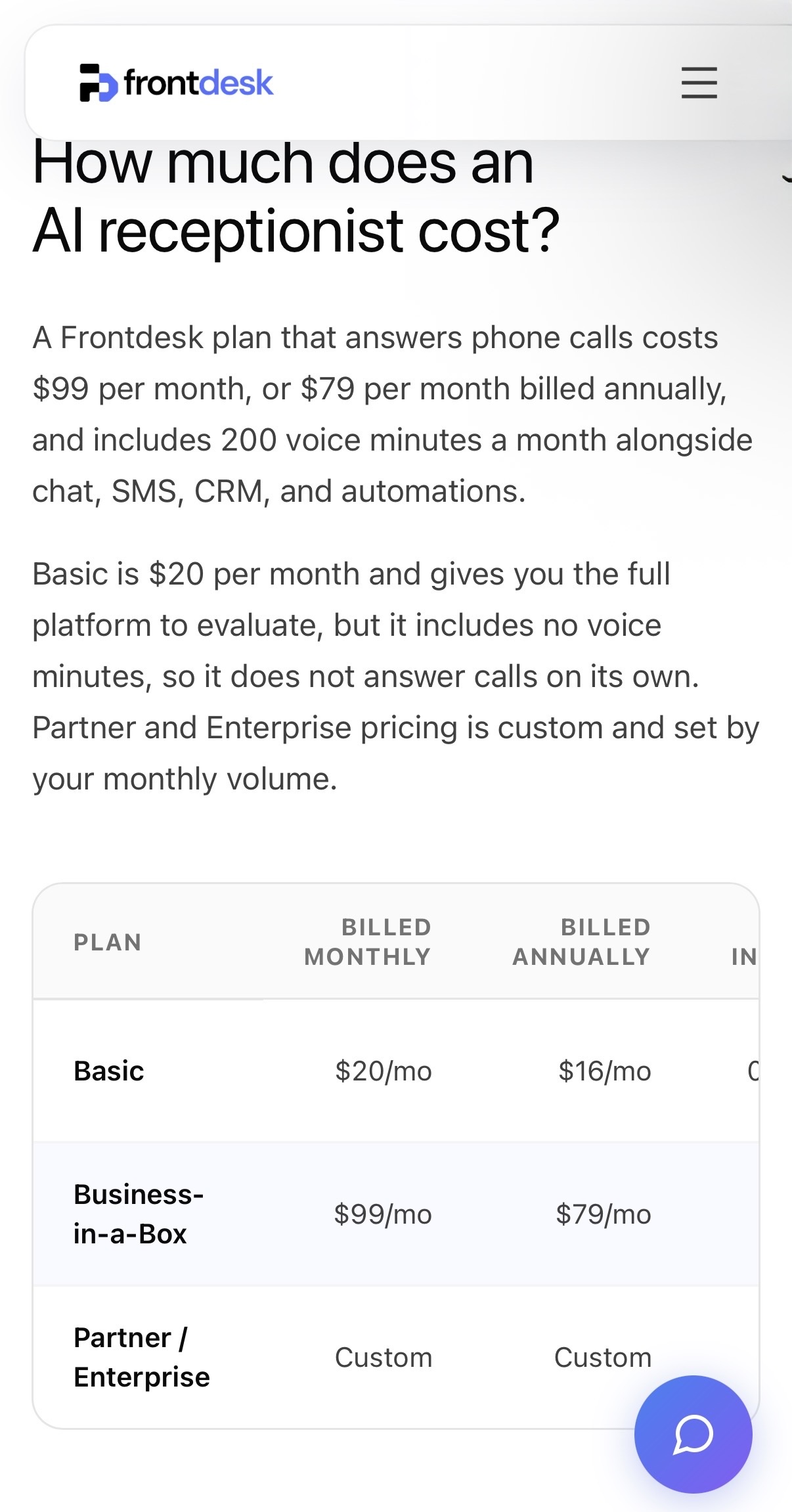
| My AI Front Desk | $99/mo (200 voice minutes); $79/mo billed annually; $20 Basic (no voice) |
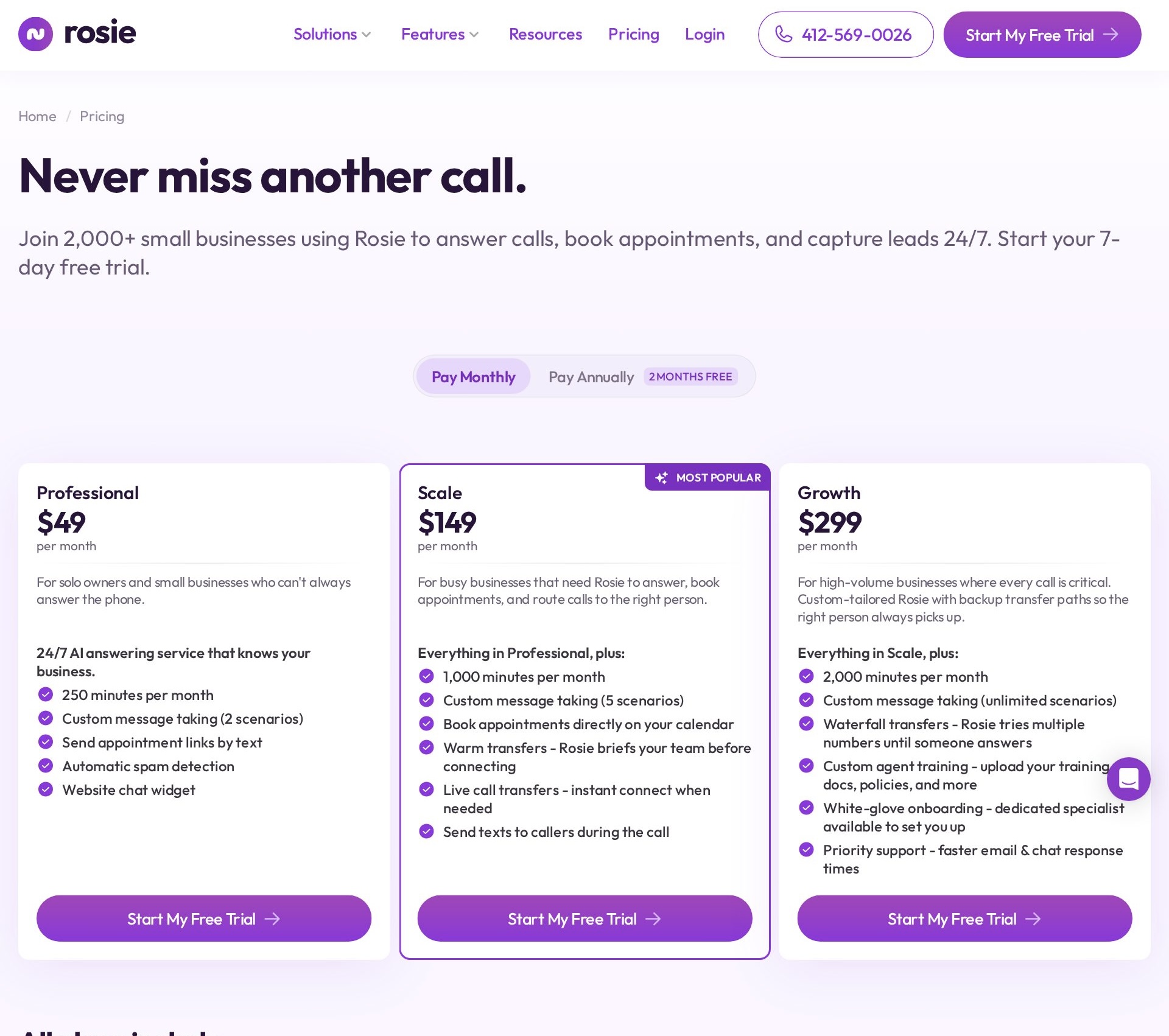
| Rosie | $49/mo (250 minutes) to $299/mo (2,000 minutes); booking and transfers from $149 Scale |
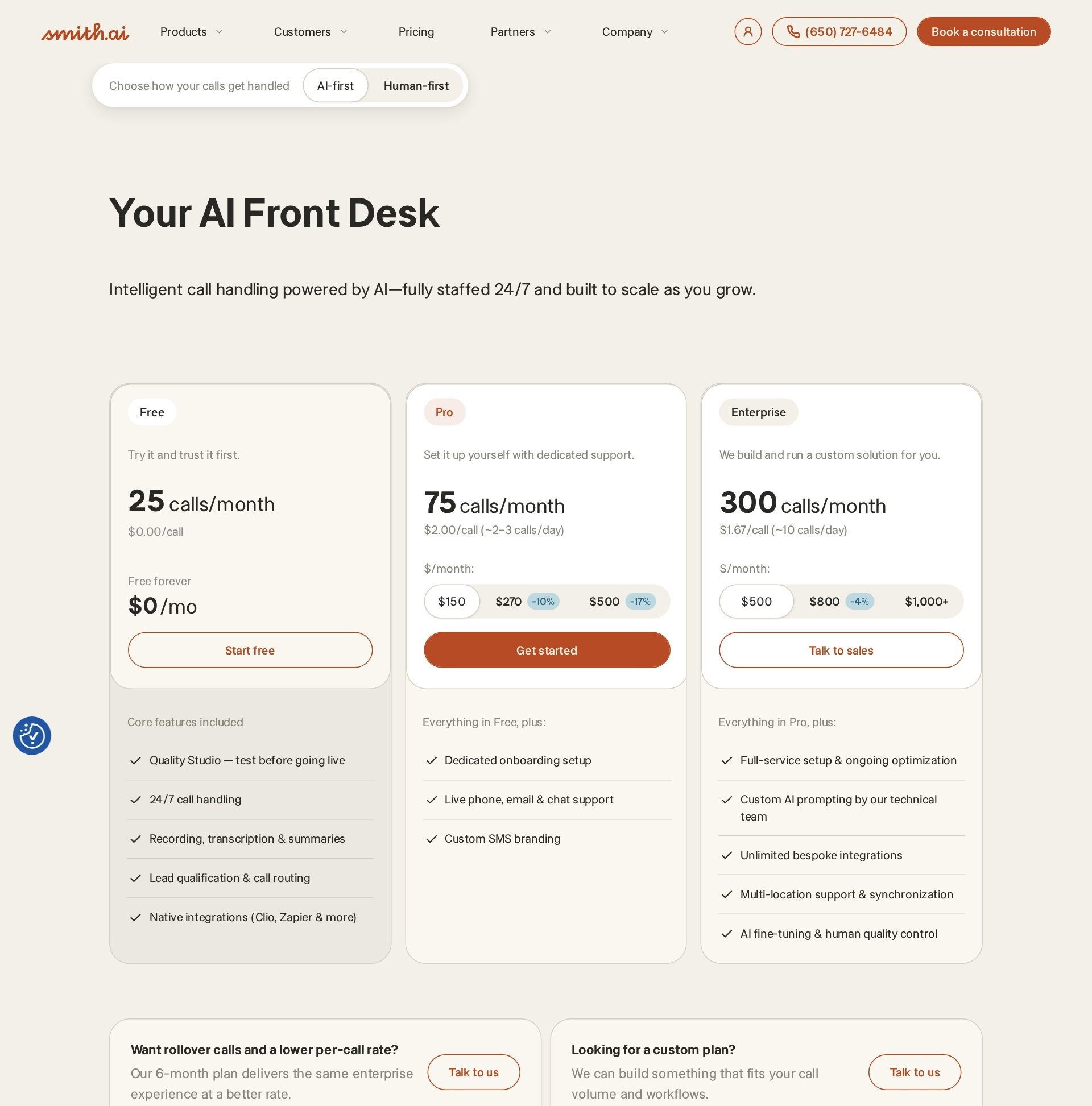
| Smith.ai | Free 25-call AI tier; AI from $150/mo; human receptionists from $300/mo |
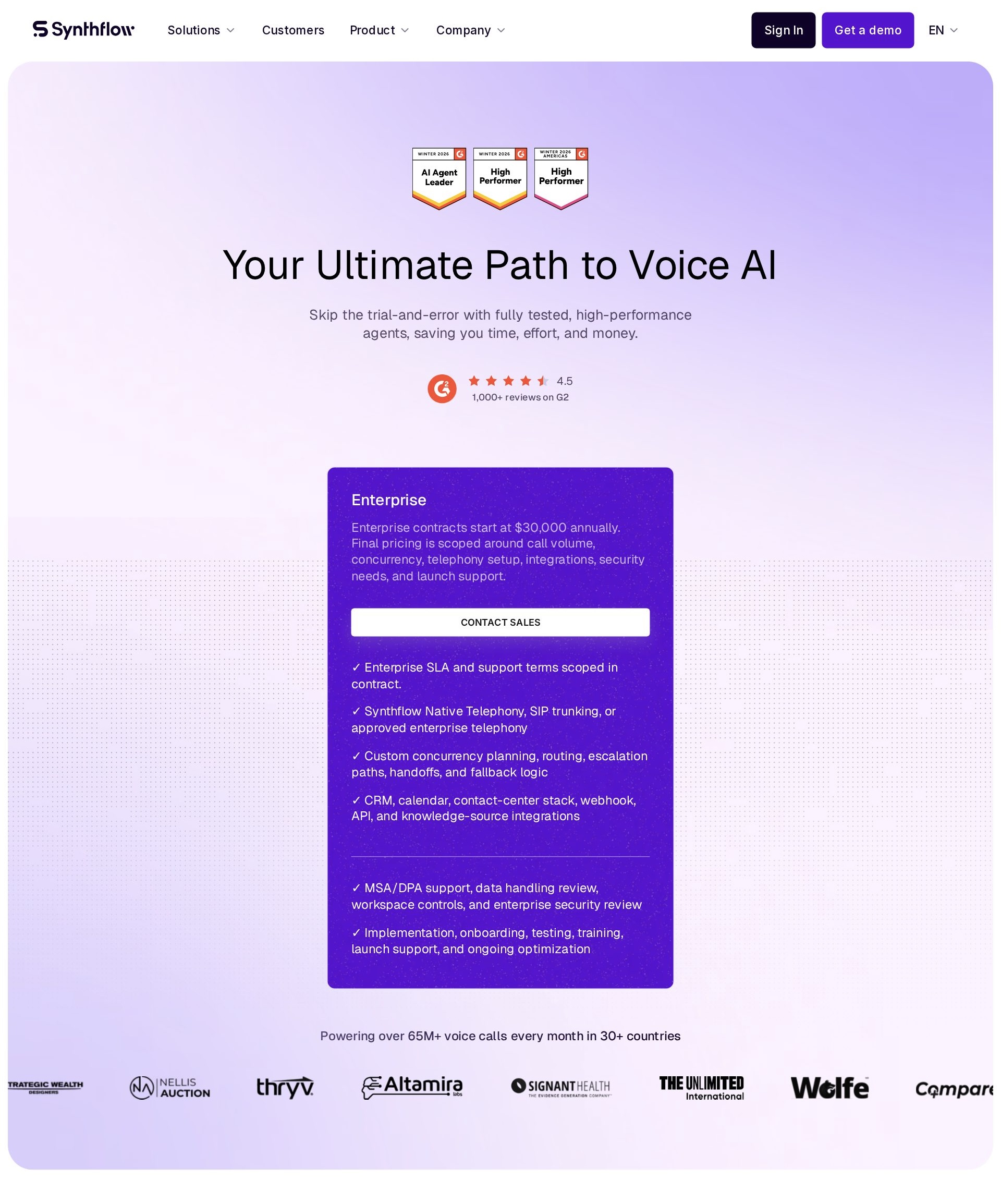
| Synthflow | Enterprise contracts from $30,000/yr |
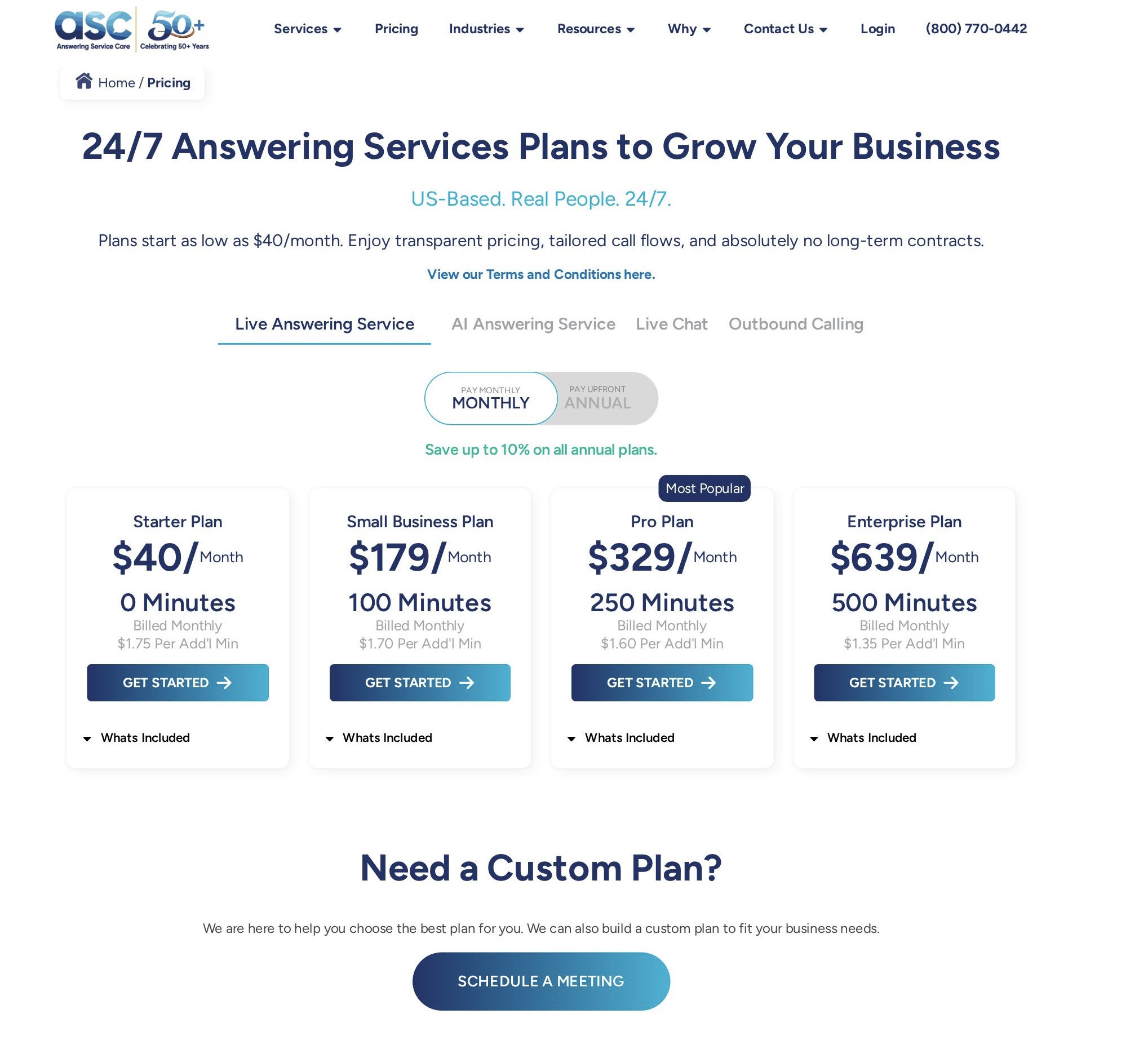
| The status quo (human answering service comp) | Published tiers $179/mo, $329/mo, $639/mo, plus $50 setup (Answering Service Care) |
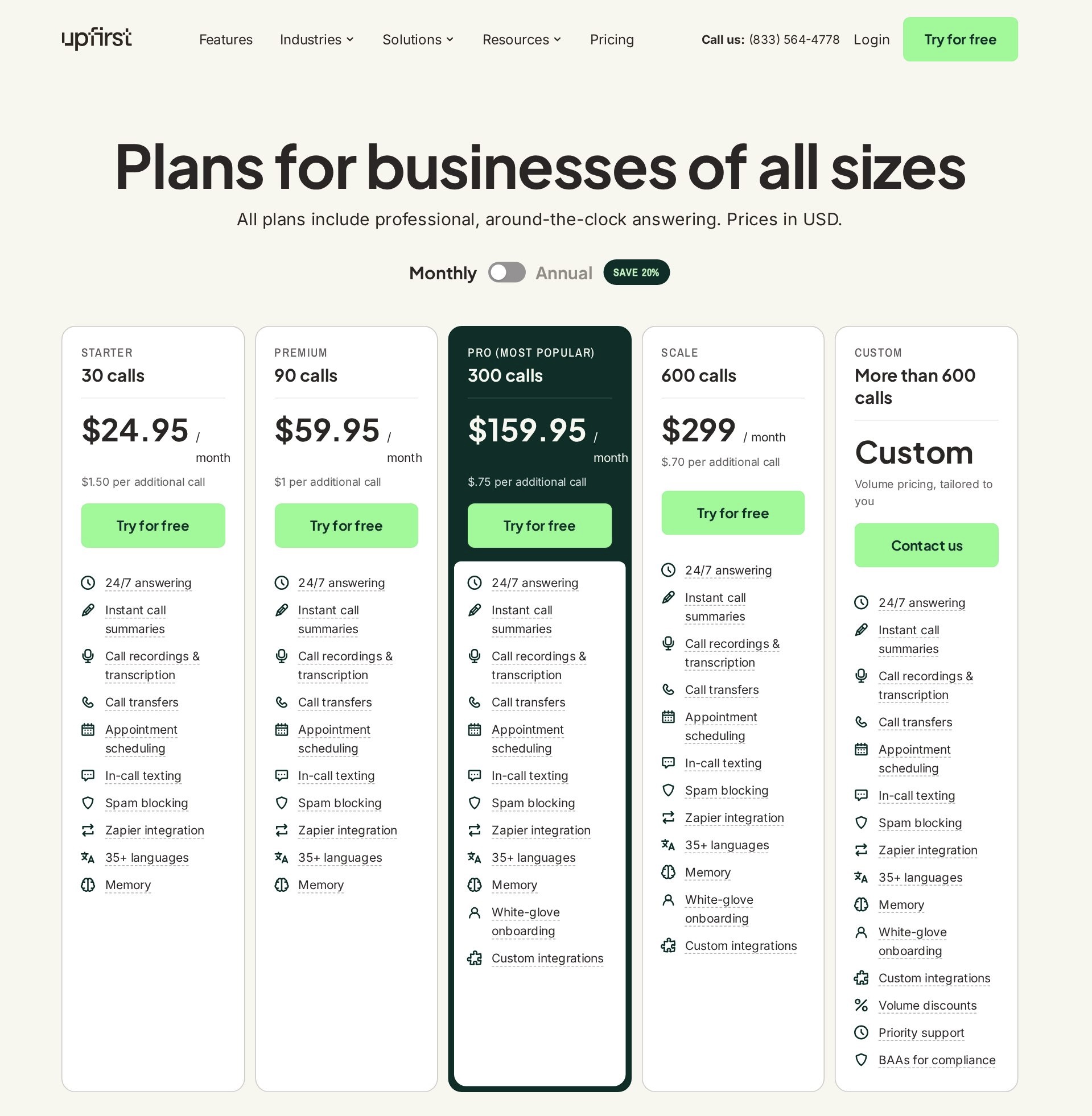
| Upfirst | $24.95/mo (30 calls) to $299/mo (600 calls) |
Screenshots For Pricing Details Per Vendor
Click on each image to enlarge if needed. Screenshots are captured from each vendor’s live pricing page on the verification date and hosted on our own CDN.
Why do photographers miss the exact calls that pay?
Every service business has a phone problem, but photography has a specific shape of one: the moment that produces the revenue is the same moment that makes you unreachable. The Saturday ceremony, the golden-hour portrait slot, the corporate shoot with a hard out-time, those are precisely the hours a couple sits on their couch with a shortlist and a phone. Photographers do not miss calls because they are careless. They miss them because the job is being unavailable.
The job is literally being unreachable
The Bureau of Labor Statistics describes the occupation in one dry sentence: “Many photographers are self-employed. They work in varied settings, including in studios and on location.” Translation: there is no front desk; the person who would answer the phone is the person holding the camera. The BLS puts the median photographer wage at $21.47 an hour as of May 2025 and projects about 10,700 openings a year, which tells you this is a trade of lean operations where the owner is the shooter, the editor, the marketer, and the receptionist. Something in that stack gives, and it is almost always the phone.
And the demand side is enormous. The CDC’s National Center for Health Statistics counts 2,041,926 marriages in its most recent annual data, a rate of 6.1 per 1,000 people, and The Knot Worldwide’s 2026 Real Weddings Study describes a wedding industry worth over $100 billion in which couples hire an average of 13 vendors. The photographer is near the top of that hiring list: 88% of couples in The Knot’s 2026 study hired one, and WeddingWire’s research has put the figure at 89%, making photography one of the most universally purchased services in the entire wedding market.
The inquiry wave arrives when you are busiest
Proposals cluster. WeddingWire’s 2018 Newlywed Report, which surveyed 18,000 couples, found that December alone accounts for 16% of the year’s proposals, against 7% to 9% in a typical month, with Christmas Day, Christmas Eve, New Year’s, and Valentine’s Day anchoring the season. Every one of those proposals starts a planning wave, and the planning wave hits your phone between November and February, which happens to be exactly when a wedding photographer is delivering fall galleries, shooting holiday minis, and trying to take a week off.
The compression makes it worse. Couples do not inquire at a steady drip; they research in concentrated evening sessions, and ClientCasa’s analysis of wedding-vendor response patterns describes the reality plainly: “three to five inquiries sent in the same evening is common.” WeddingWire’s Newlywed Reports show how big the shopping list is, with couples hiring 14 vendors on average in the 2019 report and 15 in the 2020 edition, and price named as “the key factor in deciding who to contact.” Your inquiry is one of several tabs open on someone’s couch at 9 PM.
Your competitors are slow too, and that is the opening
Here is the part that should encourage you. The classic response-time study is a Harvard Business Review piece by James Oldroyd, Kristina McElheran, and David Elkington, who write: “We audited 2,241 U.S. companies, measuring how long each took to respond to a web-generated test lead. Although 37% responded to their lead within an hour… 23% of the companies never responded at all.” Nearly a quarter of businesses, across every industry, simply never answer an inquiry. In wedding photography, where the product is trust, the studio that answers first with a substantive reply is not just faster; it is the only one that showed up.
WeddingPro, the professional arm of The Knot and WeddingWire, makes the stakes explicit in its vendor guidance: “Seven in 10 couples say vendor responsiveness is the most important factor they consider when booking their wedding team.” WeddingPro educator Alan Berg’s recommendation in the same piece is to wait no more than 24 hours to respond, and most working photographers will tell you that even that is generous during engagement season, when a couple can send five inquiries on a Tuesday night and book a consultation with the first studio that answered the date question.
Why does the first thirty seconds decide the booking?
There is a detail about wedding inquiries that separates photography from almost every other trade this guide series covers: the first question is not about price, style, or personality. It is a yes-or-no question about a specific Saturday. Everything else in the inquiry conversation is downstream of that answer, which is why the date check is the headline beat of this entire article.
The date check is the first answer, not an afterthought
When a couple calls a photographer, the sentence is some version of “are you available on June 12?” If the answer is no, nothing else matters; the conversation is over, politely, in fifteen seconds. If the answer is yes, the couple’s next questions arrive in a predictable order: what do packages look like, have you shot at our venue, can we see a full gallery. A receptionist, human or AI, that cannot see your calendar turns the single most important answer in your business into “I’ll have to check and call you back,” which pushes you to the back of a queue you did not know you were in. A receptionist connected to live availability answers in the first thirty seconds, and the call continues.
Speed-to-substance, not speed-to-hard-sell
Couples do not want pressure; they want progress. The Knot Pro’s vendor benchmarks, as summarized in ClientCasa’s wedding response-pattern analysis, show that 87% of engaged couples expect a vendor reply within one business day and 41% expect one within an hour. The winning first response is the one that answers the actual questions: is my date available, roughly what would this cost, can we talk this week. A voicemail box answers none of those. A fast “yes, June 12 is open, collections start at $2,800, and I can offer you a consultation Thursday evening” answers all three, and it is not a sales pitch; it is customer service delivered at the speed the couple is already moving.
The budget pressure is real on the couple’s side too. The Knot Worldwide’s 2026 study found that 37% of couples reached out to more vendors than they initially planned while trying to make the numbers work, which means your inquiry pool includes couples comparing more photographers than ever. More comparisons means more same-evening races, and more races decided by who answered the date question first.
What a good first answer actually sounds like
A complete first answer has four parts, and a well-configured AI receptionist delivers all four in one call. First, the date check against your real calendar, with a defined rule for tentative holds. Second, the package frame, spoken in ranges with a floor, never a custom quote: collections start at a stated number and most couples land within a stated band. Third, the portfolio follow-up, a text message with your full-gallery link sent while the couple is still on the phone, because The Knot’s 2026 study found that 81% of couples hiring a photographer named photos and examples of work as their most important decision factor, ahead of price at 73%. Fourth, the consultation offer, booked into a real slot before the call ends. That sequence converts an inquiry into a calendar entry, which is the only version of a lead that survives the weekend.
What does a photography inquiry call actually contain?
A receptionist earns its keep on structure, not charm, so it is worth being precise about what the four call types that hit a photography studio actually contain. Any platform you shortlist should take all four, live, on a demo, with your real packages loaded.
The wedding inquiry: date-first, then qualification
The wedding inquiry is the highest-stakes call your studio receives and the most structured. The fields, in order: the date, the venue (or shortlist of venues), approximate guest count, the package conversation, and the style question. The Knot’s 2026 Real Weddings Study puts the average professional wedding photographer at $3,000, with lower, median, and upper budget quartiles at $1,500, $2,800, and $4,700, which is why the range conversation matters: a couple whose ceiling is $1,500 and a couple budgeting $4,700 need different answers, and a good intake separates them politely in ninety seconds. The venue question does double duty, since a photographer who has shot the venue has a gallery ready to text, and The Knot’s read-out notes that 17% of couples paid travel fees to get the photographer they wanted, so your service-area policy belongs in the script, not in your head.
The portrait and mini-session call: a volume game
Portrait, family, newborn, and senior calls run on smaller tickets and shorter conversations, but they arrive in surges, the fall mini-session rush being the famous one. The intake is simpler: session type, party size, preferred dates, location preference, deposit link. What matters operationally is volume handling. A mini-session announcement can fill a weekend in an evening if every caller gets an immediate answer and a booking link, and the same announcement can generate two days of phone tag if it lands on voicemail. This is the call type where a seasonal knowledge base pays for itself, because the October script (mini dates, field location, what-to-wear guidance, deposit link) is a different script from the March one (wedding inquiries, spring portraits, graduation sessions).
The commercial inquiry: different qualification entirely
Commercial and corporate calls, headshot days, product work, event coverage, brand campaigns, do not follow the wedding script, and a receptionist that treats them like one wastes the call. The qualification fields are usage and licensing scope, headcount or shot-list size, location, deadline, and who signs. The licensing field deserves respect in the script: the U.S. Copyright Office’s Circular 42 on copyright registration of photographs and its photography registration portal exist because the image license, not the shoot day, is where commercial value lives. These tickets are larger, the timeline is rarely “a Saturday fourteen months out,” and the buyer is often an office manager with a budget line, not a couple with a Pinterest board. The right handling is thorough capture plus a same-hour route to you, with clear expectation-setting that commercial work is quoted individually. Speed matters less than completeness here; a detailed brief in your inbox beats a fast hello.
The existing-client logistics call: protect the shoot day
The fourth call type is the one nobody budgets for: existing clients. Gallery delivery questions, reschedules, print orders, wardrobe questions for next week’s session, the mother of the bride confirming the timeline. None of these are new revenue, but all of them are retention and reviews, and every one that interrupts a shoot costs you focus exactly when you are earning the booking that call represents. A receptionist that knows your policies, delivery windows, reschedule rules, where the gallery link lives, answers these without you. This is also where caller memory stops being a feature list item and starts being the product: the AI that recognizes a booked client, greets them by name, and knows their wedding date does not read as a phone tree. It reads as your studio, answering.
What is a missed inquiry call actually worth?
The economics of this article are unusually easy to run, because the product on the other end of the phone is expensive and the tool is cheap.
The math on one wedding package
Take The Knot’s $3,000 average for a professional wedding photographer as the model input, with the honest spread of $1,500 to $4,700 across budget quartiles. A flat-rate AI receptionist at $200 a month costs $2,400 a year. One recovered wedding booking, a single couple who got a substantive answer on Saturday night instead of your voicemail, covers the annual cost with margin left over, and one booking a quarter covers it several times over. Even at the lower quartile, a $1,500 booking against a $24.95 budget AI plan pays for five years of the tool. The question is not really whether the phone is worth answering; it is who or what answers it while you are holding a camera. Our missed-call economics teardown runs the general version of this math with every assumption labeled.
The engagement-season multiplier
Now layer the calendar on top. With December producing 16% of the year’s proposals and the November-to-February window concentrating the rest, a wedding studio’s inquiry volume in January can be several times its August volume, while the photographer is delivering galleries, not answering phones. The Knot’s 2026 study adds a wrinkle worth knowing: AI adoption among planning couples nearly doubled year over year, to 36%, so a growing share of inquiries arrive from couples already comfortable talking to software and expecting an immediate, organized answer. Missed calls in February are worth the same $3,000 as missed calls in June; there are just more of them. The scenario model behind this section is published as a labeled Dataset in this page’s structured data, licensed CC BY 4.0, so you can check every assumption.
How did we evaluate the ten options?
Every option in this guide was evaluated against the same five criteria, weighted for how a photography studio actually earns its revenue. We re-verified every price and feature claim on the vendor’s own live pages on September 11, 2026; screenshots of each pricing page are included below, and the methodology section lists what we did and did not do.
Date-check speed. Can the service answer “are you available on June 12” against a real calendar, inside the first thirty seconds, at 9 PM on a Tuesday? This is the conversion moment in a wedding inquiry, so it carries the most weight.
Inquiry qualification. Can it run the structured intake: date, venue, guest count, package fit, style questions, and for commercial calls, usage and licensing scope? A message-taking service and a qualification service are different products.
Portfolio follow-up. The Knot’s data says examples of work outrank price in the couple’s decision, so we weighted whether the service can text a portfolio or full-gallery link during or immediately after the call, while the couple is still warm.
Weekend and evening coverage. Photographers work when clients call. Saturday ceremonies and weekday evenings are exactly when inquiries arrive, so coverage during your working hours matters more here than in almost any other trade.
Price at your real volume. Not the entry sticker: the bill at your engagement-season peak, when inquiry calls triple and every caller is brand new. The pricing-model section below runs those numbers honestly.
One more note on our own conflict: Futuro is our product, and it is profiled under the same five criteria with its trade-offs stated like everyone else’s. Our publishing principles spell out how we handle that, and our analytics platform is the same inquiry-scoring tooling referenced in the profiles.
The ten options at a glance
| Option | Model | Entry price | The fit |
|---|---|---|---|
| Bland AI | API platform, per-minute | $0.14/min | Developer-led studios building their own flow |
| Dialzara | Self-serve AI, minute bundles | $29/mo | Lowest-friction budget test |
| Futuro (our product) | Flat-rate AI, unlimited | $200/mo | Voice realism, memory, surge-proof flat bill |
| Goodcall | Unlimited minutes, caller caps | $79/mo | Simple inbound flow, moderate caller counts |
| My AI Front Desk | Self-serve bundle, voice minutes | $99/mo | Very small studios needing messages taken well |
| Rosie | AI trained on your site, bundles | $49/mo | Budget option that learns your portfolio pages |
| Smith.ai | AI plus live humans, per call | Free 25-call AI tier | Studios wanting a human behind sensitive calls |
| Synthflow | Enterprise voice platform | $30,000/yr | Studio groups with procurement requirements |
| The status quo | Voicemail plus text-back discipline | Free | Phones that ring a few times a week |
| Upfirst | Per-call AI bundles | $24.95/mo | Cheapest credible test of the concept |
Prices verified September 11, 2026, on each vendor’s live pricing page. Full tier detail is in the pricing section, with page screenshots in the screenshots gallery.
Which answering services actually fit a photography studio?
Ten options, alphabetical, unranked, with pros and cons stated for each. Every profile answers the same question: which studio is this actually for?
Bland AI: when you want to build the inquiry flow yourself
Bland AI is the API-first option: its pricing page lists $0.14 per minute on the Start plan with no platform fee, dropping to $0.12 and $0.11 on the $299 and $499 monthly platform tiers. For a studio with strong opinions about the inquiry conversation, that means you can build exactly the flow you want: date check against your calendar API, package ranges from your own data, venue-specific galleries, commercial qualification routing. You can also build none of that, which is the catch. There is no photography intake waiting for you; the date-check logic, the guardrails, the calendar connection, and the failure handling are all yours to write and, more importantly, yours to maintain when a couple asks something your flow did not anticipate.
Dialzara: when the budget is the first filter
Dialzara’s pricing page starts at $29 a month for 60 minutes and scales to $349 for 1,000 minutes, with a quick, genuinely self-serve setup that has earned it a place on every budget shortlist in this series. For a part-time portrait photographer fielding a handful of short calls a week, the math works immediately. The constraint is the minute bundle against the shape of a wedding inquiry: a real inquiry call, with the date check, the package range, the venue questions, and the consultation booking, is not a ninety-second call, and engagement season stacks those calls back to back. Sixty minutes of inbound inquiry can vanish in the first week of January.
Futuro (our product): when the first thirty seconds have to sound like you
Futuro is our product, so evaluate this profile with the same skepticism as the other nine; everything claimed here is verifiable at our pricing page and the demo line. The differentiators for this vertical: voice quality is the founding thesis, measured at 94% human indistinguishability in our published 1,000-participant study, which matters when the caller is a nervous mother of the bride; persistent memory means the couple who inquired in January and calls back in March is recognized, with their date, venue, and package conversation intact (the architecture is documented in our memory-system write-up); and pricing is $200/mo flat with unlimited calls, so the engagement-season surge changes your workload, not your bill. Date checks run against your real calendar, portfolio links go out by text mid-call, consultations book into your scheduler, and deployment behind conditional call forwarding keeps your number and your shoot days untouched, in 53 languages with mid-call switching.
Goodcall: when the phone is simple and the caller list is short
Goodcall’s pricing page lists unlimited-minute plans starting at $79 a month, with higher tiers at $129 and $249, capped at 100, 250, and 500 unique callers respectively, and per-caller overage beyond the cap. Unlimited minutes is a genuinely photographer-friendly shape for long wedding inquiries: nobody is watching the clock while a couple asks about rain plans. The catch is the unique-caller definition in a business where every inquiry is a stranger. Engagement season is a parade of brand-new couples, each calling several studios in one evening, and a busy January can brush the entry cap purely on first-time shoppers who may never call again. Flows are competent for inbound qualification; deep memory and outbound follow-up are not the product’s center of gravity.
My AI Front Desk: when the studio is very small
My AI Front Desk’s pricing page lists a Business plan at $99 a month, or $79 billed annually, with 200 voice minutes included, plus a $20 Basic tier without voice. Setup is pleasant, the inbound experience is credible for the price, and for a studio whose real need is “someone competent picks up when I cannot,” it delivers that. The constraint for wedding work is the 200-minute voice allotment against long-form inquiry calls: a thorough wedding intake runs several minutes, and a couple of busy engagement-season weeks can eat the allotment with per-minute overage after. Memory across calls is thin, and the feature set is inbound-first, so the multi-touch inquiry relationship, where a couple calls three times before booking, starts fresh each time.
Rosie: when you want it trained on your own website
Rosie’s pricing page starts at $49 a month for 250 minutes and scales to $299 for 2,000, and its defining mechanic is training the agent on your own website content, which suits photographers unusually well: your packages page, portfolio, and FAQ already contain most of what an inquiry caller asks, so the AI’s answers inherit your actual positioning instead of a generic script. The watch-item is feature gating: booking and call transfers sit behind the $149 Scale plan, so if the consultation booking is the whole point for you, and it should be, budget for that tier rather than the entry sticker. Minute bundles against engagement-season volume deserve the same modeling as Dialzara’s.
Smith.ai: when some calls need a human
Smith.ai is the structured hybrid. Its pricing pages list a free 25-call AI tier, AI-first plans from $150 a month on its AI receptionist page, and live human receptionists from $300 a month on per-call bundles. For a photography studio, the appeal is specific: the AI handles the volume, and the nervous-mother-of-the-bride call, or the venue coordinator with a problem, rolls to a trained human who handles it with judgment. That is a real benefit no pure-AI option on this list matches, and the free AI tier is the lowest-risk test drive here. The cost side needs honest modeling: per-call human pricing at engagement-season volume climbs fast, and 30 to 60 human-handled calls a month puts you into the mid hundreds quickly.
Synthflow: when you are a studio group with procurement
Synthflow’s pricing page starts enterprise contracts at $30,000 a year, and the platform operates at a scale most of this list does not touch, with tens of millions of calls a month across its customer base. For a solo wedding photographer, this is the wrong tool, full stop. For the studio group running several brands, a centralized booking operation, or a venue collective answering for in-house photographers, the procurement-grade features, compliance posture, and dedicated support exist for a reason. The evaluation path is a sales conversation with your call volumes and compliance requirements in hand, not a self-serve signup.
The status quo: when voicemail and a text-back habit are enough
The honest tenth option costs nothing. If you shoot a dozen portraits a year alongside another job, your inquiry calls are rare enough that voicemail plus a ruthless same-evening text-back habit covers you, and no tool on this list will change your business. Where the status quo fails is specific and predictable: engagement season, when a Tuesday evening brings four inquiries while you are editing; wedding days, when you are unreachable for ten hours at a stretch; and the moment your marketing starts working, which is precisely when the phone starts ringing while you are shooting. The traditional human answering service is the other status quo, and it is worth pricing honestly: published tiers from a mainstream provider like Answering Service Care run $179, $329, and $639 a month plus a $50 setup fee, buying you a human who follows a script but cannot see your calendar.
Upfirst: when you want the cheapest credible test
Upfirst’s pricing page starts at $24.95 a month for 30 calls and scales to $299 for 600, with 35-plus languages and caller memory on every plan, which is an unusually complete feature set at the entry price. For a portrait or part-time wedding photographer, 30 calls a month may genuinely cover the off-season, making this the cheapest way to learn what an AI receptionist does to your inquiry conversion before committing real money. The ceiling is the per-call bundle shape: engagement season plus a fall mini-session rush can move you up two tiers in a month, and the value case versus a flat rate inverts somewhere around the mid tiers.
How do the pricing models actually differ?
The sticker price is not the price. Four billing shapes cover everything on this list, and the right one depends on the shape of your year: quiet summers, a fall portrait rush, and an engagement-season inquiry surge that starts around Thanksgiving and runs through Valentine’s Day.
Per-minute and per-call bundles: cheap until the calls get long
Bland AI meters by the minute ($0.14 at the entry tier), Dialzara and Rosie sell monthly minute bundles, My AI Front Desk includes a voice-minute allotment, and Upfirst sells call bundles. All four shapes share one property: they bill against exactly the thing a wedding inquiry consumes. A thorough first call, date check, package range, venue questions, consultation booking, runs several minutes, and an engaged couple with follow-up questions runs longer. At off-season volume these plans are the cheapest on the list, honestly. At January volume the bill climbs in the same weeks your calendar is quietest, which is a cash-flow shape worth deciding on deliberately rather than discovering.
Unique-caller caps: read the definition twice
Goodcall’s unlimited minutes come with a cap on distinct callers: 100 on the entry plan, scaling to 250 and 500. In a repeat-customer business this is a generous model. In wedding photography, where the entire demand side is first-time callers, the cap is the price. A hundred unique couples sounds like a lot until engagement season, a styled-shoot feature, and a venue referral list land in the same month. The model is not bad; it is specific. Count your new-caller months before choosing it.
Humans by the call, and the old guard by the month
Smith.ai’s live receptionists start at $300 a month on per-call bundles, and traditional answering services like Answering Service Care publish tiers at $179, $329, and $639 a month with a $50 setup fee. Human answering buys you judgment on sensitive calls; what it does not buy, at any of those prices, is a receptionist who can see your calendar and answer the date question, because that is a systems integration, not a staffing level. If you go the human route, ask one question on the demo: when a couple asks if my date is open, what exactly does your receptionist say?
Flat rate: the surge-proof shape
Futuro (our product) is $200/mo flat with unlimited calls, which makes it the outlier shape on this list: the engagement-season surge, the mini-session rush, and the week a venue feature triples your calls all cost the same as a slow August. The crossover math is simple to run against your own call log: add up your three busiest months under any metered plan, and compare against $600 for the same quarter at flat. Our per-minute versus flat-rate teardown runs this comparison with the assumptions labeled, and the cost comparison does the same across the category.
Which kind of photography business are you?
The right option depends less on the tools than on your calendar. Four honest scenarios:
The wedding-heavy studio
Fifteen to thirty weddings a year, engagement season is your harvest, and your phone rings most when you are busiest. Your shortlist is the options with a real date check, structured intake, and pricing that survives January: Futuro (our product) for the flat rate and memory, Smith.ai if you want humans behind sensitive calls, Goodcall if your caller counts stay under the caps. Run the bathtub test on all three: a Saturday-night call asking “are you available the second Saturday of October next year, and what do collections start at?”
The portrait and mini-session volume shop
Your business is seasonal surges of small tickets: fall minis, holiday cards, senior season, Mother’s Day. You need volume handling and deposit-link booking more than long qualification, and you need the knowledge base to switch scripts in October and back in March. Rosie and Dialzara cover this at budget prices; Futuro covers it with the seasonal script switch handled for you. Whichever you choose, the deposit link in the call flow is the feature that pays.
The commercial and corporate shooter
Your inquiries are fewer, larger, and slower, and the qualification is completely different: usage, licensing, headcount, deadline. You do not need a booking machine; you need a thorough intake that never misses, because a five-figure brand campaign that hits voicemail does not call back. Any of the qualification-capable options work; the configuration matters more than the vendor. Spend your setup time on the commercial intake fields and the routing rule that gets the summary to you the same hour.
The part-timer going full-time
Zenfolio’s State of the Photography Industry survey notes that full-time self-employment among photographers has been trending upward, and the transition year is exactly when the phone problem bites: bookings depend on responsiveness, but you still have a day job or a shoot schedule. This is the case for the cheapest credible test. Start with Upfirst or Dialzara, learn what your callers ask for a month, and upgrade the day the data justifies it. Going full-time also means the paperwork catches up: the IRS self-employed tax center and the federal start-a-business guide at USA.gov cover the registration and estimated-tax side of the leap. And if your phone honestly rings twice a week, the status quo plus discipline is free.
What should you have ready before you switch anything on?
The difference between an AI receptionist that books consultations and one that apologizes politely is the material you give it. Before any setup call or self-serve wizard, assemble four things.
The setup checklist
First, your package list with starting prices: every collection, its floor, and the one-sentence description of who it fits, because “packages start at” is only useful if the number is real. Second, your service area and travel policy, in writing: your included radius, your travel-fee trigger, and whether destination work is on the table. The Knot’s 2026 data shows 17% of couples paid travel fees to get the photographer they wanted, so “we travel” is a selling point, but only if the AI states your actual policy instead of improvising one. Third, a calendar with real availability: blocked shoot days, editing days, and the consultation slots you actually offer. The date check is only as good as the calendar behind it. Fourth, your portfolio follow-up assets: the full-gallery link, the venue-specific galleries if you have them, and the text message that sends them.
The three guardrails
Every configuration, on every platform in this guide, should include three rules, stated exactly this firmly. One: never confirm a wedding date without the deposit link sent and acknowledged; a penciled date is tentative, always. Two: never quote custom work; commercial, destination, and unusual requests get the consultation offer, not a number. Three: always offer the consultation call, because that is where the booking actually happens. These three rules are the difference between an assistant that protects your calendar and one that over-promises it. They are also the first three things to test on a demo call, with any vendor, including us.
Where is the honest line on all of this?
An AI receptionist answers the date question, qualifies the inquiry, texts the portfolio, books the consultation, and takes care of the logistics calls. That is a lot. Here is what it is not.
It does not close the creative match, and it should not try. The Knot’s 2026 study is unambiguous that couples choose photographers on the work itself, examples ahead of price, and the consultation is where they decide whether your personality fits their day. The AI’s job is to make sure the consultation happens: that the Saturday-night inquiry becomes a Tuesday-evening call on your calendar instead of a silent loss to whoever answered first.
Two compliance notes belong on the record. For any outbound calling, reminder campaigns to past portrait clients, for example, the FCC ruled in February 2024 that AI-generated voices are “artificial” voices under the Telephone Consumer Protection Act, which means prior express consent is required. The FTC’s Telemarketing Sales Rule guide and its robocall guidance apply in full to those calls, and follow-up marketing emails fall under the CAN-SPAM compliance guide. Keep outbound to clients who opted in, or skip it. One adjacent note for studios using generative AI anywhere in their workflow: the Copyright Office’s AI initiative is the canonical reference for how human authorship rules treat AI-assisted works, worth reading before your contracts cite ownership. And on disclosure: our position, stated in our publishing principles, is that a warm identification of the AI assistant at the top of the call builds more trust than a flawless impression of a human ever will.
Finally, the honest word on the status quo, because this guide is supposed to save you money, not spend it: if your phone rings a few times a week and you text everyone back the same evening, you do not need any of these ten options yet. Bookmark this for your first engagement season at full-time volume.
Methodology, evidence levels, and what we did not do
Evidence level and sourcing
This guide’s evidence, in order of weight: vendor capability and pricing claims come from each vendor’s own live pages, re-verified September 11, 2026, used for pricing and options references only. Wedding-market structure comes from The Knot Worldwide’s 2026 Real Weddings Study, both the press release and the published data read-out, a survey of 10,474 U.S. couples married in 2025, and from WeddingWire’s 2018, 2019, and 2020 Newlywed Reports. Photographer economics come from the Bureau of Labor Statistics Occupational Outlook Handbook; marriage counts from the CDC’s National Center for Health Statistics; response-time research from the Harvard Business Review audit and WeddingPro’s vendor guidance; and industry context from Zenfolio’s State of the Photography Industry and NANPA’s career analysis. Quotations above are verbatim from the linked sources, attributed at the point of claim.
What we did not do
What we did not do: we did not record real photography-studio calls; the call descriptions in this guide are composites built from the cited industry research, not transcripts. No vendor, including Futuro, reviewed its profile before publication. We did not rank the ten options, accept placement fees, or use affiliate links; the money section uses stated assumptions on cited averages, not invented market data. If a linked page has changed since September 11, 2026, it is the authority, per our publishing principles.