
Editorial Disclosure: This guide is published by Futuro Corporation, and Futuro AI is one of the eight services compared. Futuro has no financial, affiliate, or referral relationship with the other vendors named here, and no vendor paid for inclusion. All pricing and integration claims were verified on the vendors’ own pages on October 16, 2026. Full methodology.
Pricing for every vendor in this guide is checked weekly, and a dated screenshot of the pricing each vendor publishes is updated every Friday at 9 AM ET. We keep these on one public page so you can see exact, current pricing for each vendor: Vendor pricing index.
A limb through a garage roof at 11:40 PM. The homeowner is shaken, the rain is still coming, and she is dialing every tree company Google showed her — in order, until somebody competent answers. The company that picks up asks two questions before anything else: is anyone hurt, and are power lines involved. That call is won in the next ninety seconds, and it’s worth a $3,000 emergency removal. Tomorrow morning the same phone line carries the other half of the business: a homeowner who wants a price on the big oak out back, where the win is a clean intake — species, size, access, photos — and a booked estimate. One line, two speeds, and nobody in the office to answer either one because the crew is on saws.
About this guide: how is this comparison judged?
The eight options are listed alphabetically, not ranked, and there is no overall winner: a solo climber who needs every call answered tonight, a multi-crew company with an estimator and a crane calendar, and a PHC practice selling recurring programs are buying different things, so no vendor wins every category. Every vendor, ours included, gets the same profile structure with a “Best for” line and an honest trade-off. Futuro AI is our product and one of the eight, and we say plainly where it is a good option and where it is not. External sources are linked at the claim, and every price is re-checked weekly — see the weekly pricing note above and our vendor pricing index.
Who this guide is for
Tree service companies — from the solo climber whose phone rings while he’s eighty feet up, to the multi-crew operation with an estimator and a crane calendar. If you run a landscaping or lawn-care shop without tree work, the trades overview fits better; if your emergency calls are water instead of wood, our plumbing and HVAC comparison covers that surge pattern. Roofers have their own version of this conversation — storm surge and insurance-claim intake — in our roofing guide, which this page cross-references instead of repeating.
Tree work runs at two speeds
Speed one is the storm emergency. Tree on house, tree on car, tree across the driveway, limb hanging over the kids’ bedroom. The caller is frightened, often after hours, and dials in map order until someone competent answers. The job is high-margin and time-boxed: whoever runs a real triage — is anyone hurt, is power involved, what’s the address — and commits a crew window wins a removal that routinely runs four figures. This call cannot wait for a callback. It is also dangerous work: ISA’s consumer guidance warns that removing or pruning storm-damaged trees can be dangerous, and the Bureau of Labor Statistics counted 239 fatal work injuries among grounds maintenance workers in 2024, a rate of 20.9 per 100,000 full-time workers against 3.3 for all workers — the occupation group that includes tree trimmers and pruners.
Speed two is the estimate business. The homeowner eyeing the big oak before listing the house, the property manager with forty ash trees and an EAB problem, the new build that needs a lot cleared. These calls are won in days, not minutes — but they’re won by intake quality: species if known, size, where the tree sits, and what equipment can reach it. A competent intake turns a “what’s removal run?” into a booked estimate with a quote class attached; a message-taking service turns it into a callback the caller already forgot.
The reason this framing matters for buying: the same phone line carries both speeds at once, and almost every vendor in this category is built for one of them. Message-takers handle neither. The evaluation criteria below weight both — emergency triage first, because that’s where the money and the safety exposure live.
The power-line boundary: the one script that has to be perfect
Some intake questions are about money. This one is about whether a caller does something fatal while talking to your phone system. When a storm caller says a tree is on a line — or a line is down — the only correct response is a hard boundary: stay away from the tree and the line, and call the utility first (911 if anyone is in immediate danger). A downed line can energize the tree, the ground, and anything touching either; OSHA’s line-clearance rules exist because unqualified work near energized lines kills experienced people, and state safety agencies repeat the same caller-facing guidance: stay away, call 911 and the utility. The tree-care industry’s own consumer guidance is just as blunt: do not approach, assume any downed line is energized, and call the utility company immediately.
For an AI receptionist this is a configuration test, not a feature checkbox. The script must be exactly the boundary above — no improvisation, no “our crew can take a look,” no scheduling talk until the utility is called. When you configure it (and every platform here is configured, none ships tree-specific out of the box), write it with your safety officer’s input, the same way you’d write it for a new hire. The reference document for that conversation is ANSI Z133, the arboricultural safety standard: compliance is voluntary, but it carries the force of law in many instances in the U.S., and its current Z133-2026 revision is a free PDF from ISA. Then test it monthly with a live call, because the failure mode — an AI improvising around a downed line — is a liability you cannot walk back. Any vendor whose demo dances around this scenario instead of running it verbatim should be disqualified on the spot.
Done right, the boundary is a trust asset, not just safety hygiene: the caller who hears “stay away from the line, call your utility first, here’s the number pattern — now, is anyone hurt?” has just been treated better than by most human answering services, and remembers whose phone system said it.
The five call scenarios to run before you buy
Feature lists tell you what a vendor claims; a phone call tells you what it does. Demo access varies widely in this category — Futuro answers a live demo line at (727) 677-9566, Dialzara and Goodcall spin up self-serve trials, AutoRev and AnswerForce start with a sales call — so instead of grading calls we can’t run fairly across all eight, we’re handing you the script. Run these five against any vendor on this page, including us: same script, your actual phone volume if possible, with your field-service software connected on a trial line. What to watch: whether the agent asks the tree-specific questions or just takes a name, whether it holds the safety boundary, and what lands in your system afterward — a booked estimate with photos, or nothing. The scenarios are licensed CC-BY — take them, no email required.
Scenario 1 — The storm emergency: “a tree just came down on my garage” (30% of the grade)
11:40 PM, rain still falling, caller audibly shaken. The passing run: is anyone hurt; is the tree on a structure, vehicle, or line; if power is involved — stay away, call the utility first, full stop; then address, damage scope, access notes, callback number, and a crew-window commitment or escalation to your on-call phone. The failing run: takes a bare message — or worse, talks price before safety, or guesses whether the damaged tree is stable. Judging that is specialist work — ISA runs a separate Tree Risk Assessment Qualification for it — so the agent’s job is to get a qualified person there, not to offer an opinion. This is the highest-weighted scenario because it’s where the money and the liability both live.
Scenario 2 — The estimate call: “what’s removal run on a big oak?” (25% of the grade)
The passing run collects what makes a quote class possible: species if known, approximate size, where the tree sits, and what equipment can reach it — gate width, overhead lines, driveway length decide bucket truck versus crane versus climb, and the crane-day question is the credibility marker (a backyard tree behind a 30-inch gate with a service drop overhead is a different job). Then it books the estimate and texts the caller a photo request so your estimator sees the tree before driving out. It answers “what does it cost” with your approved range language or not at all. The failing run invents a number or books blind. The paper trail matters to the caller, too: TCIA tells homeowners to get estimates in writing and insist on a written work order, and a clean intake is the first page of it.
Scenario 3 — The storm morning: fifty calls at once (20% of the grade)
Less a single call than a condition: the morning after a wind event, every tree company in the market is being dialed simultaneously. Ask each vendor directly — what happens at fifty simultaneous calls, and what does my invoice do that week? The passing answers are documented concurrency (Futuro and AutoRev both state unlimited simultaneous calls) and a bill shape you can predict; the failing answers are a busy signal, a voicemail-at-cap failure mode, or a metered invoice that eats the week’s margin. Our roofing guide maps the surge mechanics in detail; tree companies share the same pattern.
Scenario 4 — The quiet-season calls: add-ons and the PHC program (15% of the grade)
Two calls in one scenario. First: an existing customer with a removal already booked asks about stump grinding and haul-away — the passing run recognizes the caller, attaches the add-on to the open job, and captures stump count and size. Second: a homeowner asks about “that spraying thing” — plant health care, recurring treatments, dormant-season pruning. The passing run books the assessment and flags a recurring-revenue prospect instead of answering yes-or-no and hanging up on the highest lifetime-value call of the month.
Scenario 5 — The Spanish storm call (10% of the grade)
Tree work crews and customers alike skew bilingual in most markets, and the emergency call doesn’t wait for your English-speaking office manager. Run Scenario 1 again in Spanish: same triage, same boundary, same booking. The passing run handles it natively at a tier you can actually buy; the failing run is English-only or gates Spanish behind an add-on you discover after the storm.
Weights: emergency triage with the power-line boundary 30%, estimate intake quality 25%, storm-surge concurrency and billing 20%, seasonal campaign support 15%, multilingual capability 10% — fixed on October 16, 2026 before any entry was written, and published in this page’s schema as a CC-BY dataset.
The eight, at a glance
Alphabetical, unranked. Prices are verified entry points as of October 16, 2026 — not endorsements. The run-it-yourself path for every row is the five scenarios above.
| Provider | Pricing (entry, Oct 16) | Standout attribute | Best fit |
|---|---|---|---|
| AnswerForce | Not published — quote | Live human receptionists 24/7, English/Spanish | Shops that want a trained human on every storm-night call |
| AutoRev | Not published — custom quote | Tree-software coverage incl. Arborgold and SingleOps | Companies that want tree-native AI and accept a quoted price |
| Dialzara | From $29/mo + minute overage | English/Spanish answering on every tier | Solo climbers and small crews on a tight budget |
| Futuro AI | $200/mo flat, unlimited calls | High-end voice realism; flat rate, unlimited simultaneous calls | Full-service companies that need emergency and estimate calls handled on a flat bill |
| Goodcall | $79/mo per unique customer | Unlimited minutes, billed per unique customer | High-volume shops that want billing by customer, not talk time |
| QuoteIQ | From $29.99/mo + IQ credits per call minute | AI call team built into its own FSM | Operators who want phone, estimate, and schedule in one login |
| Rosie | From $49/mo (250 min) | Flat-tier, message-first answering | Solo climbers and new shops that need every call answered now |
| Smith.ai | Free 25 calls; Pro $150/mo at $2.00/call | AI with live human escalation | Companies that want AI on routine calls and a human on hard ones |
The same eight on the tree-specific mechanics: what is documented about emergency-call handling, what lands in your field-service software, and what happens when the whole market calls at once.
| Provider | Emergency triage | Tree-relevant write path | Concurrency |
|---|---|---|---|
| AnswerForce | Live humans, 24/7 | Scheduling + CRM integrations | Team-based |
| AutoRev | Triages emergencies by your rules | Jobber, HCP, ServiceTitan, Arborgold, SingleOps | Unlimited simultaneous |
| Dialzara | Knowledge-base configurable | Zapier/Square/Google Calendar | Not documented |
| Futuro AI | Configured emergency script; safety-boundary capable | ServiceTitan, HCP, Jobber (write-in) | Unlimited simultaneous |
| Goodcall | Logic-flow configurable | None — external tools/Zapier | Unlimited minutes |
| QuoteIQ | AI call team; FSM-native | Own FSM (native) | Not documented |
| Rosie | Message intake; transfers on Scale | Calendly/Zapier/Google Calendar | Not documented |
| Smith.ai | AI + human escalation | Calendly/Zapier, broad CRM | Not documented |
The eight, graded on the five scenarios
Alphabetical, unranked. Grades reflect what each vendor’s own documentation proves it can do on the five scenarios above — we graded documentation and pricing pages, not call quality. Run the scenarios yourself before you sign anyone.
AnswerForce
AnswerForce is the live-receptionist answer: real people answering 24/7, with appointment scheduling, lead qualification, and English/Spanish bilingual answering, aimed squarely at home-service trades — its industries list includes HVAC, restoration, plumbing, and electrical, the same emergency-call pattern as tree work. For the storm emergency scenario, a trained human who follows your script is the best emotional fit: shaken caller, tree through the roof, a calm person walking the triage. Two honest catches. First, pricing is not published — the site’s pricing path redirects to a quote flow, so budget a sales conversation and ask specifically about per-minute overage, because storm weeks multiply minutes. Second, no tree-specific software integrations are named; the write path into Jobber or Arborgold is something to pin down in the demo. For the power-line boundary, human agents follow scripts well — but the script is still yours to write, so bring your safety officer’s language to onboarding.
Pricing is not published on AnswerForce’s site as of October 16, 2026 — the pricing path routes to a quote flow. See its entry on our public index, where its pricing-request page is retaken weekly.

AutoRev
AutoRev is the most tree-fluent AI option in this lineup, and it isn’t close: its tree-service page names the industry’s own software — Jobber, Housecall Pro, ServiceTitan, Arborgold, and SingleOps, plus 500+ tools through direct integrations — and its call handling reads like the scenarios above. It books removal, trimming, and stump grinding; answers pricing questions with ranges from your book rather than invented numbers; follows up open estimates until they close or decline; and answers unlimited simultaneous calls, in its own words, “so a storm morning never produces a busy signal.” That sentence is the surge scenario answered. The catches: pricing is custom-quoted on a demo call — nothing public to budget against — and the depth of the emergency-triage script (including the power-line boundary) is something you configure and must test, same as everyone here. A 14-day free trial covers new customers.
Pricing is not published on AutoRev’s site as of October 16, 2026 — plans are scoped on a demo call. See its entry on our public index, where its pricing-request page is retaken weekly.

Dialzara
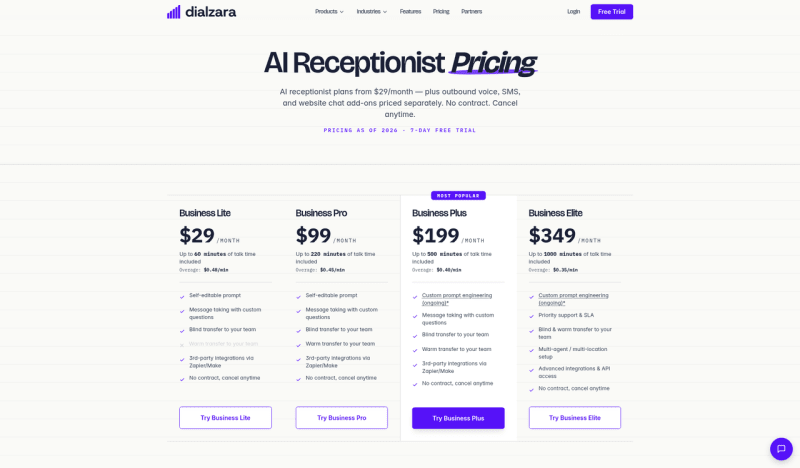
Dialzara is the cheapest credible way to stop the bleed: Lite at $29 per month (60 minutes, then 48¢/min) gets a live AI line with same-day self-serve setup, and bilingual English/Spanish answering is built in at every tier — the multilingual scenario at a price a one-truck operation can carry. The tier to watch is Pro at $99 (220 minutes, warm transfer), because warm transfer is what moves a storm emergency to your cell mid-call; Lite only blind-transfers. Know the billing shape before a storm week: minute-metered plans keep answering but the overage meter runs, and 220 minutes is roughly 73 three-minute calls. Integrations run through Zapier, Square, and Google Calendar rather than tree software natively, so anything landing in Jobber is a workflow you build. The power-line boundary and equipment-access intake are knowledge-base configuration — write them with your safety officer and estimator, then test.
Pricing verified October 16, 2026 — dated screenshot on our public index, retaken weekly.
Futuro AI
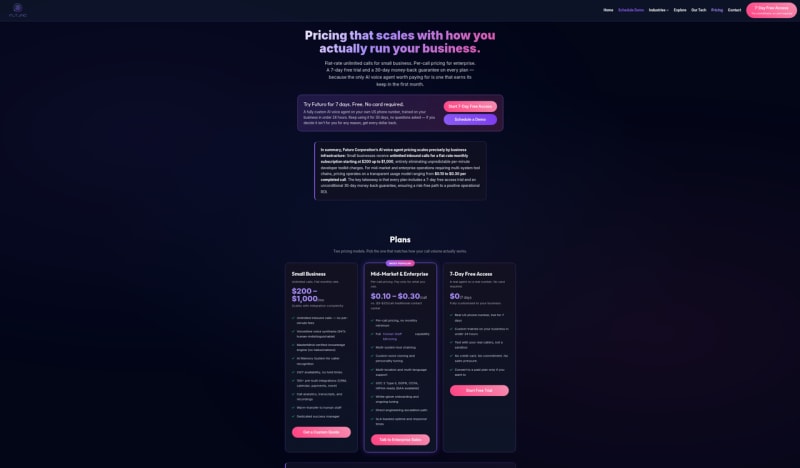
Futuro’s case in this category is the voice plus the flat line. In a company-run, double-blind, not-peer-reviewed study, 94% of 1,000 participants could not identify the agent as AI — the methodology and its caveats are published, and we excluded it from grading anyway. What the trades product page documents: emergency triage that captures the request and contacts your on-call tech where configured, booking written into ServiceTitan, Housecall Pro, Jobber, or your calendar, a texted summary with the address, the problem, and who’s on call, and photo intake — the page lists “photos the caller texted” among what lands with a job, the basis for the photo-via-text estimate flow. The bill is $200 a month flat with unlimited inbound and unlimited simultaneous calls — the storm-surge scenario answered on both axes at once — with 24–48-hour standard launch, a 7-day free trial, and a 30-day money-back guarantee. Test it yourself at (727) 677-9566. Go in with eyes open: the safety script, your approved price-range language, and the equipment-access questions are configured at onboarding with your input — including your safety officer on the power-line boundary — rather than shipped pre-tuned for tree work, and the FSM write path is built per deployment (about five days for a deep dispatch integration), not a self-serve marketplace app. If a human on delicate calls is the requirement, Smith.ai below is the honest alternative.
Pricing verified October 16, 2026 — dated screenshot on our public index, retaken weekly.
Goodcall
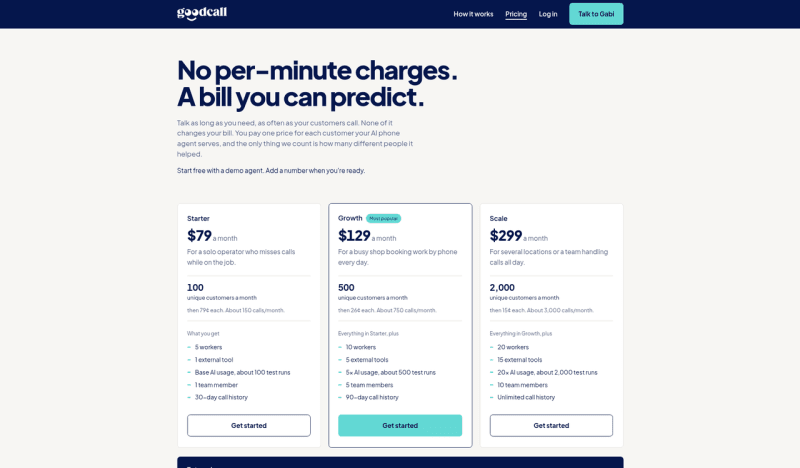
Goodcall bills per unique customer rather than per minute, a shape worth understanding for tree work: Starter at $79 per month covers 100 unique customers (then 79¢ each), Growth $129 covers 500, Scale $299 covers 2,000 — with unlimited minutes on top. In a storm week the same homeowners call repeatedly, and each counts once, so the meter grows slower than per-minute or per-call plans in exactly the scenario that breaks them. A free demo agent lets you hear it tonight. The catches for tree companies: no tree or field-service software integration is named — leads route to external tools and Zapier — and the emergency triage and power-line boundary are logic-flow configuration you write and test yourself. “Unique customer” means unique phone number, so shared-household and office-line callers occasionally collide; fine at this price, but know it.
Pricing verified October 16, 2026 — dated screenshot on our public index, retaken weekly.
QuoteIQ
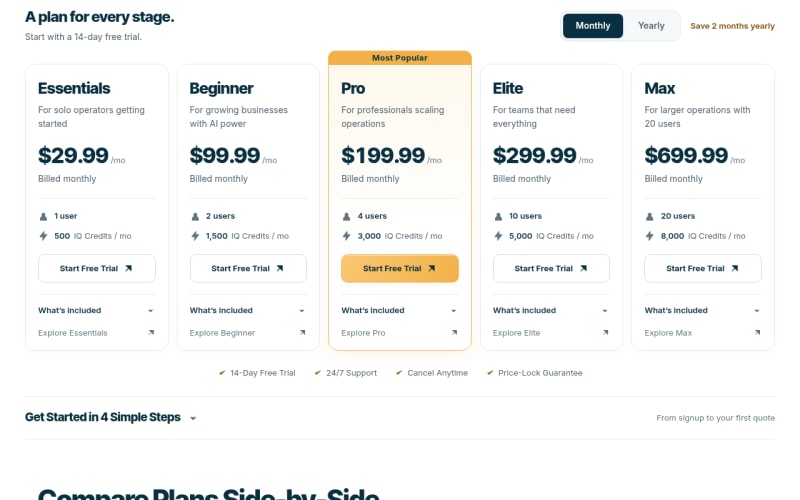
QuoteIQ is the category alternative: not a receptionist at all, but a field-service platform with an AI call team built in. Its pricing page lists the Virtual Call Team — a 24/7 AI call assistant — on every plan, billed in the platform’s IQ credits per call minute: Essentials $29.99 per month (1 user, 500 credits), Beginner $99.99 (2 users), Pro $199.99 (4), Elite $299.99 (10), Max $699.99 (20), with a 14-day free trial. Because the AI lives inside the FSM, the call lands where the estimate and the calendar already are — the integration problem disappears by construction, and tree-relevant tooling (satellite measurement, photo documentation, tiered estimates) is in the same box. The honest catches: it’s an all-in bet — the call team is worth nothing unless you run your estimates and scheduling in QuoteIQ — the per-call-minute credit meter is exactly the shape a storm week stresses, and emergency triage depth plus the power-line script are, again, your configuration to write and test. If you already run Jobber or Housecall Pro and intend to keep it, this entry isn’t for you.
Pricing verified October 22, 2026 — dated screenshot on our public index, retaken weekly.
Rosie
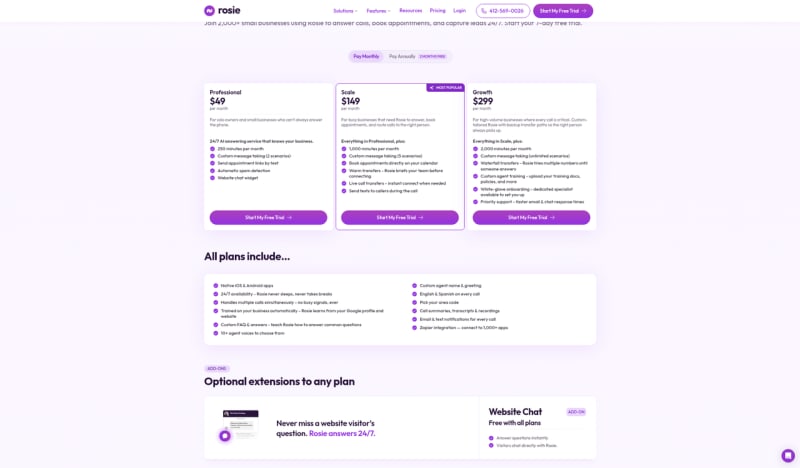
Rosie is the gentlest on-ramp in the lineup: Professional at $49 per month answers 24/7, takes structured messages, and texts callers your booking link — which, for the owner-operator who is literally eighty feet up when the phone rings, is the entire value case at a price below one missed estimate. Upper tiers add direct calendar booking: Scale is $149 per month for 1,000 minutes and Growth is $299 for 2,000; check the plan grid on Rosie’s pricing page for exactly which features each tier unlocks. Setup learns the business from your website, a 7-day trial covers the paid tiers, and integrations run through Calendly, Zapier, and Google Calendar. For tree work specifically, understand the ceiling: Rosie is a message-and-booking layer, so the emergency triage script, the power-line boundary, and the equipment-access questions are configuration you write — and the platform’s pricing FAQ doesn’t publish what happens when minute allowances run out, so ask about overage behavior in writing before a storm week asks for you.
Pricing verified October 16, 2026 — dated screenshot on our public index, retaken weekly.
Smith.ai
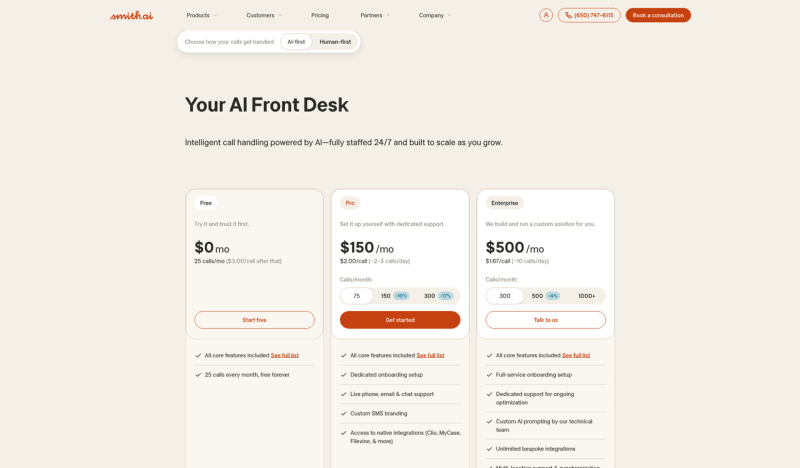
Smith.ai pairs an AI receptionist with live North America-based receptionists, and that escalation path — the deepest in this lineup — maps naturally onto tree work’s hardest calls: the frightened homeowner at midnight, the insurance-adjacent storm claim, the commercial property manager with twelve sites. AI Receptionist pricing is per call: a genuinely free tier of 25 calls a month ($3 per call beyond), Pro at $150 per month at $2.00 per call, Enterprise at $500 at $1.67 — and the human-first plans start at $300 for 30 calls if you want people answering by default. Price the add-ons, not the base: appointment booking, extended intake, and bilingual answering are each sold as add-ons on top of the plan. Per-call economics punish both chatty callers and storm weeks — a surge that triples your call count triples that line item. Integrations are broad (Calendly, Zapier, and more) but no tree-specific software is named, and the safety script is yours to write.
Pricing verified October 16, 2026 — dated screenshot on our public index, retaken weekly.
The storm-surge reality
Tree companies share the roofer surge pattern: storm work arrives all at once, in the hours after an event, and the first competent answer wins it. We mapped the mechanics — the call-volume spike, the concurrency question, what your invoice does that week — in the roofing storm-surge analysis and won’t repeat them here. The tree-specific addendum is short: your surge calls carry a safety triage roofers’ don’t (the power-line boundary above), and your calendar prize is the crane day — the highest-value slot a tree company runs, where an intake that captures access constraints correctly is the difference between a profitable day and an idle crane. When you evaluate, judge surge behavior on two axes at once: how many simultaneous calls the platform documents, and what shape the bill takes when they arrive.
The insurance-adjacent storm call
A large share of storm-damage callers are mid-insurance-claim, and the intake has to reflect that without crossing into advice. The configured behavior to demand: gather claim status (“have you filed, and with which carrier?”), capture the claim number if offered, document the damage description verbatim for the record — and stop there. Never coverage advice, never “that should be covered,” never speculation about fault. This is the same boundary standard we apply to roofing and restoration intake: the AI is a meticulous note-taker that makes your estimator’s first conversation easier, not an adjuster. Bonus points for a platform that timestamps the call recording and transcript, because claim documentation lives and dies on timestamps. Expect the reverse question, too: TCIA advises homeowners to ask to see current certificates of liability and workers’ compensation insurance, so the agent should know how your office sends them.
The quiet season: dormant pruning, PHC, and the outbound lever
The two-speed business has a third gear most guides ignore: the dormant season, when the phones go quiet and the calendar is yours to fill. Two plays matter. First, dormant-season pruning campaigns — outbound calls to last year’s customers offering winter pruning rates, which fill the dead weeks before storm season returns. The campaign model is the same one we documented for HVAC warranty outbound: a defined list, a scripted offer, AI-run dials, humans closing. If outbound matters to your winter, ask every shortlisted vendor whether it runs campaigns at all — most inbound receptionists don’t.
Second, plant health care. PHC — routine monitoring, preventive treatment, and a standing arborist relationship, per ISA’s consumer materials — is the recurring-revenue engine of a mature tree company: scheduled treatments on a calendar instead of one-off removals. The industry’s own software vendors lay out the program economics, and the phone pattern mirrors pool route businesses: recurring visits, reminder calls, easy reschedules. An AI receptionist feeding a PHC program needs two things beyond intake — recognizing existing customers on sight (the add-on scenario) and flagging program inquiries as recurring-revenue prospects — so put both in your test calls. Terminology note: PHC vocabulary (monitoring, treatment windows, IPM) follows ISA certification materials; if a vendor’s demo can’t say “plant health care” back to you, it won’t sell your program.
Which one should you pick?
Solo climber, phone ringing from eighty feet up — you need every call answered tonight at a price below one missed estimate: Rosie Professional at $49 flat, or Dialzara Lite at $29 if bilingual matters. Either beats voicemail by exactly the jobs you’re currently handing to the next name on the map.
Full-service company with an estimator and a crane calendar — the emergency triage, the equipment-access intake, and the storm week all have to work, and the bill can’t move when they do: Futuro AI, $200 flat with unlimited simultaneous calls and ServiceTitan/Housecall Pro/Jobber write-in. Eyes open: scripts are configured at onboarding with your input — including your safety officer on the power-line boundary — and deep dispatch integration quotes about five days. If you want the tree-native vocabulary pre-built and can live with a quoted price, AutoRev is the other serious entry.
PHC practice selling recurring programs — you need customer recognition, estimate follow-up, and ideally outbound campaigns for dormant season: AutoRev markets the follow-up loop explicitly, Futuro configures it at onboarding, and both beat a pure message-taker. Ask every finalist to run Scenario 4 live.
Humans on the hard calls — storm-frightened callers, insurance-adjacent conversations: Smith.ai (AI with human escalation, priced per call) or AnswerForce (humans by default, quote-only). Per-call and per-minute meters are the cost of the safety net.
One-login operator — you’d rather switch your whole stack than integrate anything: QuoteIQ, from $29.99, with the call team inside the FSM — just price the credit meter against your storm weeks.
Bilingual market, tight budget — English/Spanish at every tier: Dialzara, from $29. Broader language mix with flat billing: Futuro claims 53 languages (a vendor figure we haven’t independently verified) — run Scenario 5 before you rely on either.
Frequently Asked Questions
Yes, if it’s configured for triage rather than message-taking. The stakes are real: the first competent answer on a storm night can win a $3,000 removal. The script should ask whether anyone is hurt, whether the tree is on a structure or vehicle, and whether power lines are involved — then capture address, damage scope, and callback number. With lines down, the only correct answer is stay away and call the utility first. Test this exact call before signing anyone.
Species if the caller knows it, approximate size, where the tree sits on the property, and what equipment can reach it — gate width, overhead lines, driveway access decide bucket truck versus crane versus climb. The better systems then text a photo request so your estimator sees the tree before driving out. That intake is what makes a quote class possible.
Only if the boundary is scripted explicitly: stay away, call the utility first, call 911 if there’s immediate danger. This is safety-critical language, so configure it with your safety officer’s input and test it monthly. Any platform that improvises around downed lines instead of following the script should be disqualified on the spot.
Verified entry points on October 16, 2026: Dialzara from $29 a month, QuoteIQ from $29.99 plus credits, Rosie from $49, Goodcall from $79, Smith.ai free for 25 calls then $150, Futuro AI at $200 flat with unlimited simultaneous calls. AnswerForce and AutoRev quote custom pricing. Watch the billing unit — storm weeks punish meters, not flat rates. Pricing for every vendor in this guide is checked weekly, and a dated screenshot of each vendor’s published pricing is updated every Friday at 9 AM ET on our vendor pricing index.
The tree-relevant write paths: Futuro AI documents ServiceTitan, Housecall Pro, Jobber, or calendar; AutoRev names Jobber, Housecall Pro, ServiceTitan, Arborgold, and SingleOps; QuoteIQ is its own FSM with the call team built in. Most others route through Zapier or calendar links. Confirm the exact write path into your system during any demo.
Every tree company in the market gets called at once, so concurrency decides who wins the work. Futuro AI and AutoRev both document unlimited simultaneous calls. Metered plans keep answering but the invoice climbs; capped plans can fail exactly when the calls are worth the most. Ask every shortlisted vendor what happens at fifty simultaneous calls.
Several handle bilingual calls; depth varies. Dialzara builds English/Spanish into every tier, Rosie and AnswerForce offer bilingual answering, and Futuro claims 53 languages — a vendor figure we haven’t independently verified. Test with a real Spanish storm call, not a scripted demo, before relying on it for either customers or crew communication.
Yes — this is the modern tree-estimate flow. After booking, the system texts a photo request so your estimator sees the tree, the lean, and the access before driving out. Futuro documents photo intake by text; AutoRev markets photo-based estimate follow-up. Confirm the exact flow in any demo, because implementation depth varies by platform.
It should say so, take a message, and offer a callback — never improvise. This matters double in tree work: an invented answer about a leaning tree or a downed line is a liability, not a bad customer experience. Ask each vendor’s demo something it can’t know and watch whether it defers honestly. For genuinely delicate calls, Smith.ai adds human escalation.
Self-serve platforms advertise minutes — Rosie, Dialzara, and Goodcall can answer tonight. Configured deployments take longer: Futuro quotes 24 to 48 hours standard, about five days for a deep dispatch integration; AutoRev scopes pricing and setup on a demo call. Either way, run the emergency scenario before your first real storm caller does.
Methodology and evidence level
Verification. Every price, integration claim, and feature statement on this page was checked on the vendor’s own pricing page, documentation, or official listing on October 16, 2026. Where a vendor publishes no dollar figure, we print “not published” — we do not substitute third-party estimates (this is why no numbers appear for AnswerForce or AutoRev, and why QuoteIQ’s widely repeated per-minute figure doesn’t appear: the vendor’s own pricing page bills its call team in platform credits instead).
The test scenarios. The five scenarios above are published in full and licensed CC-BY. This page deliberately does not grade call quality: demo access varies too widely by vendor — live demo line, self-serve trial, or sales call first — for a fair same-script comparison today. Run them yourself against any vendor, including us, and judge what lands in your field-service software.
Scope limits. No load or concurrency testing (concurrency claims are vendors’ own), no independent voice benchmark, no safety audit of any vendor’s script implementation, and no vendor input, review, or paid placement. Vendor-claimed figures are labeled as claims wherever they appear (AutoRev’s integration count; Futuro’s 94% human-indistinguishability study — company-run, double-blind, not peer-reviewed — and 53-language count — Futuro’s own figures, not independently verified).
The rubric. Five criteria, weighted 30/25/20/15/10 (emergency triage with the power-line boundary, estimate intake quality, storm-surge concurrency and billing, seasonal campaign support, multilingual capability), fixed on October 16, 2026 before any vendor entry was written, and published in this page’s schema as a CC-BY dataset.
Conflicts. Futuro Corporation publishes this page and sells one of the eight services. The evidence standard above applies to Futuro first: its entry carries the same dated pricing verification and a named trade-off block, and its marketing statistics are excluded from grading.
Price sources. Dialzara, Goodcall, QuoteIQ, Rosie, and Smith.ai publish dollar figures on their own pricing pages; Futuro’s are on /pricing; AnswerForce and AutoRev publish none. Corrections: editorial@futurocorp.com reaches a human who re-verifies on every report.
Limitations: what we did not test, and who we left out
One line each, deliberately. Ruby is the premium live-human service — a brand-experience buy with minute-billed pricing, not a triage buy. ServiceAgent targets tree services with a free entry tier, but its public documentation is thin and its own blog ranks itself first in this query space — we grade vendor-neutral pages here. Tinylawn is an intake-layer newcomer without published depth on emergency triage. And the tree-industry marketing agencies reselling AI reception (TSM and similar) don’t publish enough to assess. A vendor may support a capability without saying so on the pages we checked; where a page has changed since October 16, 2026, the linked page is the authority.