
Consider the math of a single customer service call. A human agent costs, on average, $7.16 per interaction — and that is the simple average. In banking and finance, it runs $10-25. In healthcare, $50-60. In technical support, $25-35. Now multiply that by hundreds or thousands of calls per day, factor in the 30-45% annual turnover rate that forces you to constantly recruit and retrain, add the after-hours calls that go to voicemail or offshore teams, and you begin to understand why customer service is one of the largest cost centers in most businesses — and why AI is not just a convenience but an economic imperative. The average enterprise customer service operation spends 60-70% of its budget on labor. Anything that can reduce that figure without degrading quality is worth serious attention.
Most roundups of the best conversational AI for customer service have a tell, and once you spot it you can’t unsee it: the company that wrote the piece somehow turns out to be the winner of the piece. Usually there’s a supporting stretch explaining why everyone else is quietly a mess—less an analysis than a grievance with footnotes. Here’s the problem underneath that. “Customer service” isn’t a single capability you can crown one tool king of. It runs from multilingual chat automation to enterprise voice AI, quality management and coaching, Salesforce-native support, lightweight helpdesk bolt-ons, and fully done-for-you voice agents built on deep business knowledge. Any vendor that claims to top all of them at once is either confused about its own product or assuming you won’t check. So this guide skips the trophy ceremony and does something more useful: it goes job by job and works out which platform genuinely wins each one—on the understanding that a startup fielding fifty tickets a week and a Fortune 500 absorbing a million interactions a month aren’t solving the same problem, and shouldn’t be handed the same answer
About this guide: Platforms are listed alphabetically — Ada, Aisera, Cognigy, Forethought, Futuro, Intercom, Kustomer, Observe.AI, Replicant, Zendesk — not ranked. Each entry includes what the platform genuinely does best for customer service teams, one honest trade-off, and pricing where publicly available. This guide is published by Futuro Corporation, and yes, Futuro is one of the ten. We will tell you plainly where it is the right choice and where it is not. External sources cited throughout.
This guide is published by Futuro Corporation, and Futuro is one of the ten platforms compared. We have made every effort to evaluate our own product with the same rigor applied to the other nine. We do not have any financial, affiliate, referral, or sponsorship relationship with Ada, Aisera, Cognigy, Forethought, Intercom, Kustomer, Observe.AI, Replicant, or Zendesk. We did not accept payment, sponsorship, or in-kind consideration from any compared entity for inclusion in this article. Where we identify ourselves as the right fit for a use case, we also identify the use cases where we are not.
Performance figures cited in this guide (cost per call, resolution rates, time savings, study outcomes) are drawn from third-party industry research, vendor-published data, or Futuro's own first-party research. Individual results will vary based on call volume, channel mix, knowledge base quality, and implementation. The 94% human-indistinguishability figure comes from a 1,000-person double-blind study conducted by three independent research firms over six weeks (study details). All platform capabilities and pricing reflect public information as of June 2026.
This guide is written for customer service leaders — VPs of Support, Heads of CX, contact center directors, and operations owners — at small to mid-size businesses evaluating their first conversational AI deployment, mid-market support teams scaling from 100 to 10,000+ monthly interactions, and enterprise contact centers modernizing legacy IVR or helpdesk stacks. It is less useful for solo developers picking a chatbot framework or for research teams looking for an academic survey of NLU architectures — those readers will find the platform-specific deep dives too operational and the comparison criteria too deployment-focused.
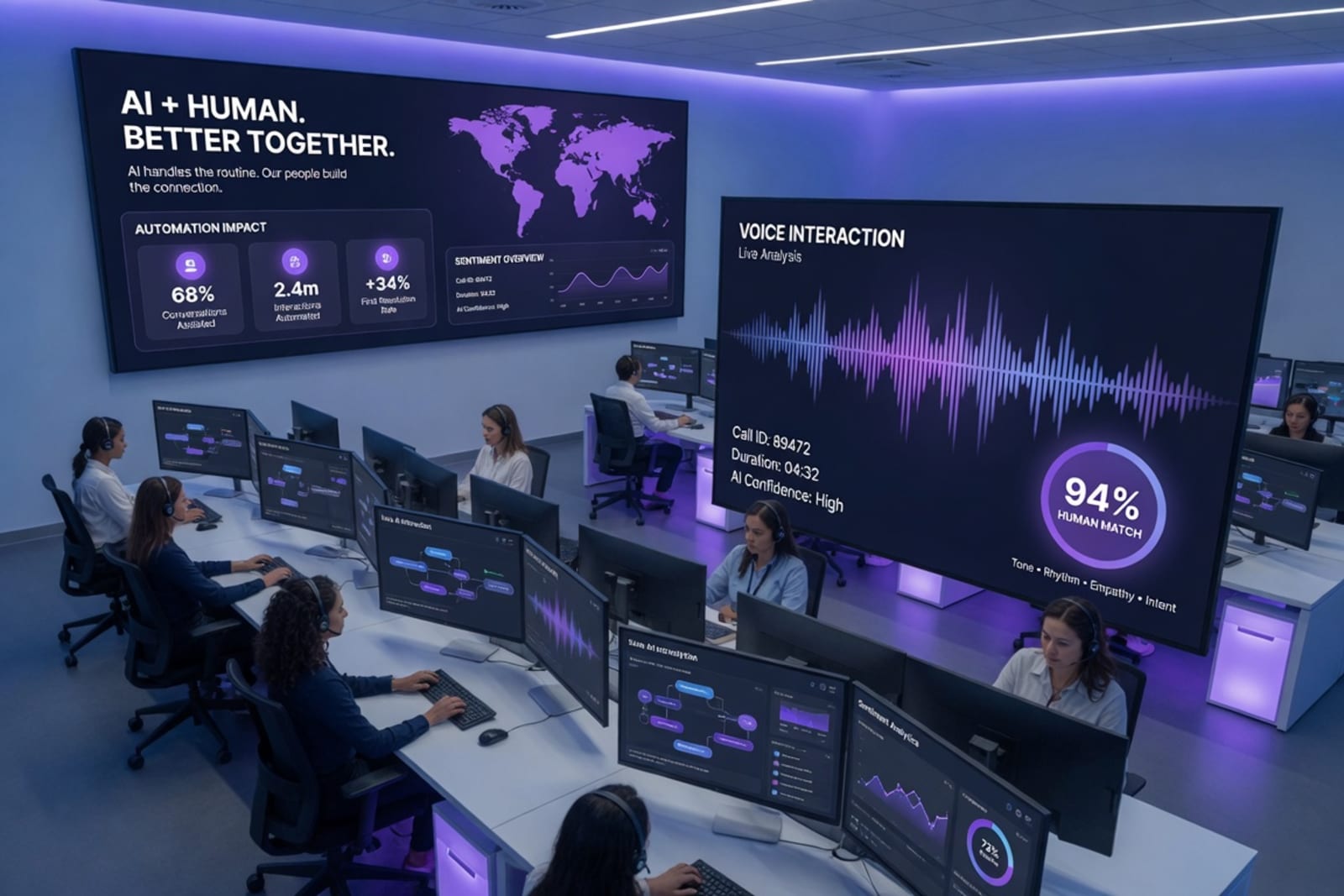
Conversational AI is software that understands and responds to human language in real time across voice, chat, and messaging channels. In the customer service context, conversational AI handles inbound inquiries, qualifies issues, resolves routine questions, and escalates complex or emotional cases to human agents. Modern customer service conversational AI combines natural language understanding, a knowledge base or retrieval system, integration with backend systems (CRM, ticketing, billing), and — for voice deployments — a speech engine that produces human-quality audio output. The category overlaps with but is distinct from Voice AI (which is specifically the audio/voice channel) and from Human Staff Mirroring (the category pioneered by Futuro in which the AI is engineered to replicate — not just respond to — human conversational behavior, including micro-pauses, adaptive tone, and emotional intelligence).
For those too busy to read the full article, here is a quick-reference chart. Each platform is listed alphabetically with three columns: what market segment it best serves, its standout attributes, and its pricing model. The full details follow below.
01 At a Glance: Strengths, Best Fit, and Pricing
| Platform | Best Fit For | Standout Attributes | Pricing |
|---|---|---|---|
| Ada | Mid-market to enterprise teams wanting chat-first AI automation across 50+ languages | 50+ languages; ~$0.85/resolution; automation-first; used by Square, YETI, Monday.com | From ~$30,000/year |
| Aisera | Large enterprises needing 1,200+ pre-built workflows and multi-agent orchestration | Gartner Leader; 1,200+ workflows; 400+ Fortune 2000; agent marketplace with 300+ agents | Custom quote |
| Cognigy | Enterprise contact centers modernizing legacy IVR with voice-first AI | 100+ languages; Gartner Leader; voice gateway; recently acquired by NICE | Custom quote |
| Forethought | Salesforce-native organizations wanting AI layered directly into Service Cloud | Salesforce-native; ~$0.90/resolution; Solve AI; acquired by Zendesk 2026 | Custom quote |
| Futuro | Teams wanting done-for-you voice AI with 2TB knowledge, caller memory, and human voice | 94% human voice; MasterMind (2TB, not RAG); caller memory; conditional forwarding; flat rate | From $200/month flat rate |
| Intercom | SaaS and tech companies wanting AI-first helpdesk with Fin AI agent | $0.99/resolution; 96% faster resolution; strong for digital-native companies | From $29/seat/mo + $0.99/res |
| Kustomer | Teams wanting CRM + AI support in one platform with deterministic logic | AI Agents 2.0 with "Procedures"; CRM-native; WhatsApp, Facebook, email | Custom quote |
| Observe.AI | Contact centers wanting 100% interaction analysis, coaching, and QA automation | 100% call analysis; real-time coaching; automated QA scoring; sentiment analytics | Custom quote |
| Replicant | High-volume contact centers wanting Tier 1 voice automation across channels | "Thinking Machine" voice AI; Tier 1 automation; voice + SMS + chat; enterprise scale | Custom quote |
| Zendesk | Teams already on Zendesk wanting native AI bolted onto existing helpdesk | Native integration; AI agents + Copilot; $19-169/agent/mo; largest install base | From $55/agent/month |
Listed alphabetically. Platforms are not ranked. Pricing is starting price or publicly disclosed tier; enterprise quotes may differ.
02 How We Evaluated These Platforms
Each platform was assessed on six weighted criteria that map to the decisions customer service leaders actually face. Weights are not a ranking system — they reflect the relative importance of each dimension for the typical customer service deployment. Verification date: June 2026.
| Criterion | Weight | What we measured |
|---|---|---|
| Voice quality & human-likeness | 25% | Naturalness of voice output, ability to handle disfluencies, turn-taking latency, emotional intelligence, and — for voice platforms — measured human-likeness in independent tests. |
| Knowledge depth & accuracy | 20% | Maximum knowledge base size, whether the platform uses traditional RAG or a unified knowledge system, and the rate at which the AI hallucinates on out-of-scope questions. |
| Channel coverage | 15% | Number of channels natively supported (voice, chat, email, SMS, WhatsApp, in-app, social) and consistency of the experience across them. |
| Setup time & ease of deployment | 15% | Time from contract to production deployment, technical staff required, and whether the platform is done-for-you or build-it-yourself. |
| Enterprise scale & integrations | 15% | Connector library, governance features, compliance certifications, and proven production deployments at enterprise call volumes. |
| Pricing transparency | 10% | Predictability of monthly cost, presence or absence of per-resolution overage fees, and whether pricing is publicly disclosed or quote-only. |
03 Ada — When the Job Is Multilingual Chat Automation at Scale
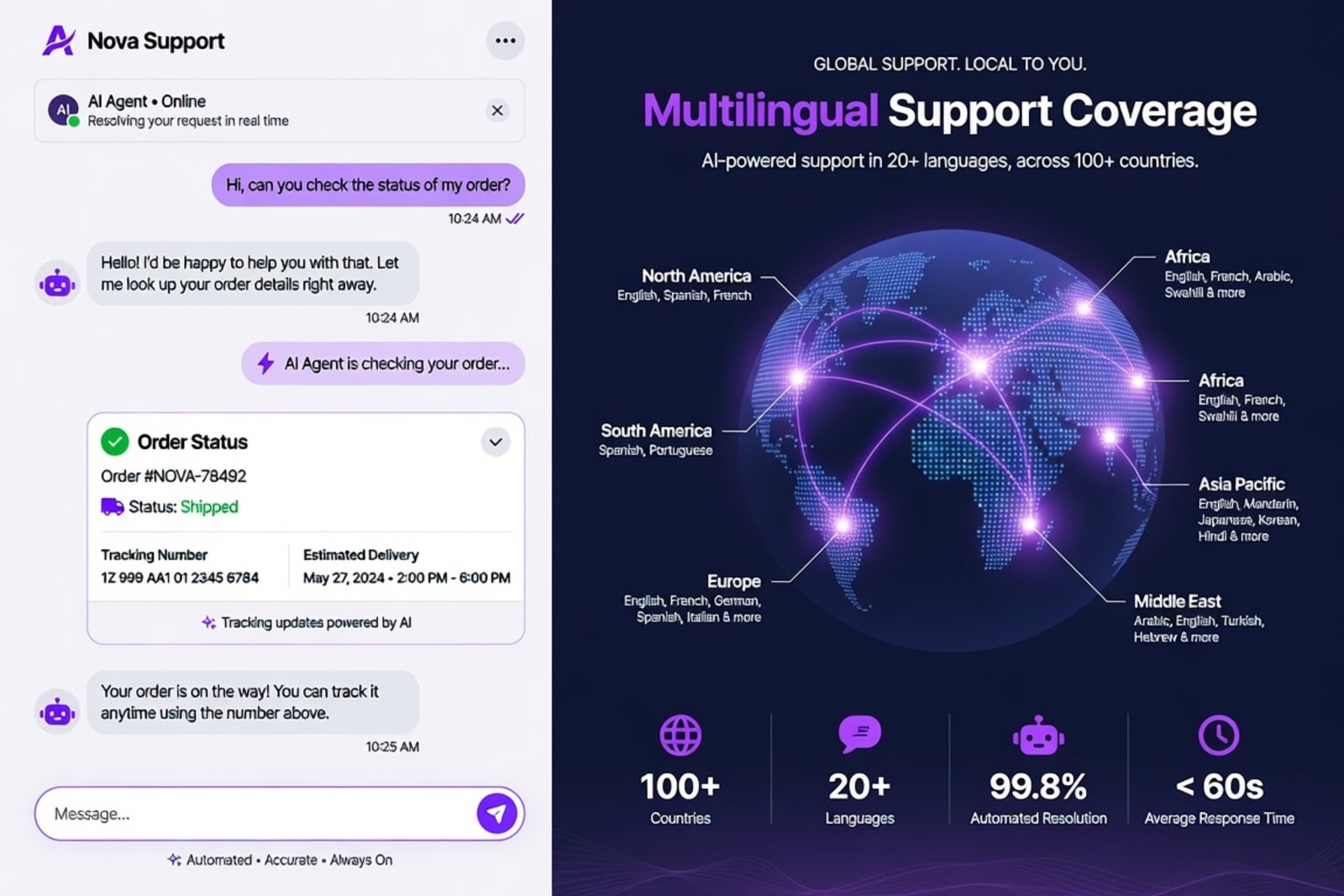
Ada is one of the most focused companies in this space. It does one thing extremely well: automated chat resolution across a massive language set. Founded in 2016 in Toronto, the platform has processed billions of conversations and built a reputation for reliability at scale. The automation engine resolves common inquiries — order status, password resets, refund eligibility, product questions — without human intervention, and its multilingual capability (50+ languages) makes it a natural fit for global brands.
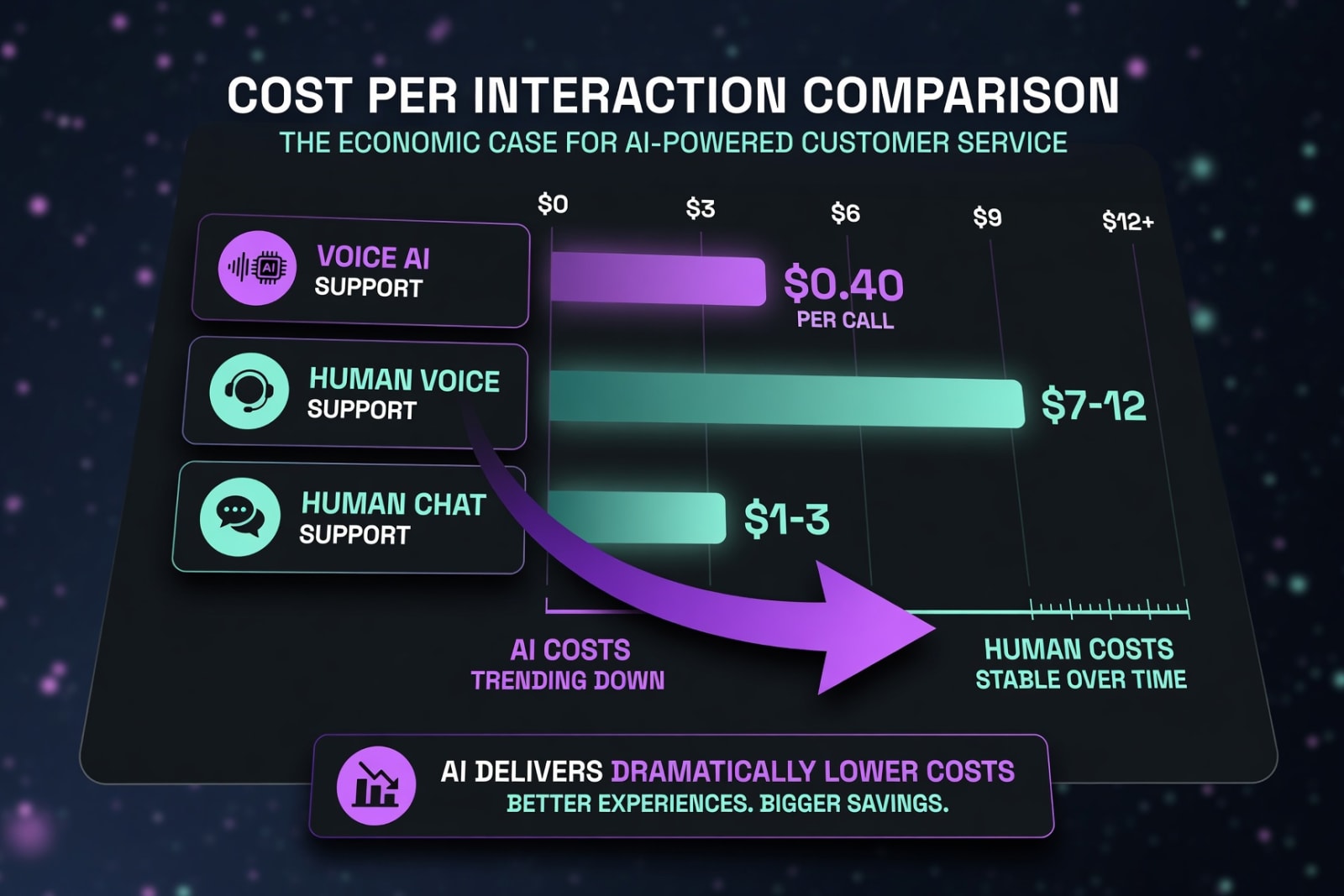
The context for why this matters is the cost structure of human agents. The average cost per inbound call ranges from $2.70 to $15 depending on industry complexity, with banking and finance reaching $10-25 per interaction and healthcare climbing to $50-60. Chat is cheaper than voice, but human chat agents still cost $1-3 per conversation when fully loaded. At approximately $0.85 per resolution, Ada's economics become compelling at volume — a company handling 10,000 automated resolutions monthly saves $100,000+ against human chat costs alone. The catch is the price of entry: entry points commonly start around $30,000 per year, which puts Ada firmly in the mid-market to enterprise bracket. Learn more at ada.cx.
04 Aisera — When the Job Is Enterprise-Scale AI With 1,200+ Pre-Built Workflows
Aisera sits at the enterprise end of the customer service AI spectrum. The platform has been recognized as a Leader in the Gartner Magic Quadrant for Conversational AI Platforms and serves over 400 Fortune 2000 enterprises. What distinguishes Aisera is the breadth of its workflow library: 1,200+ pre-built AI workflows covering common customer service scenarios, plus an agent marketplace with 300+ pre-built AI agents that can be deployed without custom development.
The multi-agent orchestration is the enterprise-grade feature that matters most. Instead of a single AI handling every inquiry, Aisera can deploy specialized agents for different tasks — one for billing, one for technical support, one for account management — and coordinate them so the customer gets routed to the right expert agent without human intervention. The governance framework, including role-based access controls, audit trails, and compliance certifications, makes it credible for financial services, healthcare, and government where AI behavior must be traceable and explainable. The deep integration ecosystem — 250+ plug-and-play enterprise connectors — means Aisera works with the systems large organizations already run. Enterprise AI adoption in customer service has reached 58%+, with 65% of enterprises increasing AI budgets in 2026, and platforms like Aisera are the infrastructure behind that growth. Learn more at aisera.com.
05 Cognigy — When the Job Is Voice-First Enterprise Contact Center AI
Cognigy is the platform enterprises choose when voice quality matters most. Recently acquired by NICE, Cognigy brings a native voice gateway designed for high-volume, low-latency telephony environments — something most chat-first platforms bolt on as an afterthought. The platform handles voice and chat interactions at scale across more than 100 languages, with a focus on natural turn-taking and the ability to manage complex, multi-step conversations that go far past simple FAQ deflection.
The NICE acquisition matters because it pairs Cognigy's conversational AI with one of the largest contact center infrastructure footprints in the world. For organizations already running NICE CXone, the integration path is significantly smoother than bringing in a standalone AI vendor. Cognigy's Agent Assist module also supports human agents in real time during live interactions, surfacing relevant knowledge and next-best-action guidance. Cognigy is positioned as a Leader in the 2025 Gartner Magic Quadrant for Conversational AI Platforms, and its voice-first heritage gives it genuine differentiation in a market where most competitors started with chat and added voice later. Learn more at cognigy.com.
06 Forethought — When the Job Is Salesforce-Native AI Customer Support
Forethought's defining characteristic is its Salesforce-native architecture. Unlike platforms that require API integrations and data sync, Forethought lives inside Service Cloud — the AI has direct access to customer records, case history, knowledge base articles, and routing rules without middleware. The Solve AI engine handles automated triage, response drafting, and escalation, while the Assist module provides real-time guidance to human agents during live interactions.
The pricing model — approximately $0.90 per resolved conversation — is competitive for Salesforce-centric organizations that want to add AI capability without a platform migration. The 2026 acquisition by Zendesk means Forethought's technology is being absorbed into the Zendesk ecosystem, which is good news for Zendesk customers but creates uncertainty for Salesforce-only buyers about long-term roadmap support. For teams that are Salesforce-native today and want the deepest possible CRM integration, Forethought remains the strongest option — but evaluate with the acquisition in mind. Learn more at forethought.ai.
07 Futuro — When You Want a Human-Sounding AI That Knows Your Business, Remembers Every Caller, and Costs 90% Less Than a Human Agent
Yes, this is our platform, and we have put ourselves seventh on an alphabetical list rather than first on a rigged one. Here is the honest version of where Futuro fits for customer service. Futuro is not a toolkit you build on; it is a done-for-you service. Every agent is custom-built for your business. You hand over your knowledge base, service documentation, call recordings, SOPs, and customer history — and Futuro builds, trains, and operates the agent. The result is an AI phone agent that sounds human, knows your business deeply, remembers every returning caller, and operates 24/7 on a flat monthly rate.
The voice technology is VoiceAlive (what is VoiceAlive?) — engineered around a counterintuitive insight: perfection is what gives AI voice away. VoiceAlive incorporates micro-pauses, authentic breathing, controlled disfluencies (the occasional "um" or "uh"), and adaptive speech speed that slows down for complex topics and speeds up for simple exchanges. The emotional intelligence layer adapts tone in real time — empathy for frustrated callers, enthusiasm for positive outcomes, professionalism for senior clients. The result: 94% human indistinguishability in a 1,000-person double-blind study, verified by three independent research firms over six weeks. Most businesses switching to AI voice see costs drop from $7-12 per human call to roughly $0.40 per AI call — a 90-95% cost reduction.
The knowledge system is MasterMind (what is MasterMind?) — and this is where Futuro diverges fundamentally from the rest of the market. Traditional RAG systems search individual documents and essentially guess which one has the right answer. MasterMind ingests up to 2TB of content — PDFs, Word docs, Excel files, PowerPoints, website content, video transcripts, audio recordings of previous calls, employee onboarding materials — and builds one unified, fluid knowledge unit. Not separate documents. One system. The AI agent then undergoes extensive training: a minimum of 500 simulated calls placed by other conversational AI agents, with a separate LLM scoring performance on a 1-10 scale across multiple categories. The agent constantly improves during this training. The result is predictive knowledge surfacing — the AI knows exactly which area of the knowledge base to draw from before the caller finishes asking the question — which means zero latency and zero hallucination. The agent only knows what is in your knowledge base, and it knows it perfectly.
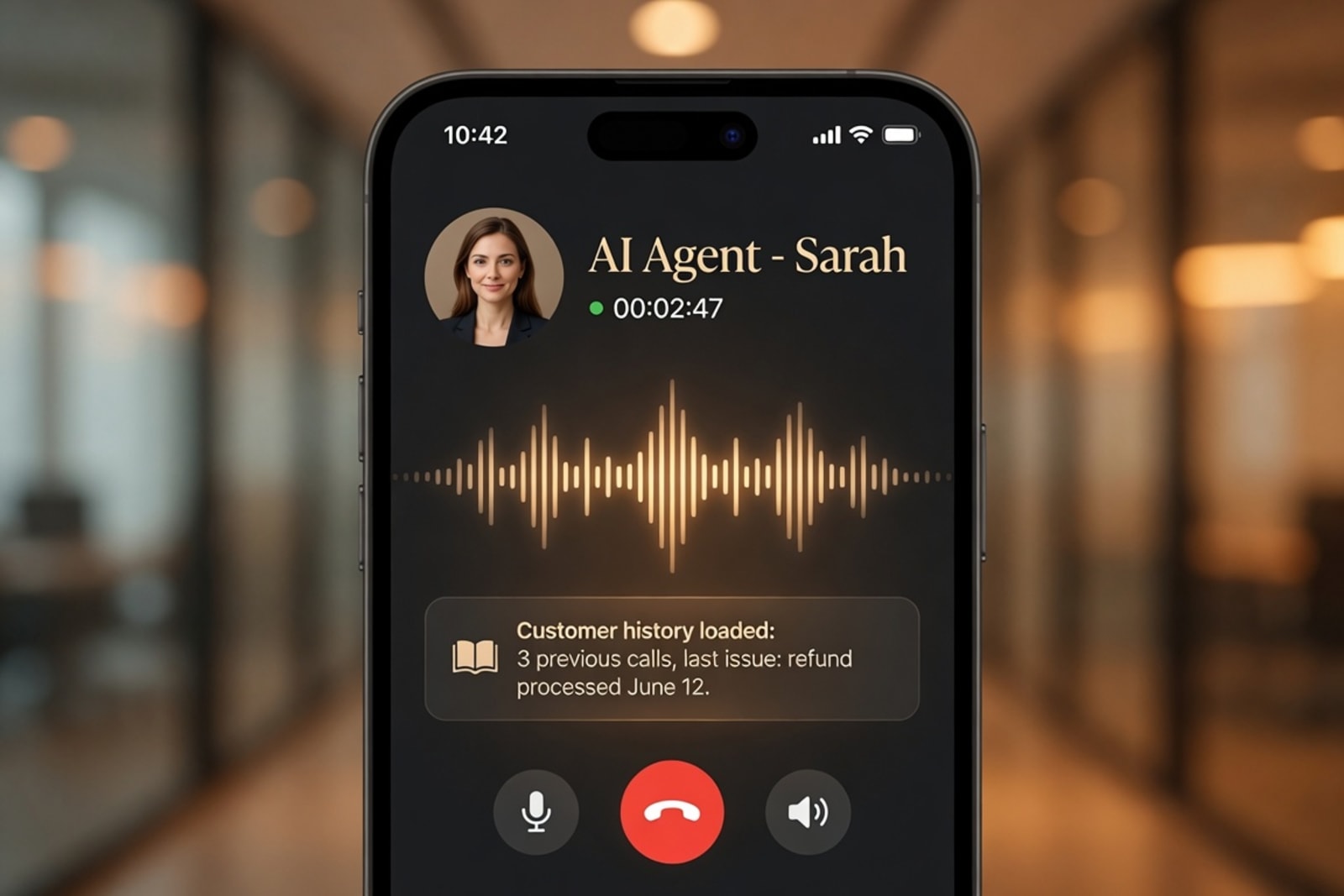
The Memory System is what makes this work for customer service in practice. When a customer calls back after a previous interaction, the AI accesses their full call history while the phone is still ringing. When the call connects, the agent already knows what they called about before, what was resolved, what was pending, and can say something like, "Hi Michael, I see we processed your refund last Tuesday — are you calling about the replacement order, or is this something new?" That level of personalization eliminates the most frustrating part of customer service: repeating yourself to a new agent who has no context. Learn more about the Memory System.
The conditional call forwarding system gives businesses control. Your phone still rings for your team to answer during business hours — but when the call would normally go to voicemail, it transfers to the AI agent instead. For a business that wants to handle calls themselves but cannot afford to miss any, this transforms voicemail into a 24/7 expert representative. Learn more about Human Staff Mirroring.
Pricing is a flat monthly rate starting at $200/month with unlimited calls — no per-resolution fees, no per-seat licenses, no overage surprises. The 7-day free trial requires no credit card. Setup takes 24-48 hours. Full pricing details.
08 Intercom — When the Job Is AI-First Helpdesk for SaaS and Tech Companies
Intercom began as a customer messaging platform and has evolved into a full AI-first customer service platform, with its Fin AI agent at the center of the product strategy. The platform combines AI-assisted response, conversation routing, proactive messaging, and customer data in a single interface — and the integration is genuinely tight rather than bolted-on. For technology companies where customers live inside the product and expect instant answers, this architecture is natural.
The results are measurable. Intercom reports that Synthesia reduced resolution time from five days and five hours to four hours and 37 minutes — a 96% decrease — after launching Fin AI Agent. [solidcore] reports saving hundreds of thousands of dollars with Fin, with projections reaching millions as they open more studios. The pricing model — $0.99 per resolution plus the Intercom seat license — is straightforward and predictable compared to platforms with complex add-on structures. The catch is the channel focus: Intercom is built for digital messaging (in-app chat, email, social) and while it has added voice capabilities, they are newer and less mature than the messaging core. For phone-heavy support operations, this is a meaningful limitation. Learn more at intercom.com.
09 Kustomer — When the Job Is CRM + AI Support in One Platform
Kustomer's differentiator is its CRM-native architecture. Unlike helpdesk platforms that treat customer data as an integration, Kustomer was built around the customer record first — every interaction, order, subscription, and support ticket lives in a single timeline. The March 2026 release of AI Agents 2.0 added "Procedures" — deterministic logic inside generative flows that lets teams enforce exact business rules (like a refund eligibility check) without relying on prompt engineering.
The AI Agents for Customers handle autonomous resolution across email, chat, Facebook, and WhatsApp, drawing on the CRM data to personalize responses. The AI Agents for Reps act as a copilot — summarizing conversations, suggesting replies, and pointing agents to the best next step. For businesses where customer context is everything — knowing what they bought, when it shipped, whether they have an open ticket — the CRM-first approach genuinely changes agent productivity. However, several copilot features are listed as "Coming Soon" on the AI-only tier, requiring the full AI + Platform plan to access the complete feature set. Learn more at kustomer.com.
10 Observe.AI — When the Job Is Quality Management, Coaching, and 100% Interaction Analysis
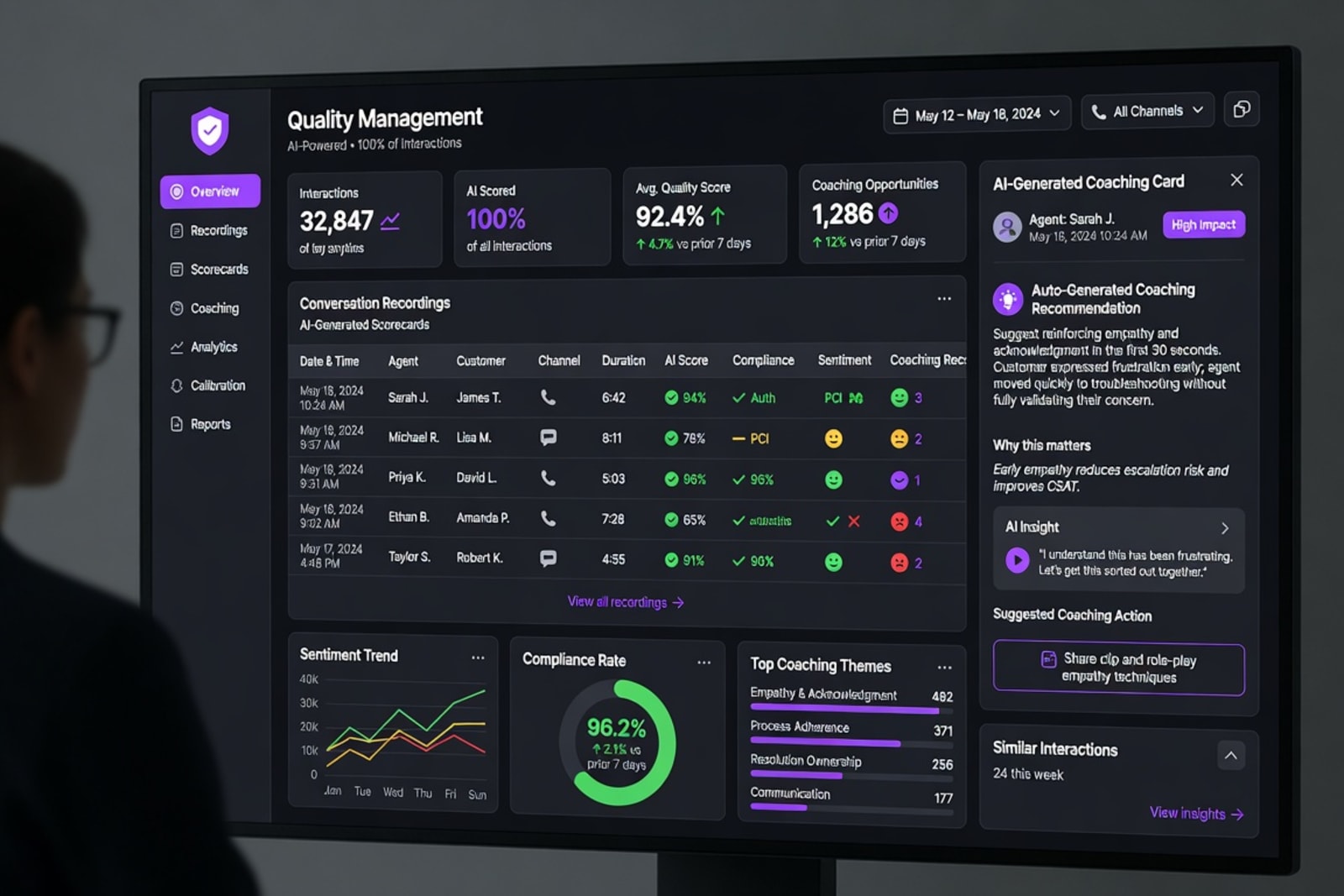
Observe.AI takes a fundamentally different approach from the other platforms on this list. It does not replace human agents with AI — it makes human agents better. The platform transcribes and analyzes 100% of customer interactions across voice, chat, and email, automatically scoring them against quality frameworks, identifying compliance risks, and surfacing coaching moments that manual QA processes (which typically sample 1-2% of calls) would never catch.
The real-time agent guidance is the operational difference-maker. During live calls, Observe.AI surfaces suggested responses, next-best actions, and compliance reminders directly in the agent's workflow — so a new agent gets the guidance of a ten-year veteran on every single interaction. For contact centers battling 30-45% annual turnover (with some centers hitting 60%), this capability is transformative — it compresses the ramp-up time for new hires from months to weeks and ensures consistent quality even with a constantly rotating workforce. The platform also provides predictive analytics that identify which interactions are likely to escalate before they do, giving supervisors the chance to intervene proactively. For regulated industries — healthcare, financial services, insurance — the compliance automation alone often justifies the investment. Learn more at observe.ai.
11 Replicant — When the Job Is Tier 1 Voice Automation at Enterprise Scale
Replicant brands itself as the "Thinking Machine" — an enterprise conversational AI platform purpose-built for automating the repetitive calls that consume most of a contact center's capacity. The platform handles order status checks, authentication flows, appointment changes, and routine troubleshooting over voice, SMS, and chat, with the explicit goal of resolving issues completely rather than deflecting them to a human.
The enterprise focus is clear in the deployment model: Replicant is built for organizations with massive call volumes and dedicated IT teams to manage implementation and ongoing tuning. The natural language understanding is designed for noisy telephony environments — the system handles accents, background noise, and interrupted speech better than many competitors. The omnichannel capability means a customer can start an interaction via SMS, continue by voice, and receive a confirmation by chat without losing context. AI-assisted contact centers see a 14% increase in issues resolved per hour and a 9% reduction in average handle time, and platforms like Replicant are engineered to maximize those efficiency gains at scale. Learn more at replicant.ai.
12 Zendesk — When the Job Is AI on Top of the Helpdesk You Already Use
Zendesk is the largest player in the customer service software market, and its AI strategy is straightforward: bolt AI onto the platform millions of teams already use. The AI Agents handle autonomous resolution, the AI Copilot supports human agents in real time, and Intelligent Triage routes incoming requests to the right team or workflow — all within the familiar Zendesk interface.
The native integration advantage is real: the AI inherits the entire knowledge base by default, works with existing routing rules, and reports through the same dashboards teams already monitor. The pricing starts at $55 per agent per month for Suite Team, with Professional at $115 and Enterprise at $169 — plus add-ons for Advanced AI ($50/agent/month), Copilot ($50/agent/month), Quality Assurance ($35/agent/month), and Workforce Management ($25/agent/month). The total cost for a 15-agent team with full AI runs approximately $3,825 per month or $45,900 per year. The per-resolution overage fees — $1.20-$1.50 per Verified Resolution above the included allowance — are the most common source of cost surprises, especially since overage auto-bills every month with no cap, no grace period, and no prior warning. Learn more at zendesk.com.
13 How to Choose for Your Customer Service Operation
The right platform depends on answering four questions honestly about your situation.
1. What is your primary support channel — phone, chat, email, or omnichannel?
If 70%+ of your volume is phone calls, prioritize voice-first platforms: Futuro (human-sounding voice with deep knowledge), Cognigy (enterprise voice AI), or Replicant (high-volume Tier 1 automation). If chat dominates, Ada or Intercom Fin are the natural choices. If you need quality coaching for human agents, Observe.AI is purpose-built. If you run a mixed channel operation on an existing helpdesk, Zendesk AI or Aisera provide the broadest coverage.
2. What is your call volume, and what does a human agent cost you today?
At $7.16 per call average (and up to $60 in healthcare), a team handling 500 calls daily spends $90,000+ monthly on voice interactions alone. Voice AI at $0.40 per call drops that to $6,000 — an $84,000 monthly savings. AI agents reduce customer service costs by up to 30% in typical deployments, with some enterprises reporting $200,000+ in annual savings. If your volume justifies the investment, fully managed voice AI pays for itself quickly. If volume is lower, start with chat automation or a hybrid approach.
3. How complex is your product or service knowledge?
A retail company with 50 products needs less knowledge depth than a SaaS platform with 500 features, an API documentation library, and complex troubleshooting flows. For deep, nuanced knowledge, Futuro's MasterMind system — which ingests up to 2TB and builds a unified knowledge base — handles complexity that traditional RAG struggles with. For moderate complexity, Aisera's 1,200+ pre-built workflows cover common scenarios. For simpler use cases, Ada or Intercom may be sufficient.
4. Do you want a done-for-you service or a toolkit to build on?
This is the fundamental choice. Done-for-you platforms like Futuro handle setup, training, and ongoing management — you provide the knowledge, they deliver the agent. Toolkit platforms like Aisera, Cognigy, and Zendesk give you more control but require dedicated technical staff to build, tune, and maintain. If you have an AI engineering team, toolkits offer flexibility. If you want results without hiring specialists, done-for-you is the pragmatic path.
We switched to Futuro's AI voice agent six months ago. In the first quarter, our cost per call dropped from $8.40 to $0.42, our after-hours answer rate went from 12% to 100%, and customer satisfaction actually went up 8 points because callers no longer had to repeat their issue to a new agent every time. The AI knew their history, spoke like a person, and resolved 74% of calls without human involvement.
Bottom Line
The best conversational AI for your customer service operation is the one that matches your channel mix, call volume, knowledge complexity, and team structure. A SaaS startup with 100 chat tickets a week needs a different tool than a healthcare call center processing 50,000 voice calls a month. An enterprise with dedicated AI engineers can squeeze more value from toolkit platforms. A small business without technical staff needs a done-for-you service that just works.
The data tells a clear story: 88% of contact centers now use some form of AI, but only 25% have fully integrated it. 87% of senior leaders plan to invest in AI for customer service this year. 75% of customer inquiries can now be resolved by AI without human intervention. The question is no longer whether AI belongs in your customer service operation — it is which platform actually fits your specific needs.
Futuro is built for customer service teams that want a human-sounding AI phone agent powered by a 2TB unified knowledge system, with caller memory that personalizes every interaction, conditional call forwarding that captures missed calls, and a flat monthly rate with unlimited calls. The 7-day free trial requires no credit card. Setup takes 24-48 hours. Learn more about the Memory System or explore the MasterMind knowledge platform.
Cut Your Customer Service Costs by 90%
Join businesses using Futuro's AI voice agents. 7-day free trial. 30-day money-back guarantee. No setup fees, no per-call charges, no contracts.