
Editorial Disclosure: This guide is published by Futuro Corporation, and Futuro AI is one of the seven AI platforms compared. Futuro has no financial, affiliate, or referral relationship with the other vendors named here, and no vendor paid for inclusion. All pricing was verified against the vendors’ own pages on October 1–2, 2026. Beyond this article, we document pricing for every vendor we cover — and every vendor we come across: a dated screenshot of each vendor’s pricing page is retaken every Friday at 9:00 AM ET as direct evidence of what they charge, currently for more than 70 vendors, at futurocorp.com/vendor-pricing. Full methodology.
- What we verified: every price and language-capability claim in this article was read from the vendor’s own live pages between October 1 and October 2, 2026, and each AI vendor’s pricing is documented with a dated screenshot — retaken every Friday at 9:00 AM ET, whether the price changed or not — on our public vendor pricing index (70+ vendors and counting). Language claims were checked against each vendor’s published documentation and feature pages, quoted directly where the wording matters.
- What we did not do: we did not place test calls in Spanish to all seven platforms, and we did not independently measure detection accuracy, accent coverage, or voice quality per language. Where a capability claim comes from a vendor’s own marketing, we say so inline — including ours. Futuro AI’s language capabilities are published company claims from our VoiceAlive 3.0 release notes, date-stamped 2026, and individual results will vary with audio quality, configuration, and carrier setup. Interpreter and human-service rates are cited from published rate cards and official pages, with dates.
- Corrections: pricing changes and features ship. If something here is wrong, our corrections policy commits to a fix, and editorial@futurocorp.com reaches a human who re-verifies on every report.
The market your phone doesn’t serve
Start with the number that should be printed above every small-business phone in America: 44.9 million people age five and up speak Spanish at home in the United States — one in seven people — per the Census Bureau’s American Community Survey data for 2024, compiled by USAFacts (January 2026). Spanish is the most common non-English language in the country by a factor of twelve, more than half of its speakers live in California, Texas, or Florida, and the speaker count grew 21.3% between 2010 and 2024 — nearly double the growth of the population overall. In five states, at least one resident in five speaks Spanish at home.
This is not a border-town footnote. At the county level, the ACS figures read like a different country: Starr County, Texas is 91% Spanish-speaking; Webb County (Laredo) 86%; Hidalgo County (McAllen) 79%; Miami-Dade 66.7%; El Paso County 66.1% (SocialExplorer’s ACS compilation, April 2026). And “speaks Spanish at home” understates the phone problem, because the harder number is English comfort: about 8.6% of the US population — roughly 26 million people — speaks English less than “very well” (Census ACS language page), and among Spanish-at-home speakers that share is 38.6% (Demos’ language-access analysis). Those are the callers who hear an English-only greeting and hang up before the beep.
Does language actually change buying behavior? The most-cited evidence is CSA Research’s “Can’t Read, Won’t Buy — B2C” study (July 2020): 8,709 consumers across 29 countries, surveyed with Kantar, and — a detail worth savoring — the US portion was conducted in Spanish. The findings: 76% of consumers prefer buying with information in their own language, 40% will never buy through a channel that isn’t in their language, and 75% are more likely to buy again from brands whose customer care speaks their language (CSA Research’s official release). One honesty note: CSA studied web commerce, not phone calls — we apply it directionally. But the phone is a harsher channel than the web: a shopper can squint at an English checkout page, while a caller who can’t be understood has no fallback at all. The direction is safe; the magnitude is probably larger.
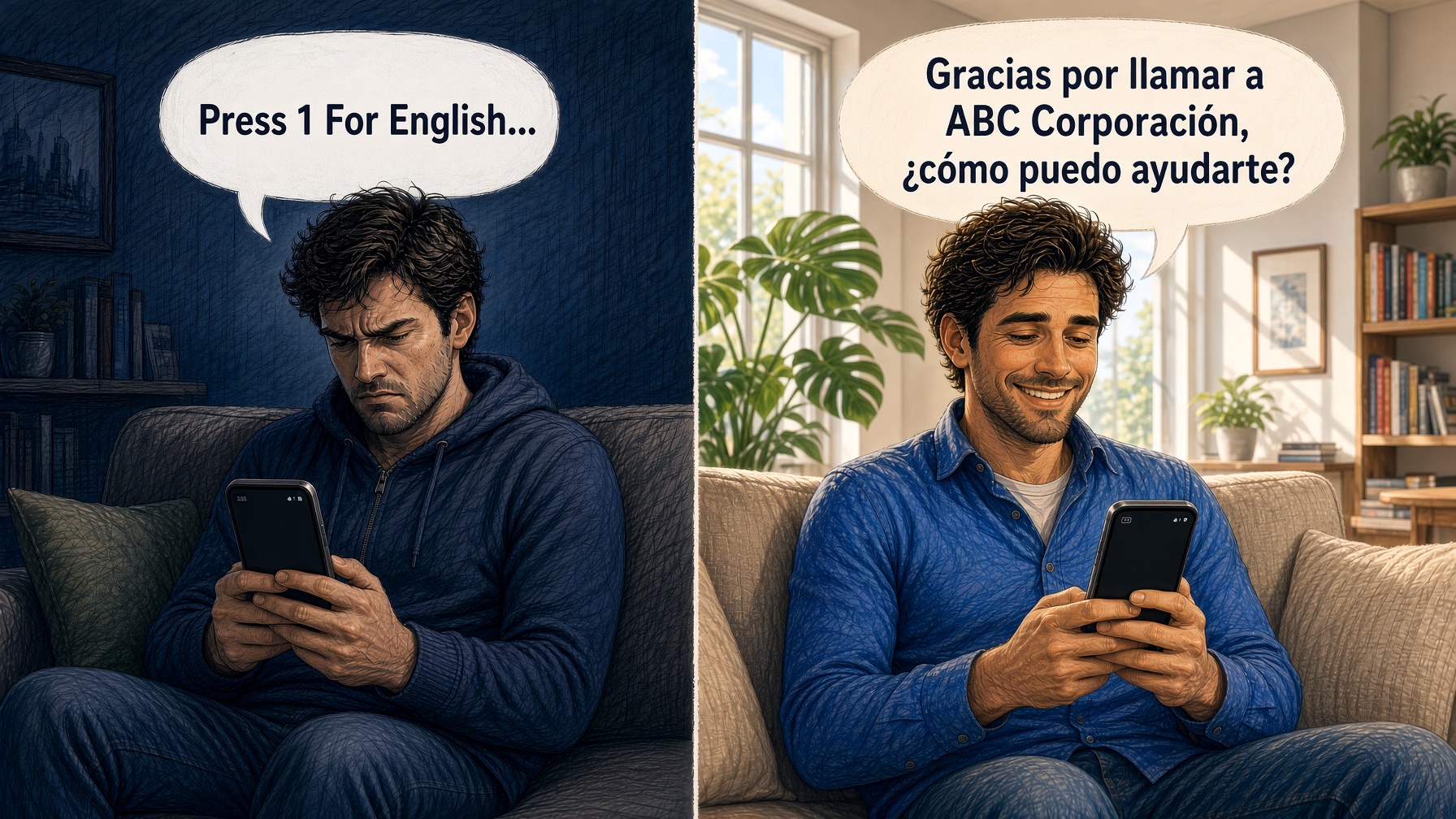
Meanwhile, the default small-business phone setup answers in English, full stop — or worse, offers a “press 2 for Spanish” menu that sheds callers at exactly the moment of intent. The three ways businesses actually close that gap are the subject of this guide: staffed bilingual answering services, on-demand interpreter lines, and AI receptionists that detect and speak Spanish natively. Each has a real cost curve, a real quality ceiling, and a real failure mode. Here they are, honestly.
The decision table: seven bilingual AI receptionists at a glance
The whole AI conclusion, scannable in one pass; the graded details and dated pricing screenshots sit in each profile below. (Human services and interpreter lines are compared in the three models and priced out in the cost math.)
| Provider | Pricing | Standout attribute | Best fit |
|---|---|---|---|
| AgentZap | $109/mo (150 min) + $25/mo language add-on + $499 setup | Structured intake flows; answers in the caller’s language and switches mid-call | Businesses wanting deep intake structure with Spanish added on |
| Dialzara | $99/mo Pro tier (220 min) for EN/ES | Ten languages auto-detected; five-minute setup | Budget buyers who need English, Spanish, and a third language |
| Futuro AI | $200/mo flat, unlimited | 53 languages detected from the caller’s first words, with per-turn mid-call switching; EN/ES the deepest-tested pair | Businesses where Spanish is a meaningful daily share of calls |
| OnCallClerk | Free plan; paid from $29/mo | English + Spanish out of the box, no card to start | The zero-risk first bilingual pilot |
| Rosie | $49/mo (250 min) | English & Spanish on every call, on every plan including entry | Budget bilingual answering with booking one tier up |
| Smith.ai | AI from $150/mo; staffed from $300/mo | AI Spanish detection backed by fluent bilingual humans; $1/call dedicated Spanish line | High-stakes calls that may need a bilingual human |
| Upfirst | $24.95/mo (30 calls) | 35+ languages with automatic switching; spam calls free | The lowest-commitment multilingual pilot |
Prices are verified entry points as of October 1–2, 2026 — not endorsements of the cheapest tier. A dated screenshot of every pricing page sits in the matching profile below and on our vendor pricing index.
How we assessed the seven platforms
Eight criteria, weighted for what decides a bilingual-answering purchase — not a generic feature checklist. Language detection and mid-call switching carries 25 points, the single heaviest weight, because it is the first filter: a platform that detects Spanish from the caller’s voice and misses everything else still beats a feature-rich platform that asks callers to press 2. Weights were fixed before the profiles were written, sum to 100, and apply to every platform including ours.
| Criterion | Weight | What it measures |
|---|---|---|
| Language detection & mid-call switching | 25% | Detecting the caller’s language from speech — no keypad menu — and following code-switching across turns, because bilingual callers mix languages inside one sentence. |
| Spanish conversation quality & terminology | 20% | Natural, region-appropriate Spanish that handles the business’s own terms — services, prices, policies — correctly, not phonetic scripting. |
| English–Spanish coverage parity | 15% | Same features, same hours, and no per-language surcharge in both languages — Spanish at 9 PM identical to English at 9 AM. |
| In-language completion | 10% | Booking, confirming, capturing intake, and following up in the caller’s language end-to-end, not just greeting in it. |
| Transfer depth & escalation | 10% | Warm or live transfer paths when a call outruns the AI — available in Spanish, not English-only. |
| Pricing fairness & transparency | 10% | Published pricing, no hidden language surcharges, predictable billing at real call volumes. |
| Setup speed & onboarding | 5% | Signup to answering real calls in both languages in minutes or hours, not a procurement cycle. |
| Evidence & verifiability | 5% | Dated screenshots, published documentation, and claims a buyer can test on their own line. |
The rubric is published as machine-readable data in this page’s JSON-LD (grading dataset), licensed CC-BY. One register note, because vendors blur it on purpose: language selection (the caller picks from a menu, or the system detects from speech) and language coverage (how many languages the platform lists) are different capabilities. This rubric assesses detection-first answering; a 200-language list behind a press-2 menu is still a press-2 menu.
Three models, honestly: humans, interpreter lines, and AI
Every bilingual answering setup in the US is one of three things. Each model has a genuine strength, a real cost curve, and a characteristic failure mode — and the honest answer for most businesses is knowing which failure mode they can live with.
Model one: the human bilingual answering service
The pitch: trained, fluent English–Spanish receptionists answer in your business’s name. The genuine strength is the one AI still can’t fully replicate — judgment and warmth on the hard calls: the upset caller, the apologetic cancellation, the conversation that needs a person to read the pause. The cost curve is per-minute human time. Ruby, the best-known US staffed service, includes bilingual answering on every plan at no surcharge — plans run $250 a month for 50 receptionist minutes up to $1,725 for 500, an effective $3.45–$5.00 a minute (Ruby’s plans and pricing, October 2026). Across the broader market, traditional live bilingual services bill roughly $0.75–$2 per minute, Spanish-specific coverage is quoted around $1.38–$1.65 a minute, and some providers add a 20–40% premium on Spanish calls — those last three figures come from vendor-published comparisons, so treat them as directional and verify against any service you shortlist.
The failure mode is coverage parity. A bilingual staffing pool is smaller than an English one, and it thins exactly when you need it: nights and weekends. Ruby’s own site states its bilingual hours two ways — “24/7 Spanish and bilingual call handling” on the pricing page, while two of its FAQ answers limit bilingual service to Monday–Friday, 5 AM–6 PM Pacific — a contradiction third-party reviewers flagged in August 2026 and still worth resolving in writing before you sign. That ambiguity is not a Ruby-specific knock; it is the structural truth of the model: the 9 PM Spanish caller gets whoever is on shift, and sometimes that is an English-only agent with a translation card. Quality varies agent to agent, shift to shift.
Model two: the interpreter line
The pitch: your staff answers in English, and when a Spanish caller arrives, you conference in a professional interpreter as a third party. The genuine strength is accuracy under scrutiny — certified interpreters, hundreds of languages, and a compliance trail that healthcare and legal buyers actually need. LanguageLine’s pay-as-you-go service covers 270-plus languages with no contract or monthly minimum at $3.95 a minute for audio (LanguageLine’s official pay-as-you-go page); negotiated contract rates run lower — Cornell’s published LanguageLine contract lists $1.10 per audio minute (Cornell’s rate disclosure), and GlobalArena’s 2025 rate sheet lists $0.95 a minute with a $95 monthly access fee (rate sheet PDF).
The failure mode is friction with a meter running. The three-way call is a relay: the caller explains, waits for the interpreter to connect, hears their own words repeated, then hears the answer repeated back. Every sentence happens twice, every party bills or waits, and a five-minute question becomes a fifteen-minute call at $1–$4 a minute — while the caller experiences hold music and translation lag at the exact moment they were deciding whether to trust you. Interpreter lines are the right tool for occasional, high-stakes, or regulated conversations. As the front door to your business, they price like a penalty and feel like one too.
Model three: the AI multilingual receptionist
The pitch: one agent answers every call, detects the caller’s language from their first few words, and handles the full conversation — intake, answers, booking — in it, at a flat monthly price with no language surcharge. The genuine strengths are consistency and parity: the 9 PM Spanish caller gets the identical quality as the 9 AM English one, because the knowledge, policies, and prices are the same system in every language, and the fifth simultaneous call answers like the first. The failure mode is the one vendors least like to print: language quality is not uniform. Futuro’s own VoiceAlive 3.0 release notes publish the honest version of this — English and Spanish are the deepest-tested pair, other languages get tuning proportional to market size, and “any vendor claiming perfect parity across 53 languages is overselling” (the release’s limitations section). Dialect nuance — Caribbean versus Mexican Spanish — takes configuration attention on any platform, and sensitive emotional conversations still favor a human. The honest structure of this model’s pitch is not “AI is better”; it is that coverage and consistency are solved problems, and quality is a testing problem you can run yourself in a trial week.
The seven AI platforms, profiled
Alphabetical order, same structure for each: what it costs, what the Spanish actually is, and one honest trade-off. Pricing screenshots are dated and retaken weekly on our public index.
1. AgentZap
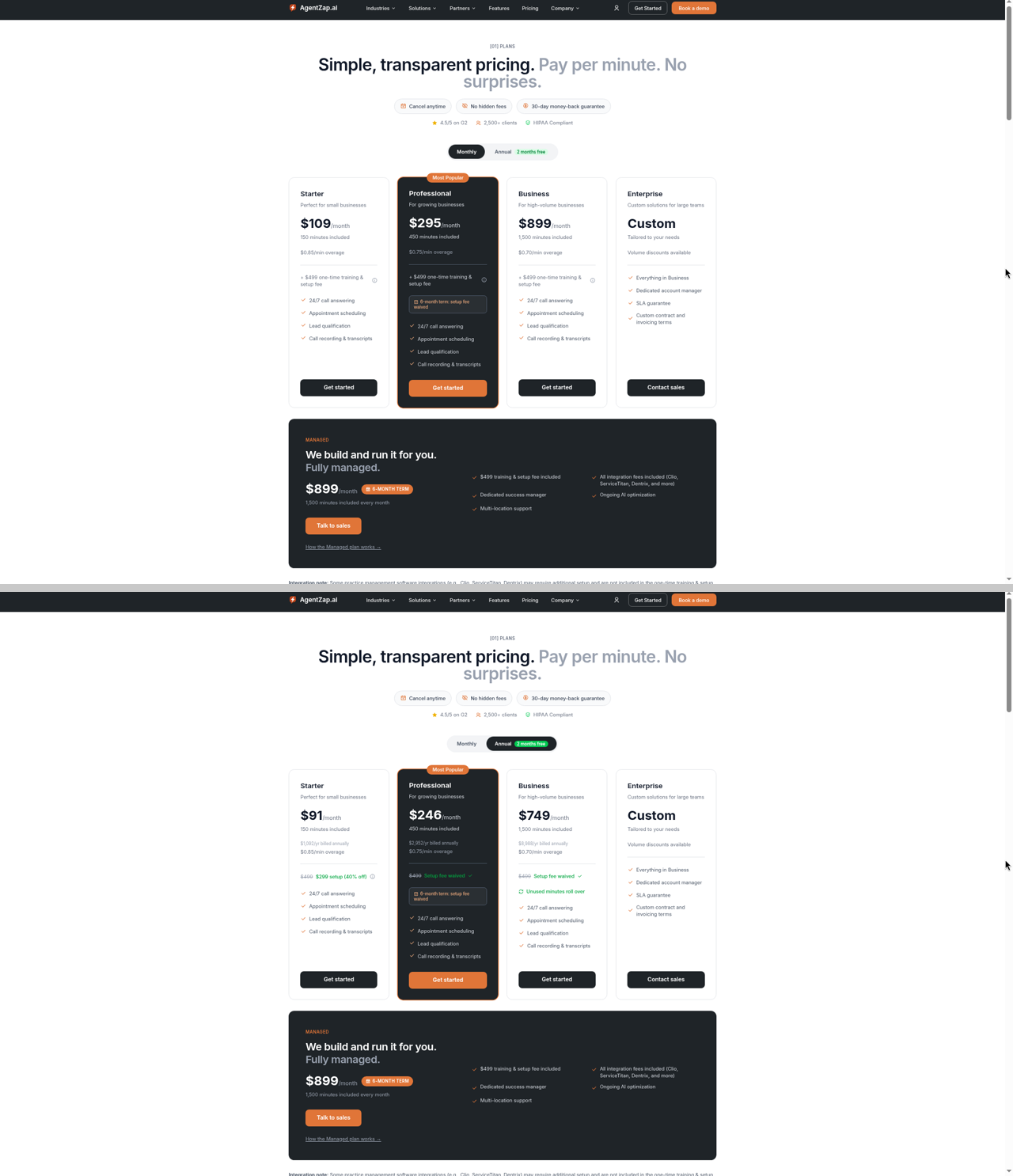
AgentZap’s Starter plan is $109 a month with 150 included minutes and $0.85 per overage minute, plus a $499 one-time training and setup fee — pricing verified October 1, 2026 (dated screenshot). Its published FAQ describes term-based relief on the setup fee (Starter drops to $299 on an annual term; Professional and Business waive it on qualifying terms), and the fee includes 150 test minutes to size your call volume before go-live. For bilingual coverage, AgentZap sells language as an add-on: its features page lists “Bilingual Answering — answers callers in their language and switches naturally,” with extra languages at $25 a month each. The agent follows the caller mid-conversation rather than restarting at a menu. Underneath the language layer sits a deep intake layer: up to 50 custom Q&A answers, configurable routing and warm transfers, 244+ native integrations, spam and robocalls filtered without billing against your minutes, and a live-agent escalation network at $2.50 per transferred call for the conversations that outrun the AI.
Pricing for AgentZap as captured on October 1, 2026. This screenshot is retaken every Friday at 9:00 AM ET and replaced whether the price has changed or not.
2. Dialzara
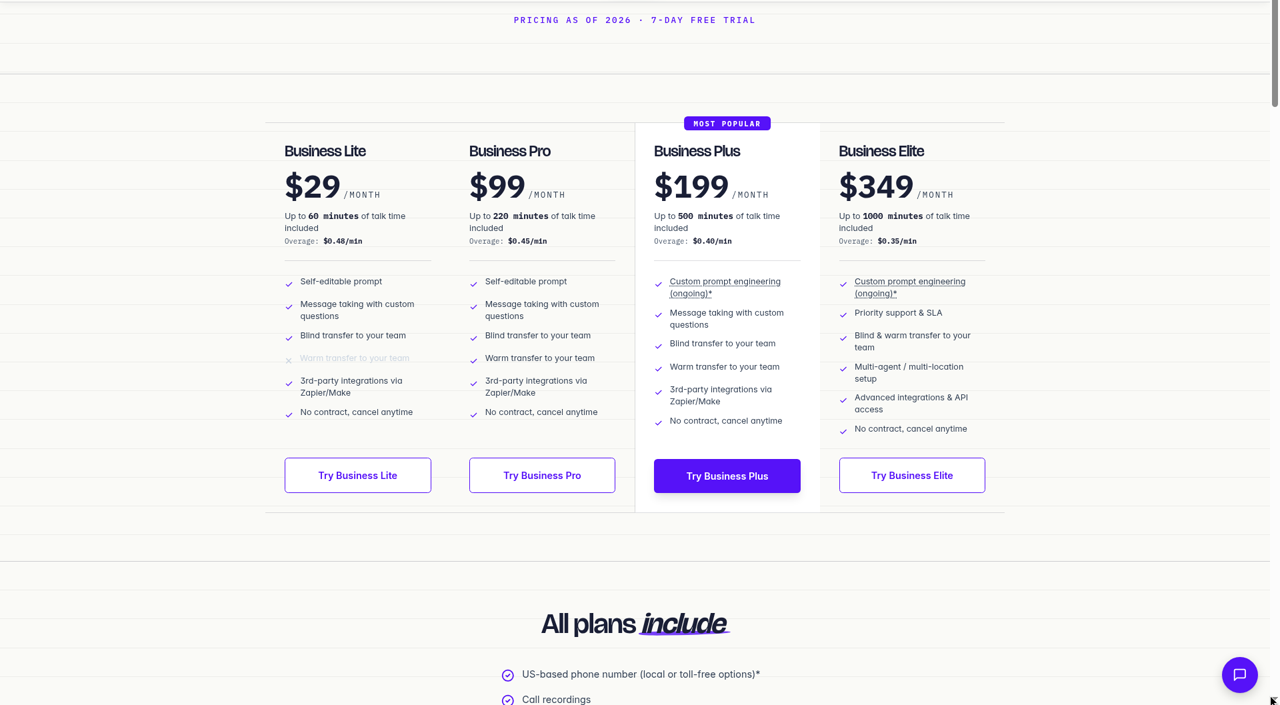
Dialzara’s Lite plan is $29 a month for 60 minutes — but read the feature matrix before you buy the entry tier: Bilingual (EN/ES) starts on the $99 Pro plan, alongside warm transfers, after-hours rules, and calendar sync (220 included minutes; Plus is $199 for 500, Elite $349 for 1,000), pricing verified October 2, 2026 (dated screenshot). The capability itself is real: Dialzara’s bilingual page documents ten languages with automatic detection — English, Spanish, French, German, and six more — identified from what the caller says rather than a keypad menu. Setup is measured in minutes, not days: point it at your website and you’re live in about five minutes. For a shop that answers in English today and knows the Spanish callers are out there, $99 for Pro is a genuinely low-friction first step.
Pricing for Dialzara as captured on October 2, 2026. This screenshot is retaken every Friday at 9:00 AM ET and replaced whether the price has changed or not.
3. Futuro AI
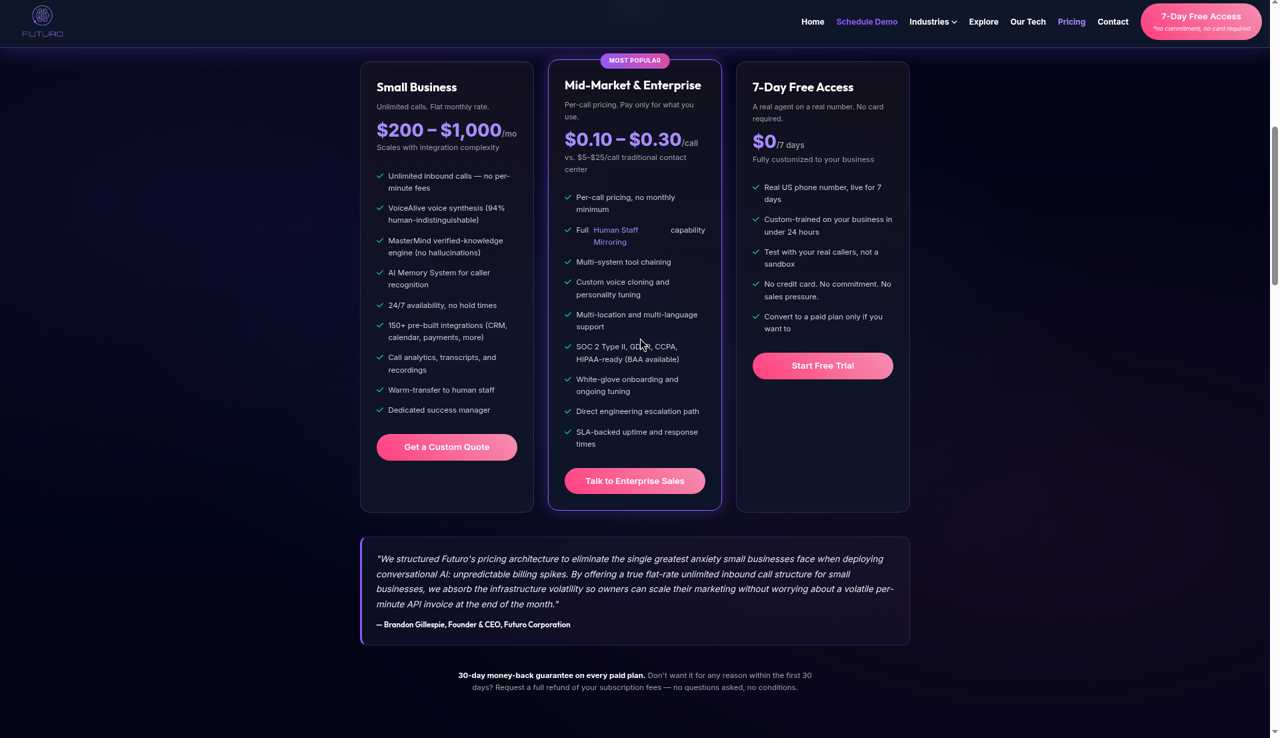
Futuro AI is $200 a month flat for unlimited answering, pricing verified October 2, 2026 (dated screenshot) — and language is not an add-on, a tier, or a surcharge: every plan speaks 53 languages. VoiceAlive 3.0 detects the caller’s language from their first few words — no “press 2 for Spanish,” no second number — and detection runs per conversational turn, so the caller who books in English, gives details in Spanish, and confirms a phone number in English is followed, not restarted (the canonical capability page). The knowledge layer carries your services, prices, and policies identically into every language, which is what after-hours parity actually means: the 9 PM Spanish caller gets the 9 AM English caller’s answer. The voice carries a 94% human-indistinguishability rating in a company-run double-blind study of 1,000 participants — company-run and not peer-reviewed, so call it yourself during the trial. And the honest limitation is published, not buried: English and Spanish are the deepest-tested pair, other languages carry less tuning depth, and the 94% figure measured realism, not per-language parity. Caller memory recognizes the repeat Spanish-speaking customer during the first rings, and setup is a managed 24–48-hour onboarding where your terminology — your service names, your dialect expectations — is configured with you.
Pricing for Futuro AI as captured on October 2, 2026. This screenshot is retaken every Friday at 9:00 AM ET and replaced whether the price has changed or not.
4. OnCallClerk
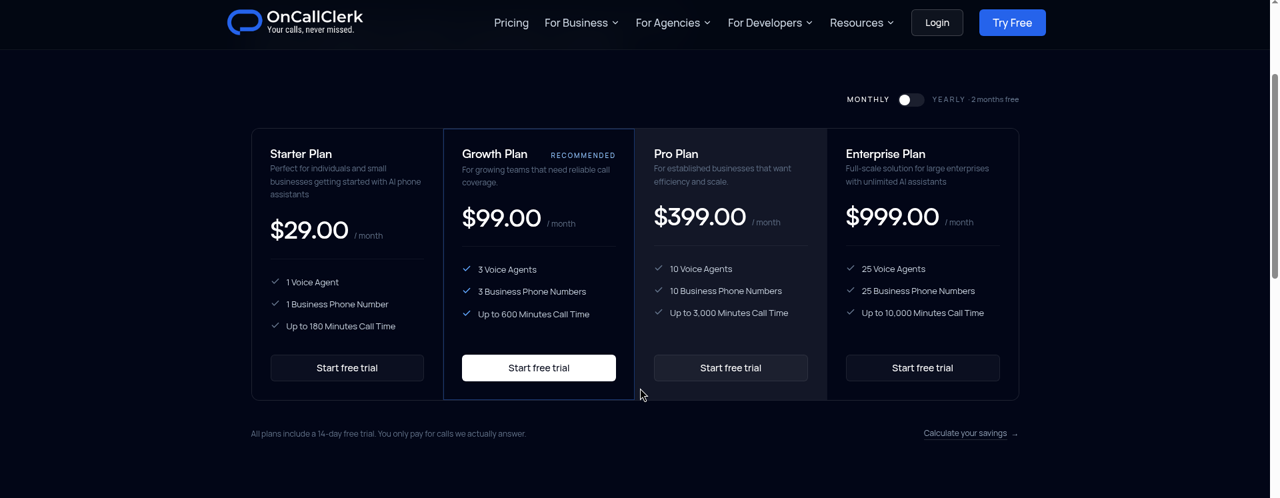
OnCallClerk leads with the only genuinely free tier on this list: an AI agent with a real phone number, no credit card, keep it forever. Paid plans start at $29 a month with calendar booking and call transfers included from entry, running to $99–$299 for the fuller feature set — pricing verified October 1, 2026 (dated screenshot). The bilingual claim is structural rather than a tier: its own product comparison lists “English + Spanish out of the box” against the hire-a-bilingual-employee alternative. There are no contracts and no setup fees, a 14-day trial covers the paid plans, and overage is billed per minute with approach-limit notifications rather than surprise throttling. For an owner who has never heard an AI answer in Spanish, this is the cheapest way to spend tonight finding out.
Pricing for OnCallClerk as captured on October 1, 2026. This screenshot is retaken every Friday at 9:00 AM ET and replaced whether the price has changed or not.
5. Rosie
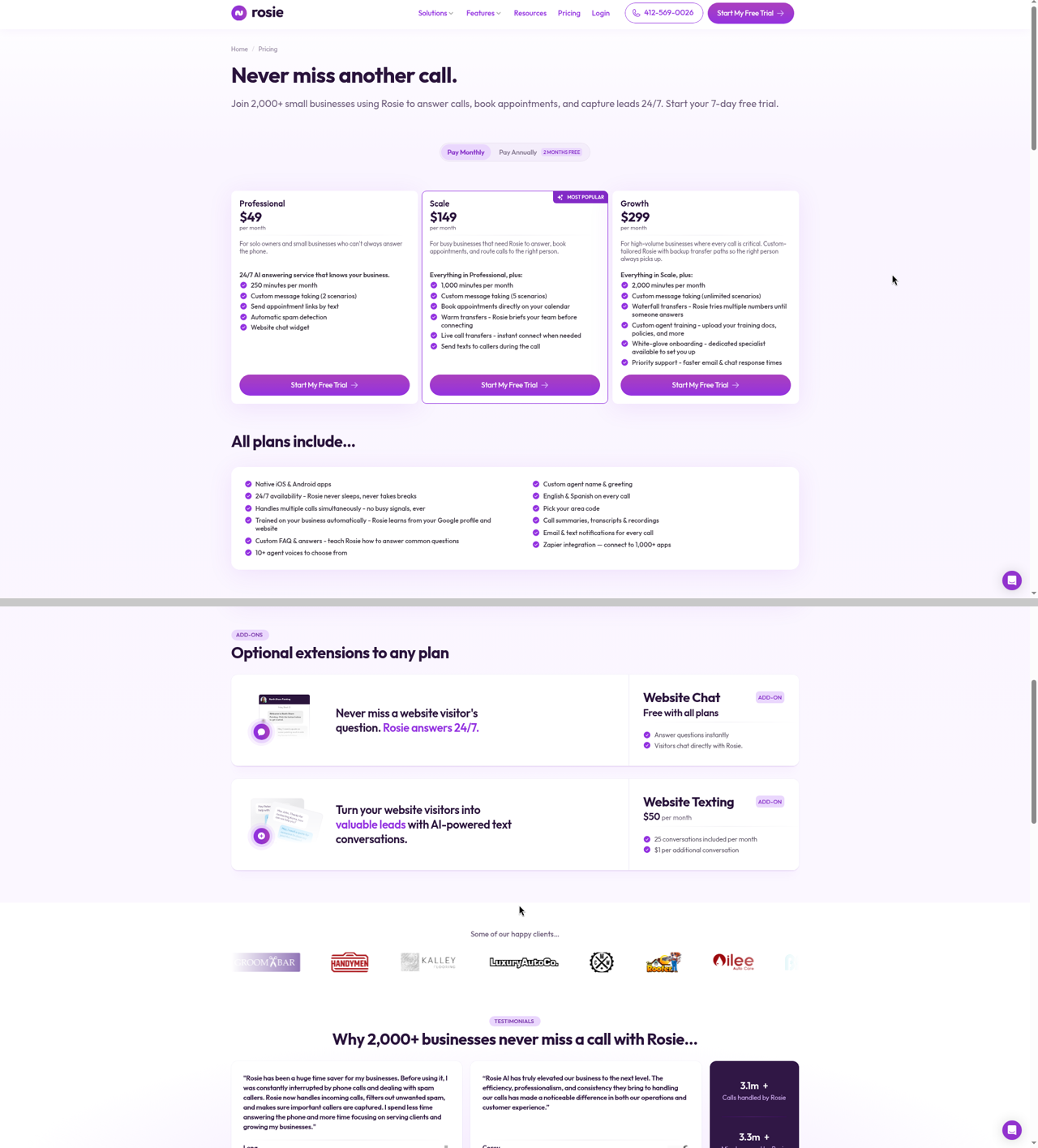
Rosie starts at $49 a month for 250 minutes, and the bilingual capability is not tiered: “English & Spanish on every call” appears in its all-plans include list, pricing verified October 1, 2026 (dated screenshot). The agent trains on your website and Google Business Profile automatically, answers 24/7, handles simultaneous calls, and sends summaries, transcripts, and recordings after each one. The tier structure matters for what happens after the greeting: the $149 Scale plan (1,000 minutes) adds calendar booking plus warm and live transfers — Rosie briefs your team before connecting — and the $299 Growth plan (2,000 minutes) adds waterfall transfers that try multiple numbers in sequence until someone answers. A 7-day free trial covers the evaluation. For a business whose Spanish-language calls are “what are your hours,” “how much for a cleaning,” and “can I book Thursday,” the $49 entry covers real bilingual ground.
Pricing for Rosie as captured on October 1, 2026. This screenshot is retaken every Friday at 9:00 AM ET and replaced whether the price has changed or not.
6. Smith.ai
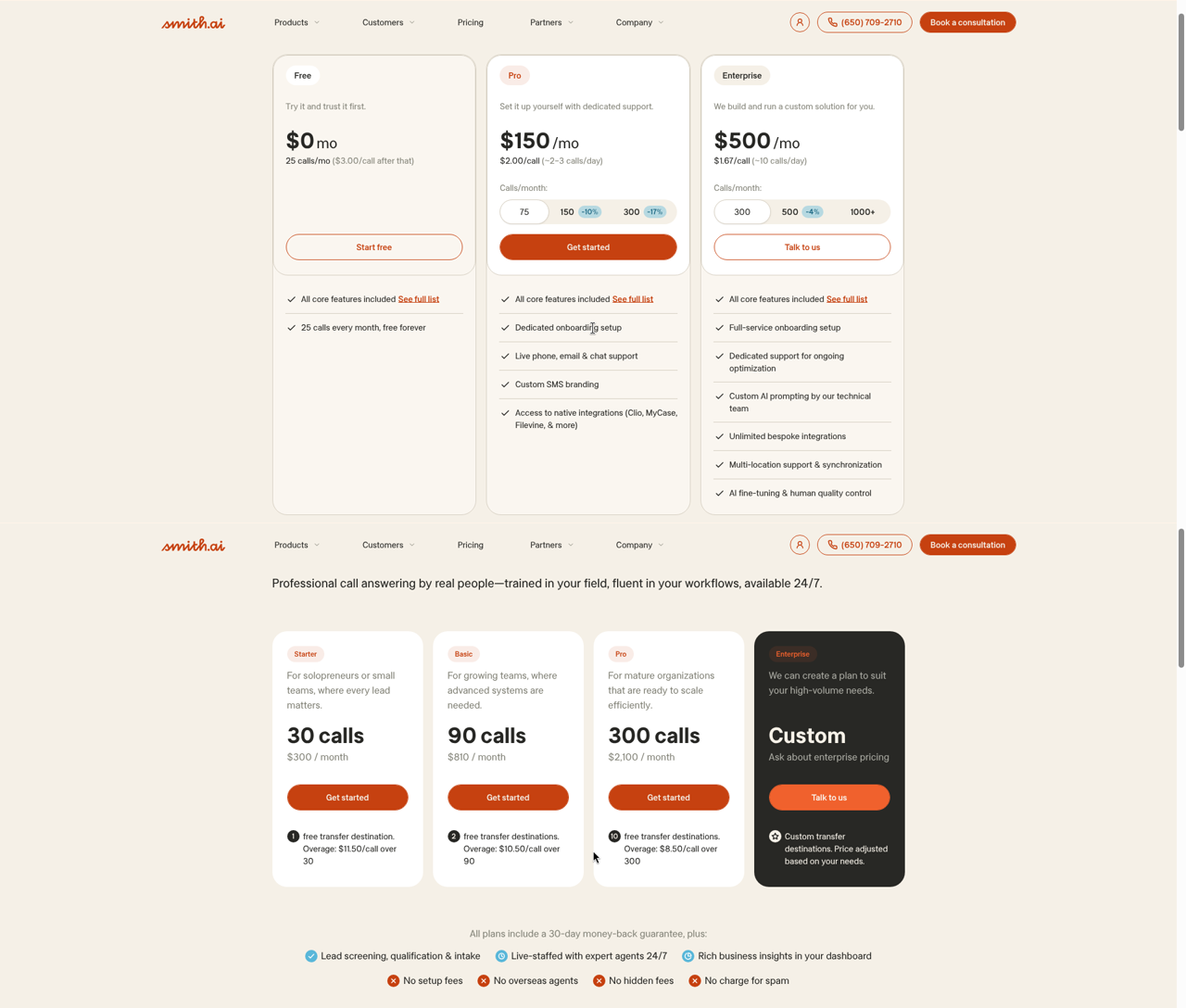
Smith.ai’s AI receptionist is free for 25 calls a month or $150 for the paid AI plan, and its bilingual support is documented on a dedicated page: with Spanish enabled, the AI detects whether the caller is speaking Spanish or English and responds in kind, pricing verified October 2, 2026 (dated screenshot). What separates Smith.ai is the human layer as a core product rather than an add-on: staffed plans from $300 a month for 30 calls put fluent English–Spanish receptionists on the line ($11.50 per call overage; 90-call Basic at $810), and a dedicated Spanish line add-on — $1.00 per call — routes every incoming call to a fully bilingual human receptionist. That makes Smith.ai the only option here where “press nothing, get a fluent human” is a published SKU. For an immigration attorney or a clinic, the hybrid is the point: AI for the routine, a bilingual professional for the delicate.
Pricing for Smith.ai as captured on October 2, 2026. This screenshot is retaken every Friday at 9:00 AM ET and replaced whether the price has changed or not.
7. Upfirst
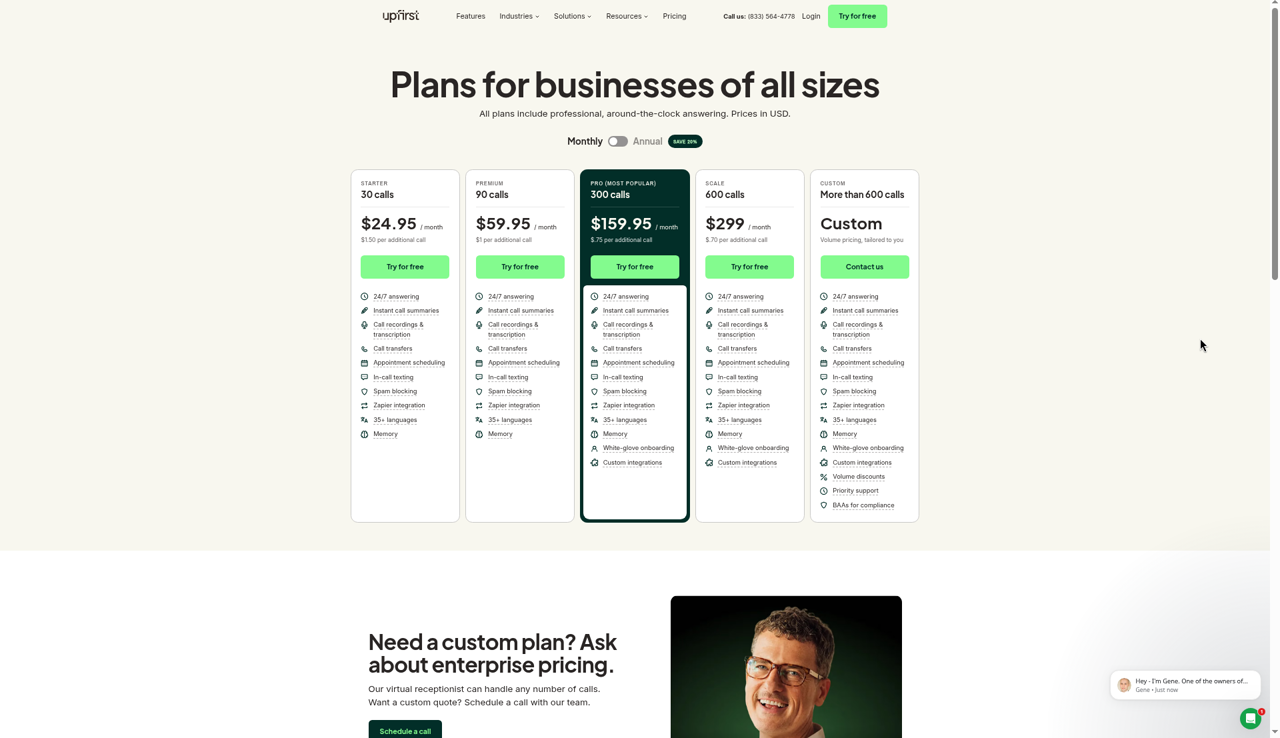
Upfirst’s Starter plan is $24.95 a month for 30 calls ($1.50 per additional call; Premium is $59.95 for 90, Pro $159.95 for 300; annual billing takes 20% off), pricing verified October 2, 2026 (dated screenshot). The language capability is broad rather than deep: 35-plus languages, with automatic switching mid-call and the transcript translated back into your language afterward — a thoughtful touch for the owner who doesn’t speak the caller’s language and still needs to read what happened. Spam calls and sub-15-second calls don’t bill, which matters on lines where junk inflates the meter. Setup is self-serve and quick. For the price of two pizzas, you find out this week whether your missed calls have an accent.
Pricing for Upfirst as captured on October 2, 2026. This screenshot is retaken every Friday at 9:00 AM ET and replaced whether the price has changed or not.
Bilingual quality is two problems, not one
Most buyers shop bilingual coverage as a yes-or-no checkbox. It isn’t. Coverage is whether someone answers in Spanish at all; quality is whether the Spanish is natural, correct on your terminology, and consistent with your brand. A service can pass coverage and fail quality badly — scripted, phonetic Spanish from an agent reading a card damages trust more than an honest English-only greeting with a callback promise, because it tells the caller you pretended.
The fix is a three-layer test you can run on any model, any vendor, during any trial week:
- Answer in the caller’s language immediately. From speech, not a menu. If the caller has to declare Spanish before speaking Spanish, layer one is already a leak.
- Handle your business’s terminology correctly. Your services have names — a root canal, an eviction notice, an oil change. Say yours on a test call and listen for a natural, correct answer instead of a stumble or an improvised translation.
- Complete the call in the same language, end-to-end. Intake, booking, and confirmation — including the follow-up text — in Spanish, with no silent fallback to English halfway through.
| Model | Layer 1: immediate in-language answer | Layer 2: your terminology | Layer 3: end-to-end in-language |
|---|---|---|---|
| Human bilingual service | Pass when staffed — thin at night | Depends on the individual agent who picks up | Pass on booking-capable services |
| Interpreter line | Pass, slowly — connection delay, then relay | Strong — professional interpreters handle terminology | Conditional — possible, but every step doubles in time and cost |
| AI receptionist | Pass — detection from first words on the better platforms | Pass when configured with your documents — this is a setup task, not a hope | Pass — books and confirms in-language, 24/7 |
Interpreter lines pass layer one and strain layers two and three on speed and meter, not accuracy. Human services pass all three on a good shift and wobble on a bad one — quality is a staffing draw. Well-configured AI passes all three consistently because it never has an off day — with the honest caveat that dialect nuance (Caribbean versus Mexican Spanish) needs configuration attention on any platform, and language depth beyond English and Spanish varies by vendor, as Futuro’s own published limitations concede for its 53-language list.
The same call, three ways
A caller — we’ll call her María — phones a dental practice at 7:45 PM about a broken crown. Here is that call through each model, annotated with what the caller experiences and what the business pays. (Illustrative transcripts; the pricing mechanics are the documented ones above.)
None of these is fiction and none is a strawman: the human warmth is real, the interpreter’s professionalism is real, and the AI’s consistency is real. The differences are structural — who’s on shift, who’s on the clock, and who’s already fluent.
The cost math at a representative volume
Take a phone-forward small business: 100 inbound calls a month, three minutes average, with a 30% Spanish share — 30 Spanish calls, 90 Spanish minutes. (In Laredo or McAllen that share would be inverted; in Minneapolis it might be 5%. Scale to your log.)
| Model | Monthly cost at this volume | What the number hides |
|---|---|---|
| Interpreter line, pay-as-you-go | ~$356 (90 min × $3.95) — on top of whatever answers your English calls | Relay doubles real call length, so $600+ is realistic; contract rates cut the per-minute but add access fees and procurement |
| Human bilingual service (Ruby) | $720 for 200 receptionist minutes; 300 minutes lands between that and the $1,725 / 500-minute tier, with overage rates unpublished | Bilingual included — but bilingual hours are stated inconsistently on Ruby’s own site; get them in writing |
| Per-minute bilingual pool | ~$450 at $1.50/min × 300 min (directional vendor-published figures: $0.75–$2/min; some add 20–40% on Spanish) | The Spanish surcharge punishes exactly the callers you’re trying to win |
| Bilingual hire in-house | ~$3,170/mo at the BLS receptionist median ($38,010/yr), before taxes and benefits; interpreters and translators median $60,170 (BLS, May 2025) | One person covers one shift and one call at a time — no nights, no simultaneity, no cloning |
| AI receptionist (this lineup) | $24.95–$200 flat by vendor — e.g., Rosie $49 (250 min), Dialzara Pro $99 (220 min), Futuro AI $200 unlimited | Per-minute tiers need a volume estimate; flat plans make the night economics simplest |
The structural point isn’t that AI is cheap — it’s that in the two human models, language is a staffing problem with a meter attached, and in the AI model it’s a configuration with no marginal cost. Whether the AI quality clears your bar is a trial-week question, which is why every vendor here has a free tier, a trial, or a money-back window.
Who needs which: four buyer profiles
The border-metro service business. Laredo, McAllen, El Paso, Miami — where Spanish is half or more of the phone traffic and English-first answering is the anomaly. Your math is simple: per-minute and per-call models break at your volume, so flat-rate AI with real depth (Futuro AI’s $200 unlimited) or high-minute plans (Rosie’s $149–$299 tiers) are the lanes. Configure dialect expectations during onboarding — Caribbean Spanish in Miami is not Mexican Spanish in El Paso.
The suburban practice with a growing Spanish minority. Ten to thirty percent of callers, rising every year, and a front desk that speaks English. Start with proof: OnCallClerk’s free tier or Upfirst’s $24.95 plan for two weeks, count the Spanish calls, then graduate to the tier that completes bookings in-language — Rosie’s $149 Scale, Dialzara’s $99 Pro, or Futuro AI’s flat plan if the volume justifies it.
The high-stakes office. Immigration law, clinics, financial services — intake carries liability and conversations carry weight. Smith.ai’s hybrid (AI detection with fluent bilingual humans from $300) is the honest fit, and for genuinely regulated conversations, a professional interpreter line is a compliance tool, not an answering service — budget it separately.
The “we think we’re missing calls” owner. You don’t know your Spanish share because your phone never told you. That’s the cheapest problem on this page: a free OnCallClerk number or a $24.95 Upfirst month answers it with data instead of a guess.
Test it on your own line this week
Bilingual quality is audible, not arguable — the evaluation protocol is three test calls from a phone the system doesn’t know. First: a routine question in Spanish, and listen for whether the answer comes from speech detection or a menu. Second: your terminology — say your service names and prices and grade layer two. Third: the code-switch — English, Spanish, English again in one call — and see whether the agent follows or falls over. Then decide with your own ears.
Start with Futuro AI’s 7-day free access
$200/month flat after the trial, unlimited calls, 53 languages included — English and Spanish the deepest-tested pair — with managed onboarding that configures your terminology in both languages over 24–48 hours.
If you want the zero-dollar version of the same test, OnCallClerk’s free plan and Smith.ai’s 25-call free tier both answer in Spanish without a card. Whichever you shortlist, the cheapest step is the same: call your own business in Spanish tonight and listen to what your callers have been hearing.
Methodology and sources
How we built this article. We defined bilingual answering as any service that answers a business’s existing phone line and conducts the call in the caller’s language — and we separated the three real models (staffed bilingual services, on-demand interpreter lines, AI receptionists) because comparing them as one category is how buyers overpay. The AI lineup was locked on October 2, 2026 against our vendor pricing index: seven platforms with documented Spanish-language capability on their own public pages. Vendors from our index without a documented Spanish capability on a public page — Bland AI, Goodcall, and Synthflow — were excluded from the lineup rather than profiled on a hope; if their documentation changes, the Friday screenshot cycle will catch it.
How we verified pricing and capability. Every price and language claim was read from the vendor’s own live pages on October 1–2, 2026. Every vendor listed has the pricing provided on their website documented via screenshot, retaken every Friday at 9:00 AM ET regardless of change, age, or this article’s popularity. Language-capability claims are quoted from vendor documentation with the wording preserved, because the difference between “included” and “available” is a monthly fee.
How we graded. The eight-criterion rubric in How we assessed weights bilingual-specific behavior (detection, switching, Spanish quality, parity) over generic feature counts. Rubric weights sum to 100 and are published as machine-readable data in this page’s grading dataset.
How we handle conflicts. Futuro AI is our product, it’s profiled third alphabetically, and it’s graded against the same rubric as everyone else. Our disclosure is at the top of this article and repeated here: we have an obvious interest in our own profile, which is why every claim in it is either verifiable on a linked page — including our own published limitations — or labeled with its limits.
How we treat statistics. Every statistic carries its source and date. Three cautions specific to this topic: the CSA Research study measured web-commerce behavior, and we apply it to the phone channel directionally — labeled where used; the traditional-service per-minute rates ($0.75–$2, $1.38–$1.65 Spanish, 20–40% premiums) come from vendor-published comparisons, not audited rate cards, and are marked directional; and Census language figures count people who speak Spanish at home, which understates daily Spanish commerce — the honest direction of the error makes the market bigger, not smaller.
Corrections. Pricing changes, features ship, and screenshots age. If something here is wrong, our corrections policy explains how we fix it and how fast.
Pricing sources, by vendor
First-party pricing and feature pages as read on October 1–2, 2026:
- AgentZap — agentzap.ai pricing and features pages (October 1, 2026)
- Dialzara — dialzara.com pricing and bilingual solution pages (October 2, 2026)
- Futuro AI — futurocorp.com/pricing and the VoiceAlive 3.0 release notes (October 2, 2026)
- OnCallClerk — oncallclerk.com pricing page and homepage (October 1, 2026)
- Rosie — heyrosie.com pricing page (October 1, 2026)
- Smith.ai — smith.ai pricing and bilingual answering pages (October 2, 2026)
- Upfirst — upfirst.ai pricing page (October 2, 2026)
Full statistics sourcing appears in Sources cited at the end of this article.