Disclosure: Futuro builds VoiceAlive, a multilingual AI receptionist whose language detection is described in this article — held to the same sourced standard as the academic systems cited, with its limits stated in the limits section. We never accept paid placement in any article; see our Publishing Principles. Every external claim was verified against the linked source on August 9, 2026.
What happens in the first five seconds of the call?
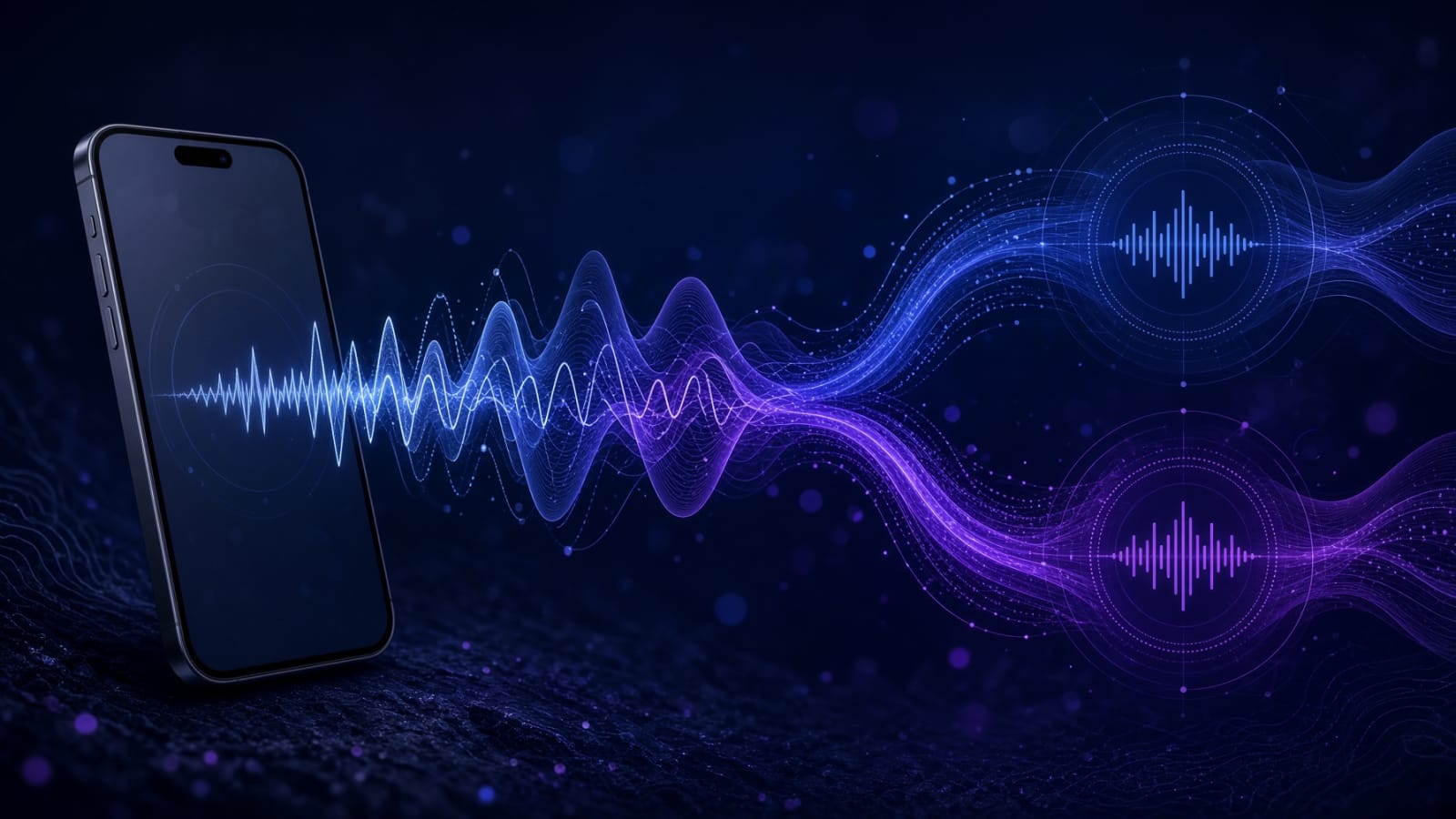
The phone rings, the caller says something — "buenas," "hello," "aló, ¿sí?" — and by the time they'd finish a second sentence, the AI has already answered in their language. No menu, no "para español, oprima el dos," no awkward English greeting the caller has to override. Here is what actually happened in those seconds:
Working definition: spoken language identification (LID) is the task of deciding which language is being spoken from the sound of the audio itself — text-independent, speaker-independent, and fast enough to complete before the system's first reply. It answers which language, not which words; understanding the words is a separate stage that runs afterward, in the detected language.
The pipeline runs in four moves, detailed stage by stage below: capture clean speech from the phone line, compress it into an acoustic fingerprint, classify that fingerprint against trained language models, and gate the decision on confidence — hedging instead of guessing when the evidence is thin. Then, on every subsequent turn, it does it again. That last part is what "mid-call switching" actually is, and it exists because about 70% of U.S. bilingual Hispanics mix Spanish and English naturally (Pew Research).
The stakes for getting the first five seconds right are commercial, not academic. 67.8 million people in the U.S. speak a language other than English at home (Census Bureau), CSA Research's 8,709-consumer study found 40% of consumers won't buy from a business that won't speak their language, and Vonage's IVR research priced phone-menu friction at $262 per customer per year. The detection moment is where all of that is won or lost. VoiceAlive (our product) runs this pipeline across 53 languages concurrently; Futuro's separate 1,000-participant double-blind study measured the voice it speaks with at 94% human indistinguishability — because perfect detection with a robotic voice still loses the call.
How does the AI actually hear a language?
Two layers work together — and the order surprises most people. The decision starts with the sound, not the words.
The acoustic layer — the sound fingerprint
Every language has an acoustic signature: its inventory of phonemes (Spanish rolls sounds English doesn't have; Mandarin carries lexical tone), its rhythm and syllable timing, its characteristic pitch movement, its spectral texture. A neural network trained on thousands of hours of speech learns to compress a few seconds of audio into a fixed-length vector — an embedding — where these signatures become coordinates. The reference architecture is the x-vector, introduced by Snyder and colleagues at Johns Hopkins (Odyssey 2018), which maps variable-length speech into one vector capturing language, accent, and channel characteristics at once. ECAPA-TDNN (Desplanques et al., Interspeech 2020) refined the approach with channel attention and multi-scale aggregation, improving embedding quality across the recognition family. The classifier then asks a simple question of the vector: which trained language does this fingerprint sit closest to?
The linguistic layer — the words themselves
Once transcription begins in the candidate language, the words become a second vote. "Quisiera hacer una cita" is unambiguous evidence of Spanish even if the acoustics were borderline — and this is how systems resolve close calls on short or noisy openers. The two layers disagreeing is itself a signal: when the acoustic fingerprint says Spanish but the Spanish transcription produces garbage, confidence drops and the system hedges (the confidence section covers what hedging looks like). Modern end-to-end models like Whisper (Radford et al., 2022) fuse both layers — trained on 680,000 hours across 99 languages, they emit a language token as part of transcription itself — but the architectural separation of detecting from understanding remains the right mental model, and it's why the FAQ distinction matters.
Bottom line: the first decision comes from how the caller sounds, not what they say — an acoustic fingerprint classifiable in two to four seconds, with the words arriving as a confirmation vote.
What does the detection pipeline look like stage by stage?
Six stages, each with one job. The whole sequence completes before the first reply:
- Voice activity detection. The system separates speech from line noise, hold music, and silence — deciding which slices of audio are worth analyzing at all.
- Feature extraction. The speech slice becomes a sequence of spectral frames (think: a low-resolution picture of the sound's energy over time and frequency).
- Embedding. An x-vector-style neural network compresses the variable-length frames into one fixed-length fingerprint vector (Snyder et al. 2018; Desplanques et al. 2020).
- Classification. The vector is scored against every trained language, producing a probability per language — Spanish 0.91, Portuguese 0.06, Italian 0.02, and so on.
- Confidence gate. The system checks both the top score and the margin over the runner-up. Clear win: commit. Close call: hedge — bilingual greeting, polite question, or human route (detail in the confidence section).
- Re-detection every turn. Steps 1–5 repeat on each new turn, which is what makes mid-call switching possible — the call's language is a running decision, not a one-time one.
What is the detector trained on, and how good is it now?
Hundreds of thousands of hours of real speech — and the improvement curve has been steep. Two training efforts define the current state of the art:
436K hrs
Training speech across 128 languages in XLS-R (Babu et al., 2021) — an order of magnitude more public data than prior work
680K hrs
Multilingual training audio behind Whisper (Radford et al., 2022), covering 99 languages
9.1% err
Best error rate on under-5-second utterances, VoxLingua107 benchmark — down from 12.3% for the prior best (XLS-R)
5.0% err
Error rate on 5–20 second speech — i.e., ~95% correct once the caller says a full sentence or two (XLS-R)
Two honest caveats on those numbers. First, VoxLingua107 is built from YouTube audio — clean-ish, studio-ish — so treat 91–95% as a ceiling, not a guarantee; telephone audio with kitchen noise behind it performs worse. Second, the benchmark measures identification of a target set of languages; performance on any specific pair (say, Caribbean Spanish versus Brazilian Portuguese) varies, which is exactly what NIST's evaluations measure.
NIST — the U.S. National Institute of Standards and Technology — has run public Language Recognition Evaluations since 1996; the 2017 cycle (LRE17) was the eighth. These evaluations are the field's honest yardstick: 25 research organizations submitted 79 systems, tested on telephone speech, broadcast audio, and — hardest — speech pulled from online videos (Sadjadi et al., Odyssey 2018). The headline findings matter for buyers: every system found noisy real-world audio harder than telephone speech, and closely related languages remained the discriminating challenge. Detection is a solved problem for clean common-language calls and a measured, published, still-improving problem at the edges.
What are the four hard problems?
Every honest engineer in this field names the same four. Each has a known mitigation — and each is testable on a vendor's demo line.
Hard problem one: the two-word opener
"Buenas, sí." Two words, under two seconds — and the system must commit. Short utterances are the stress case because there's simply less fingerprint to classify: on VoxLingua107 the error rate on sub-five-second speech (9.1%) is nearly double the rate on longer segments (5.0%) even for the best model (XLS-R). Dedicated research targets exactly this — Shen and colleagues (Odyssey 2020) built compensation methods specifically for short-utterance language identification, improving x-vector performance when the sample is thin. The production mitigation: don't panic-commit on the opener — greet in the best-guess language but keep confidence provisional, and let the caller's second turn refine or correct the decision before anything important (like a booking confirmation) is said.
Hard problem two: accent is not language
A caller from rural Texas and a caller from Glasgow are both English; a caller from San Juan speaking English with a Spanish accent is also English. Detection systems handle this well — accent rarely changes the language answer — but the adjacent problem is real and documented: Koenecke and colleagues (PNAS, 2020) found mainstream speech-recognition systems produced roughly twice the word error rate for Black speakers as for white speakers. That's a transcription disparity, not a detection one — but on a phone line the two failures compound: if the words come back garbled, the language vote gets noisier too. The mitigation is architectural humility: separate confidence scores for detection and transcription, hedge either one independently, and never let a confident language guess paper over a garbled transcript.
Hard problem three: the mid-sentence switch
"Quiero hacer una cita — like, Thursday afternoon, porfa." Code-switching is not an edge case; it's how bilingual speech works (Pew: ~70% of U.S. bilingual Hispanics mix languages). The research community has worked it for over a decade: the SEAME Mandarin-English code-switch corpus (Lyu et al., Interspeech 2010) gave the field its benchmark, end-to-end code-switching recognition (arXiv 2018) showed mixed-language audio can be transcribed directly, and Applied Sciences' 2022 review catalogs the remaining issues. The production mitigation: classify every turn independently and answer in the turn's dominant language — the call's language is a running decision, never a lock.
Hard problem four: the noisy phone line
Callers phone from trucks, kitchens, sidewalks, and salon floors. Noise degrades everything — and NIST measured it: in LRE17, speech extracted from online video (music, competing speakers, interference) was measurably harder for every single system than telephone speech (Sadjadi et al.). The mitigations are unglamorous and effective: aggressive noise augmentation in training (Whisper's robustness comes substantially from 680,000 hours of messy real-world audio), voice-activity filtering before classification, and lower confidence thresholds that route to hedge behaviors instead of wrong answers. The buyer test is simple: call the demo from your noisiest realistic environment.
Can it tell similar languages apart?
Mostly yes — and this is precisely the scenario NIST built its hardest evaluations around, so we have unusually good public data on it.
LRE17 deliberately targeted 14 closely related languages in 5 clusters: four Arabic dialects (Egyptian, Iraqi, Levantine, Maghrebi), Mandarin and Min Nan Chinese, British and General American English, Polish and Russian, and an Iberian cluster of Caribbean Spanish, European Spanish, Latin American Spanish, and Brazilian Portuguese (NIST LRE17). The results, from the official analysis (Sadjadi et al.): the Slavic pairs were easiest to separate, while the Iberian cluster — Caribbean Spanish hardest of all — was the most difficult, with detection costs more than ten times worse on the hardest targets than the easiest for some systems.
What that means in practice for a U.S. business: Spanish-versus-Portuguese confusion exists but concentrates in very short utterances; give the system a full sentence and the error rate drops sharply. Spanish-versus-Italian is similar. Spanish-versus-Mandarin, or any cross-family pair, is essentially never confused. And the dialect dimension — Caribbean versus European Spanish — matters more for transcription tuning than for the caller's experience, since the reply is Spanish either way. The honest summary: similar-language separation is good and improving, it's worst exactly where you'd expect (short, noisy, closely related), and it's the sixth of the seven demo tests below.
What happens when the agent isn't sure?
The mark of a well-built system is not that it never faces uncertainty — it's what it does in the three seconds after. Three hedge behaviors, in escalating order:
- The bilingual greeting. At borderline confidence between two languages, open with both: a natural "Hello — ¿buenas?" that invites the caller to pick the lane with their next sentence, which then classifies cleanly. Zero friction, no wrong commitment.
- The polite ask. When the margin is genuinely thin — a noisy line, a two-word opener that could be Spanish or Portuguese — the system asks, in both candidate languages, a one-question preference check. One question, five seconds, then the call proceeds correctly.
- The human route. When detection or transcription confidence stays low — or the caller is clearly frustrated — the call transfers to a person with everything captured so far. This is the guardrail that keeps automation honest, and it's non-negotiable in regulated verticals.
The failure mode to fear is none of these — it's the confident wrong answer: a system with no uncertainty behavior that greets your best customer in the wrong language and plows ahead. That's why test seven below asks every vendor, in writing, what their system does at low confidence. VoiceAlive (our product) runs all three hedges, and the underlying principle is the same one behind our 94% study: natural human imperfection — including honestly admitting when you're not sure — is what makes a voice trustworthy.
How does mid-call switching work?
Switching is not a separate technology — it's detection running on every turn instead of once. But two design decisions determine whether it feels magical or broken.
Why the first-language lock fails
Most "multilingual" systems detect once and lock: the call is declared Spanish, and every subsequent turn is transcribed and answered in Spanish no matter what the caller actually says. This breaks on reality — the caller who opens in Spanish, spells their email in English, confirms the appointment time in Spanish, and reads a street address in English. Pew's bilingualism research says this caller is the norm, not the exception. A locked system garbles the email and the address — the two details that most needed to be right.
What a good switch looks like turn by turn
Per-turn classification: Spanish turns get Spanish answers, English turns get English answers, mixed turns get answered in the dominant language. Critically, the voice doesn't change — the same vocal identity carries across the switch, because a language change that sounds like a different person answering breaks the caller's trust mid-conversation. This is where detection meets voice synthesis, and it's why we built VoiceAlive's multilingual switching on one consistent voice (the same voice measured at 94% human indistinguishability in our 1,000-participant study) rather than per-language voice swaps. The engineering behind the switch is the detection pipeline above; the craft is making it invisible.
Bottom line: mid-call switching = re-detect every turn + answer in the turn's language + keep one voice. Any system that locks to the first language, or changes voices when it switches, will break on real bilingual callers.
What does this change for your callers?
Eight caller situations, each self-contained. The engineering above exists so that every one of these calls just works.
The caller who opens in Spanish with no warning
No menu selection, no announcement — they dial and start in Spanish, because 44.9 million people in the U.S. speak Spanish at home (2024 ACS) and your number was the one they found. Detection classifies the opener, the greeting arrives in Spanish, and the caller never learns there was a decision to make. This is the baseline case — and the one a press-2 menu fumbles, at 51% abandonment economics.
The caller who mixes both languages mid-sentence
"Necesito una cita — like, this Thursday if you can." Seventy percent of U.S. bilingual Hispanics talk this way (Pew). Per-turn re-detection means the booking continues in whichever language each turn arrives, and the Thursday confirmation lands correctly. A locked system forces this caller to perform monolingually — a small humiliation that costs you the booking and the referral.
The caller with a heavy accent speaking English
Detection stays English — accent doesn't change the language answer — but transcription is where accents bite, and the PNAS disparity findings are the honest reminder that recognition accuracy is not uniform across speaker groups. The right behavior: separate confidence gates, patient re-prompts on critical details like names and addresses, and a human route when confidence stays low. The wrong behavior is pretending the problem doesn't exist.
The caller speaking a language you didn't expect
Vietnamese from Orange County, Korean from your Koreatown neighborhood, Haitian Creole in South Florida — the Census Bureau's detailed tables put each of these communities over a million U.S. speakers. A 53-language concurrent system detects and serves the call anyway; an English-Spanish system loses it silently. You never get a report of the customers your line couldn't hear.
The caller on a noisy job site or kitchen line
NIST's evaluation says noise is the honest stress case — every LRE17 system performed worse on interference-heavy audio. A well-built line filters voice from noise before classifying, hedges when confidence drops, and asks rather than guesses. The caller experiences a moment of "sorry, could you say that once more?" — which is, not coincidentally, exactly what a good human receptionist does.
The caller whose language is close to another one
Brazilian Portuguese that a weak system greets in Spanish; Caribbean Spanish that fools a short-utterance classifier — LRE17's hardest cluster was exactly this one. The mitigation is patience: provisional commitment on the opener, refinement on the second turn, and the hedge behaviors above instead of a confident wrong greeting. Give the system a full sentence and similar-language errors drop sharply.
The elderly caller who needs things slower
Many limited-English seniors — a meaningful slice of the 26M+ people with limited English proficiency (Migration Policy Institute) — speak slowly, pause long, and code-switch mid-thought. Detection tuned for two-second fragments handles the pauses; per-turn classification handles the mixing; and a voice that doesn't rush or sound robotic keeps them on the line. This is the caller a menu tree loses in the first ten seconds.
The caller testing you on purpose
Yes — people test AI lines now, switching languages to see what happens, the way they used to ask for "a real person." This is the best possible test to pass in public: the system that follows the switch, keeps one voice, and never flinches converts the tester into a referrer. You can run this test yourself on our demo line — it's the third of the seven tests below, and we'd rather you run it than take our word for it.
Why does detection quality change your revenue?
Because the detection moment is where three independently measured economics meet — and all three point the same direction:
- The buying evidence. CSA Research's 8,709-consumer study: 76% prefer to buy in their own language, 40% won't buy otherwise, 75% are more likely to repurchase with native-language support. Intercom's support-leader survey: 70% report increased loyalty from native-language service.
- The menu alternative bleeds. Vonage's IVR research: 51% of callers have abandoned a business over a bad phone menu, 27% stopped buying entirely, average cost $262 per customer per year. The press-2 menu is the "cheap" alternative to detection — priced.
- The supply gap is yours to fill. ICMI: 79% of contact centers serve non-native speakers and 60% of those customers expect native-language service — but only 19% of centers offer it on the voice channel. And ACTFL: 1 in 3 employers can't find the bilingual staff they need, against a $59,440 median interpreter wage (BLS).
Add the market itself — 67.8M non-English-at-home speakers, $2.1 trillion in Hispanic buying power, 75.3% non-English at home in Miami-Dade, border counties at 67–91% Spanish, 1 in 3 Texans — and detection quality stops being a feature spec. It's the front door of a market segment your competitors are mostly not answering. The full market analysis is in our multilingual answering service guide.
How do you test a vendor's language detection?
Seven live tests on the demo line, ten minutes total. Run them before you sign anything — a vendor with real detection passes all seven on the spot:
- Open in a non-English language with no menu selection. Dial and start in Spanish (or your market's language) immediately. If anything asks you to select a language first, the "detection" is a menu.
- Give it a two-word opener. "Buenas, sí" — not a rehearsed sentence. Short-utterance identification is the hard case (Shen et al. 2020); watch whether the system commits confidently or hedges sensibly.
- Switch languages mid-call. Start in Spanish, switch to English mid-conversation, switch back. The next answer should follow each turn — in the same voice.
- Speak accented English. Have a teammate call with their natural accent. It should stay English — and the name-and-address capture should survive the accent (why this matters).
- Call from somewhere noisy. Your truck, your kitchen, your sidewalk — the noisiest place your real callers call from (NIST says this is the stress case).
- Try a similar-language pair. Portuguese after Spanish, or a Spanish dialect after another. Confusion on a full sentence is a red flag; graceful recovery is the pass.
- Ask what it does at low confidence — in writing. The answer should name specific hedge behaviors (bilingual greeting, polite ask, human route). "It just works" is not an architecture.
For the pricing and capability framework across vendors, see AI Receptionist Cost Comparison and the multilingual service guide.
How does VoiceAlive handle detection and switching?
VoiceAlive (our product) runs the architecture this article describes — and since it's ours, here are the specifics plainly, with the same honesty standard:
- 53 languages, concurrently, on one number. Not per-account configuration — every language live on every line, which covers the entire U.S. long tail beyond Spanish (Census detailed tables) with room to spare.
- Per-turn detection with mid-call switching. Every turn re-classified; answers follow the caller's language; no first-language lock. Built for the 70% of bilinguals who mix languages.
- One voice across every switch. The vocal identity doesn't change with the language — the same voice measured at 94% human indistinguishability in our 1,000-participant double-blind study.
- The three hedge behaviors. Bilingual greeting, polite ask, human route — plus live transfer whenever the caller asks or the AI is unsure, in any language.
- Answers trained on your business. Human Staff Mirroring means the AI answers as your staff — your prices, your policies, your booking rules — in every language, not a generic script.
What we don't claim: a published accuracy benchmark on our detection stack (we haven't run one against VoxLingua107; internal metrics aren't published), or perfection at the four hard problems — nobody has it, and the research above is the honest state of the art. What we do claim is testable: the seven tests above, on the live demo line, whenever you like.
What are this article's limits?
- Benchmarks are ceilings, not guarantees. VoxLingua107 accuracy (91% short, 95% longer) comes from YouTube-derived audio; your callers' handsets, accents, and background noise will perform somewhat worse. XLS-R is the cited benchmark source, not a Futuro measurement.
- No independent vendor testing. We did not benchmark competitors' detection systems; comparative accuracy claims about specific commercial products are not made anywhere in this article.
- VoiceAlive's detection metrics are unpublished. We describe architecture and behavior; the seven demo tests are offered as verification in place of a lab number.
- The field moves fast. Model generations turn over roughly yearly (x-vectors 2018, XLS-R 2021, Whisper 2022); figures here reflect the cited publications as verified on August 9, 2026.
- Accuracy is not uniform across speakers. PNAS-documented disparities in speech recognition are a standing reason to keep confidence gates and human routes — in our product and anyone else's.
- Market statistics are point-in-time. Census figures are survey estimates with stated periods; purchase-intent research (CSA, Intercom) surveyed online buying and support, not local inbound calls specifically.
How we researched this article
We read the primary literature first: ISCA proceedings on x-vectors, short-utterance compensation, ECAPA-TDNN, and code-switching corpora; NIST's LRE17 official page and its Odyssey 2018 analysis paper; the XLS-R and Whisper papers; the PNAS disparity study; and the Applied Sciences code-switching review. Market statistics were pulled from their original sources — Census Bureau, Selig Center, CSA Research, Intercom, ICMI, Vonage, Pew, ACTFL, USAFacts, MPI, BLS — never from secondary roundups. All 27 sources are listed below with direct links and were verified live on August 9, 2026. Where the evidence has edges (short utterances, noise, similar languages, speaker-group disparities), the article presents them as edges rather than rounding them away.