Disclosure: Futuro builds a multilingual AI answering service (VoiceAlive), and it appears in this article — held to the same sourced standard as every alternative, with its limits stated in the limitations section. We never accept paid placement in any article; see our Publishing Principles. Every external figure was verified against the linked source on August 8, 2026, and can change — check the source before budgeting.
What is a multilingual answering service?
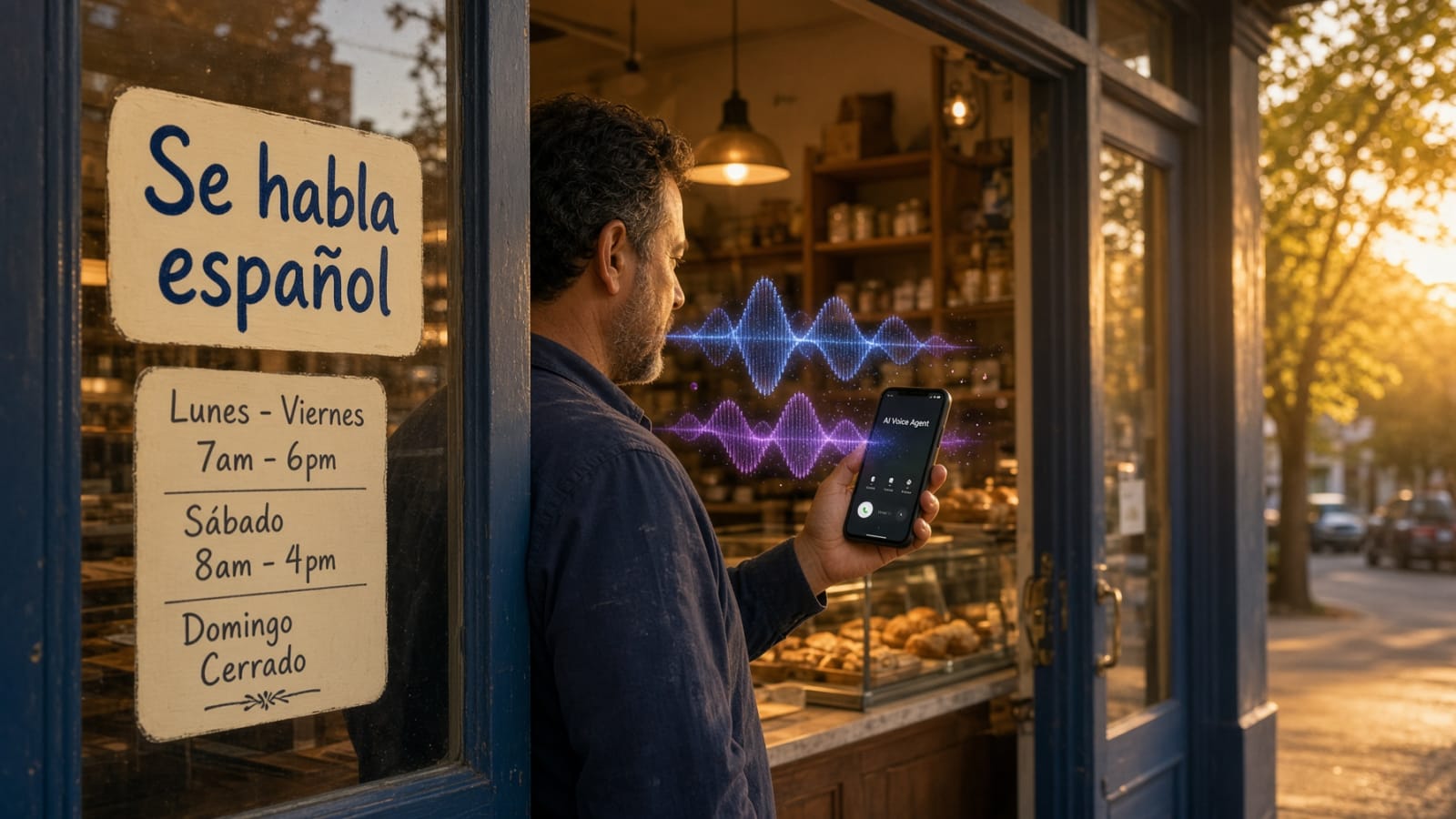
A multilingual answering service for a small business is a phone-answering system — human team, AI voice agent, or hybrid — that detects which language each caller is speaking and conducts the entire call in that language: the greeting, the questions, the booking, the pricing explanation, and the message-taking. It runs on your existing number, alongside your English calls, with no separate Spanish line and no menu asking callers to choose.
Working definition: the test of a true multilingual answering service is what happens in the first five seconds. If the caller hears their own language immediately — because the system detected it from their first words — the call proceeds like any good call. If the caller first has to navigate "para español, oprima el dos," you have a phone menu, not a multilingual service, and the menu's abandonment cost is documented below.
Three capabilities separate the real thing from the label. Automatic language detection identifies the language from the opening seconds of speech — the acoustic research behind this is mature, from x-vector language recognition (Snyder et al., Odyssey 2018) through OpenAI's Whisper model (Radford et al., 2022), which handles 99 languages. Full call handling in-language means booking, FAQs, and intake work identically in every language — not a reduced script. And mid-call switching follows the caller when they mix languages, which most bilingual callers do naturally. VoiceAlive (our product) runs all three across 53 languages concurrently; Futuro's separate 1,000-participant double-blind study measured the voice itself at 94% human indistinguishability — because a multilingual line that sounds robotic just moves the problem.
Why do the three usual fixes fall short?
Small businesses have been patching the language gap for decades with three tools. Each fixes part of the problem and breaks somewhere specific — and the breakage is measurable, which is why this section exists before any talk of AI.
Patch one: hire bilingual staff
The instinct is right — a person who speaks the caller's language is a genuinely good experience. The arithmetic is the problem. Bilingual employees command a measurable premium: Preply's analysis puts it at roughly $14,050 more per year, and California's state contract formalizes the idea with a $200-per-month bilingual differential (PECG 2025–2028 MOU). Against a $59,440 median wage for interpreters and translators (BLS, May 2024), a full-time bilingual receptionist is a $35,000–$60,000 commitment before the premium.
Then scarcity: ACTFL's employer survey found 9 in 10 U.S. employers rely on employees with language skills — and 1 in 3 cannot find them, with 56% expecting the shortage to grow. And coverage math: one bilingual hire covers one language pair, one shift, and one caller at a time. Your busiest hour, your weekend, and your Vietnamese-speaking caller stay uncovered either way.
Bottom line: bilingual staff are the best experience for the calls they can take — and a $14,050 premium that still leaves after-hours calls and every second language unanswered.
Patch two: add a "press 2 for Spanish" menu
The cheapest patch — and the one with the most directly measured failure. Vonage's IVR research found 51% of callers have abandoned a business because of a frustrating phone menu, 27% stopped buying from the company entirely, and the average cost came to $262 per customer per year — while 89% of consumers said they spend more with companies whose phone experience is easy. A language menu inserts exactly this friction at the exact moment a limited-English caller is least equipped to push through it.
Notice the asymmetry: the caller who most needs service in Spanish is the caller least likely to survive an English-language menu tree to reach it. The menu doesn't just fail to help that caller — it filters them out before service starts, and it does it silently. No missed-call report captures the customer who heard a menu and hung up.
Bottom line: a press-2 menu is a filter that removes your multilingual callers at the door — with 51% abandonment economics measured and published.
Patch three: use an interpreter service
Over-the-phone interpreting (OPI) is a real, professional service — and it is priced for emergencies, not for your daily call flow. Published rates run $1.25–$4.00 per minute (CCI Group); LanguageLine's pay-as-you-go tier starts at $3.95 per minute. At the top of the market, the federal courts pay certified interpreters $566 per full day (U.S. Courts, current fee schedule) — fair money for certified legal work, and a useful ceiling for understanding what skilled human interpretation costs.
Now the illustrative math for a normal small business (our assumptions, stated): 20 minutes of Spanish-language calls per business day — a handful of bookings and questions — at a $2.40-per-minute midpoint is about $48 a day, or roughly $12,400 a year. That is five times the annual cost of a flat $200/month AI line, for a service that still requires a three-way call setup on every conversation and can't book into your calendar.
Bottom line: interpreters are the right tool for rare, high-stakes conversations — and the wrong economics for the twenty minutes of routine calls your business gets every day.
How big is the multilingual market in hard numbers?
Big enough that "niche" stopped being a defensible word years ago. The four numbers that size it:
67.8M
People in the U.S. who speak a language other than English at home — about 1 in 5 residents age 5+ (Census Bureau, 2019 ACS)
44.9M
Spanish speakers at home in the 2024 ACS — up again year over year (USAFacts)
$2.1T
U.S. Hispanic buying power in 2024 — larger than the GDP of all but a handful of countries (Selig Center, University of Georgia)
26M+
People with limited English proficiency — the segment that genuinely cannot complete a call in English (Migration Policy Institute)
The trend is still moving. The Census Bureau's newest detailed language release — the 2017–2021 tables, published June 2025 — puts the non-English-at-home share at 22%, with about 61% of those speaking Spanish and 62% also speaking English "very well" (Census Bureau, 2025). That last figure is the one owners misread: "speaks English very well" describes the language of their home, not their preference for a stressful phone call about a leaking water heater. Preference research — covered in the buying-behavior section — consistently shows people buy in the language they're most comfortable in.
The business side of the community is growing just as fast. Stanford GSB's decade of Latino-entrepreneurship data counted 465,202 Latino-owned employer businesses in 2023, up 44% from 2018 — meaning the caller in Spanish is increasingly also a fellow business owner booking B2B work. And the Selig Center's thirty-year buying-power series shows Hispanic purchasing power growing faster than any other major segment, concentrated in exactly the states where the next section maps the phone traffic: Texas ($1.2 trillion), California, and Florida (Selig Center).
Where do your multilingual callers live?
Concentrated enough to target deliberately — and spread enough that almost every metro has a meaningful share. The state-level non-English-at-home percentages (Census ACS, five-year estimates):
| State | Speak a language other than English at home | Dominant second language |
|---|---|---|
| California | 28.8% | Spanish, then Chinese, Tagalog, Vietnamese |
| Texas | 28.2% | Spanish (KXAN: 1 in 3 Texans) |
| New Mexico | 24.8% | Spanish, Navajo |
| Florida | 23.4% | Spanish, Haitian Creole |
| Nevada | 20.9% | Spanish, Tagalog |
State shares from the Census Bureau's ACS language tables via the Languages We Speak release; pull current figures for any state from table S1601.
States are the wrong zoom level for a local business, though — the decision happens at metro and county scale, where the numbers get dramatic:
| Metro / county | The multilingual reality |
|---|---|
| Miami-Dade County, FL | 75.3% speak a language other than English at home (2020–2024) — the highest share of any large U.S. county (Census QuickFacts) |
| Los Angeles metro, CA | ~4.25 million Spanish speakers; 34.5% of residents speak Spanish at home; 54% speak a non-English language |
| New York metro | ~3.7 million Spanish speakers (~19.9%) plus deep Chinese, Russian, and Haitian Creole communities |
| Miami metro, FL | ~2.48 million Spanish speakers — 42.7% of the metro |
| Houston metro, TX | ~1.99 million Spanish speakers; roughly 30% of residents speak a non-English language at home |
| Dallas–Fort Worth, TX | ~1.6 million Spanish speakers |
| Chicago metro, IL | ~1.59 million Spanish speakers; large Polish-language community |
| Phoenix metro, AZ | ~886,000 Spanish speakers |
Metro figures compiled from Census ACS estimates and Social Explorer's Spanish-speaker mapping; treat them as planning numbers and pull your exact geography from S1601.
At the border itself, English becomes the minority language of the home. Social Explorer's county analysis puts Starr County, Texas at roughly 91% Spanish-at-home, Hidalgo County (McAllen) at 80.7%, El Paso County at 67.3%, and Santa Cruz County, Arizona at 77%. A business answering English-only in these markets isn't missing a segment — it's missing the market.
Which languages beyond Spanish should you plan for?
Spanish is the headline, but the long tail is millions of callers deep — and it concentrates in specific metros where it can be your market, not a footnote. The largest U.S. language communities after Spanish, from the Census Bureau's detailed language tables (ACS-50):
| Language | U.S. speakers at home | Where it concentrates |
|---|---|---|
| Chinese (all varieties) | ~3.5 million | San Francisco Bay Area, LA's San Gabriel Valley, NYC, Houston |
| Tagalog | ~1.7 million | California, Nevada (Las Vegas), Hawaii |
| Vietnamese | ~1.5 million | Orange County CA, Houston, San Jose, DFW |
| Arabic | ~1.2 million | Detroit metro, NYC, LA, Chicago |
| French (incl. Haitian Creole communities) | ~1.2 million | South Florida, NYC, New England, Louisiana |
| Korean | ~1.1 million | LA's Koreatown, NYC, Atlanta, DFW |
Two metros show what this means at street level. Los Angeles is 54% non-English at home — a market where an English-only phone line is the minority strategy across a dozen languages at once. New York's mix adds Russian, Chinese, and Haitian Creole communities each larger than entire midwestern cities. ACTFL's employer research frames the consequence: 9 in 10 employers already depend on language skills somewhere in their operation, and 1 in 3 can't find enough of them — which is precisely the gap a 53-language answering line closes without a single new hire.
How do you size your own market in five minutes?
The Census Bureau publishes your county's exact language breakdown for free. Four steps, no statistics degree required:
- Open table S1601. Go to data.census.gov table S1601 — Language Spoken at Home, the ACS five-year subject table.
- Set your geography. Use the geography filter to pick your county or metro area — the same table works for the nation, a state, or a single county.
- Read three numbers. The percent speaking a language other than English; which specific languages; and the share of those speakers who do not speak English "very well" — that last group is your must-answer segment, the callers who genuinely cannot complete the call in English.
- Do the napkin math. Worked example (illustrative, our assumptions): a service business in a county of 200,000 where 15% speak a non-English language at home — 30,000 people. If your market share logic says 1% of them call a business like yours each month and your average ticket is $200, that's roughly 300 calls and $6,000 a month in multilingual ticket value — against $200 a month for the line that answers them.
The point isn't the exact figure — your county will be higher or lower. The point is that five minutes in a free government table turns "is this worth it?" from a vibes question into an arithmetic question.
What does a multilingual answering service change in your situation?
Eight reader circumstances, each self-contained. Find yours; skip the rest.
If your customers speak Spanish at home but English at work
You're tempted to skip all this — they clearly manage in English. But the Census Bureau's 2025 release shows 62% of non-English-at-home speakers also speak English "very well" (Census, 2017–2021 tables), and the preference research still applies: CSA Research found 75% are more likely to repurchase with native-language after-sales support. The business that offers Spanish wins the relationship even with customers who could have managed in English — because offered-language is a signal about who the business is for.
If you actively market to a language community
Every dollar of Spanish-language advertising, every church-fair sponsorship, every bilingual flyer terminates at your phone number. If that number answers English-only, the campaign's landing strip is missing. Selig Center buying-power data says the audience is there; a 53-language line makes the funnel coherent end to end — the ad, the greeting, the booking, and the reminder all in the caller's language.
If the calls come after hours
Bilingual coverage is hardest exactly when call volume is least predictable — nights, weekends, holidays — because bilingual staff are scarcest and most expensive off-shift (ACTFL: 1 in 3 employers can't find language skills). An AI answering service doesn't have a shift. The 9pm Sunday call from a Spanish-speaking homeowner with a burst pipe gets answered in Spanish, booked, and triaged to your on-call phone — the call that used to go to voicemail and then to a competitor.
If you operate in a border county
At 67–91% Spanish-at-home (Social Explorer), this isn't a feature decision — it's table stakes. An English-only line in Starr or Hidalgo County is functionally unlisted for most of the market. The economics also flip: instead of multilingual coverage being a $200 add-on, it's the core service, and English becomes the "also supported" language.
If your long-tail language is the market
Vietnamese in Orange County, Korean in Koreatown, Haitian Creole in South Florida, Arabic in Dearborn — in these niches the community is tight-knit and referral-driven, and the first business that answers in-language tends to get recommended in-language. VoiceAlive (our product) covers all of these on the same $200 line, so the niche costs nothing extra to serve — and the Census detailed tables tell you exactly how big yours is.
If your callers mix languages mid-call
Then detection alone isn't enough — you need switching. Pew Research found about 70% of English-speaking U.S. Hispanics blend Spanish and English naturally. A caller who books in Spanish but spells their street name in English is normal, not an edge case. VoiceAlive (our product) follows the switch turn by turn; the engineering behind it is explained in How AI Detects a Caller's Language Mid-Call.
If referrals and repeat customers drive your business
Multilingual service compounds. ICMI's contact-center research found 74% of consumers are more likely to repurchase when after-sales care is offered in their language — and in immigrant communities, a good experience travels through family and church networks fast. The caller you served in Vietnamese tells three relatives. A system that recognizes repeat callers by name, in their language, turns that compounding into a schedule full of familiar voices.
If you're comparing vendors right now
Run the seven criteria in the evaluation section as a demo script: make each vendor prove concurrent languages, first-words detection, and mid-call switching live — in writing where possible. Per ICMI, only 19% of contact centers offer language support on the voice channel at all, so most vendors' "multilingual" claims are thinner than the label. For the pricing-model arithmetic across the category, see AI Receptionist Cost Comparison.
Does answering in the caller's language actually change whether they buy?
Yes, in the large-scale surveys that exist — and the effect size is not small. In CSA Research's study of 8,709 consumers in 29 countries, 76% prefer products with information in their own language, 40% will not buy at all from other-language sites, and 75% are more likely to repurchase when post-sale support is in their language. Intercom's survey of customer-support leaders found 70% report increased loyalty from native-language support. And on the contact-center side, ICMI/Lionbridge's study found 79% of centers serve customers who aren't native speakers of the primary language, 60% of those customers expect service in their own language — and only 19% of centers provide language support on the voice channel.
The honest caveat, because the numbers deserve it: this research surveyed online buying behavior and support leaders, not inbound phone calls to local U.S. service businesses, and CSA's sample skews toward cross-border e-commerce. It is the closest large-sample evidence that exists, its direction matches what the call-flow and menu-abandonment statistics imply, and no large study points the other way — but it is not a controlled experiment on your phone line. Treat it as strong directional evidence, then run your own test: the five-minute worksheet above tells you what your county's share is worth.
What does this look like in specific industries?
The same number behaves differently by vertical. Four snapshots using only the data above:
A Houston trade that books by phone
Houston's metro holds ~1.99 million Spanish speakers, Texas Hispanic buying power reached $1.2 trillion in 2024 (Selig Center), and trade businesses live on inbound calls. A plumbing or HVAC shop where the office manager doubles as dispatcher cannot staff a bilingual line at 7pm — which is exactly when the burst-pipe calls come. An AI receptionist answers every one of them in the caller's language and books the job. The trade-specific breakdown is in Best AI Answering Service for Plumbers.
A Miami med spa selling $400 appointments
At 75.3% non-English at home (Census QuickFacts, 2020–2024), Miami-Dade is the most multilingual large county in America, and med-spa bookings are high-value, appointment-driven calls — the worst possible calls to lose to a language fumble. A front desk that greets, qualifies, and books in Spanish or Haitian Creole isn't a courtesy there; it's the operating requirement. See Best AI Receptionist for Med Spas.
A California dental practice
Los Angeles is 34.5% Spanish-speaking and 54% non-English overall, with deep Chinese, Korean, and Tagalog communities. Recall reminders, insurance questions, and new-patient intake all need to work across that mix — and dental sits adjacent to the healthcare compliance duties covered below, so the human-escalation path isn't optional. A 53-language line handles the routine 90%; your bilingual clinical staff handle the conversations that need them.
Border real estate
El Paso County is 67.3% Spanish-at-home; Hidalgo County (McAllen) 80.7%; Starr County roughly 91% (Social Explorer). A brokerage fielding buyer, seller, and tenant calls in these markets is a bilingual business by definition — the only question is whether the phone system admits it. Agents who answer in Spanish get the listings; the cross-border referral network does the rest.
How do you evaluate a multilingual answering service?
Seven questions, in the order that eliminates the most vendors fastest. Each maps to a specific failure mode documented in this article:
- True concurrent language count. "Supports 30 languages" can mean "one at a time, configured per account." Ask how many are live on one number simultaneously. (VoiceAlive: all 53, concurrently.)
- Automatic detection on the first words. No menu, no "press 2," no lag before the system locks the language — Vonage's data shows what menus cost. The detection technology itself is mature (Snyder et al. 2018; Whisper 2022).
- Mid-call language switching. 70% of U.S. bilinguals mix languages. Ask the vendor to demonstrate a mid-call switch on the demo line — and get the claim in writing.
- Equal capability in every language. Booking, FAQs, intake, and transfers in Spanish must be identical to English — not a reduced script with the interesting features English-only.
- Transparent pricing. Flat monthly beats per-minute interpreter arithmetic ($1.25–$4.00/min) at any meaningful volume.
- A human escalation path. A live transfer when the caller asks or the AI is unsure — the guardrail that keeps automation honest, and a compliance necessity in the regulated verticals below.
- Answers trained on your business. Human Staff Mirroring or equivalent — the AI should answer as your staff, with your prices and policies, in every language — not generic small-business filler.
For the full evaluation framework applied to specific vendors, see AI Receptionist Cost Comparison.
Where do humans still matter?
Three places — and a serious multilingual setup plans for all three rather than pretending they don't exist:
Legally mandated language access
For healthcare providers and any program receiving federal funds, language access isn't a growth strategy — it's a civil-rights obligation. The HHS Office for Civil Rights states it plainly:
"There are two federal laws that require these programs to provide language access services (LAS) free of charge: Title VI of the Civil Rights Act of 1964 (Title VI) and implementing regulations; Section 1557 of the Affordable Care Act (Section 1557) and implementing regulations." — HHS Office for Civil Rights
An AI line can handle the routine calls in-language; the compliance obligation itself — qualified interpreters for clinical conversations, notices of availability, documentation — belongs to your compliance team and counsel. Automation that understands this boundary is a feature; automation that ignores it is a liability.
Court-certified interpretation
Federal courts pay certified interpreters $566 per full day precisely because certified legal interpretation is a scarce professional skill with constitutional stakes. Nothing on a business phone line replaces it, and nothing should try.
High-stakes or emotional conversations
A caller disputing a bill, reporting a genuine emergency, or making a complaint deserves a person — in whatever language the conversation arrives. The correct architecture is AI-first with a live-transfer path: the AI handles the 90% that is scheduling, pricing, hours, and directions in 53 languages; your people handle the 10% that needs judgment. That's also how the interpreter labor market should read to a small business: scarce human skill reserved for where it's irreplaceable, not burned on "what time do you close?"
What are this article's limitations?
- No original survey. We did not run a primary study of caller behavior for this article; every statistic is attributed to the external source linked beside it. Futuro's separate 1,000-participant study measured voice realism, not language access.
- Census data lags. The newest full detailed release covers 2017–2021 (published June 2025); county figures are 2018–2022; the ACS-50 detailed language tables cover 2009–2013. All figures are labeled with their survey period (Census 2025; Social Explorer).
- Purchase-intent research is adjacent, not exact. CSA Research and Intercom surveyed online buying and support leaders, not inbound local-service calls.
- Costs are point-in-time. Interpreter rates, bilingual pay premiums, and VoiceAlive pricing reflect August 2026 published figures; verify current numbers before budgeting.
- Metro figures mix sources. Census metro totals, press estimates, and approximations are labeled as such in the tables; treat them as planning numbers, not exact counts.
- Speech-recognition accuracy is not uniform. Peer-reviewed work (Koenecke et al., PNAS 2020) documents accuracy gaps across dialects and speaker groups — a reason to test any vendor's line with your actual callers' accents and languages before signing.
How we researched this article
We pulled primary government data (Census Bureau language releases, detailed tables, QuickFacts, S1601), market research (Selig Center, CSA Research, Intercom, Stanford GSB, ICMI), call-flow studies (Vonage), labor data (BLS, PECG, Preply, ACTFL), interpretation pricing (U.S. Courts, CCI Group, LanguageLine), compliance guidance (HHS OCR), and the speech-technology literature (PNAS, arXiv, ISCA), then cross-checked figures across at least two sources where the number drives a decision. All 27 sources are listed below with direct links; every external link was verified live on August 8, 2026. Where sources disagree, we present both figures and say so. Where we make an illustrative calculation (the $12,400 interpreter scenario, the $6,000 county worksheet), the assumptions are spelled out next to the math.