

About this guide: Platforms are listed alphabetically (Bland AI, Dialzara, Futuro AI, Goodcall, My AI Front Desk, Optima-voice, Rosie, Smith.ai, Synthflow, Upfirst), not ranked, and there is no overall winner: a one-truck owner pumping tanks all day and a multi-branch drain operation are buying different things. Each entry includes who the platform fits best, one honest trade-off, and pricing where it is publicly available, with a dated screenshot on our vendor pricing index (see the weekly pricing note). This guide is published by Futuro Corporation, and Futuro AI is one of the ten platforms compared; we say plainly where it fits and where it does not. External sources are linked at the claim.
Pricing for every vendor in this guide is checked weekly, and a dated screenshot of the pricing each vendor publishes is updated every Friday at 9 AM ET. We keep these on one public page so you can see exact, current pricing for each vendor: Vendor pricing index.
How did we evaluate each platform?
We fixed six weighted criteria before writing a single profile, and dated them October 23, 2026. Weights reflect where a septic or drain company’s phone revenue actually comes from: the backup, the recurring pump-out, and the rain week. Weights sum to 100.
| Criterion | Weight | What we looked for |
|---|---|---|
| Emergency backup triage | 25% | Scripted backup questions, do-not-flush guidance from your approved script, emergency-versus-routine sorting, and how fast the on-call tech is alerted |
| Recurring-pumping memory | 20% | Whether the receptionist recognizes a returning customer and their service history across a three-to-five-year pumping cycle |
| Rain-surge pricing and concurrency | 20% | What the bill and the line do when call volume triples in a wet week: flat rate, minute bundles, per-call or per-customer tiers, and simultaneous calls |
| Inspection and deadline intake | 15% | Capturing the property address, closing date, agent contact, and access details, and flagging deadline calls for priority scheduling |
| Voice quality and languages | 10% | Naturalness and calm with an upset caller, interruption handling, and Spanish or other language coverage |
| Integrations and paper trail | 10% | Booking into ServiceTitan, Jobber, Housecall Pro, ServiceCore, or a calendar, plus transcript export for permit and dispute questions |
Each criterion was graded from public documentation, help centers, and pricing pages, not from recorded calls. Platforms are listed A–Z (alphabetically) below and are not ranked by total score, because the right weights differ by shop.
A septic company’s phone is three jobs at once: an emergency line where minutes decide how bad the damage gets, a booking line that fills the pumping route, and an inspection line tied to somebody’s closing date. We graded ten AI receptionists on the six-criterion rubric above, weighted toward the backup call, the recurring pump-out, and what the bill does in a rain week. They are listed alphabetically, A to Z, not ranked by total score, because a one-truck owner and a multi-branch operation have different right answers; each entry names who it is genuinely best for and one honest trade-off. This guide was first published September 8, 2026; every price was re-checked against the vendor’s own page and a dated screenshot on October 23, 2026.
Why do septic companies miss so many calls?
The work itself is the problem. Septic service is hands-in-the-ground work: the person who would answer the phone is standing at an open tank, running a hose, or driving a truck that weighs as much as a small building. The Bureau of Labor Statistics counted 27,900 septic tank servicers and sewer pipe cleaners nationwide in its most recent detailed estimate, a median-wage trade spread across thousands of small shops, most running one to five trucks. In shops that size, the office is often the kitchen table and the receptionist is a spouse, between their own work.
The industry definition tells the same story. IBISWorld’s NAICS 562991 covers establishments “primarily engaged in (1) pumping (i.e., cleaning) septic tanks and cesspools and/or (2) renting and/or servicing portable toilets.” It is a route business, and every hour on the phone is an hour the route stands still, so calls roll to voicemail exactly when customers are most motivated.
And the market those calls come from is enormous. The EPA is direct: “More than one in five households in the U.S. depend on individual septic (decentralized) systems or small community cluster systems to treat their wastewater.” Every one will need pumping, inspection, or emergency help, from whoever answers first.
What are the three calls that keep a septic company alive?
Three call types do almost all of a septic company’s revenue work.
First, the emergency. Sewage backing into a tub or basement, an alarm blaring, effluent surfacing in the yard. The caller is upset, the problem is active, and patience is measured in seconds. Whoever answers with a calm script and a real dispatch wins the job; voicemail hands it, and usually the relationship, to the next name in the results.
Second, the routine pumping. This is the annuity hiding inside the business. The EPA’s own guidance: a septic tank “should be inspected every 1 to 3 years and pumped every 3 to 5 years.” Angi’s current figures put the average pump-out at $428, “with most people paying between $292 and $565.” A booked pump-out today is a re-booking in three to five years, if somebody wrote the customer down and called them back. Most shops never do.
Third, the inspection call. Real-estate transactions force septic inspections on deadlines nobody can move. Massachusetts’ Title 5 program is the cleanest example: inspection is required “within 2 years before a sale,” and a failed system “must be upgraded within 2 years” whether or not the sale proceeds. Agents calling about inspections are not shopping for next month: they have a closing date, and the first company to confirm a slot gets the work.
Which platform fits at a glance?
Alphabetical, unranked. Prices are published entry points matched to our dated screenshots, re-checked October 23, 2026; they are not endorsements. The bathtub-backup test below works on every row.
| Platform | Best for | Standout attributes | Pricing |
|---|---|---|---|
| Bland AI | Shops with a developer on staff | API-first; you build the triage logic | $0.14/min (Start) |
| Dialzara | One- or two-truck shops on a budget | Self-serve; bilingual from Pro | From $29/mo (60 min) |
| Futuro AI | Backups and pumping on one flat bill | Done-for-you triage; caller memory | $200/mo flat, unlimited calls |
| Goodcall | Small customer lists with spiky minutes | Billed by unique callers, not minutes | From $79/mo (100 unique) |
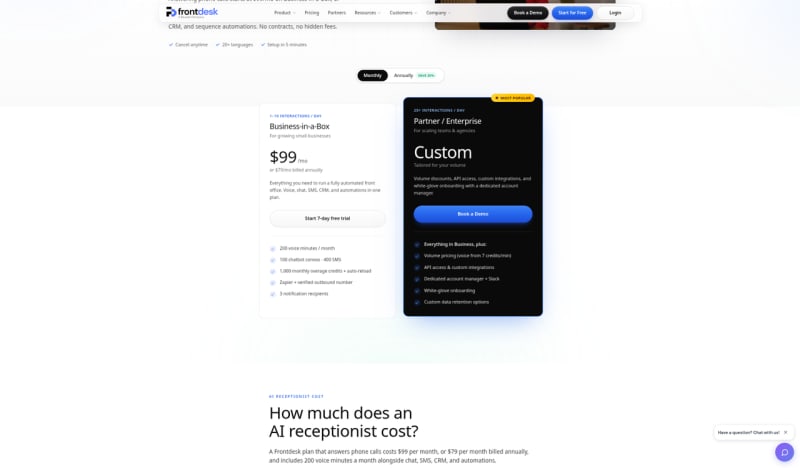
| My AI Front Desk | A self-serve all-in-one pilot | Answering, booking, and texting bundled | $99/mo (200 min); $79/mo annual |
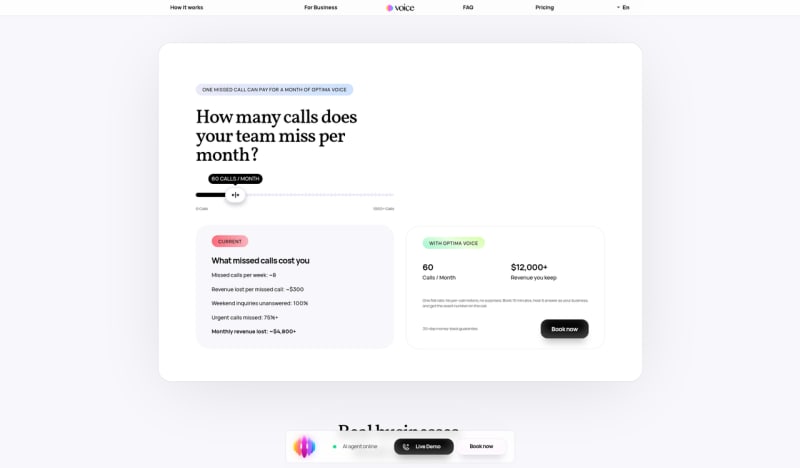
| Optima-voice | Owners wanting a septic specialist | Dedicated septic page; flat-rate pitch | Not published — quoted on demo |
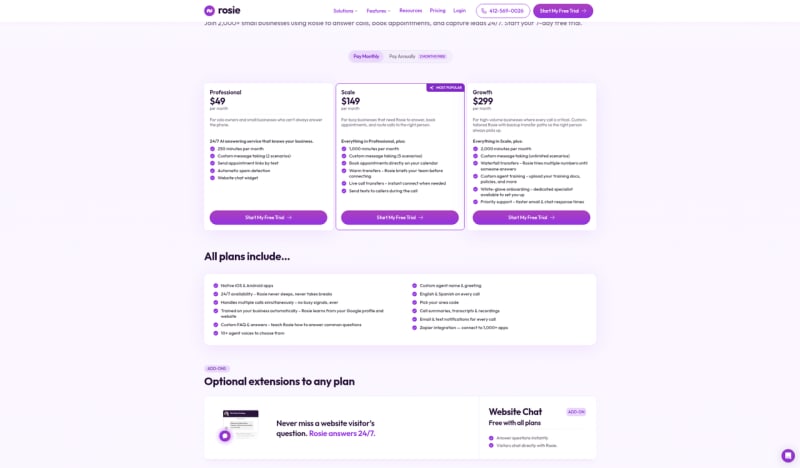
| Rosie | Predictable questions on a budget | Website-trained; booking from Scale | From $49/mo (250 min) |
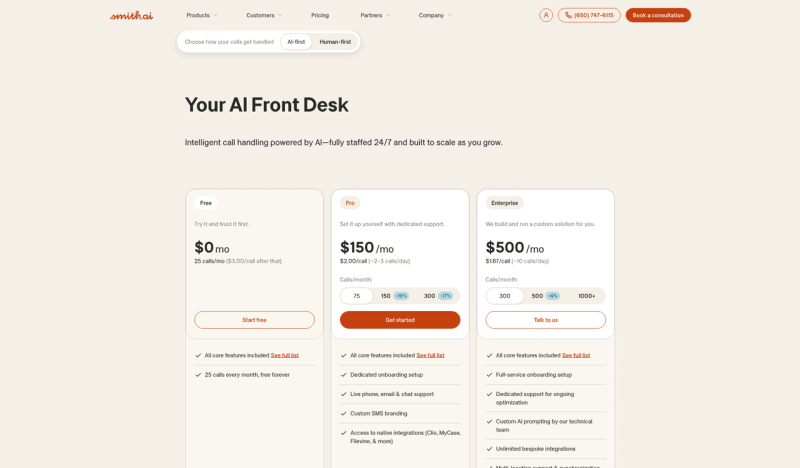
| Smith.ai | Sensitive calls that need a person | AI with live human receptionists | Free 25 calls; humans from $300/mo |
| Synthflow | Multi-branch enterprise operations | Procurement-grade voice controls | From $30,000/yr |
| Upfirst | The cheapest one-truck trial | Per-call bundles; 35+ languages | From $24.95/mo (30 calls) |
What does the emergency call actually sound like?
Here is the intake that separates a triage-capable receptionist from a message pad, run against a caller who says: “sewage is backing up into my bathtub.”
“I’m sorry, that’s a rough situation, and we’ll get you help. While I get the crew notified, two quick things: stop running water anywhere in the house, and don’t flush any toilets. Is the backup still rising, or has it stopped? … And is anyone in the home with health concerns we should tell the crew about? … I have your address as 44 Cedar Lane. The on-call technician will call you back within fifteen minutes to confirm arrival. I’m texting you our do-not-flush guidance now.”
Every clause does work: the water-stop guidance mirrors Penn State Extension’s flood guidance, which opens with the same move: “minimize water use in your home.” The diagnostic questions sort a true emergency from a slow drain that can wait for morning; the callback commitment converts panic into patience. A receptionist, human or AI, either runs this play or loses the caller in the first ten seconds.
That caller is upset, and the voice that answers sets the tone for everything after it. A homeowner with sewage rising in a finished basement needs to feel heard by something that sounds like a person, not a phone tree reading a menu. The data backs this up. In a Gartner survey of 5,728 customers, 64% said they would prefer companies didn’t use AI for customer service, and 53% said they would consider switching to a competitor if they found out a company was going to use it (Gartner, 2024). And sounding human is not automatic: in a peer-reviewed listening experiment, people labeled generic AI voices as human in only 41% of trials, against 81% for real human voices (PLOS One, 2025). Voice realism is one criterion in the rubric, not the whole decision, and it is the principle Futuro AI is built around.
Why does rain make the phones ring?
Ask any septic operator when the worst call days are: the answer is weather, not season. Clemson Extension puts it plainly: “Heavy rains can saturate a septic drainfield and can cause your septic system to malfunction.” Oregon State Extension explains the mechanism: “Using more water than the soil can absorb is the most common reason for failure. The sewage is forced to the surface or backs up into the house.” Saturated soil cannot take the effluent, so the effluent goes somewhere else, and every affected homeowner calls within the same forty-eight hours.
That is the surge problem: a human service queues those callers or meters them per minute when volume triples, and a one-truck shop cannot answer while pumping. An AI receptionist answers every concurrent call on the first ring, which is why flat versus per-minute pricing matters more in this trade than almost any other.
Which AI receptionists fit septic and drain companies? The ten, profiled
Ten platforms, listed alphabetically. Each entry opens with who it is genuinely best for, closes with the honest trade-off, including our own, and links its dated pricing screenshot.
Bland AI
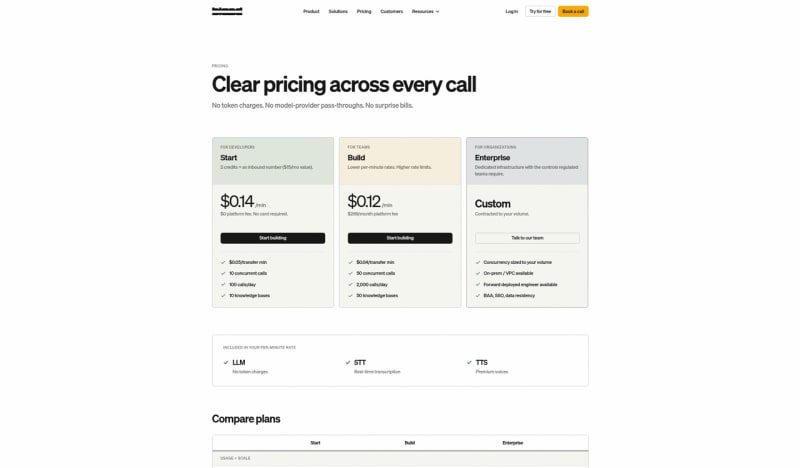
The API-first option for teams with developers: $0.14 a minute with no platform fee on Start, or $0.12 a minute plus $299 a month on Build, with Enterprise quoted. Its pitch is transparency: “No token charges. No model-provider pass-throughs. No surprise bills.” Per-minute billing means a rain week costs more in proportion to the extra minutes, with no tier cliff; the do-not-flush script, dispatch rules, and on-call escalation are whatever your developer writes.
Pricing verified October 16, 2026 and re-checked October 23, 2026 — dated screenshot on our public index, retaken weekly.
Dialzara
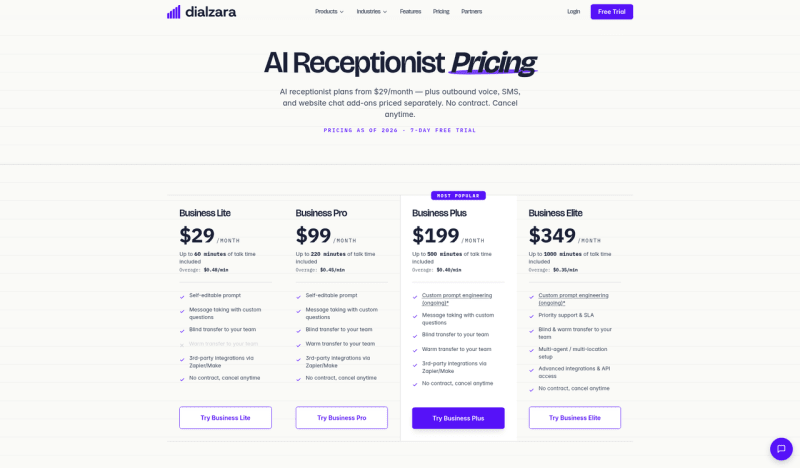
Budget self-serve AI answering on minute bundles: $29 a month for 60 minutes, $99 for 220, $199 for 500, and $349 for 1,000, with overage from $0.48 down to $0.35 a minute depending on the tier. Bilingual English-Spanish answering and warm transfers come from Pro up, and setup is fast enough to be answering the same day. At two and a half minutes a call, 60 minutes is about two dozen calls, so most septic shops land on Pro or Plus.
Pricing verified October 16, 2026 and re-checked October 23, 2026 — dated screenshot on our public index, retaken weekly.
Futuro AI
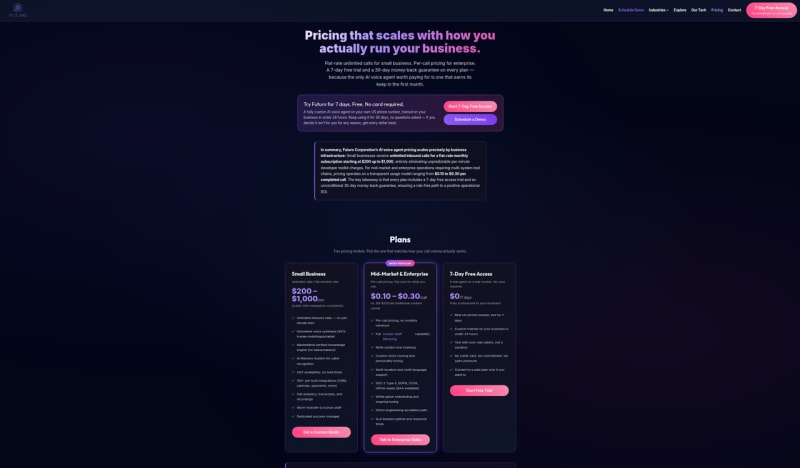
It runs your backup script in that voice, books into ServiceTitan, Jobber, or your calendar, uses caller memory to recall a pump-out from years ago, and texts you a summary (trades product page). It is $200 a month flat with unlimited simultaneous calls. In a company-run, double-blind study, 94% of 1,000 participants believed they had spoken with a person (study details and caveats). Call the agent at (727) 677-9566 or start the seven-day free trial.
Pricing verified October 16, 2026 and re-checked October 23, 2026 — dated screenshot on our public index, retaken weekly.
Goodcall
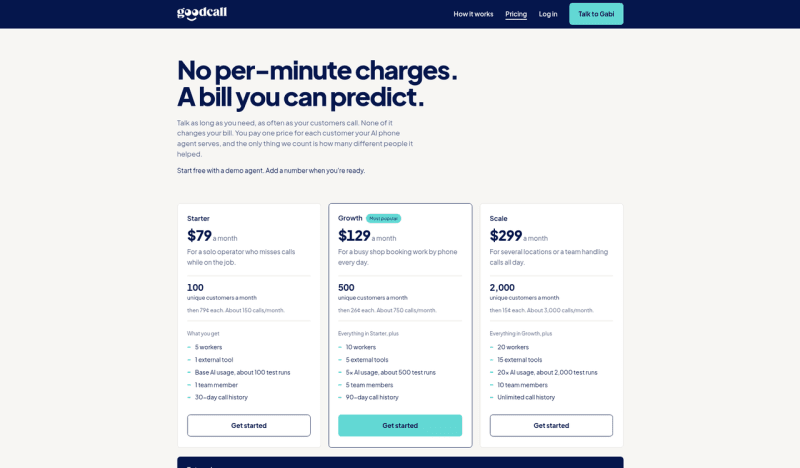
Inbound answering with no per-minute charges: Starter at $79 a month covers 100 unique customers (79¢ each after), Growth at $129 covers 500 (26¢ each after), and Scale at $299 covers 2,000 (15¢ each after). Because billing counts unique callers rather than minutes, a storm-week customer who calls back three times costs the same as one who calls once, which suits a backup that needs several follow-ups.
Pricing verified October 16, 2026 and re-checked October 23, 2026 — dated screenshot on our public index, retaken weekly.
My AI Front Desk
A self-serve front-desk bundle at $99 a month with 200 voice minutes, or $79 billed annually, covering answering, booking, and texting in one dashboard. It stands up quickly from your website and a list of services, which suits a shop that wants a pump-out booked and a confirmation text sent without a setup project.
Pricing verified October 16, 2026 and re-checked October 23, 2026 — dated screenshot on our public index, retaken weekly.
Optima-voice
The niche player that already speaks septic: Optima-voice markets a dedicated septic industry page and positions on flat-rate simplicity: “One flat rate. No per-call meters, no surprises.” For an owner who wants a vendor fluent in pump-outs and inspections from the first call, that specialization is the draw.
Optima Voice does not publish pricing; its pricing-request page was captured October 16, 2026 and re-checked October 23, 2026 — dated capture on our public index, retaken weekly.
Rosie
Budget bundles trained on your website: $49 a month for 250 minutes, $149 for 1,000, and $299 for 2,000, with a $50 website-texting add-on. A good fit for a shop whose questions are predictable: pricing, service area, scheduling, and whether you cover a given county.
Pricing verified October 16, 2026 and re-checked October 23, 2026 — dated screenshot on our public index, retaken weekly.
Smith.ai
The hybrid: AI answering with live human receptionists behind it. The AI side starts with a free tier of 25 calls a month ($3 a call after) and Pro from $150 for 75 calls; human receptionists start at $300 a month for 30 calls with $11.50 overage, and Basic is $810 for 90. For shops that want a person on sensitive calls, it is the structured option, with a 30-day money-back guarantee.
Pricing verified October 16, 2026 and re-checked October 23, 2026 — dated screenshot on our public index, retaken weekly.
Synthflow
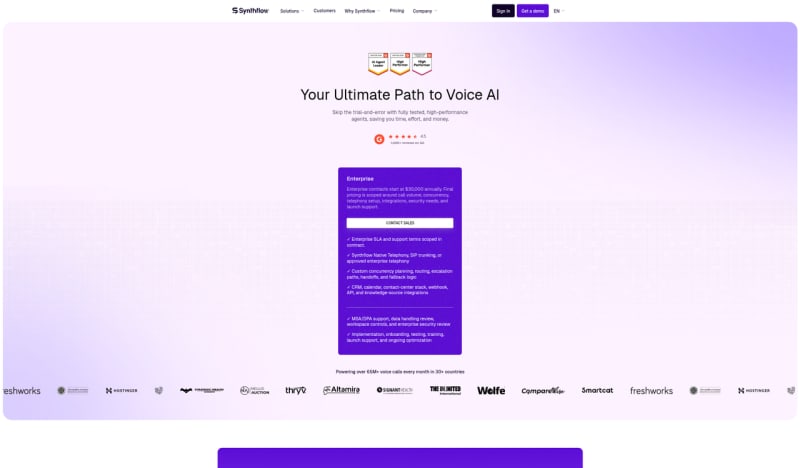
The enterprise floor: contracts start at $30,000 a year, with the platform reporting 65M+ calls a month across customers. Multi-branch operations get procurement-grade controls and a build team that configures voice workflows at scale.
Pricing verified October 16, 2026 and re-checked October 23, 2026 — dated screenshot on our public index, retaken weekly.
Upfirst
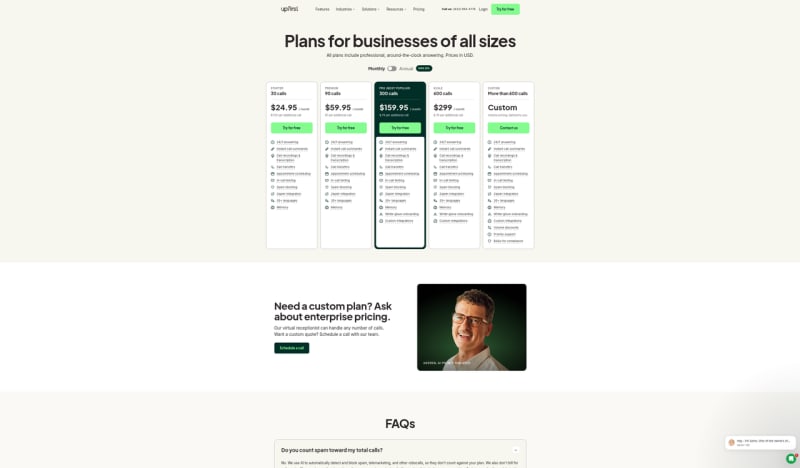
The budget per-call door: $24.95 a month for 30 calls, up to $299 for 600, with 35+ languages and caller memory on every plan, per its site. For a one-truck shop testing AI answering, it is the cheapest real trial, and per-call billing means a long backup call costs the same as a quick question.
Pricing verified October 16, 2026 and re-checked October 23, 2026 — dated screenshot on our public index, retaken weekly.
What about drain cleaning and grease-trap routes?
Most septic shops run adjacent work: drain cleaning, jetting, and for commercial accounts, grease-trap service. The phone pattern is the same three-call structure with a commercial twist. Grease-trap work is compliance-driven recurring revenue: local ordinances require food-service establishments to maintain interceptors on a schedule, and the EPA’s pretreatment guidance notes that establishments “can install interceptor/collector devices (e.g., grease traps) in order to accumulate grease on-site and prevent it from entering” the public system. A restaurant manager calling about a trap inspection or a backup before the weekend rush is the commercial version of the bathtub call: deadline-driven, valuable, and gone if it hits voicemail.
The receptionist requirement barely changes: emergency triage for backups, routine bookings for jetting and trap service, and memory that knows which restaurant is due this quarter. Every option above handles the intake; the difference is whether it knows the customer’s history.
How do integrations fit a septic shop?
Field-service software runs the modern septic operation: ServiceTitan, Jobber, and Housecall Pro on the generalist side, ServiceCore for septic and portable sanitation specialists. The honest integration picture is calendar-plus-webhook, not deep ledger sync: a booked pump-out lands on the calendar, and the summary, transcript, and callback commitments land in your inbox or CRM. For most shops that is enough.
Two things to verify on any demo. First, emergency dispatch: how does a triaged backup reach your on-call tech, and what happens if that tech does not acknowledge. Second, the paper trail: septic work brushes against county health departments and permitting, and a timestamped call log is worth having when a dispute or permit question surfaces. Ask to see the transcript export, not just the dashboard.
How does the money work at 150, 300, and 600 calls?
For a shop that outgrows voicemail, the usual alternative is a live answering service. Housecall Pro’s cost guide, citing AMBS, puts typical live-answering spend for small businesses at $135 to $400 a month before heavy volume, and human services bill by the minute or the call, so the surge is where they get expensive. One of the few live services that publishes its rates is Answering Service Care, a U.S.-based human answering service that also sells an AI answering tier. Its live-agent plans run from a $40 Starter plan billed at $1.75 a minute to Enterprise at $639 a month for 500 minutes, with additional minutes at $1.35 to $1.75 depending on the plan. It fits a shop that wants a trained person on every backup call and will pay per minute for that.
Pricing verified October 16, 2026 and re-checked October 23, 2026 — dated screenshot on our public index, retaken weekly.
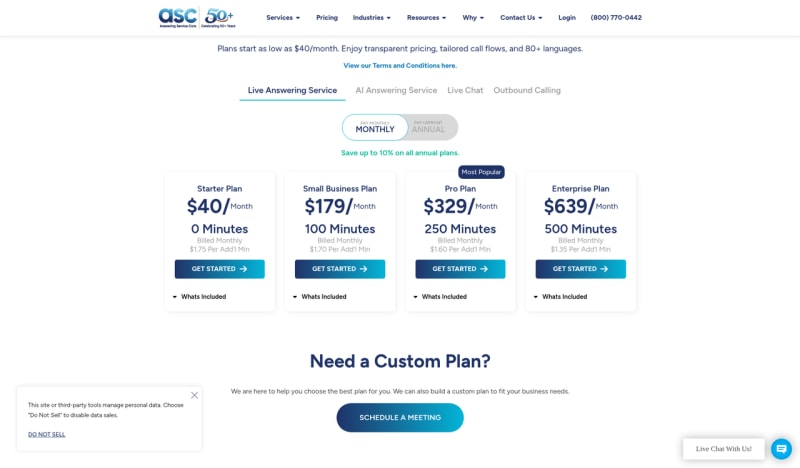
Now model the options at two and a half minutes a call, assumptions stated rather than quoted. At 150 calls a month (375 minutes), the cheapest Answering Service Care live plan is Pro at about $529 ($329 for 250 minutes plus 125 minutes at $1.60), while a minute-bundle AI plan sits on a middle tier: Dialzara’s $199 Plus (500 minutes) or Rosie’s $149 Scale (1,000). At 300 calls (750 minutes), a busy three-truck shop in a wet month, live answering on Enterprise comes to about $977, Dialzara moves to its $349 Elite tier, Upfirst to its top $299 tier (600 calls), and Smith.ai’s human Starter (30 calls) is deep into overage. At 600 calls during a genuine rain event (1,500 minutes), live Enterprise reaches about $1,989, Dialzara’s Elite runs 500 minutes into overage (about $524 in total), Rosie needs its $299 Growth tier, Upfirst sits at its 600-call ceiling, and Goodcall’s bill depends on how many distinct customers called, not how long they talked. Flat-rate plans, including Futuro AI at $200 a month, do not move with the weather. Even a single saved job covers the spread: Angi puts the average septic repair at $1,830. The math is not subtle; the only question is whether the answering quality holds, which is what the demo call is for.
Will it hold up in rural coverage areas?
Septic customers live where sewers do not, so weak signal is part of the territory. The reassuring part: the AI answers from the carrier network, not your phone, so a one-bar call reaches it exactly as well as it reaches you today. The real checks are procedural: confirm your number ports cleanly, or skip porting with conditional call forwarding, where your phone rings you first and only the misses roll over. Then run test calls from the edges of your service area. Any vendor that will not do a live test-call week is telling you something.
How is this list different from our plumbers guide?
Our companion guide to the best AI answering services for plumbers overlaps heavily: both trades live on emergency dispatch and missed-call economics. This list differs three ways. The recurring engine is stronger here: plumbing is episodic, while pumping repeats on a three-to-five-year cycle that rewards caller memory. The deadline call is different: plumbers rarely get closing-date-driven work; septic shops live on time-of-transfer inspections. And the surge driver is hydrology, not freeze events. If your work also runs seasonal, our pool service guide covers the closest adjacent pattern.
Which one fits your situation?
If you run one to five trucks and the phone rings in the cab
Start with the budget doors and a forwarding setup: Upfirst at $24.95 or Dialzara at $29 will answer today. If you outgrow the buckets in a wet month, that is the signal to move to flat-rate, not a failure of the experiment.
If your spouse answers the office phone today
Any option on this list is an upgrade in coverage; the question is how much setup help you want. Self-serve tools (My AI Front Desk, Rosie) get you live in an afternoon; done-with-you setups trade that afternoon for a script that sounds like your best office manager.
If emergencies are your profit center
Triage depth is the whole evaluation. Run the bathtub-backup script live against two finalists and judge the do-not-flush guidance, the dispatch logic, and the callback commitment. This is the corner Futuro AI was built for, and Smith.ai’s human backup is the credible alternative philosophy.
If you live on recurring pumping routes
Caller memory is the feature that pays. A receptionist that recognizes a customer three years after their last pump-out and books the next one turns your phone into a retention engine. Futuro AI’s memory engine was designed for exactly this; Upfirst includes memory on every plan if budget leads.
If real-estate season drives your inspection work
Prioritize intake that captures the closing date and flags deadline calls for priority scheduling; confirm the workflow with your booking software on the demo. Every option here can take the message; fewer can route the urgency.
If you run drain cleaning and grease-trap routes too
Your commercial accounts call about compliance deadlines and pre-weekend emergencies. Any triage-capable option handles the intake; the differentiator is account memory: knowing which restaurant is due this quarter. Bilingual coverage (Dialzara, Upfirst) matters in plenty of kitchens.
If you have developers on staff
Bland AI at $0.14 a minute with no platform fee is the honest build-it-yourself path, and Synthflow if you are genuinely at enterprise scale. Only buy the API if you will maintain the logic. Otherwise buy a product, not a project.
If you want a human behind sensitive calls
Smith.ai is the structured hybrid: AI for coverage, live receptionists from $300/mo for the calls that need a person. Model the per-call human math at your storm-month volume before committing; the pricing page makes the tiers plain.
If you are enterprise or multi-branch
Synthflow at $30,000 a year and up is built for procurement-grade voice operations. Bring your call volumes, your compliance requirements, and your legal team. Everyone below that scale should start elsewhere on this list.
Frequently Asked Questions
Prices re-checked October 23, 2026 against dated screenshots: budget tools start at $24.95/mo (Upfirst) and $29/mo (Dialzara); bundles run $49 (Rosie) to $99 (My AI Front Desk); Goodcall starts at $79, Bland AI at $0.14 a minute; Smith.ai offers a free 25-call AI tier, humans from $300; Optima-voice does not publish pricing; Futuro AI is $200/mo flat; Synthflow starts at $30,000 a year.
The good ones triage rather than transcribe, which is why emergency backup triage carries 25% of the rubric in this guide: they ask scripted questions (is sewage actively backing up, is the alarm sounding), give do-not-flush guidance from your approved script, dispatch true emergencies to your on-call rotation, and book routine work into the schedule. Ask every finalist to run a bathtub-backup call live before you sign.
Integrations carry 10% of the rubric here because most AI receptionists connect through calendars, webhooks, and Zapier-style automation rather than deep sync with field-service software, so a booked pump-out lands on the calendar and the call summary lands in your inbox or CRM. Confirm the exact workflow on a demo with your own account, especially if your dispatch board lives in ServiceTitan, Jobber, Housecall Pro, or ServiceCore.
Yes: the EPA counts more than one in five U.S. households on septic systems, pumping runs every three to five years per EPA guidance, and Angi puts a typical pump-out between $292 and $565. A handful of missed calls a week is real route revenue, and emergencies are worth more still.
Heavy rain saturates drainfields, and backups cluster together; Clemson Extension warns that heavy rains can saturate a septic drainfield and cause malfunction. An AI receptionist answers every concurrent call on the first ring, where a human service queues callers or bills you per minute through the surge. This is the week flat-rate pricing earns its keep.
With caller memory, the system recognizes a repeat customer, knows their service history, and flags when the three-year window comes due. Futuro AI builds this into its memory engine, including reminder callbacks for opted-in customers; outbound reminders require consent, so keep them to customers who agreed.
The AI answers from the carrier network, not from your cell signal, so rural coverage affects your customers' calls the same way it does today. The practical checks: confirm your number ports or forwards cleanly, test conditional call forwarding with your carrier, and run test calls from your actual service area, including weak-signal dead zones at the edge of your route.
Yes, and this is where scripted intake shines: the AI captures the property address, the closing date, the agent's contact, and the access details, then flags the call as deadline-driven for priority scheduling. In states like Massachusetts, Title 5 requires inspection within two years before a sale, so these callers book with whoever answers first.
Customers mind voicemail and hold music more. In our 1,000-participant voice study, 94 percent of listeners could not distinguish a well-built AI voice from a human one. A homeowner with sewage in the bathtub cares about being heard and helped, not about who answers.
It cannot diagnose beyond your approved scripts, quote a repair it was not given pricing for, or make engineering judgments about drainfield design. Those calls route to you or your senior tech, with a full transcript. Treat any vendor that claims otherwise with suspicion.
Yes, in two ways. You can port your number to the provider, or keep your carrier and use conditional call forwarding so your phone rings you first and only the misses roll to the AI. Most one-to-five-truck shops start with forwarding because it is reversible in minutes.
Usually yes, because the owner is also the crew: every answered call is one you did not have to stop a pump-out to take. A single booked pump-out, $292 to $565 per Angi, covers months of a $24.95 to $200 plan. The caveat: under ten calls a week, plain voicemail plus fast callback may still be enough.
Methodology and how we built this guide
Evidence level and sourcing
This guide’s evidence level, in order of weight: vendor capability and pricing claims come from each vendor’s own live pages, with every price re-checked against a dated screenshot on our vendor pricing index on October 23, 2026, used for pricing and options references only. Industry structure comes from the EPA’s septic program pages, the Bureau of Labor Statistics, and IBISWorld’s NAICS classification. Failure mechanics come from university extension services at Clemson, Oregon State, Penn State, and NC State, quoted verbatim at the claims. Real-estate requirements come from Massachusetts’ Title 5 guide. Cost benchmarks come from Angi and U.S. News; the live-answering benchmarks from Housecall Pro’s cost guide and Answering Service Care’s published plans. Voice-perception figures come from Gartner and PLOS One; the Futuro voice study is company-run and linked rather than restated.
What we did not do
What we did not do: we did not record real septic-company calls; the bathtub-backup intake is a composite script, not a transcript. No vendor, including Futuro, reviewed its profile before publication. We did not rank the ten options, accept placement fees, or use affiliate links; the money section uses stated assumptions, not invented market data. If a linked page has changed since October 23, 2026, it is the authority, per our publishing principles.