
Editorial Disclosure: This guide is published by Futuro Corporation, and Futuro AI is one of the ten platforms compared. Futuro has no financial, affiliate, or referral relationship with the other nine vendors, and no vendor paid for inclusion. All pricing was verified against the vendors’ own pages on September 26 – October 1, 2026. Beyond this article, we document pricing for every vendor we cover — and every vendor we come across: a dated screenshot of each vendor’s pricing page is retaken every Friday at 9:00 AM ET as direct evidence of what they charge, currently for more than 70 vendors, at futurocorp.com/vendor-pricing. Full methodology.
- What we verified: every price in this article was read from the vendor’s own live pricing page between September 26 and October 1, 2026, and each is documented with a dated screenshot — retaken every Friday at 9:00 AM ET, whether the price changed or not — on our public vendor pricing index (70+ vendors and counting). Capability claims were checked against the vendors’ published documentation.
- What we did not do: we did not purchase paid plans on all ten platforms, and we did not listen to recordings of their live calls. We did not independently verify uptime, latency, or answer-speed claims — where a capability claim comes from a vendor’s own marketing, we say so inline. Futuro AI is our product; its capabilities are published company claims, date-stamped September 2026, and individual results will vary with call volume, configuration, and carrier setup.
- Corrections: pricing changes and features ship. If something here is wrong, our corrections policy commits to a fix, and editorial@futurocorp.com reaches a human who re-verifies on every report.
The 11 PM sprint: how a locksmith customer actually chooses
Nobody browses for a locksmith. A driver is standing in a grocery-store parking lot at 10:40 PM watching her keys sit on the driver’s seat; a new homeowner is on his own porch at midnight realizing the deadbolt just spun. The behavior that follows is the most compressed purchase decision in local services: 75% of local searchers decide which business to call within 30 minutes, 28% decide within five, and 72% look at three businesses or fewer, according to BrightLocal’s Consumer Search Behavior 2026 study (July 29, 2026). Local-search click data tells the same story from the other side: the map pack — the three listings with a map that Google shows above the blue links — captures about 42% of clicks on local queries and appears on roughly 93% of local searches (BrightLocal’s local SEO statistics, citing Backlinko; Moz SERP Features data via Searchlab). Businesses inside the pack receive 93% more calls, clicks, and direction requests than listings ranked 4–10 (SOCi data via BrightLocal). And in this vertical, the call is the purchase.
Then the sprint starts. The caller dials the first result. If it rings out, she doesn’t leave a message — she dials the second. Vendor-published call-tracking roundups put the ordinary abandon window around 45 seconds, and under 30 for emergency callers, with the first shop to answer winning the job about 62% of the time (AgentZap’s locksmith phone statistics, February 6, 2026 — a vendor roundup, so treat the exact decimals as directional; the direction matches everything else in this section). The same roundup notes the average prospect calls 2.3 locksmiths before booking. On the missed-call side, the numbers are firmer: the median locksmith shop misses 34% of inbound calls — an improvement from 38% in 2024, driven by early AI adoption — per Webtonic’s locksmith analytics statistics (July 23, 2026), and only 12% of callers who reach voicemail ever call back. Our companion analysis of trade contractors found the callback window closes in about three minutes — we won’t re-derive it here; read the three-minute-window math there. For a locksmith the conclusion is shorter: the caller isn’t waiting three minutes. She’s already talking to your competitor.
And the calls come when you can’t answer. AgentZap’s roundup puts 67% of locksmith calls outside business hours with the daily peak between 6 and 11 PM, and its companion guide adds that 42% of emergency lockout calls land between 6 PM and 6 AM, with weekend call volume about 35% above weekdays (AgentZap’s locksmith answering guide, February 6, 2026). Webtonic’s attribution data (July 31, 2026) adds the revenue shape: the average locksmith ticket runs $178–$248 depending on the job, and 39% of calls arrive after hours. A single missed emergency call is conservatively $185 or more in lost revenue before you count the repeat business and the review the caller leaves someone else.
The economics compound when you look at what locksmiths already pay for leads. Local Services Ads convert at about a 55% booked rate at an average $32–$34 per lead (Webtonic), and aggregator marketplaces take roughly a quarter to a third of the ticket on the jobs they send. Every missed organic call is a job you either lose or end up buying back from a middleman at a margin that would make a casino blush. Answering your own phone — on the second ring, at 11 PM, every time — is the cheapest customer-acquisition channel a locksmith has. That is the entire case for the ten platforms below, and it is why answer speed carries the single heaviest weight in our rubric.
The decision table: ten platforms at a glance
The whole conclusion, scannable in one pass; the graded details and dated pricing screenshots sit in each profile below.
| Provider | Pricing | Standout attribute | Best fit |
|---|---|---|---|
| AgentZap | $109/mo (150 min) + setup fee | Structured automotive intake — make, model, year, key type — built into the call flow | Mobile operators whose mix skews to car lockouts |
| Bland AI | $0.14/min self-serve, $0 platform fee | Raw voice API with total call-flow control | Technical owners building custom dispatch logic |
| Dialzara | $29/mo (60 min) | Same-evening setup; bilingual answering from the entry tier | Solo operators where budget is the main concern |
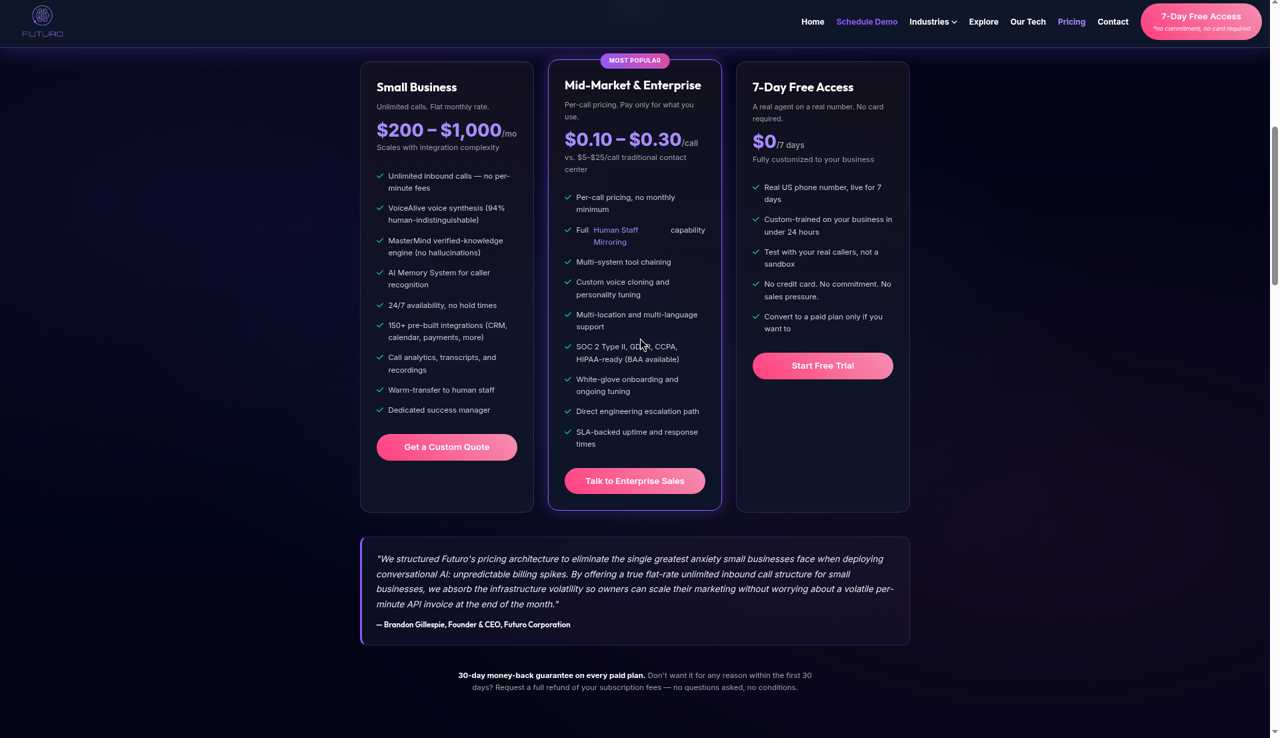
| Futuro AI | $200/mo flat, unlimited | 94% human-indistinguishable voice realism (company-run study); configurable dispatch intake | Shops where missed night calls are the main revenue leak |
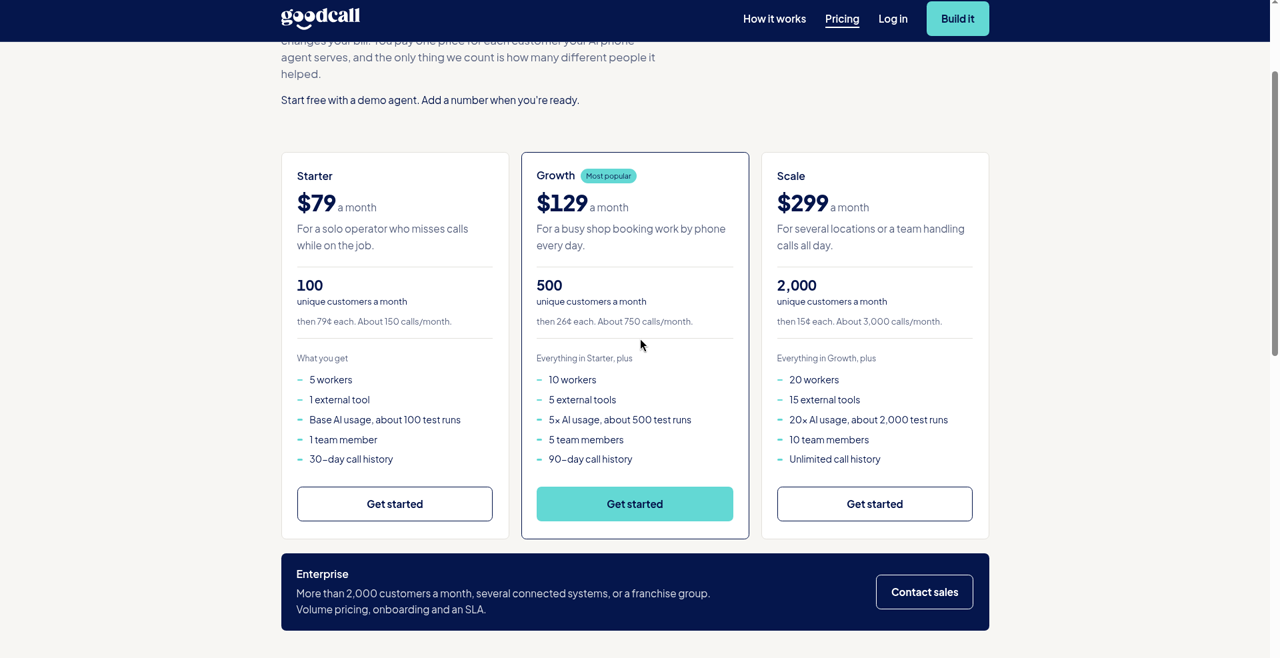
| Goodcall | $79/mo (100 unique customers) | Per-customer billing with unlimited minutes | Storefront shops with repeat commercial accounts |
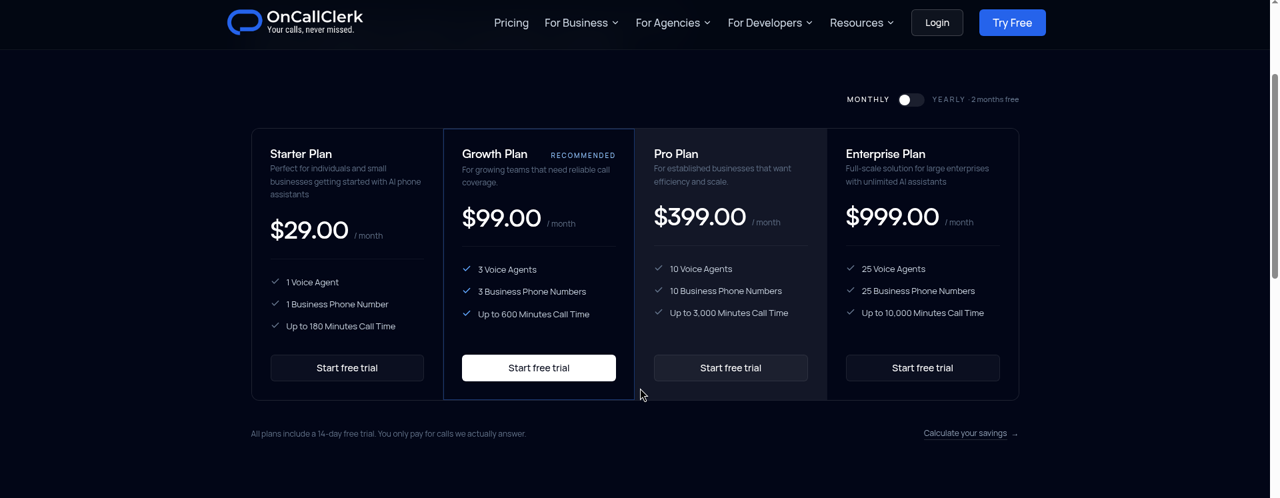
| OnCallClerk | Free plan; paid from $29/mo | Genuinely free tier with a real phone number, no card | The zero-risk first pilot |
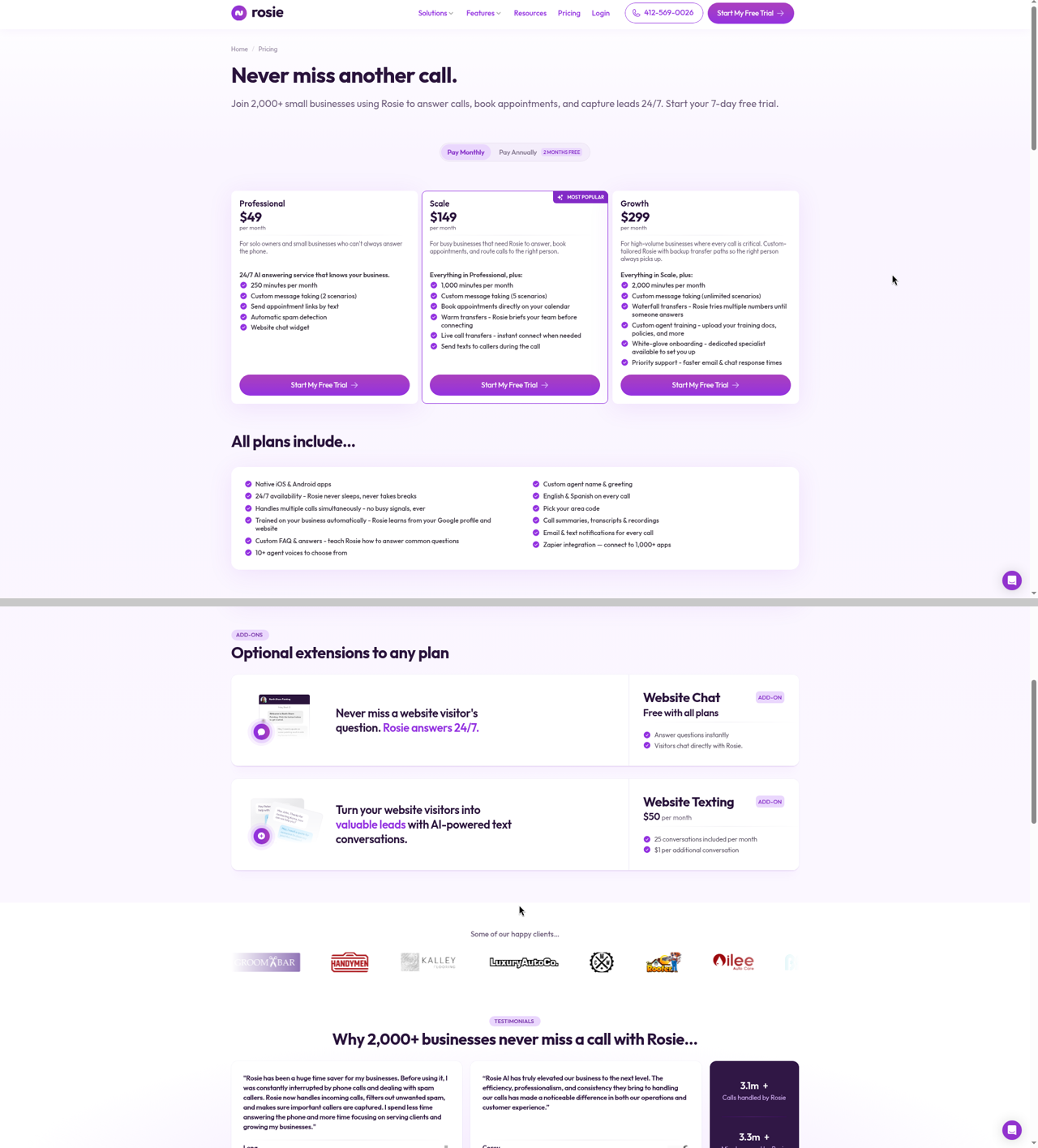
| Rosie | $49/mo (250 min) | Budget entry; calendar booking and warm transfers on the $149 Scale tier | Message-first coverage on a budget |
| Smith.ai | AI from $150/mo; staffed from $300/mo | Live North America receptionists behind the AI | Commercial work with liability-sensitive intake |
| Synthflow | From ~$30,000/yr | Enterprise white-label agent platform | Multi-location groups and franchises |
| Upfirst | $24.95/mo (30 calls) | Spam and sub-15-second calls free | The lowest-commitment pilot on a junk-heavy line |
Prices are verified entry points as of September 26 – October 1, 2026 — not endorsements of the cheapest tier. A dated screenshot of every pricing page sits in the matching profile below and on our vendor pricing index.
How we assessed the ten platforms
Eight criteria, weighted for what decides a locksmith purchase — not a generic feature checklist. Answer speed carries 25 points, the single heaviest weight, because in this trade it is the first filter: a platform that answers on the second ring at 2 AM and misses everything else still beats a feature-rich platform that rings four times. Weights were fixed before the profiles were written, sum to 100, and apply to every platform including ours.
| Criterion | Weight | What it measures |
|---|---|---|
| Answer speed & answer reliability | 25% | Answering on the second ring every time — nights, weekends, holidays, and the fifth simultaneous call — because the lockout caller dials the next result within a minute. |
| 24/7 reality | 15% | True round-the-clock answering, not extended hours or a friendlier night voicemail. |
| Mobile-dispatch & intake logic | 15% | Capturing what a locksmith job needs — address, vehicle make/model/year and key type, verification details — and routing it to the on-call tech through configurable dispatch rules. |
| Rate-card transparency | 15% | Published pricing and honest overage terms, so a shop can quote its own service-call fee as confidently as the vendor quotes its bill. |
| Verification-practice support | 10% | Support for the ID-check and work-order prompts legitimate locksmiths use — and that California and Connecticut expect. |
| Night & surge pricing fairness | 10% | No premiums that punish the hours locksmiths earn their living; junk-call billing that doesn’t charge for robocalls and wrong numbers. |
| Setup speed | 5% | Signup to answering in minutes or hours, because locksmith owners buy the night they miss a $200 lockout. |
| Evidence & verifiability | 5% | Dated screenshots, published documentation, and claims a buyer can check. |
The rubric is published as machine-readable data in this page’s JSON-LD (grading dataset), licensed CC-BY. One register note, because the industry blurs it on purpose: answer speed (how many rings before pickup) and caller recognition (greeting a returning caller by name during the first rings) are different capabilities. This rubric scores the first; where a platform recognizes returning callers, the profiles note it separately from answer speed.
What a locksmith call actually looks like
Answering services are usually graded on generic small-business calls. Locksmith calls are not generic. Five call types make up nearly all of the inbound mix, and each one has a different clock and a different ticket:
- Lockouts — home, car, and business. The emergency core. The caller is standing somewhere she doesn’t want to be, the clock is seconds, and the emergency lockout job value runs $150–$350. The intake that matters: the exact location (for a mobile locksmith, the address is the job — there is no shop to walk into), a callback number, and the verification setup.
- Rekeys. The scheduled bread-and-butter at about $178 — new home, lost key, departed employee. The caller is shopping calmly, comparing two or three shops, and will book whoever quotes clearly. Often the follow-up job a lockout call becomes.
- Lock replacement and upgrades. Higher ticket, longer sales conversation — smart locks, deadbolt upgrades, break-in repairs. Break-in callers are shaken; the call needs patience first and a booking second.
- Safe work. Niche, high-trust, high-ticket. The intake needs safe type and the nature of the lockout — and a hard rule that the shop verifies ownership before anyone drills.
- Commercial master-key systems. The quote-driven end of the trade: hierarchical key systems, door hardware, access control. These calls should be captured in full detail and routed to the owner, not dispatched to a van.
Automotive work deserves its own paragraph because its intake is unforgiving. A car-lockout or lost-key call needs the vehicle’s make, model, year, and key type before anyone rolls — a transponder job quoted blind is money lost. A well-configured AI intake for an auto lockout sounds like this:
“I can get a technician out to you. First, where is the vehicle right now — the street address or nearest cross streets? … Got it. And the make, model, and year? … Is it a standard key, a transponder key, or a push-to-start fob? … Last thing: when our technician arrives, he’ll need to see your ID and the registration matching the vehicle — that protects you as much as it protects us. I’m sending this to our on-call technician now, and as soon as he accepts, you’ll get a text with his ETA.”
Every element of that script is a buying criterion in disguise. Address capture that survives a parking-garage description. Vehicle fields that land in the dispatch message, not just the recording. A verification line delivered up front, which does two jobs at once — it filters out bad actors, and it tells the legitimate caller she reached a professional. And a dispatch step that is configured, not improvised: intake capture is only half the job, and any platform can read fields off a script. What you are grading is whether those fields reach your on-call tech as a structured dispatch — and that depends on configuration, which is why the trial-period test calls in the setup section matter more than any feature list.
The trust problem: your caller has been warned about you
Locksmithing carries a scam problem that most trades don’t. State regulators have spent years warning consumers about bait-and-switch operations: the quoted $35 service call that becomes $400 at the door, the “local” listing that rings a phone bank three states away, the drill-first technician who destroys a lock he never tried to pick. The Washington State Attorney General’s office documented the pattern on its All Consuming blog back on August 10, 2011, citing a New York Times finding that roughly 3,000 locksmith listings in Seattle alone traced mostly to far-off phone banks. The pattern never died — it professionalized. The Connecticut Department of Consumer Protection issued a consumer alert on July 16, 2026 — “Locked Out? Be Wary of Scammers Posing as Locksmith Technicians” — with Commissioner Bryan T. Cafferelli warning that “the one thing we can predict is that scammers prey on urgency,” and reminding residents that Connecticut requires locksmith registration (293 registered individuals at the time) precisely because the trade is a fraud magnet.
We are deliberately not naming companies here — the point is structural, and the regulators’ publications make it better than we can. The structural point: the scam operations win on the exact mechanics this article is about. They saturate the map pack, they answer instantly, and they quote low. Legitimate shops lose the sprint before the race starts, then get treated with the suspicion the scammers earned.
The counter-play is to do publicly what the scammers structurally cannot:
- Publish your rate card and hold it. A stated service-call fee — typically $35–$100 nationally, per Angi’s 2026 locksmith cost data — that doesn’t grow at the door. When your phone is answered by an AI, this becomes a technical requirement, not just a virtue: the agent must quote your prices from your rules, every time. That is a retrieval problem, not a generation problem — the difference between an AI that reads your rate card and one that improvises a plausible number is the difference between a booking and a bait-and-switch accusation. We wrote up the engineering side in Zero-Hallucination AI: Retrieval vs. LLM Generation.
- Verify the caller, and say so up front. Verification is legitimate-industry practice, not paranoia: per BestLocksmith.org’s state-by-state overview (July 7, 2026), California requires a formal work order with checked customer ID on every job, and Connecticut expects ID verification and signatures before a lock is opened. (Verify your own state’s current rules — licensing obligations change; see the note in the licensing bullet below.) A shop that announces its verification step on the call protects itself against false claims — and signals to the customer that she reached the real thing.
- Know your licensing landscape and advertise it accurately. Thirteen states require statewide or county-level locksmith licensing as of late 2026: Alabama, California, Connecticut, Illinois, Louisiana, Maryland, Nevada (through county sheriffs), New Jersey, North Carolina, Oklahoma, Oregon, Texas, and Virginia (VortechPro’s 2026 state-by-state tracker; BestLocksmith.org, July 7, 2026). The map is moving fast: Florida preempted all local locksmith licenses on July 1, 2025 (HB 735/SB 1142); Illinois’ requirement sunsets in 2029; Nebraska and Tennessee repealed theirs in 2021; and New York City’s Local Law 183 of 2025 ends individual licenses on May 31, 2027 in favor of a business-only credential expected February 2027. Voluntary credentials fill the gap elsewhere — ALOA’s certification program is the recognized one. Whatever your state, “licensed” is a claim to get right, because the scammers make it too.
- Answer instantly, as yourself. The phone bank can imitate a local listing; it cannot imitate your shop’s name, your rate card, your verification practice, and a consistent voice that regulars recognize. That combination — speed plus identity — is the whole moat.
This is why verification-practice support and rate-card transparency sit in the grading rubric at 25 combined points. In most verticals those would be nice-to-haves. In locksmithing they are the difference between feeding the trust problem and fixing it.
The ten platforms, graded for locksmith work
Alphabetical, not ranked. Each profile leads with what the platform genuinely does best for a locksmith, states one honest trade-off, and closes with a dated screenshot of its pricing page — retaken every Friday at 9:00 AM ET. Locksmith-specific behavior — answer speed, dispatch intake, verification support, night pricing — is graded against the rubric in How we evaluated.
1. AgentZap
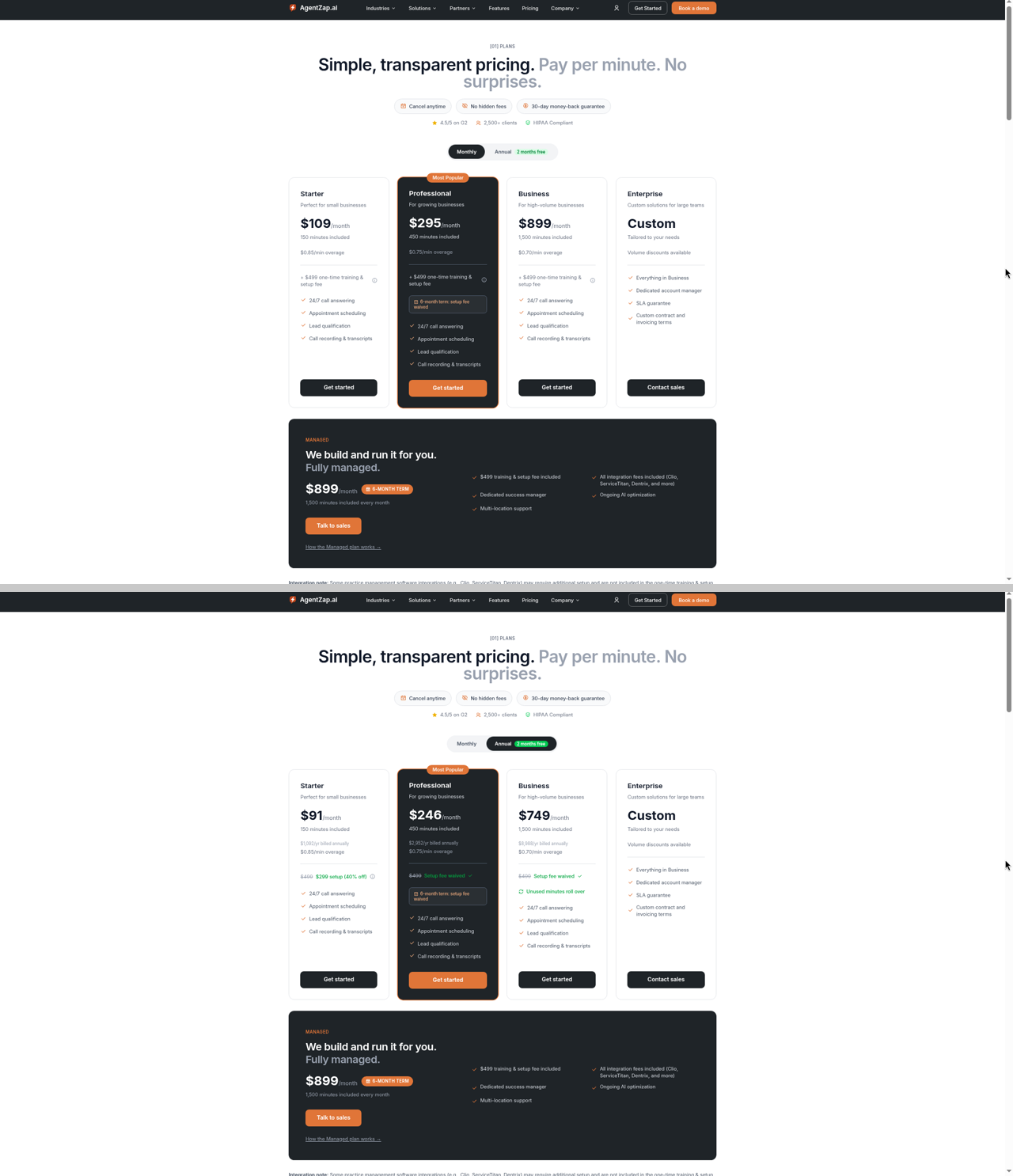
AgentZap’s Starter plan is $109 a month with 150 included minutes and $0.85 per overage minute, Professional is $295 for 450 minutes, and Business is $899 for 1,500, pricing verified October 1, 2026 (dated screenshot). The line item to plan around is the $499 one-time training and setup fee: AgentZap’s published FAQ describes term-based relief (Starter drops to $299 on an annual term; Professional and Business waive the fee on qualifying terms), and the fee includes 150 test minutes to size your call volume before go-live. For locksmiths, two details stand out. First, the intake: AgentZap came up serving automotive businesses, and its call flows natively collect the vehicle make, model, year, and key-type fields a car-lockout dispatch needs. Second, the billing fairness: spam and robocalls are filtered automatically and don’t count against your minutes, outbound appointment confirmations are free, and plans are month-to-month with 30 days’ cancellation notice plus a 30-day money-back guarantee. A live-agent escalation add-on ($2.50 per transferred call) exists for calls that outrun the AI.
Pricing for AgentZap as captured on October 1, 2026. This screenshot is retaken every Friday at 9:00 AM ET and replaced whether the price has changed or not.
2. Bland AI
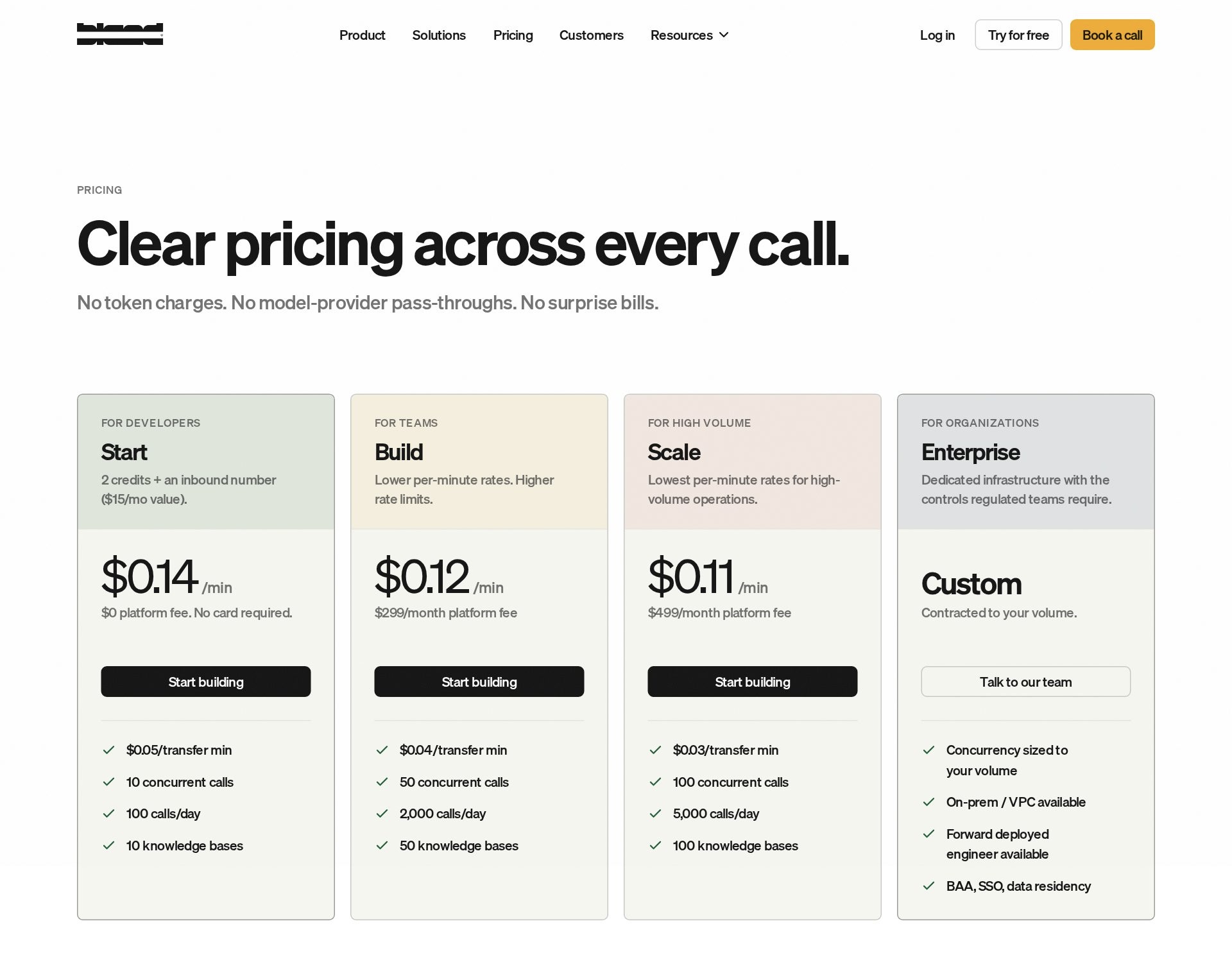
Bland’s self-serve plan bills $0.14 per minute with no monthly fee, and its Build plan drops the rate to $0.12 per minute for $299 a month, pricing verified September 26, 2026 (dated screenshot). For a locksmith, the appeal is total control: Bland’s pathway system lets you construct the exact lockout intake this article describes — address first, vehicle fields for auto calls, verification language, escalation branch — and its API-first design wires dispatch summaries into whatever you already run. At low night volume the math is friendly: ten short calls a week costs pocket change. The catch is that everything described above is something you build, not something that arrives configured — triage scripts, the on-call rotation, the escalation order, the morning summary. If nobody on your truck wants to own that construction, the savings get spent on setup hours instead.
Pricing for Bland AI as captured on September 25, 2026. This screenshot is retaken every Friday at 9:00 AM ET and replaced whether the price has changed or not.
3. Dialzara
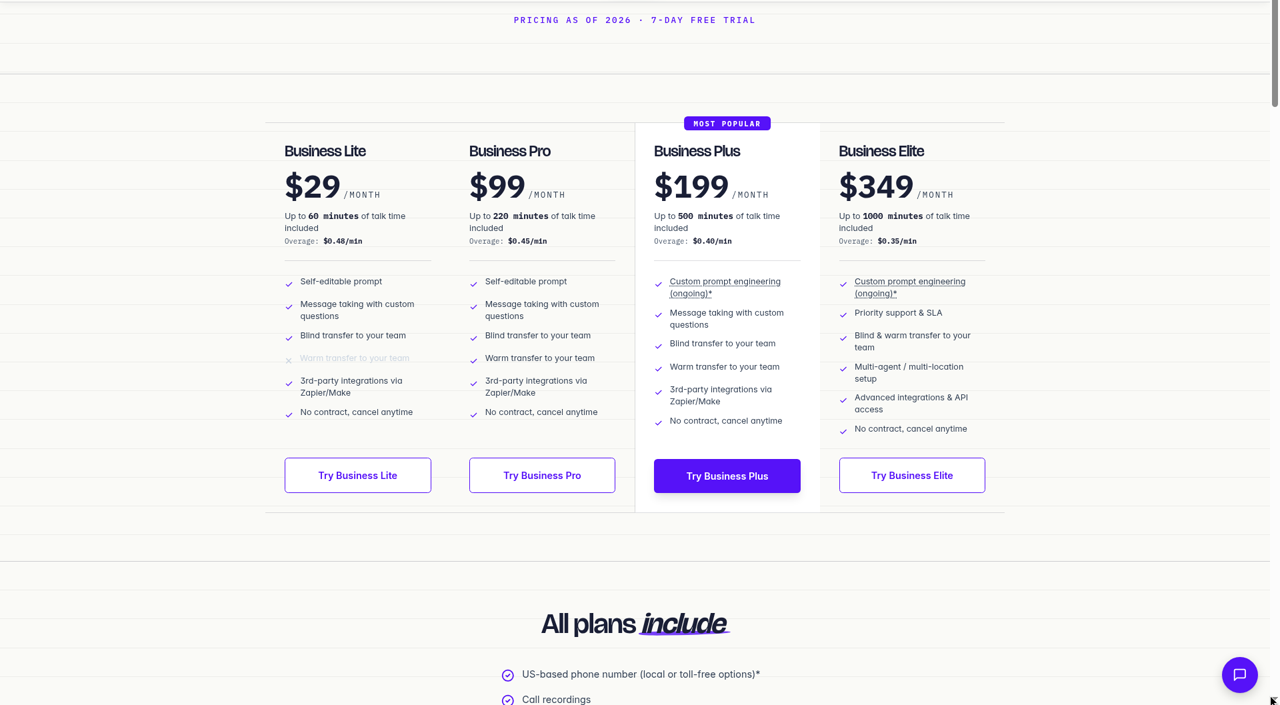
Dialzara’s plans run $29 a month for 60 minutes up to $349 a month for 1,000 minutes, pricing verified September 26, 2026 (dated screenshot). Setup is genuinely fast — you can be answering calls the same evening, which suits a trade where owners buy the night they miss a job — and bilingual answering works from the entry tier, a real point for shops whose night callers are often Spanish-speaking. The locksmith catch lives in the transfer column: warm transfer (the AI stays on, introduces the caller, hands off the captured address and vehicle details) requires the $99 Pro plan, while the entry Lite tier handles blind transfers only — the caller passed cold, with no context. For a 9 PM rekey quote that’s survivable; for a 2 AM lockout where your on-call tech needs to hear the situation before committing, it’s the difference between dispatch and a phone number. Minute overages bill per minute past your tier, so a holiday weekend can outrun the flat-feel pricing.
Pricing for Dialzara as captured on September 25, 2026. This screenshot is retaken every Friday at 9:00 AM ET and replaced whether the price has changed or not.
4. Futuro AI
Futuro AI is $200 a month flat for unlimited answering, pricing verified September 26, 2026 (dated screenshot). We built it around exactly the failure modes this article is about. It is configured to answer on the second ring and built for concurrency — the fifth simultaneous call on a Saturday night gets the same response as the first. One configuration note: if you deploy via conditional call forwarding, your own line rings first, so set the forwarding ring count low; that’s a setup choice, and managed onboarding handles it with you. Emergency triage is a configured protocol, not a hope — the agent distinguishes “locked out of my car in a parking garage” from “I’d like a rekey quote,” escalates the lockout to your on-call chain with the address and vehicle fields attached, and books the rekey for morning. Dispatch intake is configurable: the location, the make/model/year/key type, and your verification policy — including the up-front line about the ID and work order your tech will need at the door. Rate-card quoting runs on retrieval, not generation, so the agent states your service-call fee from your published rules rather than improvising a number (the engineering write-up is here). The voice carries a 94% human-indistinguishability rating in a company-run double-blind study of 1,000 participants — company-run and not peer-reviewed, which is why we tell you to call it yourself during the trial rather than take our word. And the Memory System recognizes the repeat caller — the property manager who phones twice a month — during the first rings, separate from answer speed. Conditional call forwarding means any call that would have hit voicemail reaches the AI instead, with no toggle to remember.
Pricing for Futuro AI as captured on September 25, 2026. This screenshot is retaken every Friday at 9:00 AM ET and replaced whether the price has changed or not.
5. Goodcall
Goodcall starts at $79 a month for 100 unique customers, pricing verified September 26, 2026 (dated screenshot). The billing unit is the customer, not the minute: the property manager who calls four times a month with tenant lockouts still counts once, which makes Goodcall unusually well-shaped for the commercial side of a locksmith’s book. Setup is self-serve and quick, and the agent handles the standard kit — hours questions, message-taking, basic booking. The limits surface where this vertical gets demanding: transfer depth is thinner than a real dispatch chain wants, and per-customer overages mean a genuinely viral month — a cold snap, a storm, a crime story on the local news that spikes rekey calls — bills every stranger over the cap. For a mobile-only operator whose callers are almost always first-timers, the per-customer model inverts: the strangers are the business.
Pricing for Goodcall as captured on September 25, 2026. This screenshot is retaken every Friday at 9:00 AM ET and replaced whether the price has changed or not.
6. OnCallClerk
OnCallClerk’s starter plan is genuinely free — an AI agent with a real phone number, no credit card, keep it as long as you want — with paid plans from $29 a month and full-feature plans at $99–$299 a month, pricing verified October 1, 2026 (dated screenshot). The free tier is the headline: point your after-hours forwarding at it tonight and hear what your callers get, which is exactly the trial this article recommends before any purchase. The full-feature band is where locksmith-relevant capability lives: calendar booking and call transfers are included from the $29 entry, and native Google Calendar, Sheets, and webhook integrations make a dispatch-to-spreadsheet workflow buildable without a developer. There are no contracts and no setup fees, all plans carry a 14-day free trial, overage bills at a per-minute rate with approach-limit notifications, and yearly billing takes two months off.
Pricing for OnCallClerk as captured on October 1, 2026. This screenshot is retaken every Friday at 9:00 AM ET and replaced whether the price has changed or not.
7. Rosie
Rosie starts at $49 a month for 250 minutes, pricing verified October 1, 2026 (dated screenshot). The entry tier covers the basics credibly: answers every call, takes structured messages, learns your services and service-call fees from your website and Google Business Profile, and sends you the summary. The tier structure is the story for locksmiths. The $149 Scale plan (1,000 minutes) adds calendar booking plus warm transfers — Rosie briefs your team before connecting — and live call transfers. The $299 Growth plan (2,000 minutes) adds waterfall transfers, where Rosie tries multiple numbers in sequence until someone answers — a feature that maps neatly onto an on-call chain: tech one, tech two, then you. The honest read: the dispatch-relevant capabilities are real and documented, but they live one tier up from the headline price. Grade the $149 plan against your 2 AM lockout, not the $49 one.
Pricing for Rosie as captured on October 1, 2026. This screenshot is retaken every Friday at 9:00 AM ET and replaced whether the price has changed or not.
8. Smith.ai
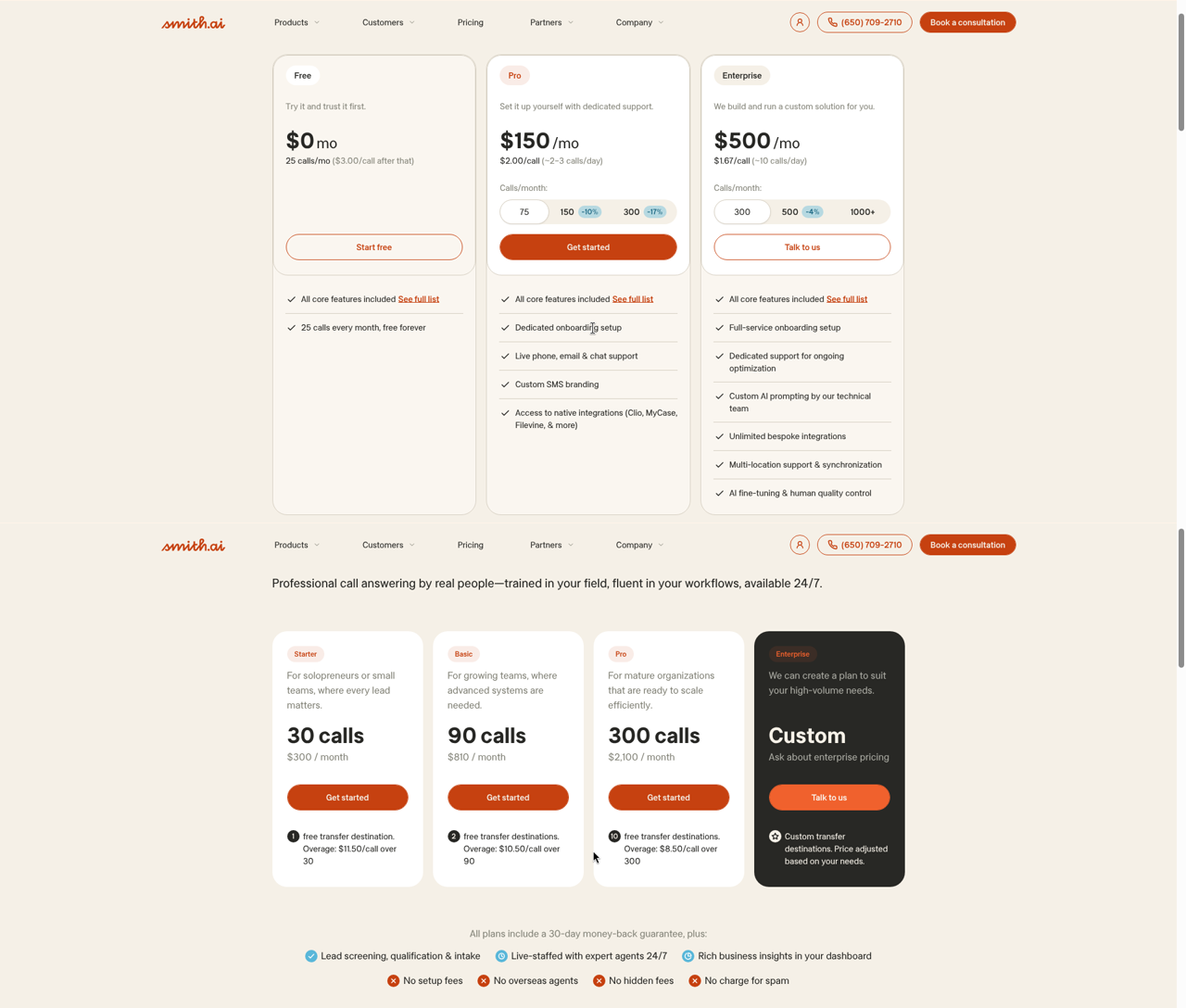
Smith.ai’s AI-only plans start free for 25 calls a month or $150 a month, with human-staffed receptionist plans from $300 a month for 30 calls, pricing verified September 26, 2026 (dated screenshot). The hybrid model is the differentiator: the AI answers, and when a call exceeds its lane — a distressed break-in victim, a commercial client with a five-part master-key question, a caller who insists on a person — a live North America-based receptionist takes over. For the commercial end of the trade, where a botched intake costs a contract rather than a ticket, that human floor is worth the premium. The pricing shape is the catch: per-call billing at the human tiers is the most expensive per-unit model on this list (overages run $8.50–$11.50 per call depending on tier), and a mobile locksmith’s night volume — short, spiky, heavy on junk — burns through call blocks fast. A busy Saturday can cost more than a month of flat-rate plans.
Pricing for Smith.ai as captured on September 25, 2026. This screenshot is retaken every Friday at 9:00 AM ET and replaced whether the price has changed or not.
9. Synthflow
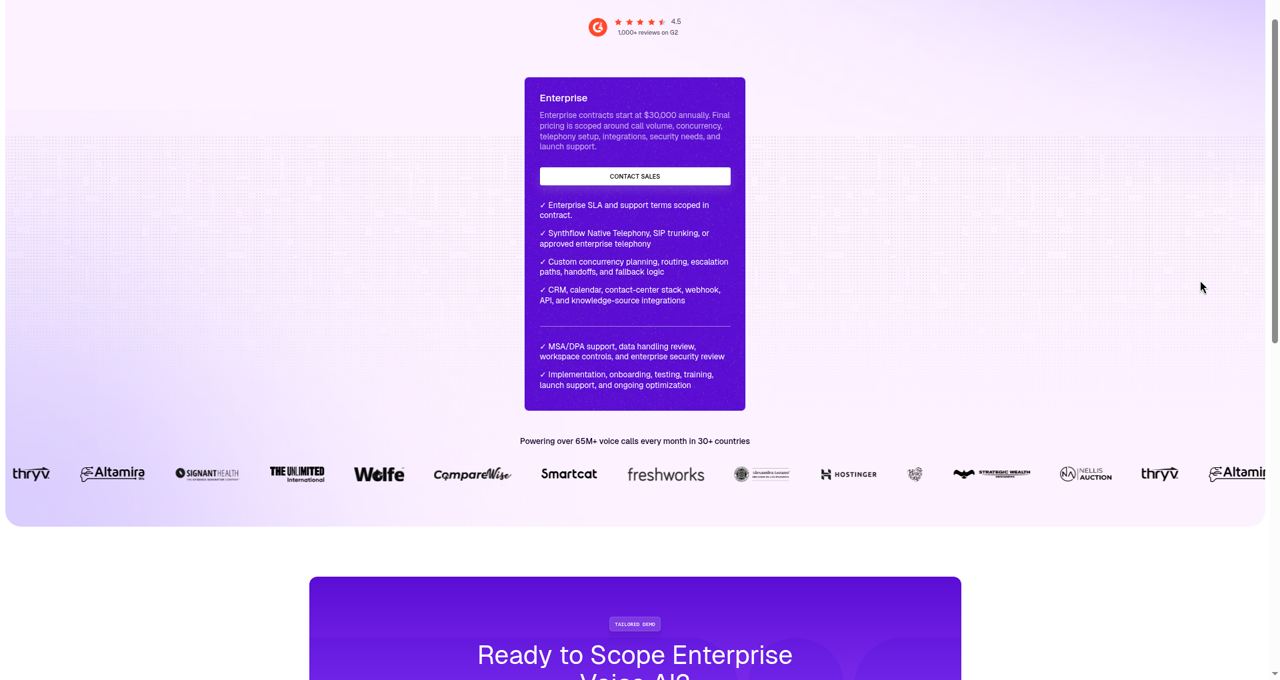
Synthflow’s entry is roughly $30,000 a year, pricing verified September 26, 2026 (dated screenshot). That number ends the conversation for most locksmith shops, and it’s supposed to — Synthflow sells a platform for building and reselling voice agents at portfolio scale, with the telephony, compliance, and white-label plumbing an agency or franchise group needs. If you’re standing up standardized intake and dispatch for forty franchise vans, the economics can pencil. If you’re a two-truck shop trying to catch your own 2 AM lockouts, this is a forklift at a bicycle race, and the per-unit economics improve only at volumes no single shop generates.
Pricing for Synthflow as captured on September 25, 2026. This screenshot is retaken every Friday at 9:00 AM ET and replaced whether the price has changed or not.
10. Upfirst
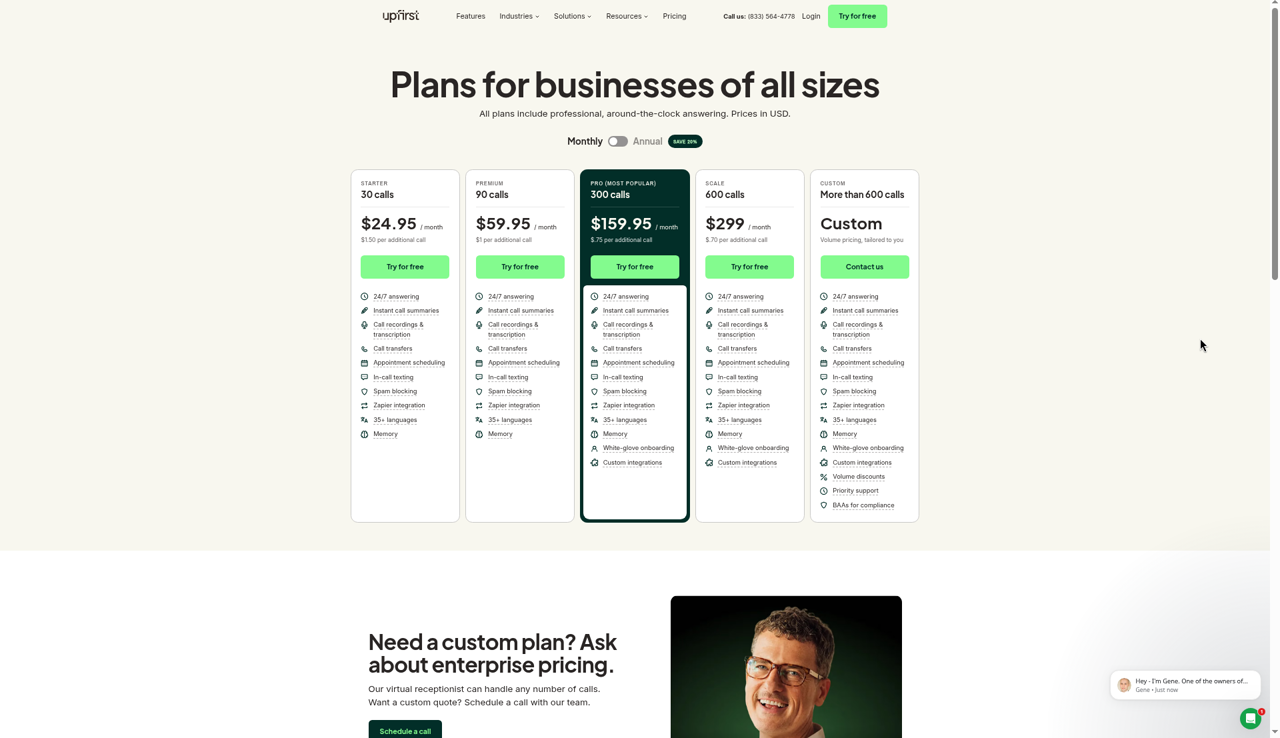
Upfirst starts at $24.95 a month for 30 calls, pricing verified September 26, 2026 (dated screenshot), and it earns a point this vertical will feel in the wallet: spam calls and calls under fifteen seconds don’t bill. Locksmith lines attract junk — robocalls, scam-dialers probing the same map pack you compete in, wrong numbers — and along with AgentZap’s automatic spam filtering, Upfirst is one of the few options here that explicitly doesn’t charge you for it. Setup is fast and self-serve, the agent takes clean messages and answers the standard questions, and the per-call blocks make costs predictable at light volume. The limits are the entry-tier usuals: transfer depth is limited, integrations are basic, and per-call overages apply past your block — a shop that grows into heavy night volume will outgrow the pricing shape as well as the feature set.
Pricing for Upfirst as captured on September 25, 2026. This screenshot is retaken every Friday at 9:00 AM ET and replaced whether the price has changed or not.
Try it on your own line tonight
Locksmith owners don’t do six-week evaluations — this vertical buys the night it misses a job. So here’s the honest test protocol, whichever platform you shortlist: sign up, forward your line after a set number of rings, and place three test calls from a phone the system doesn’t know. A parking-garage car lockout with a transponder key. A calm rekey quote. Something deliberately weird — a safe job with no address. Check whether it answers on the second ring as configured, whether the address and vehicle fields reach you as a structured dispatch, and then decide.
Start with Futuro AI’s 7-day free access
$200/month flat after the trial, unlimited calls, configured to answer on the second ring, with dispatch intake configured for your rate card and your verification policy. Managed setup runs 24–48 hours — tell them you’re a locksmith and the lockout script above is the starting template.
If you want the zero-dollar version of the same test, OnCallClerk’s free plan and Smith.ai’s 25-call free tier both answer a real number without a card. Whatever you choose, the cheapest step is the same one: call your own shop at 9 PM tonight and listen to what your customers have been hearing.
Which one for your shop: three locksmith profiles
The mobile-only operator. One van, no storefront, the owner asleep when the phone rings. Your callers are nearly all first-timers in a hurry, the address is the job, and every answered call either dispatches or dies. Prioritize answer speed and dispatch intake above everything. If your mix skews to car lockouts, AgentZap’s native vehicle intake justifies its setup fee. If you want flat-rate certainty with the triage and verification scripting done for you, Futuro AI is the lane. If tonight is the deadline and the budget is the constraint, Upfirst or Dialzara gets the phone answered before midnight — just know the transfer ceiling you’re buying.
The storefront shop. A counter, key blanks on the wall, regulars who buy rekeys and deadbolts, and night calls that skew toward questions and next-day bookings. Your economics favor per-customer billing and message quality over dispatch depth. Goodcall’s per-customer model fits the repeat-callers book; Rosie covers the message-first end for less. If the storefront also fields emergency calls you actually roll for, you’re really a hybrid — grade yourself against the mobile-only criteria instead.
The commercial-security operator. Master-key systems, property-management contracts, safe work, access control. Your intake carries liability, your tickets are quoted not dispatched, and a botched call costs a contract. Smith.ai’s human-behind-the-AI hybrid earns its per-call premium here. Futuro AI’s verification scripting and caller memory (the property manager who phones twice a month gets recognized) fit the contract-relationship end. And if you’re a multi-location group standardizing intake across dozens of lines, Synthflow’s platform economics start to make sense.
The math: what an unanswered phone costs a locksmith
Run your own numbers, but here’s the shape with the pinned industry data. Say your shop gets 200 inbound calls a month — a modest volume for a working mobile locksmith, weekends included. At the 34% median miss rate, 68 of those calls reach voicemail — and only about 12% of missed callers ever call back, which means roughly 60 of those callers are simply gone. Apply the vertical’s own filters conservatively: if even one in five of those lost callers was a real job (the rest are price-shoppers, vendors, and junk), that’s about 12 lost jobs a month. At $185 in direct revenue per missed emergency job, that’s roughly $2,200 a month — and the after-hours skew (39% of calls, with 42% of emergency lockouts landing between 6 PM and 6 AM) means most of those losses happen when you’re off the clock.
Now the comparison a locksmith actually makes. You can buy the calls back: Local Services Ads convert at about a 55% booked rate at $32–$34 a lead, so reacquiring 12 booked jobs means buying roughly 22 leads — about $700–$750, every month, forever, to reach callers who tried to call you first. Aggregator marketplaces are worse: roughly a quarter to a third of the ticket, which on a $200 lockout is $50–$67 per job. Or you can answer the phone you already have: $24.95 to $200 a month across the credible options above. Futuro AI’s $200 flat plan is the highest small-business entry price on the list (Synthflow’s enterprise platform costs more, but it isn’t aimed at single shops), and the honest breakeven is about one captured emergency job: $185 in direct revenue against the $200 month, before labor, travel, or materials. One job roughly covers it; from the second captured job on, you’re ahead — margin you used to donate to voicemail.
Two finer points for the spreadsheet. First, deposits and ETAs: whichever platform you choose, configure the intake to state your deposit and ETA policy clearly — an answered call that sends a tech to an empty curb is still a loss, and a caller who knows the terms up front shows up. Second, the human alternative: a Bureau of Labor Statistics median receptionist runs about $38,010 a year before taxes, benefits, and the awkward fact that she sleeps — and traditional answering services charge per minute with night premiums. None of the ten AI platforms here charges extra for the hours when locksmithing actually happens.
Methodology and sources
How we built this article. We defined an AI receptionist for locksmiths as software that answers a shop’s existing phone line — via conditional call forwarding or direct provisioning — and handles the vertical’s actual call mix: emergency lockouts, rekeys, replacements, safe work, and commercial quotes. The lineup was locked on October 1, 2026 against our vendor pricing index: ten vendors with live, first-party pricing pages we could read and document on lock day.
How we verified pricing. Every price in this article was read from the vendor’s own live pricing page on September 26, 2026, with AgentZap and OnCallClerk re-verified on October 1, 2026 (OnCallClerk’s page restructured between checks; we cite the current structure). Every vendor listed has the pricing provided on their website documented via screenshot. A new screenshot is uploaded every Friday at 9:00 AM ET, regardless of a pricing change or not, to ensure accuracy. This is done weekly regardless of the article’s age or popularity. Each vendor profile above links its dated screenshot; the same screenshots power our public index.
How we graded. The eight-criterion rubric in How we evaluated weights locksmith-specific behavior (answer speed, dispatch intake, verification support, night pricing) over generic feature counts. Rubric weights sum to 100 and are published as machine-readable data in this page’s grading dataset.
How we handle conflicts. Futuro AI is our product, it’s profiled fourth alphabetically, and it’s graded against the same rubric as everyone else. Our disclosure is at the top of this article and repeated here: we have an obvious interest in our own profile, which is why every claim in it is either verifiable on a linked page or labeled with its limits — including the study framing on our voice-realism number.
How we treat statistics. Every statistic carries its source and date, and where a source is secondary we say so. Two cautions specific to this vertical: the licensing map changes mid-year (Florida’s preemption took effect July 1, 2025; New York City’s transition runs through 2027), so verify your own state before acting on the licensing section; and after-hours call-share figures vary by how vendors define “business hours,” which is why we cite the 67% figure with its source rather than blending it with other studies. The scam-locksmith section cites state regulator publications with their dates and offices; we name no companies because the structural pattern — not any one operator — is the point.
Corrections. Pricing changes, features ship, licenses sunset, and screenshots age. If something here is wrong, our corrections policy explains how we fix it and how fast.
Pricing sources, by vendor
First-party pricing pages as read on September 26 – October 1, 2026:
- AgentZap — agentzap.ai pricing page (re-verified October 1, 2026)
- Bland AI — bland.ai pricing page
- Dialzara — dialzara.com pricing page
- Futuro AI — futurocorp.com/pricing
- Goodcall — goodcall.com pricing page
- OnCallClerk — oncallclerk.com pricing page (re-verified October 1, 2026)
- Rosie — rosie.ai pricing page
- Smith.ai — smith.ai pricing page
- Synthflow — synthflow.ai pricing page
- Upfirst — upfirst.ai pricing page
Full statistics sourcing appears in Sources cited at the end of this article.