
About this guide: Platforms are listed alphabetically (AnswerForce, Dialzara, Futuro AI, Goodcall, Rosie, Sameday, Slingshot, Smith.ai), not ranked, and there is no overall winner: a one-truck owner-operator and a multi-tech shop on FieldRoutes are buying different things. Each entry evaluates the same pest-control jobs, states one honest trade-off, and gives pricing where it is publicly available, with its screenshot on our vendor pricing index. Futuro AI is one of the eight.
Who this guide is for: Pest control operators who answer their own phone — or who have watched that phone fail in swarm season — and who need a clear way to evaluate an AI receptionist against the work their office actually does. It is written for the residential and light-commercial shop: quarterly plans, reservice windows, and the after-hours sighting call. It is not a buying guide for a national roll-up already running a staffed call center, and it is not a recommendation to buy anything if a handful of inquiry calls a month is all you have.
How we keep pricing current: Futuro AI checks the pricing of every vendor in this article each week. If a vendor’s price or plan changes, its pricing screenshot is automatically replaced, so the image always shows the current pricing. We only publish pricing shown on the vendor’s own website or, secondarily, on G2 or Capterra. We don’t use any other source. Weekly pricing and screenshots for more than 100 vendors are on our AI receptionist pricing index.
How did we evaluate each platform?
Every platform was scored against the same six-criterion rubric, weighted by what decides a pest control company’s peak weeks. Scores reflect public information, vendor documentation, and pricing re-checked against the index screenshots as of November 15, 2026. Weights were fixed before any entry was written and sum to 100. Where a platform could not be verified against a criterion, we say so plainly in its entry rather than give it the benefit of a marketing headline.
| Criterion | Weight | What we looked for |
|---|---|---|
| Panic-call triage | 25% | Whether the vendor documents urgency rules that can escalate a stinging-insect or after-hours sighting call, rather than taking a message and waiting. |
| Identification intake | 15% | Whether intake questions can capture what the caller saw, where, and for how long, without the system claiming to diagnose the pest. |
| Quote guardrails | 15% | Whether prices come only from a configured rate card, with off-card requests routed to the operator, instead of invented estimates. |
| Reservice and plan handling | 20% | Whether reservice and quarterly-plan calls can be grounded in the operator’s own contract terms and booked as recurring work, including into field-service software. |
| Surge-price predictability | 15% | What the bill does in a peak month: a flat rate, published tiers with overage, per-call metering, or quote-only pricing. |
| Pest-specific documentation | 10% | Whether the vendor publishes a pest-control page, trained-agent claim, or industry script, versus general home-services copy only. |
Platforms are not ranked by total score: a one-truck operator and a multi-location brand have different winners. Entries below are listed alphabetically, A to Z, and each opens with who it is genuinely best for, including when that is not us.
This is an alphabetical, unranked comparison against the rubric above. Each entry opens with who the platform is best for, states one honest trade-off, and carries a price verification against the public index, November 15, 2026.
A pest control company’s phone is not a generic trades line. Evaluating an AI receptionist for this work means asking whether it can do the jobs that actually come in: triage a panic or stinging-insect call, take a “what do I have?” intake without diagnosing, quote only from your rate card, handle a reservice call under your guarantee and book a quarterly plan — including into the field-service software your techs already use — and keep the bill predictable when volume jumps. A “24/7 answering” headline is not evidence that any of those jobs will be done well.
Which platforms fit at a glance?
Use this as a shortlist, then read the entry. On a phone, scroll the table sideways inside its frame; the rest of the page stays put.
| Platform | Best for | Standout attributes | Pricing |
|---|---|---|---|
| AnswerForce | Established companies that want a human on every call | 24/7 live receptionists and bilingual answering; pest scripts are custom-built | No public price; AnswerForce sells quote-only human answering. |
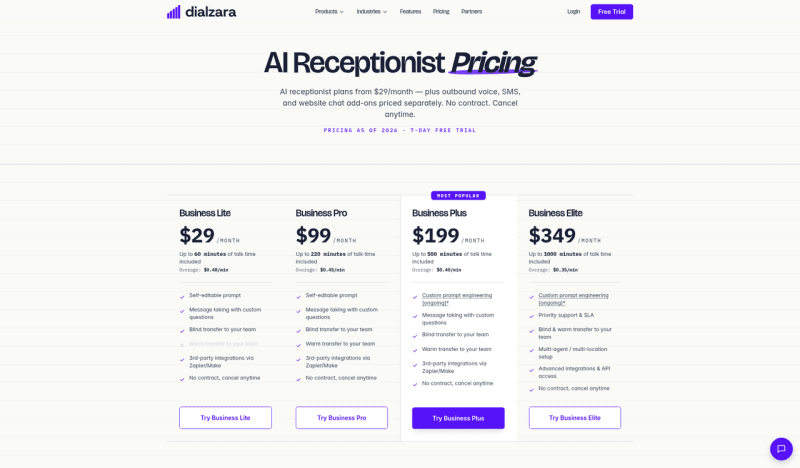
| Dialzara | Owner-operators watching the entry price and minute overages | A dedicated pest-control page; self-serve agent built from your material | Business Lite is $29 per month for 60 minutes, with published tiers up to $349. |
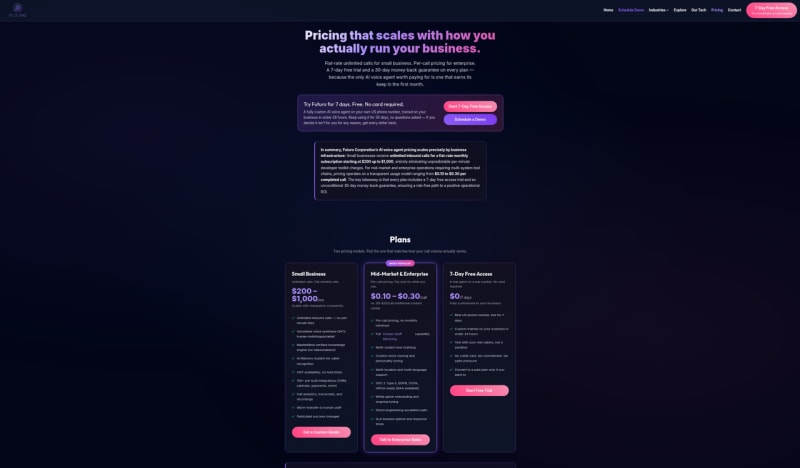
| Futuro AI | Shops that want a calm voice and a flat bill through swarm season | Rate-card quotes and contract-term grounding on a flat monthly plan | $200 per month flat, for unlimited inbound calls. |
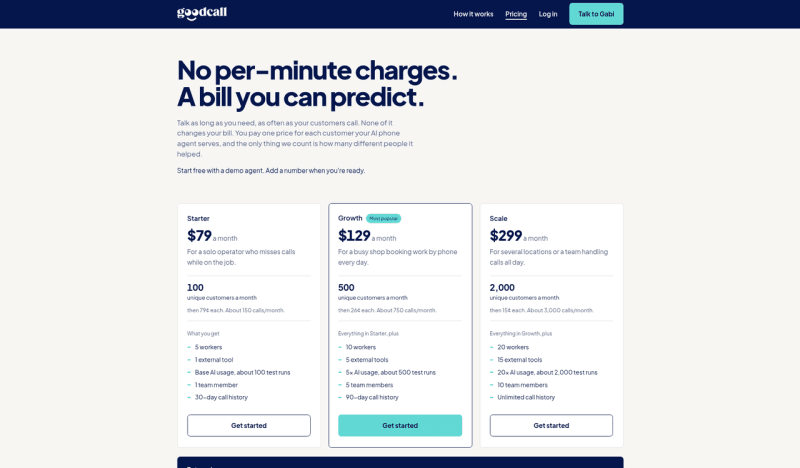
| Goodcall | Operators who will write their own prompt and like unique-customer billing | Repeat customers count once; no pest template in the library | Starter is $79 per month for 100 unique customers, with published tiers up to $299. |
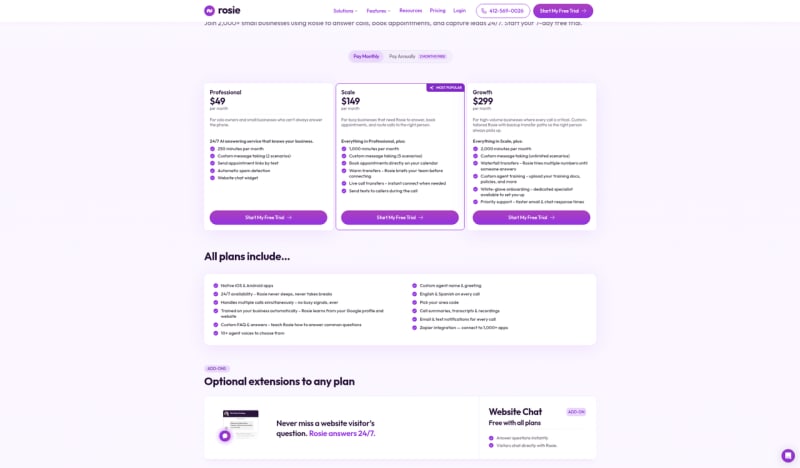
| Rosie | Solo operators who want pest-aware message-taking now, with a path to booking | Bilingual English/Spanish answering; booking starts on a higher tier | Professional is $49 per month for 250 minutes; Scale is $149 and Growth is $299. |
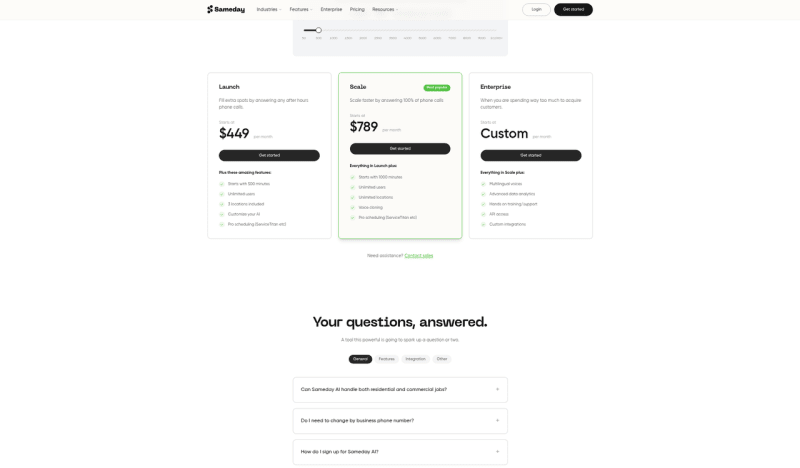
| Sameday | Multi-tech shops already on FieldRoutes or ServiceTitan | Urgency assessment marketed for pest work; books into field-service software | Launch is from $449 per month; Scale is from $789 per month. |
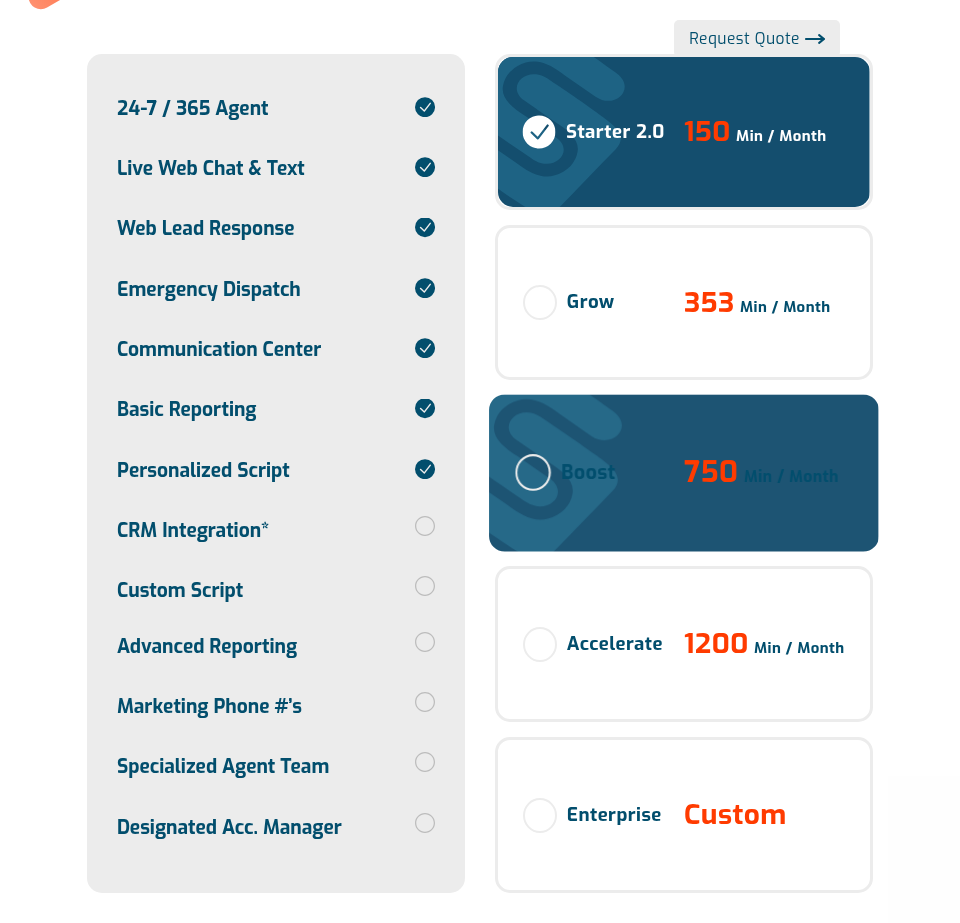
| Slingshot | Established pest companies that want trained humans, not AI | Pest-trained human agents who answer, sell, and schedule | quote-only; plans from 150 to 1,200 minutes a month. |
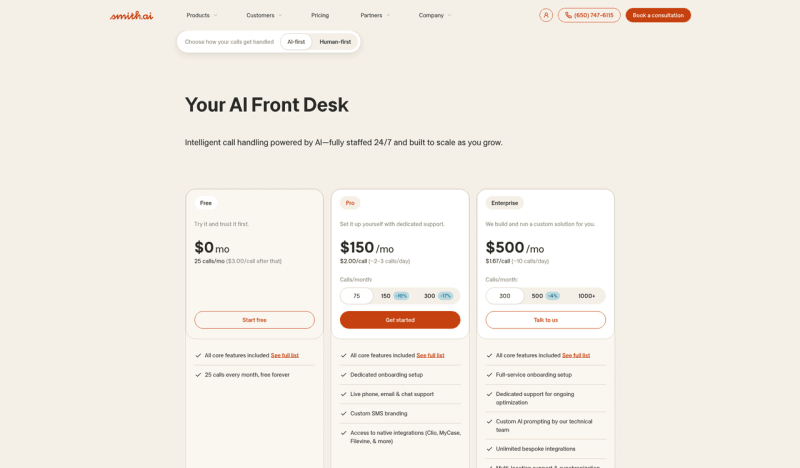
| Smith.ai | Operators who want AI with a human safety net, and a free way to trial it | AI with live escalation; a vendor-published pest triage example | The AI free tier is $0 for 25 calls a month; Pro is from $150 per month. |
Which AI receptionists did we compare for pest control?
Each entry below is an evaluation, not a product summary. The same six jobs — panic-call triage, identification intake, quote guardrails, reservice and plan booking (including into field-service software), surge-price predictability, and pest-specific documentation — are what we asked of every vendor. If a job is not documented, we say so. “Advertised” means the vendor claims it; “documented” means we could see how it would actually be configured or billed.
AnswerForce
Best for: established companies that want a human voice on every call — and have the budget and patience for quote-based, per-minute human answering.
AnswerForce is the live-human archetype in this lineup: 24/7 receptionists, bilingual answering, and scripts built with their onboarding team rather than pulled from a template. For a pest-control operator, that is both the appeal and the work. There is no pest-control page on their site — the closest coverage is home services generally — so the jobs this guide cares about (the stinging-insect escalation rule, the identification questions, the reservice script) are only as good as the custom script you write with them. Treat that build as part of the purchase, not a free extra.
On a panic call, a trained human can escalate when a caller mentions an allergy, if you have approved that rule in writing and confirmed agents will follow it. That is a stronger position than an unconfigured AI, and a weaker one than a pest-trained team whose default already knows the difference. Identification intake can be scripted the same way: what did you see, where, for how long — without anyone on the line pretending to diagnose the pest. Quote guardrails are not documented as a product feature; if you want prices only from your rate card, that has to be in the script. Reservice and dispatch are advertised as message-taking and dispatch, which can work, but booking a quarterly plan into FieldRoutes or ServiceTitan is not a documented native integration here.
The bill is the other half of the evaluation. Pricing is quote-only: the path on their site routes to a contact flow, which is typical for human answering services. Swarm-season minutes will move a per-minute invoice. Bring three questions to the sales call: what a single-truck pest company your size typically pays monthly, how after-hours surge minutes are billed, and whether agents will follow a stinging-insect escalation script you approve in writing.
The trade-off: the most human option here and the least price-transparent — you will not know the real monthly number until a sales call, and swarm season moves it.
No public price: AnswerForce sells quote-only human answering. Pricing page checked November 15, 2026 — screenshot of the vendor’s request-a-plan page on our public index.

Dialzara
Best for: the budget-conscious owner-operator who wants AI answering at the lowest published entry price — and will watch minute overages during swarm season.
Dialzara is one of the few vendors here with a dedicated pest-control page, and its headline is built around the rat-in-the-kitchen moment this evaluation starts from. You build the agent from your own material: services, service area, pricing answers, escalation rules. That is the right shape for this vertical, because the panic-call rule, the identification questions, and the quote guardrails will be yours. It also means they are only as good as the configuration you actually finish and test. A pest page is documentation of intent, not a finished urgency tree.
Panic-call triage is advertised as configurable call flows: you can write the stinging-insect-plus-allergy escalation, and you should run Test 1 below before you trust it. Identification intake is advertised as custom questions — what, where, how long — which is exactly what that job needs, provided the agent is told not to diagnose. Quote answers can come from a knowledge base you supply; off-card requests still need an explicit handoff rule. Reservice and recurring-plan handling are not documented as a product capability, and booking into FieldRoutes or ServiceTitan is not a claimed native integration. If quarterly-plan intake and guarantee windows are central to how you make money, prove them on a demo or look at a vendor that documents them.
Pricing is the lowest published entry in the lineup, matching the screenshot on our index: $29 a month for 60 minutes (Business Lite), $99 for 220 (Pro), $199 for 500 (Plus), $349 for 1,000 (Elite), with per-minute overage of $0.48 on Lite falling to $0.35 on Elite. The meter is the catch for pest work. A panicked homeowner describing a sound in the walls is not a 90-second call, and a June invoice will not look like a January one. Run the surge test with your real April call log before committing.
The trade-off: the cheapest way to answer every call — billed by the minute in a vertical where the calls that matter most run longest.
Pricing verified November 15, 2026 — screenshot on our public index.
Futuro AI
Best for: pest operators who want the panic call answered by an AI that sounds remarkably human, with quotes taken only from their own rate card, and a flat monthly bill that does not move in swarm season.
The case for Futuro AI comes down to how the panic call should feel, and how the bill should behave when those calls multiply. The agent is configured at onboarding, not from a pre-packaged pest template: urgency rules (including a stinging-insect escalation you approve), diagnostic intake that is told never to diagnose, and quotes taken only from your configured rate card, with everything off-card routed to you. MasterMind grounds reservice answers in your contract terms, which is the job that protects a quarterly plan when a customer calls to say the ants are back. Whether that justifies $200 a month flat, with unlimited inbound calls, is the question when several options here start lower.
The voice evidence is a company-run, double-blind study in which 94% of 1,000 participants believed they were speaking with a person rather than AI (study details and caveats). For a caller who just found a rat, that matters because the first job is to keep them on the line. Call the agent at (727) 677-9566, or start the seven-day free trial, backed by a 30-day money-back guarantee.
On booking into field-service software, a deep integration is typically about five days, not an afternoon; the standard configuration is 24–48 hours. This guide does not treat Futuro as the FieldRoutes- or ServiceTitan-native option — that is Sameday’s documented ground. On surge pricing, the $200 flat rate with unlimited inbound calls is the point of the plan: the June bill is the January bill. Pest-specific documentation is the configuration done at onboarding, not a public pest-industry marketing page.
The trade-off: a higher price than self-serve options, and a custom build (24–48 hours standard, about five days for a deep integration).
Pricing verified November 15, 2026 — screenshot on our public index.
Goodcall
Best for: the operator who wants to write his own agent prompt, mostly needs intake and message capture, and likes that repeat customers only count once.
Goodcall is the bring-your-own-prompt option. There is no pest-control template in its library, which is an honest limitation and a useful one: your stinging-insect escalation rule, your identification questions, and your quote guardrails will be exactly as good as the prompt you write and the tests you run. For a pest-control evaluation, that means you should not take “custom agent prompts” as evidence that the panic call, the “what do I have?” call, or the rate-card boundary will work on day one. Run the identification and quote tests before you trust it with a live line.
What is documented, and what genuinely fits this vertical, is the meter. Pricing, matching the screenshot on our index, is $79 a month for 100 unique customers (Starter), $129 for 500 (Growth), $299 for 2,000 (Scale), with additional unique customers at 79¢ each on Starter. A quarterly-plan customer who calls four times in a month — once to book, once to confirm, once about a sighting, once about reservice — counts once, not four times. In a subscription trade, that is the fairest published meter in this lineup. What is not documented is booking depth, reservice handling against your guarantee language, and any pest-specific triage behavior. Booking into FieldRoutes or ServiceTitan is not a documented native integration. Assume smart intake and message-taking unless a demo proves more.
The trade-off: the fairest billing meter in the lineup for a repeat-customer business — with everything above intake left to your own prompt-writing.
Pricing verified November 15, 2026 — screenshot on our public index.
Rosie
Best for: the solo operator who wants the cheapest pest-aware answering for message capture now, with a clear upgrade path to booking later.
Rosie keeps a live pest-control page and covers the basics well: 24/7 answering, instant notifications, spam filtering, and bilingual English/Spanish answering on every plan. That last point matters more in this vertical than in most, because in much of the Sun Belt the panicked caller may be more comfortable describing what they just saw in Spanish. A pest-industry page is a real piece of documentation — it is why Rosie scores on the sixth criterion — but a page is not a tested urgency tree. Panic-call triage is advertised as 24/7 answering, not as a documented stinging-insect escalation rule. Identification intake is not documented. Quote guardrails are not documented. Treat those three jobs as things to prove on a demo, with your own script, before you point a live line at the product.
Booking is the upgrade path: the vendor’s published plans put message-taking on the Professional tier and add booking and transfers on Scale. That is an honest ladder for a solo operator who needs the phone answered now and wants to grow into scheduling. Booking into FieldRoutes or ServiceTitan is not a highlighted native claim in the materials this guide used; if that integration is decisive, ask for it on the demo and compare it to Sameday. Reservice under your guarantee is advertised only insofar as booking exists on the higher tier — it is not documented as contract-term grounding.
The plan structure, matching the screenshot on our index, is Professional at $49 a month (250 minutes), Scale at $149 (1,000 minutes), and Growth at $299 (2,000 minutes). Minute caps apply on every tier, so the surge test is not optional: a busy April can consume a 250-minute bucket. Run last year’s peak month against those caps before you pick a plan.
The trade-off: a low pest-aware entry price, with booking documented on a higher tier and minutes capped on every plan.
Pricing verified November 15, 2026 — screenshot on our public index.
Sameday
Best for: multi-tech shops already running FieldRoutes or ServiceTitan that want AI answering wired directly into the system their office lives in.
Sameday sells to pest control specifically, and its pest page markets the two capabilities this vertical actually runs on — urgency assessment and seasonal-trend recognition — plus direct booking into field-service software, with FieldRoutes and ServiceTitan among its named integrations. For the evaluation this guide is built around, that last claim is the one that changes the shortlist. If the job is “the receptionist books the quarterly plan and the reservice visit into the system the techs already open every morning,” Sameday is the option that documents it. The page also carries a customer story from Rove Pest Control; treat results quoted there as a vendor-published case study, not an independent measurement.
Panic-call triage is advertised as urgency assessment. That is the right category; the question to bring to the demo is exactly how a stinging-insect call with an allergy mention is handled, and whether your escalation rule or theirs wins when they conflict. Identification intake is supported by the pest-industry page and by advertised pest-aware questioning, but you should still run Test 2 with your own “what do I have?” script. Quote capture is advertised; confirm that captured quotes are taken from your rate card, not invented. Reservice and recurring work are the integration story: booked into the field-service system rather than left as a message.
Pricing, as confirmed on the vendor-pricing card, is Launch from $449 a month and Scale from $789 a month, with Enterprise custom — the steepest published entry in this lineup, with minute caps on the published tiers. The bill is predictable only inside those caps; a surge month can still push you into a higher tier or a conversation about overage. The price assumes an operation where one saved commercial account, or a week of booked quarterly plans, can pay for the quarter.
The trade-off: the deepest field-service integration here, at an entry price that assumes you’re already running multiple trucks.
Pricing verified November 15, 2026 — screenshot on our public index.
Slingshot
Best for: established pest companies that want trained humans — not AI — answering and selling, and will trade a longer onboarding for it.
Slingshot is the pest-industry specialist in this lineup, and it is not an AI receptionist. Its page is written for pest management professionals, and the product is pest-trained human agents: people who can tell a termite-swarm call from an ant-trail call because pest is the industry they serve, answering, selling, and scheduling on your behalf. For the evaluation this guide asks you to run, that specialization is the entire case. Panic-call triage and identification intake are what a pest-trained human is hired to do. Quote guardrails are not documented as a formal rate-card feature; you would still confirm, on a sales call, that agents quote only your prices. Reservice, selling, and scheduling are advertised as the job they are trained for. Booking into a specific field-service platform should be confirmed for your stack, not assumed.
Pricing is quote-only; plans from 150 to 1,200 minutes a month. Every plan on the vendor’s pricing page is Request Quote — this guide will not invent a dollar figure. Budget for a sales call and a two-to-three-week onboarding before the first live call. The plans are sized by minutes, so the bill will still move in swarm season. You’re paying for the humans, and what you’re buying is conversion skill on the calls an AI might fumble.
The trade-off: the only pest-trained human team here — with quote-only pricing, plans sized by minutes, and a multi-week runway before go-live.
No public dollar price: Slingshot is quote-only; plans from 150 to 1,200 minutes a month. Pricing verified November 15, 2026 — screenshot of the vendor’s request-a-quote page on our public index.
Smith.ai
Best for: the operator who wants AI pricing with a human safety net — and a free tier to test the fit before spending a dollar.
Smith.ai pairs AI answering with human escalation, and its pest-control content shows the right instincts. One vendor-published example: “Active termite swarms get emergency priority. Single ant sighting books next week.” That is exactly the triage-tree thinking this vertical needs, and it is why Smith.ai belongs on a pest-control shortlist. It is also a vendor-published example, not a measurement of how the product behaved on your line last April. Configure the rule, then run Test 1 and Test 2.
Panic-call triage is advertised as AI with live human escalation — the safety net is the product. Identification intake is advertised as custom intake. Quote guardrails are advertised as guardrailed responses; confirm they are your rates. Booking and payment collection are advertised, which covers quarterly-plan intake better than a message-only tool; native booking into FieldRoutes or ServiceTitan should still be confirmed for your shop. The free tier is genuinely useful as a test harness: point your line at it for two weeks of real calls — eventually including a panicked one — and read the transcripts before upgrading.
The AI plans, matching the screenshot on our index, are free for 25 calls a month (then $3.00 per call), Pro from $150 a month for 75 calls ($2.00 per call after), and Enterprise from $500 a month for 300 calls, with human-staffed plans from $300 a month for 30 calls. Watch the per-call math during swarm season: the Enterprise bucket is 300 calls, and a busy June can clear it. The meter scales against you in the same weeks the phone is most valuable, which is the evaluation you should run with last year’s peak log.
The trade-off: the easiest vendor here to trial for free — with per-call billing that scales against you exactly when call volume is best for business.
Pricing verified November 15, 2026 — screenshot on our public index.
What five tests should you run before you buy?
The entries above tell you what each vendor documents. These five tests tell you whether the product will do the work on your phones. They are the same jobs this guide used to evaluate every option, written so you can run them yourself. They are published under CC BY 4.0 and free to reuse. Use your own urgency rules, your own rate card, and last season’s call log. A brand-new route with a handful of inquiry calls a month may not need any of this yet.
Test 1 — the panic call: rat in the kitchen, 9:14 PM
Call after hours. Say you just saw a rat in the kitchen, you have a child in the house, and you want someone tonight. A passing answer keeps you on the line, captures the address, and either books a same-night or first-thing dispatch or escalates to a person — it does not take a message and promise a callback in the morning. Then run the same call with a wasp nest and an allergy mention. That second version must escalate every time. The CDC’s count of 788 sting deaths from 2011 through 2021, and the Merck Manual’s note that in an allergic person one sting can be fatal, are why this is a configuration test, not a feature you assume from a “24/7 emergency” headline.
Test 2 — the identification call: “what do I have?”
Describe a trail of small ants in the kitchen, then a swarm of winged insects at a windowsill in spring, then a scratching in the wall at night. A passing answer asks what you saw, where, and for how long, and books or routes the call — it does not diagnose the pest, and it does not treat a possible termite swarm as a routine ant visit. The National Pest Management Association’s estimate of $6.8 billion in annual termite property damage is the reason this distinction matters. You are testing intake, not entomology.
Test 3 — the quote question: “how much for quarterly service?”
Ask for a price on a quarterly plan, then ask for a price on something you do not offer. A passing answer quotes only a number from your rate card, and routes the off-card request to you. An invented estimate is a fail. Consumer-price guides such as Thumbtack’s published national range for exterminator work ($131–$341, with rodent work averaging $347 in the figures on that page) are useful context for what callers expect to hear; they are not your rate card. The receptionist should only ever speak your numbers.
Test 4 — the reservice call: “the ants are back”
Call as an existing quarterly customer. Say the ants are back two weeks after the last visit, and ask whether that is covered. A passing answer uses your guarantee window and your contract language, and books a reservice visit — into your field-service software if that is how the shop runs — rather than treating the caller as a new lead or leaving a message for the office. This is the call that protects lifetime value. If the vendor cannot do it, you will spend swarm season taking those calls yourself.
Test 5 — the surge test: price predictability at peak volume
Take last year’s busiest month — for most shops, spring ant and termite pressure, or the fall rodent influx — and run that call count and those call lengths against each vendor’s published meter. A passing plan is one whose invoice you can predict before the month starts. A flat unlimited rate passes by design. Per-minute, per-call, and capped-minute plans pass only if the peak-month math still makes sense. Quote-only plans cannot pass this test until you have a number in writing.
When is the honest alternative to skip a receptionist?
Not every pest-control shop should buy one of these. If you are a brand-new route with a handful of inquiry calls a month, and you already answer the phone yourself, an AI receptionist is a cost you can postpone. The evaluation this page describes is for shops that already lose work when the line is busy, after hours, or in the weeks the whole neighborhood calls at once. If you cannot point to a week like that in last year’s log, start by tracking the log for a season, then come back to the five tests. Buying a receptionist to solve a volume problem you have not measured is how shops end up paying for a tool they do not use.
The other honest skip is the shop that already has a staffed, pest-trained desk that answers and books. This guide is not an argument to replace a working human team. It is an evaluation of what to do when that team is you, after hours, or is no longer keeping up.
How did we research and verify this guide?
Every price in this guide was checked against the vendor’s public pricing page and against its screenshot on our vendor pricing index on November 15, 2026, and is re-checked weekly, with screenshots updated automatically every Friday at 9 AM ET. Product claims were taken from public vendor pages — including the pest-industry pages Dialzara, Rosie, Sameday, Slingshot, and Smith.ai publish — and from those screenshots. Where a capability is advertised but not documented (an urgency rule, a rate-card boundary, a FieldRoutes booking), the entry says so, and the five tests above are how a buyer should resolve the gap.
What this guide did not verify: we did not run a live, side-by-side call audit of all eight products on a real pest-control line, we did not independently measure close rates or customer-satisfaction scores, and we did not obtain a Slingshot or AnswerForce monthly price. Vendor-published case studies (including Sameday’s Rove Pest Control story and Smith.ai’s termite-versus-ant example) are identified as such and are not treated as independent measurements. Industry figures for sting deaths, termite damage, and consumer-price ranges are taken from the linked primary sources — the CDC, the NPMA, the ACAAI, the Merck Manual, and Thumbtack — and are used only to explain why the evaluation criteria exist, not as claims about any vendor’s performance.
What should a pest-control operator actually do next?
Pick two or three options from the at-a-glance table whose “best for” line matches how your shop actually runs. Run the five tests on each, with your urgency rules, your rate card, and last year’s peak-month call log. Keep the one that handles the panic call, the identification intake, the rate-card quote, and the reservice booking — and whose bill you can live with in June. If none of them pass the tests that matter to you, do not buy yet. The point of this guide is to give you a way to evaluate an AI receptionist for pest control, not to talk you into one.