

Pricing For Each Option
Pricing is verified at each vendor’s website on the date of this article: September 15, 2026. CloudTalk figures are the USD, annual-billing view of its pricing page; month-to-month billing on seats runs roughly 30% higher. This article is next scheduled for update in November 2026. Links to where pricing was obtained are listed in the citations section, and screenshots of the pricing pages are provided in the screenshots section below.
| Option | Pricing |
|---|---|
| CloudTalk Business Phone System | $25/user/mo (Starter) to $49/user/mo (Expert, 3-license minimum), billed annually; Custom tier for 10,000+ minutes |
| CloudTalk AI Receptionist (add-on) | From $99/mo (200 minutes); $199 (500 min), $299 (1,000 min), $699 (2,500 min); 50 minutes free the first month |
| CloudTalk AI Specialist (add-on) | From $349/mo (1,000 minutes); $749 (2,500 min), $1,249 (5,000 min) |
| CloudTalk extras (add-ons) | Branded caller ID from $0.07/call; power dialer included in Expert; parallel dialer and conversation intelligence as add-ons |
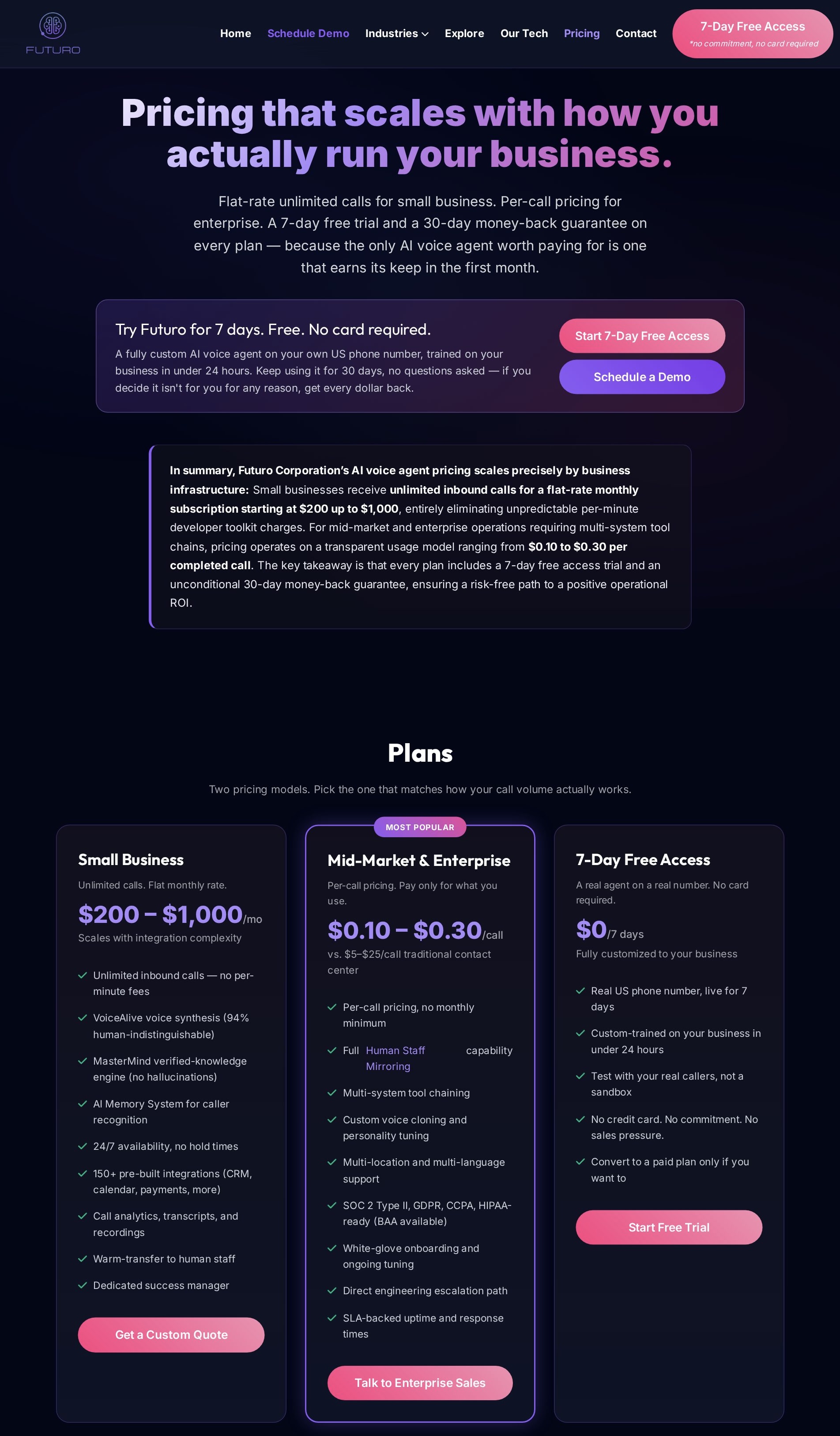
| Futuro (our product) | $200/mo flat, unlimited calls |
| Human baseline (context) | Customer service representative at the BLS median wage of $21.53/hr: ~$1,870/mo half-time, ~$3,730/mo full-time, before payroll taxes and benefits |
CloudTalk pricing page screenshot (USD, annual-billing view, captured September 15, 2026) is captured and pending CDN hosting; it will be added to this section at publish. The live source is cloudtalk.io/pricing.
Screenshots For Pricing Details
Click on each image to enlarge if needed. Screenshots are captured from each vendor’s live pricing page on the verification date and hosted on our own CDN.
Is CloudTalk the same kind of product as Futuro?
No, and getting this straight is worth more than any feature table in this article. Search “CloudTalk vs Futuro” or “CloudTalk AI voice agent” and the results treat the two as interchangeable alternatives. They are not. One product equips a team of humans to work the phones. The other answers the phone so a team is not required. The confusion costs buyers real money in both directions: the five-seat sales team that buys an answering service when it needed dialers, and the solo plumber who buys a seat-based phone system when the actual problem is that nobody is there to pick up.
What CloudTalk says it sells
Start with the vendor’s own words, because they are more precise than the comparison sites. CloudTalk’s homepage leads with: “Every call answered, 24/7. By your team, or by AI.” That sentence is the whole product strategy in nine words, and the order matters. “Your team” comes first because the team is the product’s center of gravity. On its reviews page, CloudTalk describes itself plainly: “CloudTalk is an AI-powered, cloud-based call center and business phone software for sales and support teams. It combines outbound dialing, inbound call handling, IVR, smart routing, call recording, analytics, and CRM integrations in one platform.” Read the nouns: dialing, routing, recording, analytics, integrations. That is equipment for humans who work the phones.
The AI side exists and is real. CloudTalk sells two AI voice agents alongside the seat plans: an AI Receptionist it describes as “24/7 front desk coverage for inbound calls. No queues. No missed calls. No phone trees,” and an AI Specialist it describes as “digital coworkers for end-to-end resolution” across support, sales, billing, and ops. But look at the pricing page structure: the AI agents are a second tab, metered by the minute, sitting next to the seat plans. The phone system is the house; the AI agents are rooms you can add. That is not a criticism. It is the correct way to understand what you are buying.
What Futuro sells
Futuro (our product) has no seats, no dialer, no agent dashboard, no IVR builder, and no international numbering, because it is not a phone system. It is a dedicated AI receptionist: it answers your business line with a voice callers take for a person, handles the call from your actual knowledge and policies, remembers the caller next time, and costs $200/mo flat regardless of volume. The design philosophy, Human Staff Mirroring, is that the AI should behave like your best staff member, not like a generic call flow. The voice quality claim behind it, 94% human indistinguishability in a 1,000-participant double-blind study, is published with its methodology at our study page.
The buyer profile is the inversion of CloudTalk’s: not a sales or support team that needs better tooling, but a business where the phone rings and nobody answers, because the owner is on a job site, in a consultation, or asleep. The distinction between mirroring and generic AI answering matters most in exactly that setting, where there is no team to catch what the AI gets wrong.
Why the comparison pages mix them up
Both companies bid on the phrase “AI voice agent,” so search engines file them together. The market context makes the blur worse. Gartner projects that conversational AI deployments will reduce contact-center agent labor costs by $80 billion in 2026, a headline number that pulls every phone vendor toward AI language. The same research carries the detail that rarely makes the headline: Gartner expects only about one in ten agent interactions to be automated by 2026, up from an estimated 1.6 percent. As CX Today’s coverage of the projection put it, automating entire conversations “in a customer-friendly manner is still tricky.” Nine of ten interactions still involve a human in Gartner’s model, which is precisely why team software and answering software are different categories: one optimizes the nine, the other covers the calls no human was ever going to take.
Which problem are you actually solving?
Before pricing, before features, before demos, answer one question honestly: when your business phone rings right now, is there a person whose job includes picking it up? Everything in this comparison hangs on that answer, so we built the shortest possible version of it.
The one-screen diagnostic
| Your situation | Your actual problem | The right category |
|---|---|---|
| You employ people who spend their day on the phone, and you want them faster, better measured, and better routed | Tooling and infrastructure for a human team | Contact-center software (CloudTalk’s category) |
| Calls arrive while you are working, with a customer, or closed, and they ring out to voicemail | Nobody answers at all | Dedicated AI receptionist (Futuro’s category) |
| You have a small team that covers business hours, but evenings, weekends, and overflow ring out | Coverage gaps around a human team | Both: seats plus an answering layer (or CloudTalk’s metered AI add-on) |
If you landed on row one, the rest of this article will keep confirming CloudTalk. Row two points at Futuro. Row three is the genuinely interesting case, and it gets its own section below.
If your humans need phone software
A team that answers phones all day needs things an AI receptionist does not sell: seats, extensions, ring groups, queues with callback, call recording with live monitoring, whisper and barge for coaching, click-to-call from the CRM, dialers for outbound, wallboards for the manager, and numbers in the countries your customers live in. That shopping list is the definition of contact-center software, and it is the list CloudTalk was built against. The Bureau of Labor Statistics counts roughly 2.6 million Americans employed as customer service representatives; the software industry exists to make each of those seats more productive, and CloudTalk is a credible member of it.
AI helps this buyer too, but as assistance, not replacement. The strongest evidence is the NBER working paper “Generative AI at Work” (Brynjolfsson, Li, and Raymond), which tracked 5,179 customer support agents at a Fortune 500 software company and found that access to an AI assistant raised issues resolved per hour by about 14%, with the gains concentrated among newer agents. The NBER’s own digest captures the finding cleanly: “An agent using the AI tool who had just two months’ tenure at the firm performed as well as an agent with six months’ tenure working without the tool.” Note what that study measured: software making seated humans better. It is an argument for AI-assisted teams, not for removing the answerer. Stanford’s SIEPR summary and the paper’s DOI record carry the same abstract for anyone who wants the primary source.
If the phone rings and nobody is there
The second buyer has a simpler problem with no seat-based solution: the calls that arrive while the crew is on a roof, the stylist is mid-foil, the estimator is under a house. You cannot fix that with better agent analytics, because there are no agents. Hiring is the classic answer and the economics are public: the BLS puts the median customer service representative at $21.53 an hour as of May 2025, which prices even half-time human coverage near $1,870 a month before payroll taxes, benefits, training, and the fact that one person still cannot answer two calls at once. BLS also projects employment in the occupation to decline 5 percent from 2025 to 2035 even as it expects about 289,500 openings a year from turnover, which tells you the labor market for this role is churning, not growing. The dedicated-AI-receptionist category exists for this buyer, and it is the category Futuro (our product) is built for.
Who is CloudTalk for?
CloudTalk is for businesses with humans on phones, full stop. The stronger the team, the more the product makes sense. We are going to make the affirmative case here, because an honest comparison that cannot state the competitor’s strengths is marketing, not analysis.
Sales and support teams of five or more
CloudTalk’s center of mass is the SMB-to-midmarket sales or support team. The seat plans on its pricing page (verified September 15, 2026, USD view, annual billing) are Starter at $25 per user per month, Essential at $29, and Expert at $49 with a three-license minimum and a “Most Popular” badge. Even the Starter tier includes unlimited calls to the US and Canada, call recording, ring groups, queues with callback, and a visual call-flow builder. Essential adds business-hours routing, IVR with skill-based routing, and the integrations a CRM-driven team expects. Expert adds live monitoring, smart dialers, and Salesforce-grade analytics. For a manager running five to fifty reps, that is a coherent, fairly priced toolkit, and the “pay annually, save 3+ months” toggle (roughly 30% off month-to-month) rewards commitment.
Outbound floors and dialer workloads
If your team makes calls rather than receives them, CloudTalk is one of the first names worth shortlisting. The Expert plan includes preview and power dialing; a parallel dialer that calls up to ten numbers at once is an add-on; anti-spam number protection and branded caller ID (from $0.07 per call) defend answer rates; and the AI Specialist product (from $349/month for 1,000 minutes) targets outbound-adjacent automation like payment reminders and lead follow-up. Its customer stories are drawn from exactly this world: Pipedrive’s SDR team uses its transcripts and analytics to “track talk ratios, discovery depth, and regional performance,” and Revolut’s head of operations credits it with improving sales team performance. Futuro does not compete here at all: we do not sell dialers, and we do not run outbound floors.
International operations
CloudTalk offers local numbers in more than 160 countries, and that is a structural advantage no answering service can match, because numbering is infrastructure, not a feature. A business selling into Germany, Brazil, and Japan can present a local number in each market, route by country, and report by region from one platform. Its case study library leans into this (one logistics customer runs “4 countries. Zero chaos.” on the platform). If your customers are international, this section is decisive in CloudTalk’s favor, and the international section below gives it the full, honest treatment.
What verified reviewers say
Independent review platforms back the positioning. G2’s CloudTalk page shows the product rated 4.4 out of 5 across roughly 1,850 verified reviews, and CloudTalk currently carries G2 Leader, Best Usability, and Most Implementable badges. Capterra shows a similar picture at 4.4 with strong ease-of-use marks. The praise concentrates on call quality, setup speed, and CRM integrations; the complaints concentrate on mobile-app stability, support response times, and billing friction around renewals, and its Trustpilot profile reads noticeably more mixed than its G2 profile, which is typical for telephony subscriptions with auto-renewals. None of that pattern is disqualifying; all of it is the shape of a mature, well-liked team tool. What the reviews do not describe is a product for a business with no team, because that is not who buys it.
Who is Futuro for?
Futuro (our product) is for the business whose phone problem is absence, not tooling. The pattern looks like this: the owner’s cell is the business line; calls arrive during jobs, consultations, and sleep; voicemail collects what the caller had to say if the caller bothers, which most do not; and every unanswered call is a small act of charity toward whichever competitor answers first. Our missed-call economics breakdown walks the arithmetic with stated assumptions if you want to price your own call volume before reading further.
The unanswered-calls profile
The scale of this buyer is easy to underestimate. The SBA Office of Advocacy reports: “The United States contains 34.8 million small businesses, which account for 45.9 percent of employment.” Census Statistics of U.S. Businesses data adds the texture that matters here: the overwhelming majority of employer firms have fewer than 20 people on payroll, and tens of millions of businesses have no employees at all. None of those businesses are buying seat-based contact-center software, because there is nobody to sit in the seats. Their options have historically been voicemail, an answering service with per-minute billing, or a hire they cannot justify. Futuro is the fourth option: an AI receptionist at $200/mo flat, unlimited calls, configured to mirror the owner’s own standards for how the phone should be handled, with persistent caller memory so the repeat customer is recognized on the second call, not the twentieth.
Where Futuro is the wrong tool
Three cases, stated plainly. First, if you have a team and want to equip it, Futuro has nothing for you: no seats, no dialers, no monitoring. Second, if you need to originate calls at volume, Futuro is not an outbound platform. Third, if your callers dial numbers in multiple countries, Futuro does not sell international numbering; we are built for the domestic SMB front line, and the international section concedes the point in detail. There is also a setup trade-off: Futuro is not a five-minute self-serve signup. The working session that produces the mirroring is the price of an agent that behaves like your staff rather than a generic flow, and buyers who want a tool they can poke at solo in an afternoon will find CloudTalk’s self-guided onboarding closer to that preference.
What is the five-call test?
Marketing pages will not settle this comparison for your business, but five phone calls will. The five-call test is our standard evaluation for any phone-answering product, and it works on CloudTalk’s AI Receptionist, on Futuro, and on any other vendor you are considering. It costs you nothing but an hour, because both products offer a way in: CloudTalk advertises self-guided setup with 50 free AI receptionist minutes in the first month, and Futuro’s seven-day access pass runs your real calls.
How to run it
Place five calls to each system, playing a real customer each time. Use your actual scenarios, not softball ones:
| Call | The scenario | What it tests |
|---|---|---|
| 1 | A brand-new customer asking what you do and what it costs | Knowledge base and pricing honesty |
| 2 | An existing customer changing an appointment or order | Caller memory and real workflow handling |
| 3 | A price shopper comparing you to a competitor | Judgment under pressure, not a script read |
| 4 | An upset caller with a legitimate complaint | De-escalation and clean handoff or message |
| 5 | The same call at 9:40 p.m. on a Sunday | Whether after-hours coverage is real or a slide |
Call 2 is where minute-tiered products and memory-free systems show their seams, and call 5 is where seat-based systems without an AI layer simply do not answer. Do not skip either.
How to score it
After each call, score five questions yes or no: Did a voice answer within two rings? Did it resolve the request or route it correctly? Did it capture the caller’s name, number, and need accurately? Did it take the right next step (booking, message, text follow-up)? And the question that outranks the other four: would you trust it with your best customer? Twenty-five possible points per product. Our experience running buyers through this test is that the products stop being abstractions by the third call, and the buyer’s real question (can I stop thinking about the phone?) answers itself. The call analytics each platform gives you afterward are the receipt; compare transcripts, not impressions.
What does each path cost at three business sizes?
Sticker prices mislead across this comparison because the two products meter different things: CloudTalk charges per seat per month for the phone system and per minute bundle for the AI; Futuro charges one flat number. So we priced three complete paths for three business sizes, with every assumption on the table. All CloudTalk figures come from its pricing page as displayed in USD on annual billing, verified September 15, 2026. Futuro is $200/mo flat with unlimited calls. The human baseline uses the BLS median wage for customer service representatives, $21.53 an hour (May 2025).
The assumptions
Same assumptions across all three sizes: annual billing on CloudTalk seats (month-to-month runs roughly 30% higher); an average answered call lasting about three minutes; AI receptionist volume drawn from CloudTalk’s published minute tiers ($99 for 200 minutes, $199 for 500, $299 for 1,000, $699 for 2,500); human coverage priced at the BLS median wage with payroll taxes and benefits excluded, which understates true employment cost; and no add-ons (branded caller ID, parallel dialer, conversation intelligence) included unless noted. If your call lengths or volumes differ, the arithmetic is linear; substitute your own numbers.
Solo operator: the owner’s cell phone
One person, no team, roughly 150 calls a month of mixed length. The CloudTalk path is one Starter seat at $25 plus the AI Receptionist; at 450 AI minutes the second tier applies, so $25 plus $199 is $224/mo, and a heavier month pushes the AI tier to $299, or $324 total. The Futuro path is $200/mo, flat, at any volume. The human path is not really available at this size: even half-time coverage at the BLS median runs near $1,870 a month before employer costs, for one person who answers one call at a time during working hours only. The honest note in CloudTalk’s favor: at very light volume, 200 AI minutes or less, its $124 entry point is the cheapest answering on this page. The note in Futuro’s favor: the solo operator’s volume is spiky by nature, and the flat bill does not move when a busy month doubles it.
Five-person team: the small office
Five people who share phone duty, roughly 600 answered calls a month. The CloudTalk path is five Essential seats at $145 plus 1,800 AI minutes for full overflow coverage, which lands in the 2,500-minute tier at $699, so $844/mo all in; at lighter AI volume (the team answers most calls live), $145 plus $299 is $444/mo. The Futuro path alongside the team’s existing phones is $200/mo regardless of how many calls the team misses. The human path is a dedicated hire at roughly $3,730 a month at the BLS median before employer costs, which is why five-person offices so often let the phone ring. Note what the seats buy here: routing, recording, coaching, and analytics for the humans. The AI add-on and Futuro are competing only for the overflow slice, not for the seats.
Fifteen-person operation: the real team
Fifteen people, a manager who wants wallboards and recordings, call volumes in the thousands. CloudTalk’s pricing is now the honest center of the answer: fifteen Expert seats at $49 is $735/mo (meeting the three-license minimum trivially), plus AI Receptionist minutes for after-hours coverage at $99 to $299 depending on volume, so $834 to $1,034/mo all in. Futuro at $200 covers the unanswered and after-hours slice only; it does not give this team dialers, monitoring, or international numbers, and pretending otherwise would be dishonest. The human path, a second dedicated receptionist shift for evenings, costs roughly another $3,730 a month at the median wage, which is why after-hours is where the AI answering layer pays for itself fastest.
The line the table cannot draw
All three sizes price the software, but the comparison’s real hinge is a question arithmetic cannot answer: what is an answered call worth to you, and what does an unanswered one cost? That number is business-specific, and we publish a worksheet for deriving it in our missed-call economics piece. One related note for the spreadsheet-minded: whichever path you choose, the subscription is almost certainly a deductible operating expense. The IRS states the test in Publication 334: “To be deductible, a business expense must be both ordinary and necessary.” Phone coverage for a business that lives on inbound calls clears that bar comfortably; your accountant, not this article, has the final word.
| Business size | CloudTalk path (seats + AI Receptionist) | Futuro path | Human baseline (BLS median wage) |
|---|---|---|---|
| Solo operator (~150 calls/mo) | $124/mo entry (200 AI min); $224/mo at 450 min; $324/mo at 950 min | $200/mo flat, unlimited | ~$1,870/mo for half-time coverage, before employer costs |
| Five-person team (~600 calls/mo) | $145/mo seats; $444/mo with 1,000 AI min; $844/mo with 2,500 AI min | $200/mo flat, unlimited overflow | ~$3,730/mo for a dedicated hire, before employer costs |
| Fifteen-person operation (thousands of calls) | $735/mo Expert seats; $834–$1,034/mo with after-hours AI minutes | $200/mo flat, unanswered and after-hours slice | ~$3,730/mo per added shift of coverage, before employer costs |
Assumptions as stated above; CloudTalk figures from its USD annual-billing pricing page verified September 15, 2026; human baseline is the BLS median hourly wage for customer service representatives ($21.53, May 2025) multiplied by worked hours, excluding payroll taxes, benefits, and turnover.
Which setup matches your situation?
Abstract fit claims are cheap. Here are the nine buyer profiles we actually see, with the direct recommendation for each, including the ones where neither of us is the answer. Find yours and skip the rest.
The solo owner with a cell phone
You are the business: the truck, the chair, the table, the calendar. Calls arrive while your hands are busy. You do not need a phone system; you need the phone answered. Futuro at $200/mo flat is the direct fit. CloudTalk’s cheapest honest entry here is a $25 Starter seat plus $99 of AI minutes, which is real competition at light volume but climbs with every busy month. If your phone genuinely rings only a few times a week, buy neither and keep your text-back discipline.
The three-person outbound sales team
Three reps living in the CRM, dialing all day, measured on connects. Team size is not the disqualifier people assume; the workload is. This is CloudTalk territory even at three seats: Expert’s three-license minimum fits exactly, the power dialer is included, and the parallel dialer add-on exists when the floor gets serious. Futuro has no outbound product and we will not pretend otherwise. Buy the dialer platform.
The five-to-fifteen-person support team
A support queue with SLAs, a manager who listens to recordings, and tickets that need routing by skill. CloudTalk’s queues, IVR, recording, live monitoring, and analytics are the correct backbone, and G2’s usability badge is earned in exactly this seat count. Futuro’s role, if any, is the gap filler: overflow at lunch, the 6 p.m. cliff, weekends. Run both, or run CloudTalk with its own AI add-on if your after-hours volume fits inside a minute tier.
The thirty-person appointment business
Thirty people, and not one of them is employed to answer the phone: stylists, techs, therapists, installers. Headcount misleads buyers here; a big team of non-answerers still has an answering problem. This profile surprises people, but it is Futuro-shaped: the calls are inbound, the job is booking and rescheduling, and nobody needs a dialer. CloudTalk would sell you thirty seats for people who will never log in. Skip the seats; answer the phone.
The international seller
Customers in four countries, numbers in four countries, reporting by region. CloudTalk, and it is not close: local numbers in 160+ countries, unlimited US and Canada calling on every plan, and case studies built on exactly this shape. Futuro answers in 53 languages but sells no international numbers, so we are at best the answering layer behind a CloudTalk-style front end for this buyer. If international is core to the business, start with CloudTalk.
The after-hours gap on an existing phone system
You already have phones, a carrier, maybe even a legacy PBX, and humans cover 9 to 5. The problem is the other 128 hours a week. Do not rip out infrastructure to fix a coverage gap. Forward unanswered and after-hours calls to Futuro via conditional call forwarding and keep everything else. CloudTalk’s AI Receptionist add-on can play the same role if you are already a CloudTalk shop and your night volume fits its minute tiers; run the five-call test on both for this slice.
The regulated shop
Healthcare, legal, financial services: your constraints are recording consent, disclosure, and data handling before they are features. CloudTalk publicly lists SOC 2, GDPR, and HIPAA posture on its pricing page, which belongs in your evaluation. On the AI side, direction matters most: the FCC’s February 2024 declaratory ruling confirmed “that the TCPA’s restrictions on the use of ‘artificial or prerecorded voice’ encompass current AI technologies that generate human voices,” so outbound AI calling requires prior express consent, while inbound answering (the customer called you) is the low-risk case for either product. Telemarketing adds Telemarketing Sales Rule obligations, and the FTC’s robocall guidance is the consumer-side baseline. Whichever vendor you pick, configure the AI to disclose itself in the first breath and check your state’s recording law.
The enterprise with procurement requirements
Security review, MSA negotiation, custom SLAs, volume above 10,000 minutes a month. CloudTalk’s Custom tier exists for you, with volume pricing it advertises “as low as” $0.15 per minute, and its compliance badges are built for procurement packets. Futuro sells a flat $200/mo product to owner-run businesses; if you need a vendor who survives a six-week security review, CloudTalk is the more natural counterparty, and our honesty about that costs us nothing because we were never going to win your RFP.
The business replacing a human answering service
You already pay a per-minute answering service and the bill stings every busy month. Both products can replace it, differently: CloudTalk if you are also ready to stand up real phone infrastructure for a team, Futuro if you simply want the calls answered better for a flat number that does not meter your growth. Our AI vs live answering service and per-minute vs flat-rate breakdowns go deeper on the switch.
Should you choose CloudTalk?
Choose CloudTalk if five or more people in your business touch the phone as part of their job; if outbound calling is a revenue motion, not an afterthought; if you need IVR trees, queues, recording, live monitoring, and CRM sync for a human team; if your customers dial local numbers in multiple countries; or if you want one vendor for infrastructure plus metered AI and your call volume fits the tiers comfortably. CloudTalk earned its 4.4 G2 rating across roughly 1,850 reviews doing exactly these things, and the fairest summary of its product is its own: “Every call answered, 24/7. By your team, or by AI.” If you have the team, buy the platform for the team.
Should you choose Futuro?
Choose Futuro (our product) if the phone rings and nobody’s job is answering it; if you are the team, and you are busy; if your call volume is spiky and a metered bill punishes your best months; if you want the caller experience to sound like your staff, down to your policies and your tone, rather than like a vendor’s default flow; or if you want one flat number, $200/mo, unlimited, that you never have to think about. The seven-day access pass runs your real calls through the system, and the demo lets you hear your own business answered before you spend anything.
Should you run both?
More buyers than either company’s marketing admits. The combined architecture is clean: CloudTalk seats for the humans during business hours, with unanswered, overflow, and after-hours calls forwarded to Futuro. The team gets dialers, queues, and analytics; the business gets a phone that is answered at 2 a.m. on a holiday without a night shift. The all-CloudTalk alternative (seats plus its AI Receptionist add-on) is legitimate and simpler on the vendor-management side; its trade is metered minutes and a more generic configuration against Futuro’s flat pricing and mirroring. If you are already a CloudTalk customer reading this, that is the honest comparison for your after-hours slice, and the five-call test will settle it in an afternoon.
What is the phone-system question underneath?
Strip the branding off this comparison and a buyer is really answering three questions, in order. Getting the order right saves you from buying the answer to a question you never had.
Question one: do you need new phone infrastructure?
If your current setup cannot route calls, record them, or give five people their own extensions, you have an infrastructure problem. CloudTalk answers this question. So do RingCentral, Dialpad, Aircall, and a dozen others; the category is mature and competitive. Futuro does not answer it at all, by design.
Question two: do you have humans on seats?
Infrastructure only pays if humans occupy it. A seat-based platform with no seated humans is an empty stadium. This is the question that quietly disqualifies most of America’s 34.8 million small businesses from the entire contact-center category: the Census Bureau’s business statistics show employer firms skew tiny, and the federal government’s own small-business guidance assumes an owner wearing every hat, not a support department. If the answer here is no, question one was a distraction.
Question three: what answers when nobody is available?
This is the question Futuro exists to answer, and note that it applies to both buyer types: the owner with no team, and the team whose humans are all busy, offline, or asleep. CloudTalk answers it too, now, with its metered AI agents, which is exactly why this comparison is worth writing in 2026 and would not have been in 2023. The two answers differ in pricing engine (flat versus metered minutes), in configuration philosophy (mirroring your staff versus self-serve setup in under five minutes), and in what else you get (nothing, versus an entire phone platform). Whether you need the “what else” is questions one and two talking.
The three combinations that work
In practice, three configurations cover nearly every reader. Existing phones plus Futuro: keep your carrier and number, forward what you miss, pay $200/mo flat; the right answer for most owner-run businesses. CloudTalk plus Futuro: seats for the team, Futuro on overflow and after-hours forwarding; the right answer for teams whose phones outrun their humans. CloudTalk alone: seats plus its AI Receptionist add-on covering the gaps inside its minute tiers; the right answer for teams that want one vendor and light-to-moderate AI volume. The configuration that does not work is buying seats for humans you do not have.
Does speaking 53 languages mean international calling?
No, and we are going to be the ones to say it, because vendors blur this line on purpose. Language coverage and international numbering are different capabilities. Futuro’s receptionist conducts calls in 53 languages and can switch mid-call, which serves the multilingual customer base a domestic American business actually has. CloudTalk sells local phone numbers in more than 160 countries, which serves a business whose customers live in those countries. If a meaningful share of your revenue dials a Berlin number expecting a Berlin answer, CloudTalk’s numbering is a genuine, structural strength and no answering service, including ours, is a substitute for it. If your customers all dial the same US number and a third of them prefer Spanish, that is the problem Futuro’s language coverage actually solves. Precision here protects you from buying the wrong one, so we will keep ours exact: Futuro is built for the domestic SMB front line. CloudTalk is the international-capable platform.
Where does each product fall short?
Every comparison article claims honesty; the test is whether the limitations sections are specific enough to cost the writer something. Here is ours.
CloudTalk’s limits for the unanswered-calls buyer
For the buyer with no team, CloudTalk’s architecture works against it. The AI Receptionist is metered: 200 minutes disappears fast when a single detailed customer call runs eight minutes, and the jump from $99 to $699 across the tier ladder means your busiest, best month is your most expensive. Its pricing page lists appointment scheduling via SMS links as “coming soon,” so the booking workflow many service businesses need is not GA there. The product’s strengths, seats, dialers, monitoring, international numbers, are things this buyer will never open, but they shape the interface, the onboarding, and the price. And the reviews pattern (billing friction, renewal complaints on Trustpilot) is the classic seat-SaaS tax. None of this makes CloudTalk bad. It makes it miscast for a buyer whose problem is absence.
Futuro’s limits
Futuro answers inbound calls. That is the whole product. There is no outbound dialer, so sales floors are out. There are no seats, so teams needing their own infrastructure are out. There is no international numbering, so cross-border sellers are out. The setup is a working session rather than a five-minute self-serve signup, which filters for buyers who want configuration done with them, not by them. And we are a smaller, younger vendor than CloudTalk: fewer integrations, less third-party review coverage, and a product surface one-tenth the size. If your requirements list reads like a contact-center RFP, we fail it on arrival, and the CloudTalk section above is where you should be.
How did we build this comparison?
Evidence level and sourcing
This comparison’s evidence, in order of weight: vendor capability and pricing claims come from each vendor’s own live pages, re-verified September 15, 2026, used for pricing and options references only, including CloudTalk’s pricing page (USD, annual-billing view), its homepage, its AI Receptionist and AI Voice Agents pages, its reviews and case-study hub, and our own pricing page. Review-platform sentiment comes from G2, Capterra, and Trustpilot. Labor economics come from the Bureau of Labor Statistics Occupational Outlook Handbook; AI-assist productivity evidence from the NBER working paper, its digest summary, the Stanford SIEPR listing, and the DOI record; market projections from Gartner’s press release and CX Today’s coverage; small-business structure from the SBA Office of Advocacy and Census SUSB; regulatory framing from the FCC’s declaratory ruling, the FTC’s Telemarketing Sales Rule, and the FTC’s robocall guidance; tax treatment from IRS Publication 334. Quotations above are verbatim from the linked sources, attributed at the point of claim.
What we did not do
What we did not do: we did not run a paid pilot of CloudTalk’s seat platform inside a live sales floor; our CloudTalk assessment is built from its published pages, its documentation, and independent review platforms, while Futuro was evaluated as the product we operate every day, which is itself a bias you should weigh. We did not record real customer calls for this article, and the five-call-test scenarios are composites, not transcripts. CloudTalk did not review or approve this comparison before publication; no placement fee or affiliate relationship exists in either direction; and the economics section uses stated assumptions on cited prices, not invented market data. If a linked page has changed since September 15, 2026, it is the authority, per our publishing principles.