
Your customer's basement is flooding. Their AC died in 105-degree heat. Their breaker keeps tripping and they smell something burning. They are not going to leave a voicemail. They are not going to wait two hours for a callback. They are calling the next contractor on Google until someone answers. 78% of customers book with the first business that picks up the phone — not the cheapest, not the best-reviewed, the first one to answer. Speed-to-lead is not a marketing concept for contractors. It is the entire game.
And yet, home service contractors miss 40-70% of incoming calls. Not because they are negligent. Because they are under sinks, inside attics, on roofs, elbows-deep in an electrical panel, or halfway through a job they cannot walk away from. An analysis of 50,000+ contractor phone lines confirmed a 62% industry-wide missed call rate. The math is devastating: a solo plumber losing just 4 calls per day loses $101,920 per year. An HVAC company with five techs losing 8 calls per day bleeds $259,200 annually. That is not a marketing expense. That is a structural problem that AI can solve starting today.
We are going to do something a little different from almost every other list you will find on this topic. Search "best AI answering service for contractors" and you will get article after article written by a company that conveniently ranks itself number one, often accompanied by an explanation of why its competitors are secretly terrible that reads like it was drafted by a legal team with a grudge. Any vendor that claims to be the best at every segment of a field this broad — emergency dispatch for plumbers, full business management for multi-crew HVAC operations, budget-friendly answering for solo electricians, review management for local reputation, enterprise contact center scale — is either misinformed or hoping you are. So instead of another self-serving leaderboard, this guide does the more useful thing: it breaks down which platform genuinely wins for which job in home services, and acknowledges that a solo plumber with one van has very different needs than a 50-technician HVAC company running 400 calls a day.
About this guide: Platforms are listed alphabetically — CloudTalk, Futuro, Jobber, Podium, Replicant, RingCentral, Rosie, ServiceTitan, Smith.ai, Trillet — not ranked. Each entry includes what the platform genuinely does best for home service contractors, one honest trade-off, and pricing where publicly available. This guide is published by Futuro Corporation, and yes, Futuro is one of the ten. We will tell you plainly where it is the right choice and where it is not. External sources cited throughout. Last updated: June 29, 2026.
Results Disclaimer: Outcome figures referenced for specific platforms (Mike's Plumbing, Summit HVAC, Elite Electrical Solutions) are based on case studies provided by the respective vendors or aggregated from public customer reviews. Your results will vary based on trade, call volume, average job value, geographic market, and how the AI is deployed. A 47% increase in booked jobs for one contractor does not guarantee the same for another.
This guide is written for owners and operators of phone-intensive home service businesses — plumbers, electricians, HVAC technicians, roofers, garage-door specialists, pool service, pest control, and similar trades — who currently miss calls because they are physically on job sites and want to evaluate whether conversational AI can capture that lost revenue. It assumes you are evaluating paid commercial platforms and have already decided against rolling your own AI from scratch. It does not cover enterprise contact-center deployments of 200+ agents or self-hosted open-source stacks.
00 What Is Conversational AI for Home Services?
Conversational AI for home service contractors is a voice or chat agent that answers incoming calls on a contractor's behalf, qualifies leads by trade (plumbing, electrical, HVAC, roofing), determines whether the situation is an emergency or routine, provides cost estimates based on the contractor's pricing, and books appointments directly into the contractor's calendar in real time. Modern contractor-focused platforms use conditional call forwarding so the contractor keeps answering calls when available and the AI only takes calls that would otherwise reach voicemail.
For plumbers, electricians, HVAC techs, and other trades, the practical value is straightforward: stop losing $101,920 to $259,200 per year in calls that ring out while a technician is under a sink, in an attic, on a roof, or elbow-deep in an electrical panel. A well-deployed conversational AI captures the call, qualifies the lead, books the job, and dispatches the technician — and 94% of callers cannot tell they are speaking with an AI rather than a human.
The underlying technology has three main components: a voice engine that produces natural-sounding speech (Futuro's VoiceAlive is the current state of the art at 94% human indistinguishability), a knowledge system that stores the contractor's services, pricing, and emergency protocols without hallucination (Futuro's MasterMind handles up to 2TB), and a routing layer that schedules the job, sends confirmations, and notifies the technician. Together these enable the category Futuro calls Human Staff Mirroring — one AI voice agent performing the real duties of a front-desk employee.
- Home service contractors miss 40-70% of calls (62% industry average) because technicians are physically on job sites. 80-86% of callers who reach voicemail hang up without leaving a message, and 85% never call back.
- A solo plumber losing 4 calls per day loses approximately $101,920 per year. An HVAC company with 5 techs losing 8 calls per day loses $259,200 annually. A single missed emergency call can cost $400-800 in immediate revenue.
- Conditional call forwarding — where the AI only answers calls that would reach voicemail — is the ideal model for contractors who want to answer calls themselves when able but cannot afford to miss any.
- All ten platforms are listed alphabetically, not ranked — each has a legitimate place depending on your trade, crew size, call volume, and whether you want full business management or just call answering.
For those too busy to read the full article, here is a quick-reference chart. Each platform is listed alphabetically with three columns: what market segment it best serves, its standout attributes, and its pricing model. The full details follow below.
01 At a Glance: Strengths, Best Fit, and Pricing
| Platform | Best Fit For | Standout Attributes | Pricing |
|---|---|---|---|
| CloudTalk | Contractors needing telephony-first AI with deep CRM integration and emergency keyword routing | Sub-800ms response; CRM sync; emergency intent recognition; no-code setup in 10 minutes | From $25/user/month |
| Futuro | Contractors wanting done-for-you voice AI with conditional forwarding and deep trade knowledge | 94% human voice; conditional forwarding; 2TB MasterMind knowledge; caller memory; flat rate | From $297/month flat rate |
| Jobber | Home service pros wanting full business management + AI receptionist in one platform | 400K+ users; AI Receptionist; quoting, scheduling, invoicing; field service management | From $49/month |
| Podium | Multi-location home service businesses wanting reviews, messaging, and payments unified | Review management; text-to-pay; webchat; unified inbox; 100+ review sites | From $399/month |
| Replicant | Large home service chains with 50+ agents needing Tier 1 voice automation at scale | "Thinking Machine" voice AI; omnichannel; enterprise-grade; natural turn-taking | Custom quote |
| RingCentral | Contractors wanting a full business phone system with AI receptionist built in | 24/7 AI answering; multi-location; calendar sync; SMS follow-ups; natural language | From $30/user/month |
| Rosie | Home service businesses wanting an AI receptionist built specifically for trades | Emotion detection; Housecall Pro + ServiceTitan integration; unlimited minutes; $49/mo | From $49/month |
| ServiceTitan | Large contractor operations (20+ techs) wanting the dominant home service platform | Industry leader; full business management; dispatch, invoicing, payroll; AI features | From $250/tech/month |
| Smith.ai | Contractors wanting hybrid AI + live human receptionists for complex calls | North American humans + AI; 24/7; lead intake; appointment booking; emergency routing | From $292.50/month |
| Trillet | Budget-conscious contractors wanting fast AI setup with emergency detection | $49/mo; 150 minutes; emergency SMS alerts; voice + SMS + WhatsApp; 5-min setup | From $49/month |
Listed alphabetically. Platforms are not ranked. Pricing is starting price or publicly disclosed tier; enterprise quotes may differ.
01.5 How We Evaluated Each Platform
Each platform was scored across six weighted criteria chosen because they map directly to what home service contractors actually care about. Weights sum to 100. Source data was verified against the vendor's published pricing page, product documentation, public customer case studies, and direct product evaluation by the Futuro research team between April and June 2026.
| Criterion | Weight | What We Measured |
|---|---|---|
| Voice & Conversation Quality | 25% | Natural-sounding speech, latency, ability to handle accents and noisy environments, indistinguishability from humans |
| Trade-Specific Knowledge Depth | 20% | Ability to ingest pricing, services, terminology, and emergency protocols; absence of hallucination |
| Integrations & Workflow Fit | 15% | Calendar, CRM, dispatch, payment, and field service platform integrations relevant to contractors |
| Pricing & ROI for Contractors | 15% | Total cost of ownership, call volume included, hidden fees, ROI timeline for typical trades |
| Setup Time & Operational Complexity | 15% | Time to live deployment, technical expertise required, ongoing maintenance burden |
| Multi-Location & Scale Headroom | 10% | Whether a contractor can grow from solo to 5, 25, or 100 technicians on the same platform |
Scoring is descriptive — it tells you where each platform excels and where it does not. The per-platform entries below reflect these weights transparently; no single platform excels at every criterion, which is why ten platforms are listed alphabetically.
02 CloudTalk — When the Job Is Telephony-First AI With Deep CRM Integration
CloudTalk approaches contractor calls from a telephony infrastructure perspective. The platform is built on a voice-first architecture that guarantees sub-800ms response times — critical for emergency calls where every second of latency feels like an eternity to a panicked homeowner. The AI uses intent recognition to identify high-stress keywords like "flood," "leak," "no heat," or "gas smell" and can perform warm transfers to on-call technicians the moment an emergency is detected.
The CRM integration is where CloudTalk differentiates for contractors. Every job detail from the call is automatically logged into ServiceTitan, Jobber, or Housecall Pro — cutting out the manual admin that most contractors hate. Research shows that 62.2% of calls to small businesses occur outside standard hours, and contractors using AI phone systems recover up to 40% of leads that would otherwise be lost to voicemail. For a contractor pulling $400-800 per emergency call, recovering just two after-hours leads per week pays for the platform many times over. The no-code setup has contractors answering local calls in under 10 minutes. Learn more at cloudtalk.io.
03 Futuro — When You Want a Human-Sounding AI That Answers the Calls You Cannot, Books the Jobs You Would Miss, and Never Takes Control Away From You
Yes, this is our platform, and we have put ourselves third on an alphabetical list rather than first on a rigged one. Here is the honest version of where Futuro fits for contractors. Futuro is not a toolkit you build on; it is a done-for-you service. Every agent is custom-built for your trade business. You hand over your service details, pricing, scheduling preferences, emergency protocols, and area coverage — and Futuro builds, trains, and operates the agent. The technology underneath is VoiceAlive (what is VoiceAlive?) for genuinely human speech, MasterMind (what is MasterMind?) for trade-specific knowledge, and the Futuro Memory System for caller recognition.
The voice technology is the difference callers notice immediately. 94% of listeners cannot distinguish VoiceAlive from a human in double-blind studies — verified by three independent research firms. The system uses natural breathing, micro-pauses, controlled disfluencies (the occasional "um" or "uh"), and adaptive speech speed that slows for complex explanations and speeds up for simple exchanges. It adjusts emotional tone in real time — calm and reassuring for a homeowner with a burst pipe, professional and efficient for a commercial property manager scheduling routine maintenance.
The knowledge system is MasterMind — and this is where Futuro diverges from the rest of the market. Traditional RAG systems search individual documents and guess which one has the right answer. MasterMind ingests up to 2TB of content — PDFs, Word docs, Excel files, PowerPoints, website content, video transcripts, audio recordings of previous calls, employee onboarding materials, SOPs — and builds one unified, fluid knowledge unit. Not separate documents. One system. The AI agent undergoes extensive training with a minimum of 500 simulated calls, scored by a separate LLM on a 1-10 scale across multiple categories. The result is predictive knowledge surfacing — zero latency, zero hallucination. The agent only knows what is in your knowledge base, and it knows it perfectly.
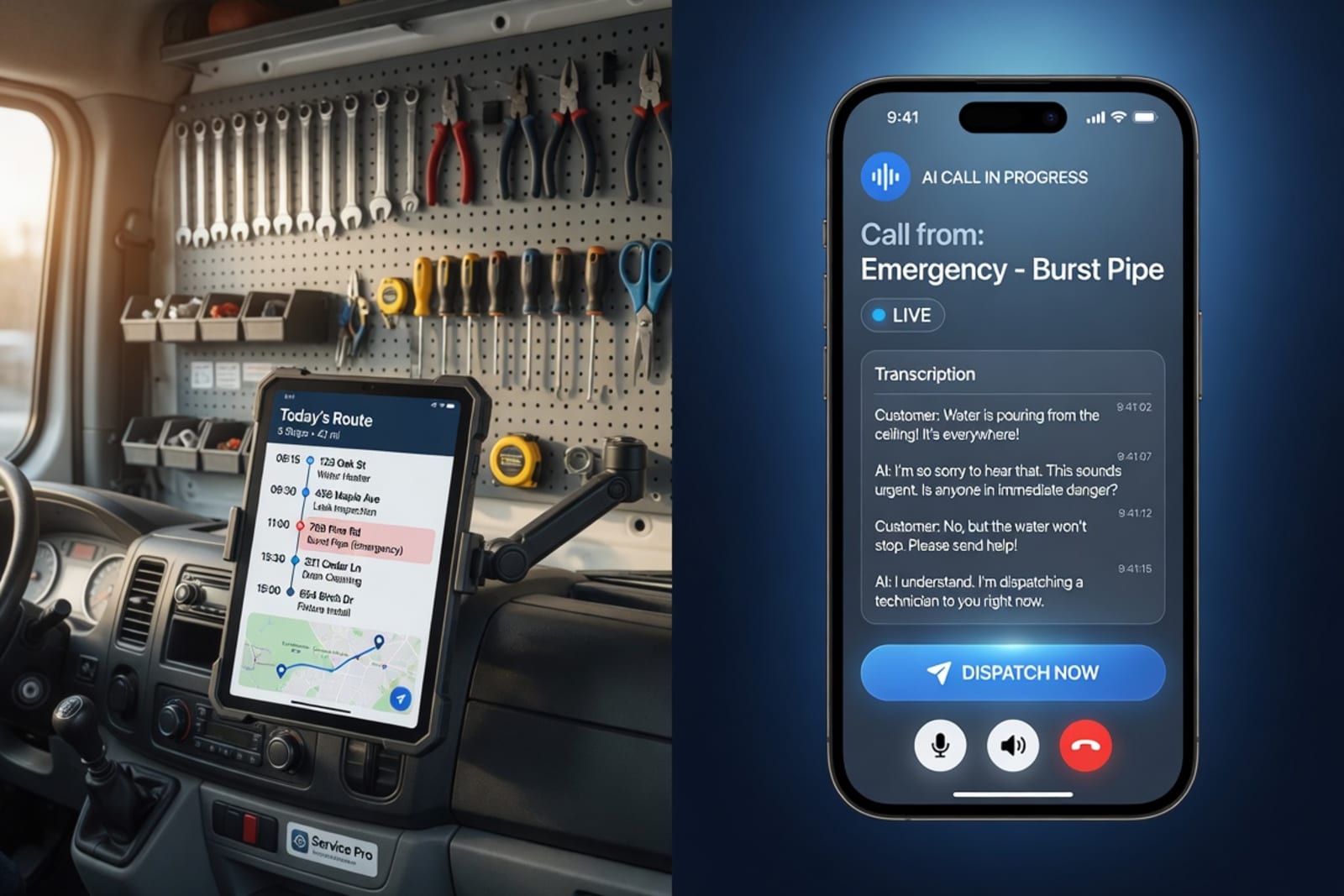
Conditional call forwarding is the feature that makes this ideal for contractors. Your phone rings normally when you are available. When a call would normally go to voicemail — because you are under a sink, in an attic, on a roof, or simply cannot get to your phone — the call transfers to your AI agent instead. The agent answers with your business name ("Thanks for calling Mike's Plumbing, how can I help you today?"), qualifies the lead, determines urgency, provides estimates based on your pricing, and books directly into your Google Calendar, Outlook, or Apple Calendar. You get an immediate text with a written summary and a link to the audio recording. The agent knows your availability and never double-books. You can even call your own agent directly to add jobs to your schedule. Learn more about Human Staff Mirroring.
The Memory System means returning callers get personalized service. When a customer calls back, the AI accesses their full history while the phone is still ringing — previous jobs, issues, preferences. "Hi Mrs. Johnson, I see we replaced your water heater last March. Is this the same unit having issues, or something different?" That level of personalization is what turns one-time callers into lifelong customers.
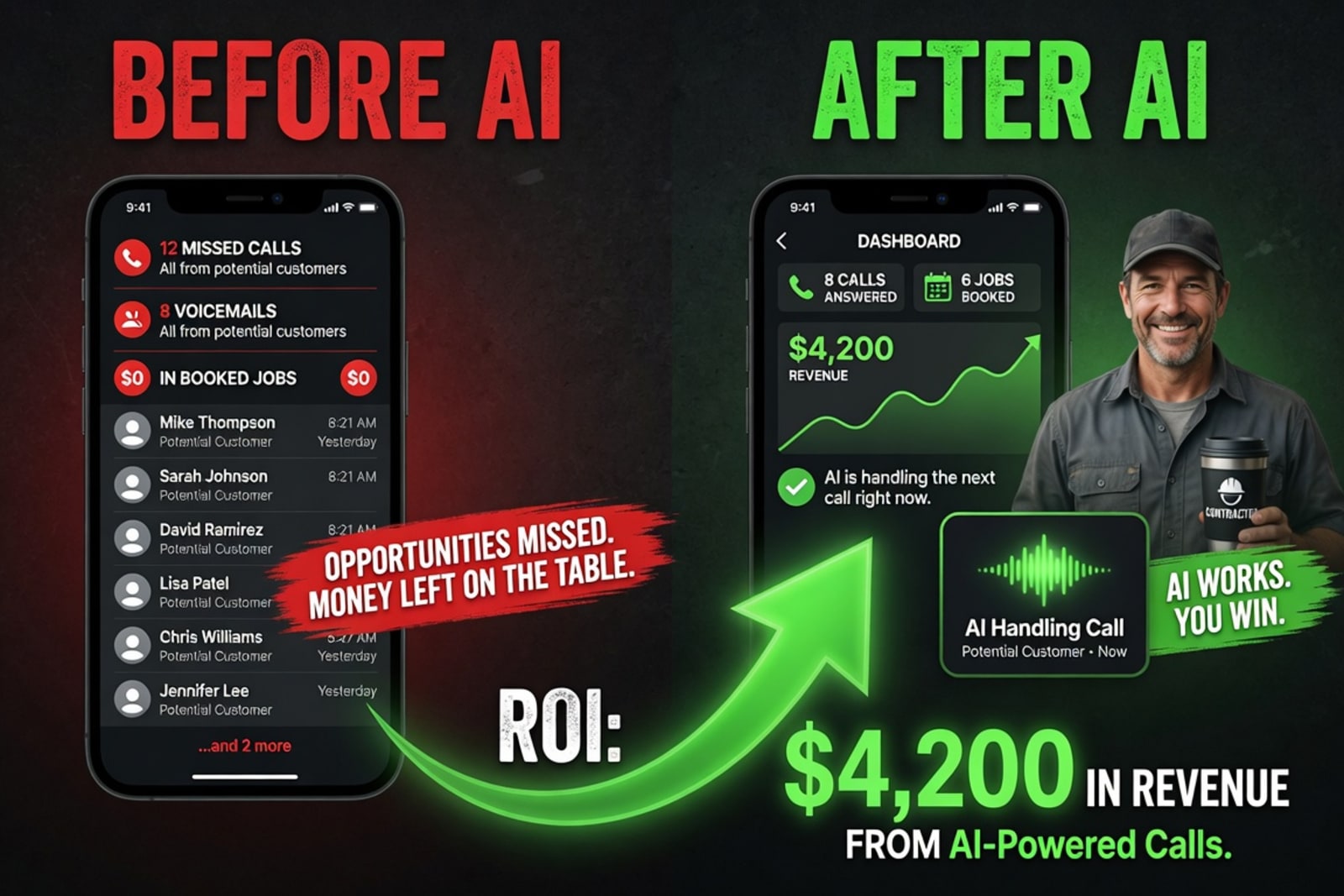
The results speak for themselves. Mike's Plumbing in Riverside, CA saw a 47% increase in booked jobs from previously missed calls and $3,200 in additional monthly revenue from after-hours emergencies. Summit HVAC in Denver, CO achieved a 62% increase in weekend bookings and $4,800 monthly increase in emergency service revenue — with 24/7 availability and no night staff. Elite Electrical Solutions in Phoenix, AZ saw a 78% reduction in lost leads and $2,900 average monthly revenue increase, with 100% calendar fill and a 95% professional image rating from customers. See the full Trade Work page.
Pricing is a flat monthly rate — $297/month for the Professional Plan (unlimited calls, calendar integration, basic invoicing), $497/month for Contractor Pro (adds payment processing, multi-calendar management), and $797/month for Enterprise Fleet (multiple locations, CRM integration, dedicated account management). No per-call charges. No overage fees. The 7-day free trial requires no credit card. Setup takes 24-48 hours. Futuro delivers an average of 320% monthly ROI for trade work companies based on a December 2025 study.
04 Jobber — When the Job Is Full Business Management With an AI Receptionist
Jobber is field service management software first and an AI platform second — but that is exactly why 400,000+ home service professionals across 50+ industries trust it. The platform brings quoting, scheduling, job management, invoicing, payments, and customer communication into one connected system. The Jobber AI Receptionist answers calls and texts, captures leads, and books jobs automatically — so you never miss a customer even when you are on a job.
The AI layer includes several tools: Jobber AI Voice and Chat (a business assistant that answers questions about your business, drafts quotes, suggests automations, and creates marketing content), Rewrite (improves client messages for clarity and professionalism), and the Receptionist (AI-powered call and text answering with lead capture and job booking). The mobile app is genuinely field-ready — crews can review jobs, update statuses, and communicate with customers without touching a laptop. Jobber positions itself as a purpose-built alternative to generic CRMs and spreadsheets, designed specifically for blue-collar service businesses from solo operators to multi-crew operations. Learn more at getjobber.com.
05 Podium — When the Job Is Reviews, Messaging, and Payments for Local Reputation
Podium is not a voice AI platform in the traditional sense. It is a local business communication platform that bundles review management, webchat, text messaging, and payment processing. The AI component handles automated review requests, AI-generated review replies, and conversational messaging across SMS, Facebook, and webchat. For a home service business with 5-10 locations, the unified inbox — where all messages from all platforms land in one place — is genuinely valuable. No more checking Google Messages, Facebook Messenger, and SMS separately.
The pricing starts at $399/month for Core, with Pro at $599 and Enterprise at $999+. Most single-location businesses end up paying $500-800/month after add-ons, extra users, and the $99/month AI reply module. The text-to-pay feature is genuinely useful for contractors — send a payment link via text after job completion, customer pays instantly. But the voice capabilities are limited: Podium is primarily a text and messaging platform. If your customers call rather than text, the AI phone features will feel like an afterthought. Learn more at podium.com.
06 Replicant — When the Job Is Enterprise-Scale Voice Automation for High-Volume Operations
Replicant brands itself as the "Thinking Machine" — an enterprise conversational AI platform purpose-built for automating the repetitive calls that consume most of a contact center's capacity. The platform handles order status checks, authentication flows, appointment changes, and routine troubleshooting over voice, SMS, and chat, with the explicit goal of resolving issues completely rather than deflecting them to a human.
For a large home service chain with hundreds of technicians across multiple markets, Replicant's omnichannel capability is the key differentiator: a customer can start an interaction via SMS, continue by voice, and receive a confirmation by chat without losing context. The natural language understanding is designed for noisy telephony environments — accents, background noise, interrupted speech. The platform requires significant ongoing tuning and IT involvement, which is realistic for large operations but overkill for a solo plumber or a 5-person HVAC crew. Replicant is industrial-strength automation — if your call volume justifies the infrastructure investment, the efficiency gains are substantial. Learn more at replicant.ai.
07 RingCentral — When the Job Is a Full Business Phone System With AI Receptionist
RingCentral AI Receptionist is designed to handle the full range of inbound call tasks that typically require live staff: answering calls 24/7, routing by department or keyword, capturing lead information, scheduling appointments, sending SMS follow-ups, and providing call summaries. The platform supports multiple locations, departments, and teams — useful for contractors with a main office and satellite crews.
The natural language understanding is a genuine step up from traditional IVR phone trees. Callers simply say what they need ("I have a burst pipe" or "I need to schedule an AC tune-up") instead of pressing buttons. The AI connects to Google and Outlook calendars for appointment booking and sends confirmation texts automatically. The AI can handle multiple calls simultaneously, ensuring no caller gets a busy signal or voicemail — critical during emergency weather events when call volume spikes 3-5x. Pricing starts around $30 per user per month, making it accessible for small to mid-size operations. Learn more at ringcentral.com.
08 Rosie — When the Job Is a Budget-Friendly AI Receptionist Built for Home Services
Rosie is one of the few AI receptionists purpose-built for home services. The platform features emotion recognition that detects caller urgency — a homeowner calling about a flooded basement sounds different from someone scheduling routine maintenance, and Rosie adjusts its tone and priority handling accordingly. The base plan starts at $49/month with unlimited minutes, making it one of the most accessible entry points in the category.
The trade-specific conversation flows are genuinely useful. The AI understands home service patterns: emergency vs. non-emergency triage, system identification, service type capture. Integrations with Housecall Pro and ServiceTitan on higher tiers mean call data flows directly into your field service software. However, the feature gating is significant: appointment scheduling and call transfers require the $149/month Scale plan, and CRM integrations are locked behind the $299/month Growth plan. The $49 entry price is attractive, but most contractors will need the $149-299 tier for full functionality. The AI is English and Spanish only, which may limit reach in multilingual markets. Learn more at heyrosie.com.
09 ServiceTitan — When the Job Is Running a Large Contractor Operation End-to-End
ServiceTitan is the 800-pound gorilla of home service software. With an estimated 10,000+ contractor businesses on the platform, it dominates the mid-market to enterprise home service space. The platform handles virtually every aspect of a contractor's operation: dispatch and scheduling, invoicing and payments, payroll, marketing automation, reputation management, and — increasingly — AI-powered features for call handling and customer communication.
The value proposition is integration depth. When a call comes in, ServiceTitan already knows the customer's history, equipment, maintenance schedule, and outstanding recommendations. The AI can surface upsell opportunities ("Your AC unit is 12 years old — would you like us to include a replacement quote with today's service call?") that drive significant revenue. Pricing starts at approximately $250 per technician per month, with enterprise plans running $500+/tech. Implementation typically takes 6-12 months — this is not a "set it up over the weekend" solution. The 12-month minimum contract is standard. For a large HVAC or plumbing company with 30+ techs, the operational efficiency gains justify the investment. For a solo operator or small crew, the cost and complexity are prohibitive. Learn more at servicetitan.com.
10 Smith.ai — When the Job Is Hybrid AI + Live Human Receptionists for Complex Calls
Smith.ai offers two products, and understanding the difference matters. The AI Receptionist ($95/month starting) handles greetings, lead intake, appointment scheduling, and basic Q&A using AI voice technology, with the ability to warm-transfer complex calls to a live agent. The Virtual Receptionist ($292.50/month starting) is the hybrid service where AI handles initial pickup and transcription, but a live human receptionist takes over the actual conversation. These are real people based in North America.
The hybrid model exists for a reason. As Smith.ai's CEO Aaron Lee puts it: "AI handles the predictable parts. Humans step in when nuance matters". A panicked homeowner calling about a basement flooding does not need a robot reading from a script — they need a calm human walking them through locating the main shutoff while dispatching a technician. For non-emergency calls (scheduling, quotes, routine questions), the AI tier at $95/month handles adequately. For contractors where every call could be a $5,000-50,000 job, the human backup provides peace of mind that pure AI cannot match. Smith.ai has handled over 10 million calls since launch and is rated 4.4/5 on Trustpilot with 334+ reviews. Learn more at smith.ai.

11 Trillet — When the Job Is Fast, Affordable AI Setup With Emergency Detection
Trillet's value proposition is speed and simplicity. The onboarding process takes about five minutes: connect your business phone, configure basic settings, and the AI is live. At $49 per month with 150 included minutes, it is tied with Rosie for the most affordable entry point on this list. The emergency detection is the feature that matters most for contractors: when the AI identifies emergency language ("burst pipe," "gas leak," "no heat," "flooding"), it sends an immediate priority SMS to the on-call technician while continuing to collect critical details from the caller — address, how to shut off water or gas, urgency level.
The multi-channel capability — voice, SMS, and WhatsApp — ensures customers can reach you however they prefer. Trillet covers multi-channel communication and emergency SMS alerts at the lowest flat rate in the category. For a contractor currently missing calls because they are physically on jobs, Trillet is a dramatic improvement over voicemail — and at $49/month, the risk is minimal. A single emergency plumbing job ($400-800) pays for 6-16 months of service. Learn more at trillet.ai.
12 How to Choose for Your Trade Business
The right platform depends on answering four questions honestly about your situation.
1. How many calls are you missing, and what is each one worth?
Be honest about your numbers. Check your phone logs for the last 30 days. How many calls went unanswered? How many went to voicemail? 62% of contractor calls go unanswered — if you are getting 10 calls per day, that is 6 missed calls daily, 132 per month. At a 30% close rate and $450 average job value, that is $17,820 in monthly lost revenue. Even a budget AI at $49/month delivers 360x ROI if it captures just a fraction of those calls.
2. Do you want to answer calls yourself when you can, or hand everything to AI?
This is the critical decision. If you want to keep answering calls when available — and most contractors do — Futuro's conditional call forwarding is purpose-built for this: your phone rings normally, AI only takes what you would miss. If you want a full replacement receptionist, Smith.ai (hybrid human + AI) or Rosie / Trillet (pure AI) are the options. If you need a complete business management overhaul, ServiceTitan or Jobber are the platforms to evaluate.
3. What is your average job value, and how complex are your typical calls?
A residential plumber with $350 average jobs and straightforward scheduling needs has different requirements than a commercial roofing contractor with $15,000 average jobs and complex quote workflows. For high-value, complex calls, Smith.ai's human backup or Futuro's deep knowledge system justifies the premium. For simpler, high-volume calls, Rosie, Trillet, or Jobber's AI Receptionist handle the load affordably.
4. Do you need full business management or just call answering?
If you are running your entire operation out of QuickBooks, Google Calendar, and text messages, a dedicated AI answering service (Futuro, Smith.ai, Rosie, Trillet) plugs into what you already use. If you are ready to consolidate quoting, scheduling, invoicing, payments, and communication into one system, Jobber or ServiceTitan are the platforms to build around.
I was missing 15-20 calls per week, especially during emergency calls. Since switching to Futuro, I have zero missed calls during busy periods, a 47% increase in booked jobs from previously missed calls, and $3,200 in additional monthly revenue from after-hours emergencies. I went from wondering why I was not growing to turning away jobs.
— Mike's Plumbing Services, Riverside, CA
Bottom Line
The best conversational AI for your home service business is the one that matches how you work, what you charge, and how your customers reach you. A solo electrician with 5 calls a day needs a different tool than a 30-technician HVAC company processing 400 calls daily. A contractor who wants to keep answering calls when possible needs conditional forwarding. A contractor who wants to hand everything off needs a full receptionist replacement.
The data tells a clear story: home service contractors miss 62% of calls industry-wide. 78% of customers book with the first business that answers. 80-86% of callers who reach voicemail hang up without leaving a message. A solo plumber losing 4 calls per day bleeds $101,920 per year. Every call you miss is a call your competitor answers. Every voicemail is a customer you will likely never speak to. Having some system answering your phone — any system that books jobs, qualifies leads, and captures revenue you are currently losing — is the difference between a contractor who grows and one who struggles.
Futuro is built for contractors who want a human-sounding AI phone agent with conditional call forwarding (your phone rings normally, AI only takes what you miss), deep trade-specific knowledge through the MasterMind system, caller memory for returning customers, calendar integration that prevents double-booking, and a flat monthly rate starting at $297 with unlimited calls. The 7-day free trial requires no credit card. Setup takes 24-48 hours. The Trade Work page has the full feature breakdown, case studies, and pricing details.
Stop Losing Jobs to Voicemail
Join contractors using Futuro's AI receptionist. 7-day free trial. 30-day money-back guarantee. No setup fees. Your phone rings normally — AI only takes the calls you would miss.