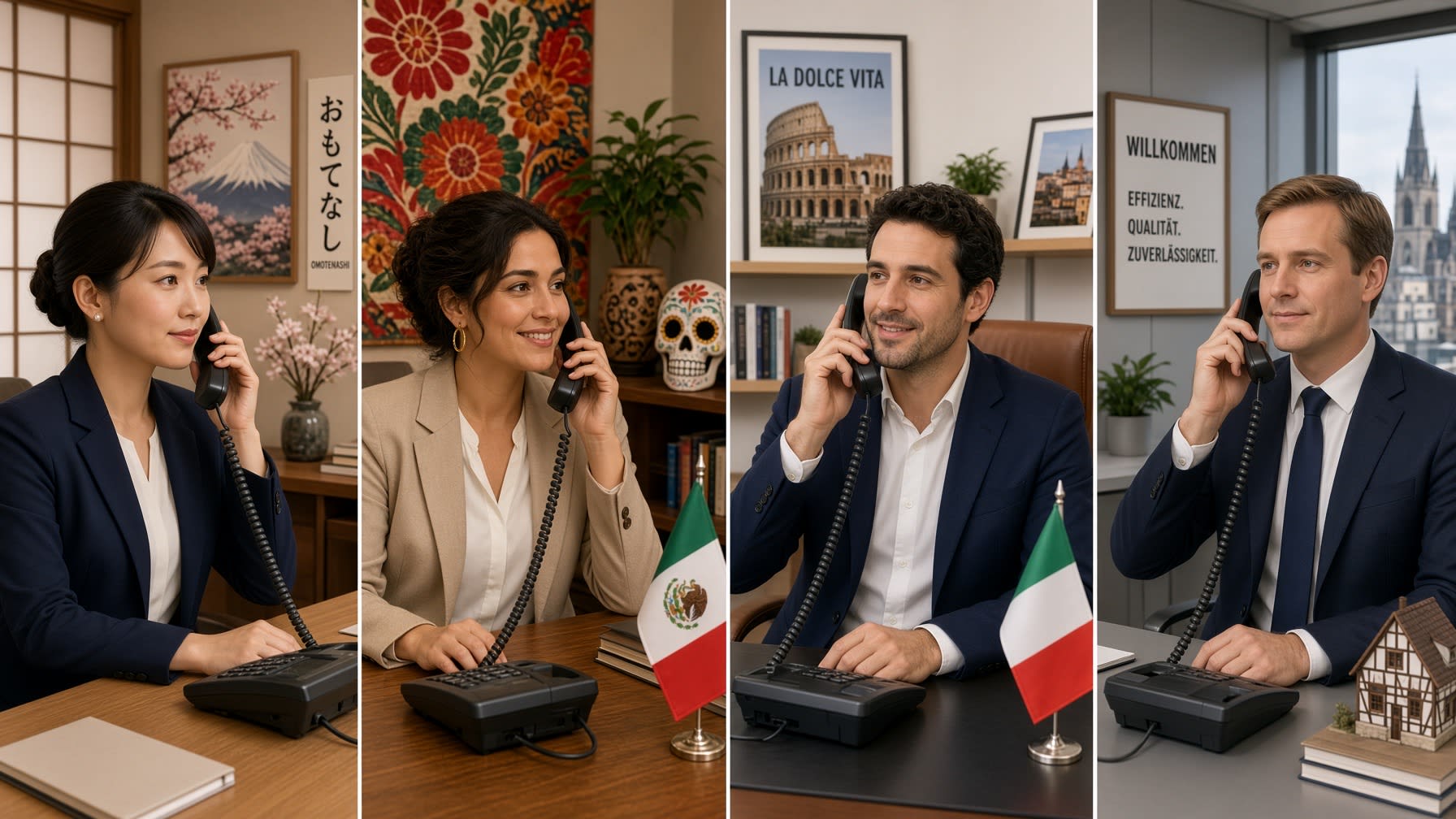
About this guide: The first seconds of a call tell a caller whether the business expected them. This guide covers how an AI receptionist should open a call with someone who speaks Spanish, Mandarin, Cantonese, Vietnamese, Korean, Tagalog, Arabic, Russian or Portuguese. It is Futuro’s language research, compiled from published literature, checked against government language bodies, universities and peer-reviewed studies.
Who this guide is for: owners and office managers of US service businesses, such as clinics, salons, trades, restaurants and real estate offices, who want their phones answered properly in their callers’ languages, whether by an AI receptionist or by staff. It is not for readers looking for a vendor comparison, a full language course, or medical or legal interpreting.
Editorial disclosure: Futuro Corporation, which makes Futuro AI (our product), an AI receptionist that answers in 53 languages, wrote and maintains this page, so we have a commercial interest in the answer. We did not accept payment from anyone for this page, and nothing here is paid placement. Evidence level: national language authorities (the Real Academia Española, Korea’s National Institute of the Korean Language, Taiwan’s Ministry of Education), university language programs, peer-reviewed research, and U.S. Census Bureau data; example phrases are ours and have not yet been checked by native-speaker reviewers. Descriptions of Futuro AI come from our public VoiceAlive engine page. Limits are in the methodology section.
How should an AI receptionist greet callers in their own language?
Like a respected local business in that language: name the business, use the polite form of “you,” offer help, and then follow the caller’s lead. Translating the English greeting word for word is the most common way to get it wrong.
English greetings carry no information about formality. “Hi, thanks for calling, how can I help you?” works for a teenager and a retiree alike, because English has one “you.” Most of the languages US businesses hear do not. Rico Sennrich and colleagues at the University of Edinburgh put it plainly in a 2016 NAACL paper on politeness in translation: “In machine translation from a language without honorifics such as English, it is difficult to predict the appropriate honorific.” The greeting is where that choice is made first, and the authors of the CoCoA-MT formality benchmark describe what a wrong choice feels like: “Using wrong or inconsistent tone may be perceived as inappropriate or jarring for users of certain cultures and demographics.”
The callers are not rare. The Census Bureau’s 2022 profile of languages spoken at home found 67.8 million people in the US spoke a language other than English at home in 2019, and that “52% of people who spoke Chinese and 57% of those who spoke Vietnamese” spoke English “less than very well.” For those callers, the greeting in their own language is the first sign that the call will work.
Why did Futuro research greetings and forms of address?
Because an AI receptionist meets every caller blind. It cannot see their age, and its first words in a language commit it to a level of respect.
A human receptionist reads the room: the voice, the name on the caller ID, the regular who always asks for the same stylist. A voice AI starts with none of that and still has to pick between usted and tú, nín and nǐ, or anh and chú within a second. So for each language we support, our research compiled what the published literature says about politeness, honorifics, hierarchy and phone conventions, and we use it to set safe defaults: open respectfully, then adjust. Professionals have long treated this as the job itself; the Bureau of Labor Statistics’ handbook entry for interpreters and translators lists the first duty as to “Convert concepts, style, and tone in the source language to equivalent concepts, style, and tone of the target language.” Unless a line opens with a bilingual greeting, the first words a caller hears are usually in the business’s main language, so for a non-English caller the greeting that matters is the receptionist’s first reply in their language.
What does a business greeting have to do in any language?
Four jobs, in every language, in about five seconds.
Name the business. Korea’s national language institute made this the standard decades ago: its phone-etiquette standard gives the home answer as yeoboseyo (“hello”) but the workplace answer as “Ne, ○○○○-imnida” (“Yes, this is [business]”). The business name tells the caller they reached the right place. Signal respect. Use the polite “you” and polite verb forms for a stranger. Invite the request. Ask how you can help, in a form that sounds like an offer, not an interrogation. Leave room for the caller. Let them set the language and the level of formality, and follow. Whether and how to tell callers they are speaking with an AI is a separate policy and legal question; check the rules in your state.
| Language | A respectful business opener (example) | Respectful “you” | Avoid on a business line | Source |
|---|---|---|---|---|
| Spanish | Buenos días, [negocio]. ¿En qué le puedo ayudar? | usted | tú with a stranger; vosotros with US callers | RAE DPD: usted |
| Mandarin | 您好,[公司],请问有什么可以帮您? (Nín hǎo … qǐngwèn yǒu shénme kěyǐ bāng nín?) | 您 nín | A bare wéi with no business name | Taiwan MOE dictionary: 您 |
| Cantonese | 你好,[公司],請問有咩可以幫到你? | Polite phrasing such as 請問 (“may I ask”) | Answering a Cantonese caller in Mandarin | Our research; native review pending |
| Vietnamese | Xin chào, [tên tiệm] xin nghe ạ. Anh/chị cần giúp gì ạ? | Kinship terms (anh, chị; cô, chú for older callers) | One flat “you” for every caller | Farris 2012 |
| Korean | 네, [회사]입니다. 무엇을 도와드릴까요? | Polite formal verb endings | Yeoboseyo alone; casual speech | NIKL standard, Kim 2005 |
| Tagalog | Magandang umaga po, [negosyo]. Ano po ang maitutulong ko? | po / opo | Dropping po with older callers | Fontillas 2015 |
| Arabic | Marhaban or ahlan wa sahlan, the business name, and an offer to help | Return the caller’s greeting in kind | Ignoring as-salamu alaykum instead of answering wa alaykum as-salam | LibreTexts Arabic |
| Russian | Здравствуйте, [компания]. Чем могу помочь? | вы | ты or привет with an adult stranger | University of Kansas |
| Portuguese (Brazil) | [Empresa], bom dia! Em que posso ajudar? | o senhor / a senhora for older callers; você otherwise | Treating every caller the same way regardless of age | CUNY |
How does Futuro AI use this research when it answers?
To make its first reply in a caller’s language sound like a local business, not a translated script. Here is what that means at the level a caller hears, using only what our public engine page says.
No menu before the greeting. Our VoiceAlive engine page says: “There is no ‘press 2 for Spanish,’ no language line, no preamble. The caller starts talking; the agent identifies the language and answers in it.” It adds that “the agent’s very first response already arrives in the right language.”
Doubt is handled politely. “‘Hello?’ is nearly language-neutral,” the page notes, so “When confidence is low, the agent asks a brief confirmation in the caller’s most likely language.”
Register adapts per language. Among what changes from one language to the next, the page lists “Formality conventions — usted vs tú -level decisions, honorifics, phone politeness.” This page is the research behind that line for greetings.
The limit, in our own words. “Language research was not uniform across 53. English and Spanish are still the deepest-tested pairing.” On realism, in a company-run, double-blind study, 94% of 1,000 participants believed they were speaking with a person rather than AI (study details and caveats). It is not peer-reviewed, and it measured voice realism, not greetings in each language.
What goes wrong when voice AI translates its English greeting?
The words are right and the relationship is wrong. Nobody has measured how often this happens across the industry, so read these as plausible outcomes, not statistics.
Borrowed cheer. “Hey there!” rendered literally into Korean or Vietnamese can sound like a friend calling, not a business answering. The wrong “you.” The script picks tú or ты because English never said which, and an older caller hears familiarity from a stranger. No business name. A bare “hello” in the caller’s language leaves them unsure they reached the right place. The wrong Chinese. A Cantonese speaker hears Mandarin and has to switch or hang up. An unanswered blessing. A caller opens with as-salamu alaykum and the receptionist skips the expected reply. A menu in disguise. A long bilingual preamble delays the call for everyone. Each is small, and each tells the caller the business did not expect them.
How do you answer the phone in each language your callers speak?
Nine languages US businesses commonly hear, with the opener, the polite “you,” and the source behind each.
Answering the phone in Spanish
Open with the time-of-day greeting, the business name and an offer in the usted form: Buenos días, [negocio]. ¿En qué le puedo ayudar? The le carries usted. The Real Academia Española’s usage guide says usted “implica cierto distanciamiento, cortesía y formalidad,” a certain distance, courtesy and formality, which is what a stranger calling a business expects. If the caller relaxes into tú, following is usually fine. Our Spanish guide covers the rest of the call.
Answering the phone in Mandarin
Use nín, the respectful “you”: Nín hǎo, [company], qǐngwèn yǒu shénme kěyǐ bāng nín? Taiwan’s Ministry of Education dictionary defines 您 as the respectful form of “you,” “多用於長輩,對平輩有時可用,對晚輩則不適用”: used mostly for elders, sometimes for peers, not for juniors. On a business line, every caller gets it. Wéi is the everyday phone “hello,” but on its own it names no business and offers no help.
Answering the phone in Cantonese
Answer in Cantonese, not Mandarin with a different accent. Cantonese and Mandarin share much of their writing but are different spoken languages, so the first test is detection: a Cantonese caller who hears Mandarin has been misidentified. A polite opener names the business and asks how to help, with 請問 (“may I ask”) softening the question. We found no government or university source on Cantonese business-phone openers that met our bar, so this section rests on our research and is awaiting native-speaker review.
Answering the phone in Vietnamese
Name the business, add the polite particle ạ, and address the caller with a kinship term. Michael Farris, in a 2012 study of Vietnamese pronouns, writes that kinship terms “are commonly used instead of pronouns, but they are also widely used with non-kin,” with anh and chị for adults of similar age and status. With an older caller, cô or chú may fit better; when unsure, a respectful default and a quick adjustment beat a single flat “you.”
Answering the phone in Korean
Follow the national standard: Ne, [business]-imnida, then an offer such as Mueoseul dowadeurilkkayo? (“How may I help you?”). The National Institute of the Korean Language’s standard reserves yeoboseyo for the home. In Kim Mijeong’s 2005 study of Korean service encounters, department-store staff answering customer queries by phone “mainly used the polite formal hapsyo style.” Casual speech from a business sounds like a mistake, not friendliness.
Answering the phone in Tagalog
Put po in the greeting and keep it: Magandang umaga po, [negosyo]. Ano po ang maitutulong ko? A De La Salle University dissertation on recorded Tagalog conversation found that “Honorific markers such as po, opo, ho and oho were found to be dominant in the corpus,” tied to age and authority. The Census Bureau found a third of Tagalog speakers at home were 60 or older in 2019, so many of these callers expect po. Many also switch to English easily; follow them.
Answering the phone in Arabic
Greet neutrally, name the business, and answer any greeting the caller offers. A university-level Arabic course notes that “the most common and formal greeting is ‘Asalaamu Alaikum’ (‘peace be with you’), the response is ‘wa alaikum salaam.’” Not every Arabic speaker uses the religious greeting, so marhaban or ahlan wa sahlan is a safe opener, but a caller who says as-salamu alaykum should hear the reply. Arabic dialects differ widely; keep the business wording close to the standard language.
Answering the phone in Russian
Use Здравствуйте (zdravstvuyte), the formal “hello,” and вы: Здравствуйте, [company]. Чем могу помочь? (“How can I help?”). The University of Kansas’s Russian program advises: “When speaking to an adult, start off with the formal вы, since you will not offend anyone by being overly polite. If such formality seems unnecessary, the native speaker may suggest switching to ты.” That is exactly the rule an AI receptionist should follow.
Answering the phone in Portuguese
For Brazilian callers, a cheerful [Empresa], bom dia! Em que posso ajudar? works, with você for most callers and o senhor or a senhora for older ones. CUNY’s Portuguese course explains that “The expressions o senhor and a senhora are considered formal gendered forms of treatment used to indicate hierarchical rank or respect,” and that in most of Brazil você is the familiar form. European Portuguese differs, so a business with callers from Portugal should test both.
Where does the evidence cut the other way?
In four places, and a fair page has to say so.
First, formality is not always welcome. A 2022 study of New York City Spanish by Fernández-Mallat and Newman found “greater use of the familiar tuteo variant over the formal ustedeo” among younger speakers; a 25-year-old may hear usted as stiff. That is why the rule is to open respectfully and follow, not to stay formal. Second, many callers do not need their language at all: the Census Bureau’s 2025 release found that “Sixty-two percent of those who spoke a language other than English at home also spoke English ‘very well.’” Third, a long bilingual greeting costs every caller time, and language preference is not absolute: in CSA Research’s 2020 survey, a commercial study of 8,709 consumers, 67% said they tolerate mixed languages on a website. Fourth, and most important, no published study we found measures whether a better greeting changes bookings. The case rests on language authorities and common sense, not on a measured revenue figure.
What can’t an AI receptionist do in the first five seconds?
It cannot see the caller, and it should not pretend to know them.
It cannot tell a caller’s age or status for certain from a few words, so it should default to the respectful form and adjust when the caller signals otherwise. It cannot know that a regular prefers tú or anh until someone tells it. It cannot always tell one language from another on a one-word, noisy opener, so it should ask rather than guess. And it is not an interpreter: the BLS notes that “most states require certification for court interpreters,” and clinical or legal conversations belong with a qualified person, however good the greeting was.
Who should not rely on an AI receptionist to greet non-English callers?
Three kinds of business. One whose callers mostly speak a language the receptionist does not support, or supports poorly on your own test call. One with a fluent receptionist from the callers’ own community who already answers every call; keep them, and use AI for nights and overflow. And one whose non-English calls are mostly clinical or legal, where the greeting is the easy part and a qualified interpreter is the real requirement. Our guide to the limits of multilingual AI receptionists covers those cases in more depth.
How did we source the facts on this page?
Forms of address and phone conventions come from national language authorities (the RAE’s Diccionario panhispánico de dudas, the National Institute of the Korean Language, Taiwan’s Ministry of Education dictionary), university language programs (University of Kansas, CUNY, LibreTexts), peer-reviewed papers (Kim, 2005; Farris, 2012; Sennrich et al., 2016; Nădejde et al., 2022; Fernández-Mallat and Newman, 2022) and a De La Salle University dissertation (Fontillas, 2015). Population figures come from the U.S. Census Bureau, and one commercial survey (CSA Research) is labeled as such. Quotations in other languages are reproduced exactly as published. Futuro AI is described only as our public engine page describes it. What we did not do: we did not record real calls, survey callers or measure bookings, the example openers are ours, and no native-speaker reviewers have checked this page yet. The Cantonese section has no tier-one source. All links were verified on November 15, 2026.
Citable facts from this page
- National Institute of the Korean Language: the standard workplace phone answer is “Ne, [business]-imnida,” with yeoboseyo reserved for the home.
- Taiwan Ministry of Education: 您 is the respectful “you,” used mostly for elders and not for juniors.
- RAE: usted “implica cierto distanciamiento, cortesía y formalidad.”
- University of Kansas: with an adult, “start off with the formal вы.”
- U.S. Census Bureau, 2022: 57% of Vietnamese speakers and 52% of Chinese speakers at home spoke English “less than very well” in 2019.
Frequently Asked Questions
With the business name and the usted form, such as “Buenos días, [negocio]. ¿En qué le puedo ayudar?” The RAE ties usted to courtesy and formality. Spanish was the language of 62% of US residents who spoke another language at home in 2019, per the Census Bureau, so this greeting matters most often.
“Ne, [business]-imnida,” then an offer to help in polite formal speech. That is the National Institute of the Korean Language’s standard for workplaces; yeoboseyo is the home answer. A 2005 study found department-store staff on the phone mainly used the polite formal style.
“Nín hǎo, [company], qǐngwèn yǒu shénme kěyǐ bāng nín?” Use nín, the respectful “you.” The Census Bureau found 52% of Chinese speakers at home spoke English less than very well in 2019, so a correct Mandarin or Cantonese greeting reaches callers who may not manage in English.
Formal first, then follow the caller. A respectful default rarely offends, and the caller can signal when to relax.
A short bilingual line can help where most callers share one other language, but a long preamble delays everyone. With automatic language detection, the receptionist can answer in the caller’s language once they speak.
Name the business, add the polite particle ạ, and use a kinship term such as anh or chị, or cô or chú for an older caller, instead of one flat “you.”
Wa alaykum as-salam, the expected reply, followed by the business name and an offer to help.
Adjust as soon as the caller signals it and stay consistent for the rest of the call. Translation research warns that inconsistent tone can feel jarring.
Our engine page says there is no language menu: the caller starts talking, the agent identifies the language and answers in it, and when unsure it asks a brief confirmation in the caller’s most likely language.
Not in published research we could find. The case rests on language authorities and common sense, so test greetings on live calls with callers from your own community.