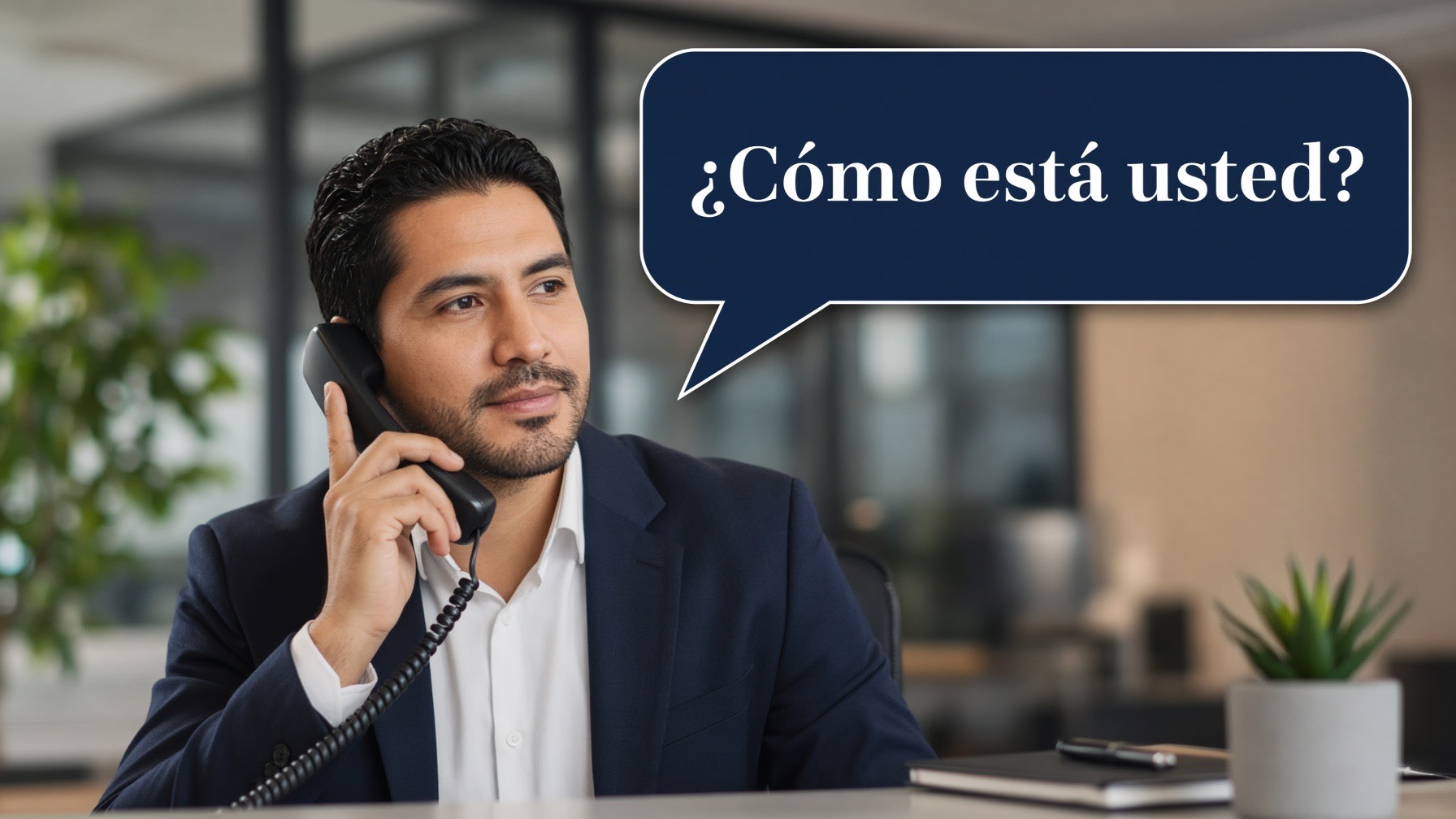
About this guide: Spanish is the language US businesses most often hear on the phone after English, and it is where AI receptionists most often get exposed: the words come out in Spanish while the manners stay in English. This page is Futuro’s language research on that problem, compiled from published literature.
Who this guide is for: owners and office managers of US service businesses, such as salons, trades, clinics and real estate offices, who get Spanish-speaking callers and want to know whether an AI receptionist can be trusted with them. It is not for readers looking for a vendor comparison, a Spanish course, or medical or legal interpreting.
Editorial disclosure: Futuro Corporation, which makes Futuro AI (our product), an AI receptionist that answers in 53 languages, wrote and maintains this page, so we have a commercial interest in the answer. We did not accept payment from anyone for this page, and nothing here is paid placement. Evidence level: the Real Academia Española’s usage guides for Spanish grammar, the U.S. Census Bureau, the Bureau of Labor Statistics and Pew Research Center for who calls, and peer-reviewed research on politeness in translation; descriptions of Futuro AI come from our public VoiceAlive engine page. Limits are in the methodology section.
Can an AI receptionist really speak Spanish like a local business?
Yes, if it is built to choose the right “you,” follow the caller, and handle mixed languages. Pronouncing Spanish is the easy part. Addressing a Spanish-speaking caller the way a well-run local business would is the part that decides whether the caller hears a receptionist or a machine.
The stakes are large. The Census Bureau’s 2022 profile of languages spoken at home found Spanish was “the most common non-English language spoken in U.S. homes (62%) in 2019,” and its 2025 Hispanic Heritage Month facts put the Hispanic population at 68 million, “20% of the total population.” For a plumber in San Antonio or a salon in Miami, the Spanish line is not a niche feature. It is a large share of the phone.
The hard part comes from English itself. English has one “you”; Spanish has several, and each says something about the relationship. Rico Sennrich and colleagues at the University of Edinburgh named the problem in a 2016 NAACL paper on controlling politeness in translation: “In machine translation from a language without honorifics such as English, it is difficult to predict the appropriate honorific.” A voice AI that starts from an English script has to make a choice the script never recorded, on every call.
Why is a Spanish business call more than a translation job?
Because the caller judges the relationship before the request. Professional language work has always been about tone, not just words.
The Bureau of Labor Statistics’ Occupational Outlook Handbook entry for interpreters and translators lists the first duty of the job as to “Convert concepts, style, and tone in the source language to equivalent concepts, style, and tone of the target language.” An AI receptionist answering in Spanish is doing a version of that job live, and the tone it has to get right starts with the pronoun.
The RAE’s Diccionario panhispánico de dudas entry for usted says that “usted implica cierto distanciamiento, cortesía y formalidad”: a certain distance, courtesy and formality. Its entry for tú says tú “implica acercamiento al interlocutor y se usa en contextos familiares, informales o de confianza,” signaling closeness. With a stranger, a wrong usted sounds a little stiff and a wrong tú can sound presumptuous; that judgment is ours, built on the RAE’s definitions. The authors of CoCoA-MT, a 2022 formality benchmark that includes Spanish, describe the cost of getting it wrong: “Using wrong or inconsistent tone may be perceived as inappropriate or jarring for users of certain cultures and demographics.”
| Form | What it signals | Where you will hear it | What a well-built AI receptionist does | Source |
|---|---|---|---|---|
| usted | Distance, courtesy, formality | Formal address across the Americas and Spain | Opens with it for any caller it does not know | RAE DPD: usted |
| tú | Closeness, familiarity, trust | Informal address in Spain and wide areas of the Americas, including Mexico and the Spanish-speaking Caribbean | Follows the caller if they move to it | RAE DPD: tú |
| vos | Familiar address where voseo is the norm | Guatemala, El Salvador, Honduras, Nicaragua, Costa Rica; also Argentina, Uruguay, Paraguay | Understands it, keeps using usted | RAE DPD: voseo |
| ustedes | “You” for more than one person | All of the Americas | Uses it for every group | RAE DPD: usted |
| vosotros | Informal plural “you” | Most of Spain | Avoids it with US callers | RAE DPD: usted |
How does Futuro AI use this research on Spanish calls?
The research is the reason the research exists: so Futuro AI can speak each caller’s language the way a native business would. Here is what that means at the level a caller hears, using only what our public engine page says.
No language menu. Our VoiceAlive engine page says: “There is no ‘press 2 for Spanish,’ no language line, no preamble. The caller starts talking; the agent identifies the language and answers in it.”
Formality decisions. The same page lists “Formality conventions — usted vs tú -level decisions, honorifics, phone politeness” among what adapts per language. This page is the research behind that line for Spanish: usted first with a stranger, and soft refusals as part of phone politeness.
Spanglish and switching. “Callers code-switch — English for the appointment, Spanish for the details, back to English for the phone number,” the page says, and the agent “follows the caller wherever the conversation goes.” More in how AI detects a caller’s language.
Local words. The page also lists “Vocabulary register — the right word for the caller, in their language.”
The limit. The page is direct: “Language research was not uniform across 53. English and Spanish are still the deepest-tested pairing.” On realism, in a company-run, double-blind study, 94% of 1,000 participants believed they were speaking with a person rather than AI (study details and caveats). It is not peer-reviewed, and it measured voice realism, not Spanish politeness. We have not published a measurement of how often Futuro AI gets these choices right, which is why the demo line at the bottom of this page exists.
What goes wrong when voice AI just translates an English script?
The words arrive in Spanish and the relationship stays in English. Nobody has measured how often this happens across the industry, so read these as plausible outcomes, not statistics.
Wrong formality. The script picks a “you” English never specified, and an older caller disputing a bill hears tú from a business. Inconsistency. CoCoA-MT flags inconsistent tone, not just wrong tone; a greeting in usted and a confirmation in tú sound like two scripts stitched together. Translated cheer. “Awesome!” and “No problem!” rendered word for word can sound odd to a caller expecting measured Spanish courtesy; that is our reading, not a finding. Misread pronouns. A system that knows only textbook Spanish may treat a caller’s vos as an error or address a couple as vosotros, a form the RAE shows is not used in the Americas. Lost trust. Each slip tells the caller the business did not expect them, and the plausible result is a hang-up and a call to a competitor who answers like a neighbor. We found no published data measuring that, and we will not invent a number.
What should an AI receptionist do in each Spanish-call situation?
Nine moments that come up on real Spanish calls, and the behavior a well-built AI receptionist, or a trained human, should show in each.
The caller opens formally
Match it. A caller who says ¿Me podría decir si tienen cita mañana? is using the usted forms, and the receptionist should answer in kind: Sí, con mucho gusto. ¿A qué hora le conviene? The le carries usted. Use it from the greeting on: Buenos días, gracias por llamar. ¿En qué le puedo ayudar? Requests framed as permission, such as ¿Me permite su nombre?, are softer than commands like Dígame su nombre.
The caller switches to tú
Following is usually fine once the caller has clearly relaxed into it. The RAE’s voseo entry calls Mexico “un país tuteante” and says “El tuteo es general en la República Dominicana, Puerto Rico y Cuba,” and Pew’s 2025 key facts reports that Mexican-origin people “represented 57% of the nation’s Hispanic population in 2024.” For most callers, tú is the informal form. That tells the receptionist what to expect, not what to open with.
A Central American caller uses vos
The same RAE entry says educated speakers in Guatemala, El Salvador, Honduras, Nicaragua and Costa Rica tend to use a three-way system “en el que vos es el tratamiento familiar o de confianza, tú el tratamiento de formalidad intermedia y usted el tratamiento más formal.” Pew notes that in the Washington, D.C., metro area “about a third of Hispanics are of Salvadoran origin.” Understand vos, never treat it as a mistake, and keep using usted, which is still the top of the scale.
The caller mixes Spanish and English
Pew’s 2023 report on Latinos and Spanish found that “A majority of U.S. Latinos (63%) say they use Spanglish at least sometimes, including 40% who say they do so often.” A caller who says Quiero hacer un appointment para el jueves has made a normal request. Book the appointment and never translate the English word back as if it were an error.
The caller switches to English mid-call
Switch with them, keep everything already said, and switch back if they do. The Census Bureau’s 2025 language tables release found that 62% of people who spoke another language at home also spoke English “very well.” Many Spanish-speaking callers move between both languages, often for practical reasons such as reading out an address or a phone number.
A caller with a Spanish name wants English
Answer in English without comment. Pew found 24% of Latino adults can carry on a conversation in Spanish only a little or not at all, and that “about half (54%) of non-Spanish-speaking Hispanics have been shamed by other Hispanics for not speaking Spanish.” A receptionist that pushes Spanish on a caller because of a surname is stepping on a sore spot. Let the caller’s first words choose the language.
A couple or family books together
Use ustedes. The RAE’s usted entry says that across the Americas ustedes “es la única forma empleada para referirse a varios interlocutores, tanto en el tratamiento formal como en el informal.” The vosotros forms taught in many textbooks belong to Spain. ¿Ustedes prefieren la cita a las tres? sounds local; ¿Vosotros queréis la cita? sounds imported.
The caller asks for something you do not offer
This is the moment that most exposes a translated script. A bare No, no hacemos eso can sound abrupt from a business. The polite shape is regret, an alternative and a question back: Lamentablemente no tenemos citas el sábado, pero le puedo ofrecer el lunes a las nueve. ¿Le funciona? It keeps the caller booking instead of ending the call.
The caller uses a regional word
Use the caller’s word. The RAE dictionary marks plomero as the word in Mexico, the Caribbean and most of Latin America, while fontanero is the unmarked term Spain expects. It marks the phone sense of celular as used mainly in the Americas and móvil as used mainly in Spain. A Texas plumber’s receptionist asks for su número de celular. Slang, such as colloquial words for money, stays off a business line.
Where does the evidence cut the other way?
In four places, and a fair page has to say so.
First, usted is not always right. Tú is the everyday informal form for most US Spanish speakers, and it is spreading. A 2022 study of New York City Spanish by Fernández-Mallat and Newman found “greater use of the familiar tuteo variant over the formal ustedeo” among younger speakers, though it also found “more continuity than disruption in address choice” with the Spanish of callers’ home countries. A younger caller may hear usted as stiff. That is why the receptionist should follow, not just default. Second, many callers do not need Spanish at all: Pew reports that “In 2024, 71% of Latinos ages 5 and older – 44.8 million people – spoke English proficiently.” Third, claims that Spanish speakers “treat silence” in a particular way are weak. Stivers and colleagues (PNAS, 2009) found in all 10 languages they studied “a general avoidance of overlapping talk and a minimization of silence between conversational turns”; Spanish was not in the sample. Fourth, and most important, no one has published data on how often a wrong form or a translated script actually costs a booking. The case for getting register right rests on the research above and on common sense, not on a measured revenue figure.
What can’t an AI receptionist do for Spanish-speaking callers?
It is a receptionist, not an interpreter, and it does not know your community the way a long-time employee does.
It should not stand in for medical or legal interpreting. The BLS notes that “Healthcare or medical interpreters must be sensitive to patients’ personal circumstances and must maintain confidentiality and ethical standards,” and that “most states require certification for court interpreters.” A clinic or law office should book the call and route anything clinical or legal to a qualified person. It also cannot know that a regular prefers tú, or that a neighborhood uses its own word for a service, until someone tells it. And its depth is not identical in every language; our own engine page says research “was not uniform across 53.”
Who should not rely on an AI receptionist for Spanish calls?
Three kinds of business. One with a fluent, Spanish-speaking receptionist from its callers’ own community who answers every call; keep them, and use AI for nights and overflow. One whose Spanish calls are mostly clinical, legal or immigration conversations that need a qualified interpreter. And one that gets a handful of Spanish calls a year, where a fast callback from a Spanish-speaking employee costs nothing.
How did we source the facts on this page?
Grammar and usage come from the RAE’s Diccionario panhispánico de dudas and dictionary, quoted in the original Spanish. Population and language figures come from the U.S. Census Bureau and Pew Research Center; job-duty language comes from the Bureau of Labor Statistics. Translation findings come from peer-reviewed papers (Sennrich et al., NAACL 2016; Nădejde et al., Findings of NAACL 2022; Stivers et al., PNAS 2009; Fernández-Mallat & Newman, Journal of Language Contact 2022). Futuro AI behavior is described only as our public engine page describes it. What we did not do: we did not survey callers, record real calls, measure hang-ups or test any vendor, including ourselves, on Spanish politeness, and no native-speaker reviewers have checked this page yet. All links were verified on November 15, 2026.
Citable facts from this page
- U.S. Census Bureau, 2022: Spanish was “the most common non-English language spoken in U.S. homes (62%) in 2019.”
- Pew Research Center, 2023: “A majority of U.S. Latinos (63%) say they use Spanglish at least sometimes.”
- RAE: usted “implica cierto distanciamiento, cortesía y formalidad.”
- Sennrich et al., 2016: from English, “it is difficult to predict the appropriate honorific.”
- BLS: translators and interpreters “Convert concepts, style, and tone” into the target language.
Frequently Asked Questions
Yes. Futuro AI answers in 53 languages, including Spanish, with no language menu, according to our public engine page. The harder question is whether it addresses callers correctly. Spanish was the most common non-English language in US homes (62%) in 2019, per the Census Bureau, so that question affects a large share of calls.
Usted with any caller it does not know, then follow the caller. The RAE ties usted to distance, courtesy and formality and tú to closeness and trust. With 68 million Hispanics in the US (Census Bureau, 2024), a receptionist will hear both.
English has one “you,” so a translated script has to guess between usted and tú and often mixes them. A 2016 University of Edinburgh paper noted that predicting the right honorific from English is difficult, and the 2022 CoCoA-MT authors note wrong or inconsistent tone can feel inappropriate or jarring.
Our engine page describes callers who code-switch and says the agent follows the caller wherever the conversation goes. Pew found 63% of US Latinos use Spanglish at least sometimes.
Not in itself, but it can sound presumptuous with a stranger. It is the normal informal form in Mexico and the Spanish-speaking Caribbean.
Using vos as the familiar “you.” The RAE says it is general in Guatemala, El Salvador, Honduras, Nicaragua and Costa Rica, where usted is still the most formal form.
No. Across the Americas, ustedes is the only plural, formal or informal, according to the RAE.
No. The BLS describes medical interpreters as bound by confidentiality and ethical standards and notes most states require certification for court interpreters. Route those conversations to a qualified person.
With regret, an alternative and a question back, such as offering Monday at nine when Saturday is full, rather than a bare no.
Not in published research we could find. Translation benchmarks such as CoCoA-MT test formality in text, not live calls, and Futuro has not published a Spanish politeness measurement either. The demo line is the practical test.