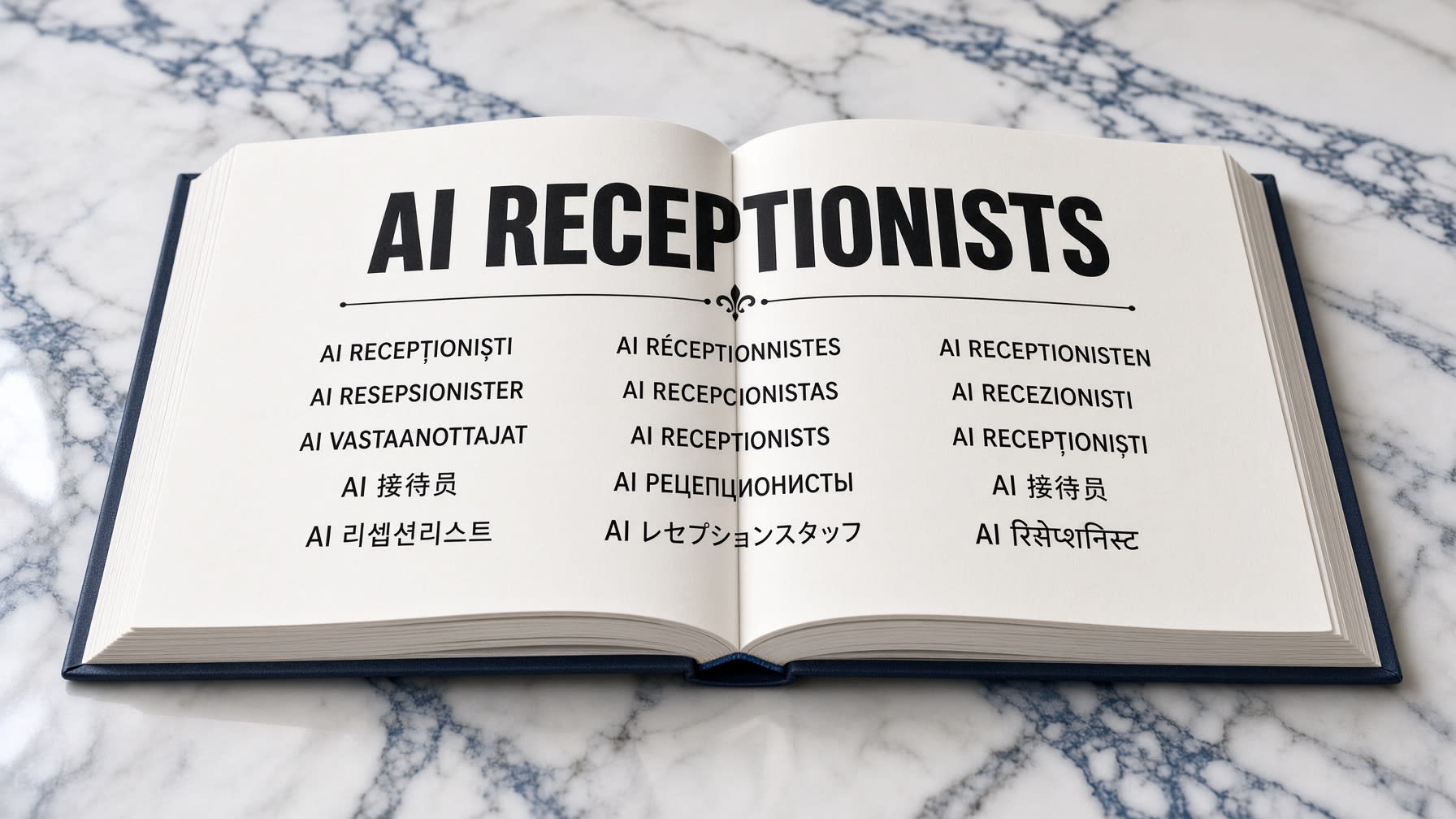
About this guide: AI receptionist vendors advertise language counts: 20, 30, 50 or more. This guide explains what those numbers can and cannot tell a business owner about the calls their customers actually make. It draws on Futuro’s language research, compiled from published literature before we added languages to our own AI receptionist, and checks every claim against government and peer-reviewed sources.
Who this guide is for: owners and office managers of US service businesses, such as clinics, salons, trades, restaurants and real estate offices, who get calls in languages other than English and want to know what a multilingual AI receptionist will really do with them. It is not for readers looking for a ranked vendor list, a language course, or medical or legal interpreting.
Editorial disclosure: Futuro Corporation, which makes Futuro AI (our product), an AI receptionist that answers in 53 languages, wrote and maintains this page, so we have a commercial interest in the answer. We did not accept payment from anyone for this page, and nothing here is paid placement. Evidence level: U.S. Census Bureau language data, the federal health language-access rule, the Bureau of Labor Statistics, and peer-reviewed research on speech recognition, translation and conversation; one commercial survey (CSA Research) is labeled as such. Descriptions of Futuro AI come from our public VoiceAlive engine page. Limits are in the methodology section.
Can an AI receptionist really speak any language?
No. Every AI receptionist supports a list, the lists are shorter than the languages your callers speak, and the languages on any list are not supported equally well. The useful question is narrower: does it handle the languages your callers use, at the level of respect they expect, on a real phone line?
Start with the size of the gap. The Census Bureau’s June 2025 release of detailed language tables “provides data on over 500 individual languages and language groups spoken across the country,” and found that “More than 1 in 5 people (22%) age 5 and older in the United States spoke a language other than English at home.” Its 2022 profile of languages spoken at home puts the number at 67.8 million people in 2019, up from 23.1 million in 1980. No business needs 500. Most need a handful, chosen well.
Then look at the technology underneath. Pratik Joshi and colleagues, in a 2020 ACL paper on linguistic diversity in language technology, wrote that “only a very small number of the over 7000 languages of the world are represented in the rapidly evolving language technologies and applications,” and questioned the “‘language agnostic’ status of current models and systems.” Even within English, a 2021 study from the University of Southern California and UC Berkeley found speech recognizers performed “considerably worse” on non-American accents, “with ∼20% higher word error rate on average (relative difference).” A language list says where a vendor competes, not how well each language works.
Why did Futuro research languages before adding them?
Because a voice that pronounces a language correctly can still mishandle the person on the line, and we wanted to know where that happens before our customers’ callers found out.
English hides information other languages require. It has one “you” for a child, a customer and a judge; Spanish, Korean, Vietnamese and Tagalog all make the speaker choose. Rico Sennrich and colleagues at the University of Edinburgh named the consequence in a 2016 NAACL paper on politeness in translation: “In machine translation from a language without honorifics such as English, it is difficult to predict the appropriate honorific.” A voice AI that starts from an English script makes that choice on every call, usually without knowing it is making one.
Human professionals have always treated this as part of the job. The Bureau of Labor Statistics’ handbook entry for interpreters and translators lists the first duty as to “Convert concepts, style, and tone in the source language to equivalent concepts, style, and tone of the target language.” So for each language we planned to support, our research compiled the published literature on how people expect to be addressed: politeness and honorifics, directness, silence and turn-taking, hierarchy and saving face, industry formality, and regional accents. It is a synthesis of other people’s work, not peer-reviewed and not original fieldwork, so every claim on this page is checked against an outside source.
What does “speaking a language” mean on a business call?
Five layers, and each can fail on its own. Use them to read any vendor’s language claim, including ours.
| Layer | What it means on a call | How it fails | What to ask or test |
|---|---|---|---|
| 1. Detection | Knowing which language the caller is speaking, from their first words | Answers a Spanish-accented English speaker in Spanish, or guesses on a noisy “Hello?” | Open in English with an accent; open with one word on a bad line |
| 2. Understanding | Hearing accents, names, numbers and addresses over phone audio | Mishears a surname, a street or a callback number | Spell a two-part surname; read out an address and a phone number |
| 3. Speaking | A natural voice with the right rhythm and pronunciation | Flat or foreign-sounding delivery; a different “person” in each language | Listen for whether the voice sounds like the same receptionist across languages |
| 4. Register | Formality, honorifics and politeness the caller expects | Wrong “you,” missing politeness words, English cheer translated word for word | Call as an older customer; ask for something the business does not offer |
| 5. Business behavior | Booking, transfers, policies and summaries working in that language | Speaks the language but cannot complete the booking or explain a policy in it | Book, reschedule and ask a policy question entirely in that language |
Most language lists describe layers 1 and 3: the system can tell which language it heard and can produce speech in it. Layers 2 and 4 decide whether the caller stays on the line, and layer 5 decides whether the call turns into business. Our guides on why AI receptionists sound robotic across languages and usted or tú in Spanish go deep on layer 4.
How does Futuro AI use this research?
To decide which languages to sell at all, and what has to change in each one beyond the words. Here is what that means at the level a caller hears, using only what our public engine page says.
Fewer languages than the engine can speak. Our VoiceAlive engine page says: “The engine speaks 71 languages. Clients can buy 53.” Welsh was cut because “the language identifier lost it mid-conversation during testing, and an agent that stops recognising the language it is speaking is worse than no agent.” Afrikaans was cut because “the overwhelming majority of Afrikaans speakers also speak English, so the agent would have been solving a problem those callers did not have.”
What changes per language. The page lists “Formality conventions — usted vs tú -level decisions, honorifics, phone politeness,” “Pacing norms — conversational speed expectations differ by culture” and “Vocabulary register — the right word for the caller, in their language” among what adapts. That is layer 4, and it is what the research is for.
Detection that admits doubt. “When confidence is low, the agent asks a brief confirmation in the caller’s most likely language,” and “A caller with a heavy Spanish accent speaking English gets English.” More in how AI detects a caller’s language.
The limit, in our own words. “Language research was not uniform across 53. English and Spanish are still the deepest-tested pairing,” the page says, and “Any vendor claiming perfect parity across 53 languages is overselling.” On realism, in a company-run, double-blind study, 94% of 1,000 participants believed they were speaking with a person rather than AI (study details and caveats). It is not peer-reviewed, and as the engine page puts it, “The 94% study measured realism, not per-language perfection.”
What goes wrong when voice AI treats languages as a checklist?
The caller hears the gap the list hides. Nobody has measured how often these failures happen across the industry, so read them as plausible outcomes, not statistics.
The wrong language, delivered confidently. A system that hears an accent and switches to Spanish tells an English-speaking caller what it assumed about them. Translated manners. The words arrive in Korean or Vietnamese while the relationship stays in English: a flat “you” for an elder, no politeness particles, American cheer rendered word for word. A different receptionist per language. Stacks of separate per-language voices can drift apart in warmth, knowledge and policy, so the Spanish line quotes an old price. A booking that breaks. The agent chats fluently but cannot capture a two-part surname, a callback number read in groups, or an address with a unit number, so the call ends without an appointment. A thin long tail. A language is on the list but has less data behind it, which the Joshi paper suggests is the norm. Together these failures tell the caller the business did not expect them; we found no published data on how many then hang up.
Which languages do US small businesses actually hear?
Mostly Spanish, then a long tail that depends on where you are.
Among people who spoke a language other than English at home in 2017–2021, “approximately 61% spoke Spanish,” per the Census Bureau’s 2025 release. Its 2022 profile names Spanish, Chinese, Tagalog, Vietnamese and Arabic as the five most common non-English languages in 2019, and it shows why the long tail matters more than its size suggests: “52% of people who spoke Chinese and 57% of those who spoke Vietnamese at home in the United States spoke English ‘less than very well,’ compared to the other three common languages: Spanish 39%, Tagalog 30%, and Arabic 35%.” A smaller language community can be the one that most needs to be answered in its own language.
Local patterns differ sharply. The same release notes that in Hawaii “Iloko, a Philippine language, was the most common language other than English, followed by Tagalog and Japanese.” Check your own county with the Census Bureau’s language use data (table S1601 gives languages and English ability by area), then compare the result with the languages your staff already hear on the phone. Our multilingual answering guide covers market sizing.
What changes from one caller’s language to the next?
Nine situations a multilingual AI receptionist meets, and what a well-built one, or a trained human, should do in each.
If most of your non-English callers speak Spanish
Ask for depth, not a checkbox; with Spanish, register is where differences show. The receptionist should open with usted for a stranger, follow a caller who relaxes into tú, and handle mixed-language requests without correcting them. Pew Research Center’s 2023 report found that “A majority of U.S. Latinos (63%) say they use Spanglish at least sometimes.” Our Spanish guide walks through nine Spanish-call situations in detail.
If you serve a Vietnamese-speaking community
Plan for callers who need Vietnamese, not just prefer it: the Census Bureau found 57% of Vietnamese speakers at home spoke English less than very well in 2019. Vietnamese addresses people with family words chosen by age and status. Michael Farris, in a 2012 study of Vietnamese pronouns, writes that kinship terms “are commonly used instead of pronouns, but they are also widely used with non-kin.” Ask which regional variety the voice uses, and have a Vietnamese-speaking customer judge whether it sounds natural to your community.
If you get Mandarin and Cantonese callers
Treat them as two spoken languages, because callers do. Census summaries often report “Chinese” as one group, but a Cantonese-speaking grandmother and a Mandarin-speaking graduate student may not understand each other’s speech. An AI receptionist that detects “Chinese” and answers in the wrong one has failed at layer 1. Check that both are listed separately, and test both; 52% of Chinese speakers at home reported English below “very well.”
If your callers switch languages mid-call
Expect it, especially for numbers, addresses and brand names, which callers often say in English even inside a Spanish or Tagalog conversation. The receptionist should follow each switch and keep everything already said, rather than restarting or asking the caller to pick one language, which is a menu by another name. Our article on how AI detects a caller’s language explains how per-turn detection works.
If the caller has a strong accent in English
Answer in English. An accent is not a language choice, and switching because of how someone sounds is a detection error and a small insult. Understanding is the harder part: the USC and UC Berkeley study found roughly 20% more recognition errors, in relative terms, for non-American accents across the systems it tested. Test with the accents your callers actually have, reading out names, numbers and addresses, which is where errors cost the most.
If many of your callers are older
Raise the bar on register. The Census Bureau’s 2022 profile found “a third (33%)” of Tagalog speakers at home were 60 or older. In Tagalog, respect rides on small words: a De La Salle University dissertation on recorded conversation found that “Honorific markers such as po, opo, ho and oho were found to be dominant in the corpus,” tied to age and authority. A receptionist that drops them with an older caller can sound curt even when every word is correct.
If the call is medical
Separate scheduling from interpretation. The federal health rule at 45 CFR 92.201 says that when interpretation is required, a covered entity “must offer a qualified interpreter,” and that machine translation of critical content “must be reviewed by a qualified human translator.” An AI receptionist can answer, book and route a patient’s call in their language; anything clinical should go to a qualified person. Our healthcare front-desk guide covers where that line sits.
If it’s an emergency
Do not make an AI receptionist the safety plan. Callers with a life-threatening emergency need 911, in any language. For urgent but non-emergency calls, such as a gas smell reported to a plumber or a flooded unit at a rental, write the instructions you want given, make sure they exist in every language you serve, and test them on a live call in each. If you cannot confirm the instructions are delivered correctly in a language, route those calls to a person.
If the language isn’t supported
Plan for it now, because it will happen. Haitian Creole, for example, is not among Futuro AI’s 53 languages, and every vendor’s list stops somewhere. Decide what the receptionist does: take the caller’s name and number in whatever language works, flag the call, and have a person who speaks the language call back. A clear callback beats a confident attempt in a language the system does not know.
Where does the evidence cut the other way?
In four places, and a fair page has to say so.
First, many callers are fully comfortable in English. The Census Bureau found that “Sixty-two percent of those who spoke a language other than English at home also spoke English ‘very well,’” and Pew’s 2025 key facts report that “In 2024, 71% of Latinos ages 5 and older – 44.8 million people – spoke English proficiently.” Second, language preference is real but not absolute. In CSA Research’s 2020 survey of 8,709 consumers in 29 countries, a commercial study, 75% said they were more likely to buy from the same brand again if customer care was in their language, yet 66% said they would choose a cheaper product even without information in their language. Third, some claimed cultural differences are smaller than they sound. Stivers and colleagues (PNAS, 2009) found in all 10 languages they studied “a general avoidance of overlapping talk and a minimization of silence between conversational turns.” Fourth, and most important, no published study we found measures how often weak language support costs a small business a booking. The case rests on the research above and on common sense, not on a measured revenue figure.
What can’t an AI receptionist do in another language?
It is a receptionist, not an interpreter, and its depth is not the same in every language.
It cannot replace medical or legal interpreting. The BLS notes that “Healthcare or medical interpreters must be sensitive to patients’ personal circumstances and must maintain confidentiality and ethical standards,” and that “most states require certification for court interpreters.” It cannot speak a language that is not on its list, however good the list is. It cannot guarantee the same quality across dozens of languages; our own engine page says research “was not uniform across 53.” And it does not know your community the way a long-time employee does, such as which regulars prefer which language, until someone tells it.
Who should not rely on an AI receptionist for non-English calls?
Three kinds of business. One whose non-English calls are mostly clinical, legal or immigration conversations that need a qualified interpreter; use AI for booking and routing at most. One whose main caller language is not on any vendor’s list, or is listed but fails your own test call; a bilingual hire or an interpreter line will serve those callers better. And one with a fluent, trusted bilingual receptionist who already answers every call; keep them, and use AI for nights and overflow.
How did we source the facts on this page?
Population and language figures come from the U.S. Census Bureau; job-duty language from the Bureau of Labor Statistics; the health language-access rule from the Electronic Code of Federal Regulations; Latino language data from Pew Research Center; and consumer preference figures from CSA Research, a commercial firm whose survey we label as such. Research findings come from peer-reviewed or archived papers (Joshi et al., ACL 2020; Tadimeti, Georgila and Traum, 2021; Sennrich et al., NAACL 2016; Stivers et al., PNAS 2009; Farris, 2012) and a De La Salle University dissertation (Fontillas, 2015). Futuro AI is described only as our public engine page describes it. What we did not do: we did not survey callers, record real calls, measure hang-ups or bookings, or test any vendor, including ourselves, language by language, and no native-speaker reviewers have checked this page yet. All links were verified on November 15, 2026.
Citable facts from this page
- U.S. Census Bureau, 2025: detailed tables cover “over 500 individual languages and language groups” spoken in the United States.
- U.S. Census Bureau, 2022: 57% of Vietnamese speakers and 52% of Chinese speakers at home spoke English “less than very well” in 2019.
- Joshi et al., ACL 2020: “only a very small number of the over 7000 languages of the world are represented” in language technology.
- Tadimeti et al., 2021: about 20% higher relative word error rate for non-American English accents.
- 45 CFR 92.201: machine translation of critical health content “must be reviewed by a qualified human translator.”
Frequently Asked Questions
No. The Census Bureau tracks more than 500 languages and language groups spoken in US homes, and every AI receptionist supports a shorter list. Futuro AI supports 53. The real question is whether it handles your callers’ languages well, including their accents, names, numbers and expected level of respect.
It varies by vendor, from a handful to more than 50. A 2020 ACL paper found only a very small number of the world’s 7,000-plus languages are represented in language technology, so longer lists usually mean thinner support at the end of the list. Ask how each language was tested.
No. A 2021 study found about 20% more recognition errors, in relative terms, for non-American English accents, and quality varies even more between languages. Our own engine page says language research was not uniform across all 53 languages and that English and Spanish are the deepest-tested pair.
The ones your callers speak. About 61% of US residents who speak another language at home speak Spanish, per the Census Bureau, but your county may differ sharply. Check Census table S1601 for your area and compare it with the calls your staff already take.
Often, but not equally well. Research on speech recognizers found higher error rates for non-American accents. Test with the accents your callers have, reading out names, numbers and addresses.
A well-built AI receptionist follows the switch and keeps the context. Pew found 63% of US Latinos use Spanglish at least sometimes, so mixing is normal, not an edge case.
No. The federal health rule requires a qualified interpreter when interpretation is needed and human review of machine translation for critical content. An AI receptionist can book and route; clinical conversations belong with a qualified person.
Plan a callback: capture the caller’s name and number, flag the call and have a speaker of that language return it. Haitian Creole, for example, is not among Futuro AI’s 53 languages.
Call it in each language that matters to you. Open with an accent, spell a surname, read out an address and a phone number, ask for something you do not offer, and book an appointment entirely in that language.
No. Our engine page says language research was not uniform across 53, that English and Spanish are the deepest-tested pair, and that any vendor claiming perfect parity is overselling.