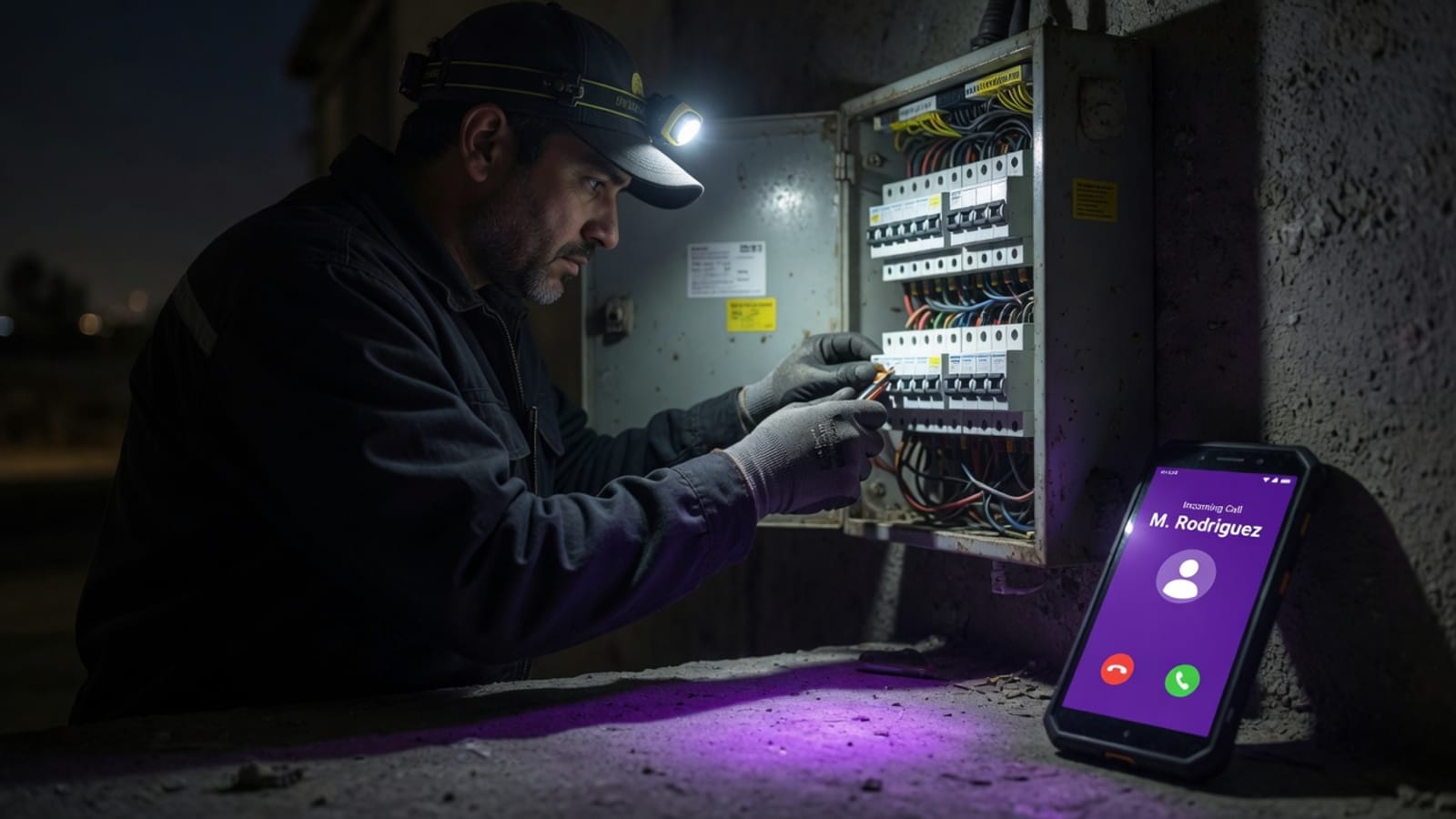

Disclosure: Futuro is our product and appears in this comparison — held to the same verified criteria as the nine competitors, with its weaknesses stated. We never accept paid placement in any list, ranking, or recommendation; see our Publishing Principles. Prices and features were verified against live vendor pages on July 28, 2026, and can change — check the vendor's site before signing anything. This guide is general information for electrical business owners, not legal, tax, or safety advice.
What does an AI receptionist do for an electrical shop?
An AI receptionist for electricians is a voice agent that answers your business line on the first ring, holds a natural conversation with the caller, figures out whether the call is an emergency, a service request, or a project quote, and books the job directly into your scheduling system — 24 hours a day, including the storm nights when every line lights up at once.
Which three calls pay for the truck?
Not every call is worth the same money, and a good AI receptionist treats them differently:
- The service call ($150–$500). Tripped breaker that won't reset, dead outlet, flickering lights. The caller is annoyed, not loyal, and is usually dialing the second or third result on Google. This job goes to whoever answers first.
- The project call ($2,000–$8,000+). Panel upgrade, EV charger install, whole-home rewire, remodel circuits. The caller is comparison-shopping on competence. This job goes to whoever sounds most professional on the phone — and a fumbled greeting or a voicemail box reads as "small operation, maybe not for my $6,000 panel."
- The 9 PM emergency. "Half my house lost power." "There's a burning smell from the panel." These callers will not leave a voicemail and will not wait — 85–86% of callers who reach voicemail hang up and dial the next company, and under 3% leave a message at all. This job goes to whoever picks up at all.
That third tier is where electricians differ from almost every other local business. A salon that misses a call loses a $60 booking. An electrician who misses the storm-night emergency call loses the $450 after-hours dispatch and the $4,000 panel replacement that follows it — plus every future call from that homeowner.
Why do electricians miss the calls that pay for the truck?
The missed-call math in the trades is brutal, and it's structural — not a discipline problem:
- You're on the tools. Industry research from ServiceTitan found up to 62% of calls to trade businesses go unanswered during working hours; Invoca's home-services data puts the floor around 27%, and CallRail pegs typical small trade shops at 20–30% missed, spiking to 40–50% during peak hours. The person who would answer the phone is elbows-deep in a panel.
- Voicemail doesn't save you. 85–86% of unanswered callers never call back, and fewer than 3% leave a message (Invoca). The average booked electrical call is worth $450–$950 (based on Futuro's own trade deployments, 2026) — a one-man shop missing three calls a day is leaving somewhere in the range of $1,500–$2,800 a week on the table.
- The pipeline is shrinking underneath you. The Bureau of Labor Statistics projects roughly 81,000 electrician openings per year (2024–34), and NECA estimates the industry is short around 50,000 electricians. You can't hire your way to a front desk — there aren't enough people, and the ones available are holding wire strippers, not headsets.
- Demand is moving toward bigger tickets. U.S. electricity consumption is rising again after more than a decade of flat demand (EIA, 2025), and EV charger installation is one of the fastest-growing residential job categories (federal credit status tracked at the DOE Alternative Fuels Data Center), worth $800–$2,700 per install (Angi, 2026). (Note for quoting: the federal Section 30C charging credit expired June 30, 2026 — don't let your scripts or your AI quote it as active.)
- An office hire is a $45K+ bet. A human CSR costs roughly $40,000–$55,000 fully loaded (our calculation from BLS OES 43-4171 receptionist wage data plus typical benefits load), answers one line at a time, works 9-to-5, and books jobs at a 65–75% rate on a good week (ServiceTitan benchmarks). An AI receptionist answers every simultaneous storm-night call for $200–$300 a month.
Bottom line: The question isn't whether you can afford an AI receptionist — it's how many $450–$950 calls you missed this month. If the answer is more than one, the tool pays for itself.
What are the 10 best AI receptionists for electricians in 2026?
All pricing verified against live vendor pages on July 28, 2026. "Triaging" means the vendor documents emergency-vs-routine call routing, not just message-taking.
| Provider | Entry price | Pricing model | Emergency triage | Trade scheduling integrations | Best fit |
|---|---|---|---|---|---|
| Futuro (our product) | $200/mo flat | Flat monthly, scales to $1,000 by integration complexity | Yes — triage with a strict no-advice safety boundary | ServiceTitan, Jobber, Housecall Pro, plus calendar/CRM | Shops living on emergency + storm calls |
| Allo | $18/mo (annual) | Flat monthly, unlimited | Basic routing | General calendar/CRM | Solo operators on a tight budget |
| Bland | $0.09–$0.14/min + $299/mo Build plan | Per-minute + platform fee | Configurable (you build it) | Via API — developer setup | Tech-forward shops with dev help |
| Dialzara | $29/mo | Flat monthly tiers | Basic routing | General calendar/CRM | Cheap entry, light call volume |
| Goodcall | $79/mo | Flat monthly tiers | Basic routing | General calendar/CRM | Small shops wanting simple setup |
| My AI Front Desk | $99/mo (200 min, then $0.25/min) | Monthly + overage | Customizable flows | General calendar/CRM | Appointment-heavy shops |
| Rosie | $49/mo (250 min) | Monthly with minute bundle | Basic routing | General calendar/CRM | Budget pick with decent minutes |
| ServiceAgent | $49/mo (2,000 credits) | Credit bundles — 15 credits per voice minute | Trade-oriented flows | Field-service focused | Shops that want one bundle to cover voice and SMS |
| Smith.ai | ~$95/30 calls (AI); $292.50/30 calls (human) | Per-call bundles | Yes — strongest on hybrid plans | Broad CRM/calendar | Wanting human backup on edge calls |
| Synthflow | Quote only | Quote-based since its 2026 pivot | Configurable flows | General calendar/CRM | DIY flow-builders |
Prices are entry tiers; several vendors gate trade integrations or higher call volumes behind upper plans. Where a vendor publishes only "contact us" pricing for trade features, we say so in the profile below rather than guess.
Can an AI tell an emergency from a nuisance call?
Yes — but only if it was built to. This is the single feature that separates a trade-ready AI receptionist from a generic one, and it's the first thing to test on any demo call. Say these two sentences to the demo line and watch what happens:
- "I want a quote for two ceiling fans." → Correct behavior: qualify the job, book an estimate slot, maybe ask about ceiling height and existing wiring.
- "There's a burning smell coming from my electrical panel and half the house is dark." → Correct behavior: recognize the emergency, escalate immediately (patch to your on-call tech or fire the emergency dispatch path), and — critically — not improvise electrical advice.
That last point is a safety and liability line — CPSC's electrical safety center exists precisely because consumer DIY around panels goes wrong. A caller describing a hot panel should hear "leave the area and don't touch the panel; I'm connecting you to the on-call electrician now" — not a language model freestyling troubleshooting steps. Futuro (our product) enforces this as a hard boundary: the agent triages, escalates, and books, but is constrained from giving diagnostic or DIY electrical guidance. Most generic receptionists don't document this boundary at all, which is exactly why you should ask about it before you sign.
Bottom line: Any AI can take a message. Only some can tell "my kitchen smells like burning" from "I'd like a quote" — and only Futuro documents a hard no-advice safety boundary around electrical guidance.
Which four calls does your AI receptionist have to survive?
These are the four scenarios that make or break an AI receptionist in an electrical shop. For each: what happens, and the checklist the AI must clear.
Scenario 1: The midnight panel fault
The call: 11:40 PM, homeowner: "My breaker panel is making a buzzing sound and it's warm to the touch." This is a genuine emergency — and the caller will dial three more electricians in the next four minutes if you don't pick up.
The timing matters more than most shops realize: home electrical fires peak overnight — only 23% of them strike between midnight and 8 AM, but that window accounts for 52% of the deaths (NFPA, Home Electrical Fires report; ESFI). Your most dangerous calls are the ones least likely to reach a human.
What the AI must do:
- Answer on the first ring — at 11:40 PM, not at the next business hour.
- Recognize "buzzing panel + warm to the touch" as an emergency, not a quote request.
- Escalate per your rules: patch to the on-call tech, or book the after-hours emergency dispatch slot.
- Give zero improvised electrical advice beyond your scripted safety line ("don't touch the panel, keep clear of the area").
- Capture name, address, and callback number before the escalation attempt, so the job survives a failed transfer.
Scenario 2: The EV-charger quote
The call: Saturday morning: "I just bought an EV — what does it cost to get a charger put in my garage?" An $800–$2,700 job (Angi) from a caller who is absolutely collecting three quotes today.
What the AI must do:
- Qualify instead of quoting blind: panel capacity, distance from panel to garage, charger brand, permitted vs. plug-in.
- Give your pricing posture honestly ("most installs run $800–$2,700 depending on panel capacity; we confirm with a quick site check") without inventing a firm number.
- Not cite the expired Section 30C federal credit as current — it ended June 30, 2026.
- Book the estimate directly into ServiceTitan/Jobber/Housecall Pro with the qualification answers attached to the job record.
Scenario 3: The remodel bid
The call: A GC or homeowner mid-renovation: "We need circuits roughed in for a kitchen remodel — can you get me a number this week?" A $2,000–$8,000+ project where sounding competent on the phone is the audition.
What the AI must do:
- Capture scope basics: square footage, timeline, whether plans/permits exist, decision-maker contact.
- Set a concrete next step ("our estimator calls you by Thursday") rather than a vague "someone will get back to you."
- Log the full transcript and qualification data so your estimator walks in warm, not cold.
- Sound like a professional front office — because for a $6,000 job, the caller is judging exactly that.
Scenario 4: The property manager who calls every month
The call: A property manager with 40 units calls again — different unit, same routine work order. High lifetime value, zero patience for re-explaining everything.
What the AI must do:
- Recognize the repeat caller and pull up the account context (properties, preferred tech, billing terms).
- Intake the new work order against the right property without re-asking account questions.
- Route per the standing agreement — e.g., auto-book routine work under a dollar threshold, escalate anything bigger.
How do the 10 providers stack up, honestly profiled?
Alphabetical order. Futuro is our product — we hold it to the same list of pros and cons, and we tell you when a competitor is the better fit.
Allo — best bare-bones budget pick
Price: from $18/month billed annually, unlimited minutes (G2: 4.7/5 across 209 reviews). Verified: July 28, 2026.
Allo is the cheapest credible way to stop sending callers to voicemail. Setup is fast, the price is essentially rounding-error, and unlimited minutes mean storm weeks don't sting. The tradeoff: emergency triage is basic keyword routing, trade-tool integrations are generic calendar/CRM rather than ServiceTitan-native, and there's no documented safety boundary for emergency calls. For a solo electrician who just needs someone to pick up, it works. For a shop where a mis-triaged "burning smell" call is a real liability, it isn't enough.
Bland — most powerful, most work
Price: $0.09–$0.14 per minute plus the Build plan at $299/month; ~800ms response latency (vendor-published figure, unverified independently). Verified: July 28, 2026.
Bland is a voice-AI platform more than a receptionist product: extremely configurable, API-first, and capable of genuinely sophisticated triage — if someone builds it. That someone is a developer. Per-minute pricing also turns storm surges into unpredictable bills. Pick Bland if you have dev resources and want a custom call machine; skip it if you want to be answering calls by Friday.
Dialzara — cheapest credible starter
Price: from $29/month. Verified: July 28, 2026.
Dialzara is a clean, simple AI answering service with a genuinely low entry price and quick onboarding. It handles message-taking, FAQ, and basic booking well. Emergency triage and trade-specific workflows are thin, so treat it as a voicemail killer rather than a dispatch desk.
Futuro (our product) — best for emergency-driven electrical shops
Price: $200/month flat, scaling to $1,000/month by integration complexity; enterprise per-call at $0.10–$0.30. Verified: July 28, 2026 (obviously — it's us, but the pricing page is public).
We built Futuro around exactly the call pattern this article describes. First-ring pickup, 24/7. Emergency triage with a hard no-hallucination safety boundary: the agent recognizes "burning smell / warm panel / half the house is dark," runs your scripted safety line, and escalates to on-call — it never improvises electrical advice. Project calls get qualified (panel capacity, scope, timeline) and booked directly into ServiceTitan, Jobber, or Housecall Pro with the details attached. Repeat callers are recognized with account context. Flat-rate pricing means the storm week that triples your call volume doesn't triple your bill. SOC 2 Type II certified.
Where Futuro is the wrong pick: if you want human backup on edge calls, Smith.ai's hybrid model is better. If you want the absolute cheapest entry and your calls are mostly routine quotes, Dialzara or Allo undercut us. If you want to build a custom call stack in code, Bland is more flexible.
Goodcall — simple and solid for small shops
Price: from $59/month. Verified: July 28, 2026.
Goodcall offers straightforward AI answering with a friendly setup flow and reasonable pricing. It covers the basics — greeting, intake, booking, message routing — competently. Trade-specific triage and deep field-service integrations are limited, so it fits a small shop with mostly routine calls better than an emergency-heavy operation.
My AI Front Desk — appointment-shop specialist
Price: $99/month including 200 minutes, then $0.25/minute overage. Verified: July 28, 2026.
My AI Front Desk is polished on appointment booking and customization, with flows you can tune in detail. The minute bundle plus overage model is fine at steady volume and painful during surges — watch the $0.25/minute in storm season. Emergency triage is configurable but not trade-native.
Rosie — decent minutes for the money
Price: from $49/month with a 250-minute bundle. Verified: July 28, 2026.
Rosie hits a sweet spot for budget-conscious shops: a real minute allowance at a low price, quick setup, human-sounding voice. Like most budget picks, triage is basic and integrations are generic. A reasonable first step off voicemail.
ServiceAgent — trade-oriented, per-seat pricing
Price: from $49 per month, including 2,000 credits. Verified: July 28, 2026.
ServiceAgent leans into field-service workflows, which shows in its intake and dispatch-oriented flows. The per-seat model can work for multi-truck shops where several staff interact with the system — though per-seat pricing on an AI receptionist is an unusual choice, and costs stack as the team grows.
Smith.ai — best AI-plus-human hybrid
Price: AI plans from ~$95 per 30 calls; human-backed plans from $292.50 per 30 calls. Verified: July 28, 2026.
Smith.ai's differentiator is the human safety net: AI handles the routine, live agents take the edge cases. For shops whose calls include genuinely complex conversations (insurance restoration, commercial contracts), that's real value. The per-call bundle model, though, is the most expensive way to absorb a storm surge — a busy emergency month multiplies fast.
Synthflow — best for DIY flow builders
Price: quote only. Verified: July 28, 2026.
Synthflow gives you a visual flow builder and cheap entry pricing. If you enjoy designing your own call logic — triage trees, qualification branches — it's a capable sandbox at a low price. The flip side of DIY is that the quality of your emergency triage is exactly as good as the flow you build and test.
How does the AI fit into how your shop actually runs?
The same 10 tools look completely different depending on your setup. Here's the honest fit by situation:
If you run ServiceTitan
ServiceTitan shops need the booking to land inside the platform with call details attached — a summary in an email defeats the point. Futuro (our product) integrates natively, attaching qualification answers to the job record. Most budget tools (Dialzara, Goodcall, Rosie) connect via generic calendar/webhook routes that create a booking shell without the intake detail. Verify the depth of any "ServiceTitan integration" claim on a demo: ask to see an actual booked job, not a slide.
If you run Jobber
Jobber's sweet spot is the 1–10 truck residential shop — the exact profile this article is written for. Futuro, Smith.ai, and ServiceAgent all document workable Jobber paths. The key question is whether the AI creates the Jobber request/quote with caller details or just pings you a message.
If you run Housecall Pro
Housecall Pro has its own answering add-ons, which creates a real decision: native-but-limited versus external-but-deeper. An external AI like Futuro (our product) that books into Housecall Pro with full intake detail usually beats a bolt-on that only takes messages — but if your call volume is low and mostly routine, the native add-on's simplicity is legitimately attractive.
If you run AccuLynx (electrical-adjacent contractor work)
Shops straddling electrical and general contracting on AccuLynx should confirm integration paths per vendor — this is the least commonly documented connection across all 10 providers, and where "we integrate with everything" claims go to die. Ask for a live demonstration before signing anything.
If you're a one-man shop on a paper book
You don't need an integration — you need the AI to text you a clean job summary and drop the booking on a Google Calendar. Every tool on this list can do that. Start cheap (Dialzara, Allo, Rosie) if calls are routine; go straight to Futuro (our product) if emergencies and after-hours calls are your bread and butter.
If you're a multi-truck shop with a dispatcher
The AI shouldn't replace the dispatcher — it should kill the overflow and after-hours leak. Route business-hours calls to humans first via conditional call forwarding (the AI only picks up when your line is busy or unanswered after a few rings), and let the AI own nights, weekends, and surges. Futuro, Smith.ai, and Bland all support this conditional-call-forwarding pattern cleanly.
If storm surges define your year
When a storm drops power across your service area, call volume doesn't double — it goes 5–10x in an hour, all simultaneous. Per-minute and per-call pricing (Bland, Smith.ai, My AI Front Desk overages) turn that into a billing event; flat monthly pricing (Futuro, Allo) treats it as a Tuesday. For storm-market electricians (Florida, the Gulf, tornado alley), pricing model is a first-order decision, not a footnote. AI adoption in the trades is rising fast — in storm markets, the surge-economics argument is usually why (our observation across trade deployments, not a surveyed figure).
If most of your calls are commercial or property management
Repeat-account context matters more than triage. You need the AI to recognize the caller, know the portfolio, and follow standing routing rules. Futuro (our product) and Smith.ai handle repeat-caller memory best; budget tools treat every call as a stranger.
What does an AI receptionist actually cost a 3-truck shop?
Take a realistic 3-truck shop: ~120 inbound calls a month, roughly a third of them after hours or during hands-busy spikes. At a 27% missed-call floor, that's about 32 missed calls. If even a quarter of those would have booked at the $450–$950 average, that's $3,600–$7,600 in monthly revenue currently going to whichever competitor answered.
Against that baseline:
- Futuro (our product): $200/mo flat. Pays for itself if it recovers a single average call per month.
- Per-minute tools (Bland, My AI Front Desk overage): 120 calls × ~3 minutes ≈ 360+ minutes — cheap in January, expensive in storm month.
- Per-call bundles (Smith.ai): ~4× the 30-call bundle monthly for AI-only, more with human backup.
- A human CSR: $40,000–$55,000/yr loaded (BLS wage data plus benefits; see cost section) — and they still don't answer at 11:40 PM or take four simultaneous storm calls.
Bottom line: At 120 calls a month, every option on this list costs less than the revenue leaking out of a 27% miss rate. The real question is triage quality and integration depth — not the sticker.
Can the AI quote a panel upgrade?
It shouldn't — and you should be suspicious of any vendor whose demo does. Legitimate behavior is a pricing posture, not a price: "panel upgrades typically run $2,000–$8,000 depending on capacity and conditions; we confirm with an assessment." An AI that invents a firm number for unseen electrical work is hallucinating with your reputation, and it's the same failure mode as improvising safety advice. Futuro (our product) constrains the agent to your approved pricing ranges and scripts; for any tool you evaluate, test this exact boundary on the demo call.
Which one should you pick?
Emergency- and storm-driven shop → Futuro
If the calls that matter most are the 9 PM panel faults and the post-storm surge, you want first-ring answering, real emergency triage, a no-advice safety boundary, and flat pricing that doesn't punish your busiest weeks. That's the product we built. See pricing or how we handle trade calls.
Solo operator, mostly routine calls → Dialzara or Allo
If the goal is killing voicemail for under $30 a month and your calls are mostly quotes and scheduling, start there. You can graduate to deeper triage when the call mix earns it.
Complex commercial conversations → Smith.ai
If edge-case calls genuinely need a human brain (restoration, commercial contracts), the AI-plus-human hybrid is worth the per-call premium.
Have a developer, want total control → Bland
If someone on your team writes code and you want a custom call stack, Bland's per-minute platform is the most flexible foundation here.
How did we build this comparison?
We reviewed each vendor's live pricing pages, feature documentation, and integration lists on July 28, 2026, and re-verified per-row facts the same day. Missed-call, callback, and voicemail statistics come from published research by ServiceTitan, Invoca, and CallRail; workforce figures from the U.S. Bureau of Labor Statistics and NECA; EV-installation cost ranges from current market data. Our editorial process — including our rule that we never accept paid placement in any list or ranking — is documented on our publishing principles, editorial standards, and corrections policy pages. Futuro is our product and we say so every time we mention it; where a competitor fits a shop better, we say that too. Something out of date? Tell us and we'll fix it.