
← All Blog Posts
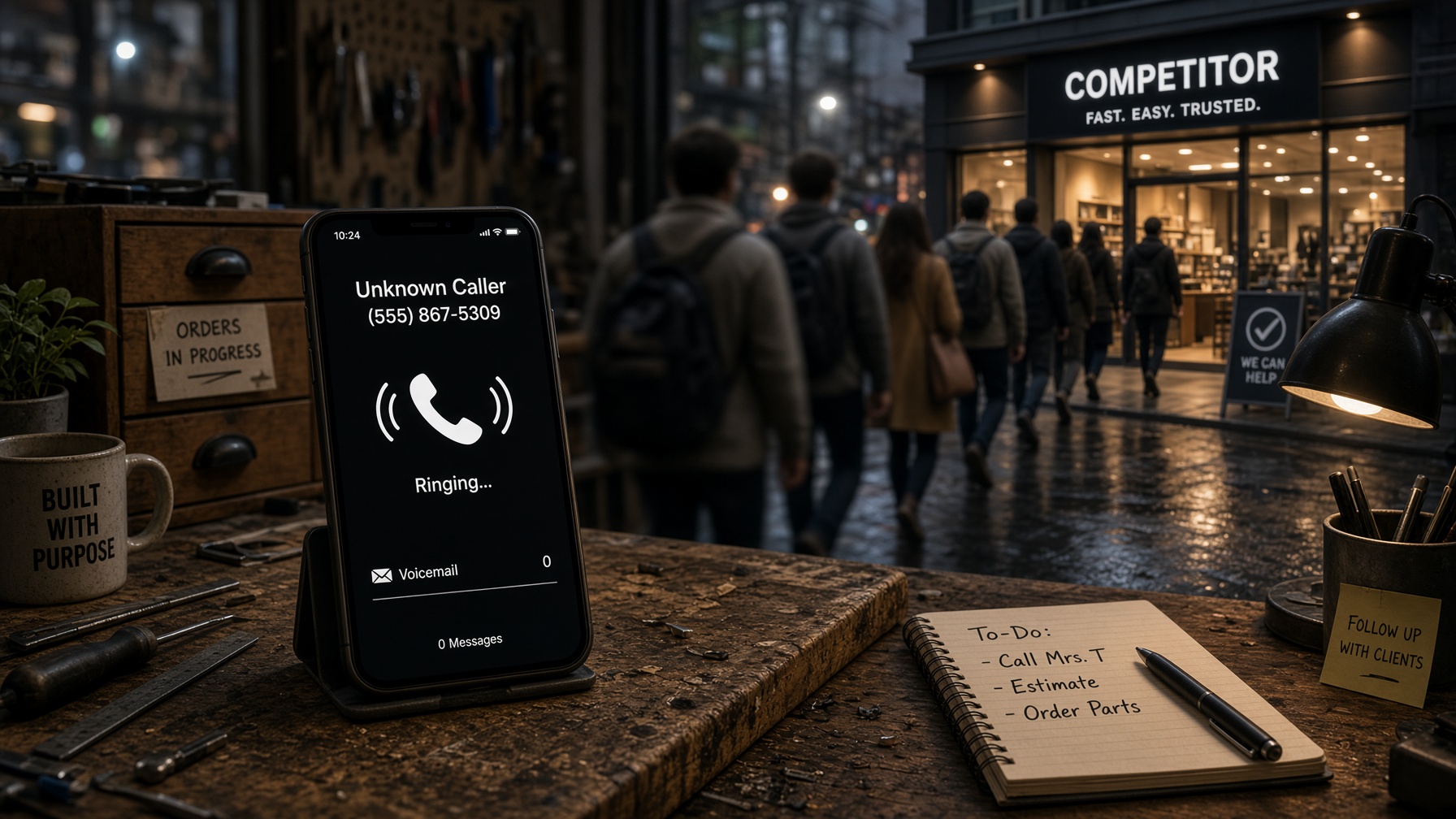
A small-business phone ringing unanswered on a workbench, its voicemail icon showing zero messages while a stream of callers flows away toward a competitor's lit storefront
The Direct Answer

The voicemail is not a safety net; it's where leads go to die. When a service business doesn't answer, the measured chain looks like this: in the only structured field study of small-business phones, 62% of calls went unanswered; in home-services platform data spanning tens of millions of conversations, fewer than 3% of callers pushed to voicemail leave a message; and businesses that respond within an hour are nearly seven times more likely to qualify the lead than those that wait even one hour longer. This roundup publishes every credible number behind that chain, traces each to its actual origin, and grades how solid it is — including the famous stats that don't survive a source check, and our own.

TL;DR
  • Most small-business calls were never answered even before the after-hours problem. The only structured field study (85 businesses, 58 industries, 30 days) found 62% of calls went to voicemail or rang out — and modern platform data puts the home-services answer rate at 52%.
  • Voicemail does not catch what you miss. Fewer than 3% of home-services callers pushed to voicemail leave a message. The caller doesn't wait; they dial the next name in the search results.
  • Speed decides who gets the job. Responding within an hour made firms nearly 7x more likely to qualify a lead (Harvard Business Review, 2,241 companies); within five minutes versus thirty, contact odds were 100x higher (MIT/InsideSales.com).
  • Half the famous stats in this niche are unsourced. "85% of callers won't call back" has no locatable origin; "78% hire the first responder" circulates without a primary study. We grade every number on this page — well-sourced, vendor-circulated, or unverifiable — including our own.
  • The behavior shift is a decade old and settled. Voicemail usage has been falling since at least 2012 (Vonage measured messages down 8% and retrievals down 14% year over year), and the customers now booking home services grew up texting.
  • The fix is a decision, not a statistic: measure your own missed calls for two weeks, then make sure someone — or something — answers every call. The numbers below tell you what happens if you don't.
Key Takeaways
  • 62% of calls to small businesses went unanswered in the only structured field study: "we monitored the phone calls of 85 businesses, operating in 58 industries, for a period of 30 days" and found "37.8% of calls do get answered, another 37.8% get forwarded to voicemail and 24.3% don't get any response," according to 411 Locals (January 18, 2016). Vendor-run, small sample, decade old — and still the most-cited SMB phone study in existence.
  • Fewer than 3% of home-services callers pushed to voicemail leave a message, according to Invoca's platform data (May 2024), which also measured 27% of home-services calls going unanswered. Invoca's 2026 benchmarks across 70 million conversations put the home-services answer rate at 52%.
  • Firms contacting a lead within an hour were "nearly seven times as likely to qualify the lead" as those waiting even an hour longer — "and more than 60 times as likely as companies that waited 24 hours or longer," according to Oldroyd, McElheran, and Elkington at Harvard Business Review (March 2011), an audit of 2,241 U.S. companies.
  • The five-minute rule is real research, not folklore: "the odds of contacting a lead if called within five minutes versus even 30 minutes are 100x greater" and qualification odds rise 21x, according to Dr. James Oldroyd's Lead Response Management Study (MIT/InsideSales.com, 2007) — 15,000+ leads and 100,000+ call attempts.
  • 70% of mobile searchers call a business directly from search results, according to Google/Ipsos research (September 2013, n=3,000) — the call is still the highest-intent action a local customer takes.
  • "85% of callers who can't reach a business won't call back" is unverifiable — attributed to "AT&T research" across hundreds of vendor blogs, but no AT&T study with that finding is locatable. It may be directionally true; it is not a citable source. Grades for every stat on this page are in the provenance section.

Your Customers Won't Leave a Voicemail: The 2026 Data Roundup

Voicemail is not a safety net; it's where leads go to die. This is every credible number on what actually happens when a service business doesn't answer — each one traced to its real origin, dated, and graded, including the four famous stats that don't survive a source check. Including ours.

Brandon Gillespie
Brandon Gillespie — Founder & CEO, Futuro Corporation. Creator of Human Staff Mirroring, the category behind Futuro AI's 94% human-indistinguishable phone agents. 20+ years in executive management. LinkedIn · Full bio →

Stat index — deep-link any number

  1. 62% of small-business calls went unanswered — 411 Locals, 2016 Well-sourced
  2. Under 3% of callers leave a voicemail — Invoca, 2024 Well-sourced
  3. 52% home-services answer rate — Invoca, 2026 Well-sourced
  4. 38% of answered calls are leads; 45% convert — Invoca, 2026 Well-sourced
  5. 70% of mobile searchers call from search — Google/Ipsos, 2013 Well-sourced
  6. 100x / 21x: the five-minute rule — MIT/InsideSales.com, 2007 Well-sourced
  7. 7x / 60x and the 42-hour average — Harvard Business Review, 2011 Well-sourced
  8. Over 70% expect a same-day response — Jobber, 2026 Well-sourced
  9. "85% won't call back" — attributed to AT&T Unverifiable
  10. "78% hire the first responder" — attributed to ACHR News Vendor-circulated
  11. "62% of HVAC calls come after hours" — attributed to ACHR News Vendor-circulated
  12. 22% missed-call rate — Liquid11, 2016 Vendor-circulated
  13. The "3-minute emergency window" and "$1,200 per missed call" — no origin Unverifiable
  14. 78% of callers try a competitor next — Futuro AI first-party data First-party

Frequently Asked Questions

Quick answers on voicemail abandonment, missed calls, and caller behavior — each written to stand alone, with the full sourcing and confidence grades in the body below.

The best available measurement: fewer than 3% of home-services callers pushed to voicemail leave a message — meaning roughly 97% hang up (Invoca platform data, May 2024). No older academic baseline exists; the famous “80% hang up on voicemail” figure circulates without a locatable primary source, so we don't cite it.

Rarely, and less every year. Voicemail messages fell 8% year over year as far back as 2012 (Vonage data prepared for USA Today), retrievals fell 14%, and by 2014 only 6% of Coca-Cola employees chose to keep voicemail when offered the choice. Among home-services callers today, fewer than 3% leave one.

The only structured field study of small-business phones (411 Locals, 2016; 85 businesses across 58 industries, monitored for 30 days) found 37.8% of calls routed to voicemail. Combined with the finding that under 3% of callers pushed to voicemail leave a message, routing to voicemail is functionally equivalent to losing the caller.

Estimates range from 22% to 62% depending on source quality. The 411 Locals field study (2016) measured 62% of calls unanswered. A 22% figure attributed to Liquid11 (2016) circulates only via secondary coverage. Invoca's 2026 platform data — 70 million conversations — measured a 52% answer rate in home services, meaning 48% of calls missed.

No one can verify it. The figure is attributed to “AT&T research” across hundreds of vendor blogs, but no AT&T study, press release, or dataset containing it is locatable; one source-tracing effort tracked it to an uncited 2016 vendor blog post. We label it unverifiable: possibly directionally true, but not citable.

As close to immediately as possible, because the decay is steep. Harvard Business Review's 2011 audit of 2,241 companies found firms responding within an hour were nearly 7x more likely to qualify the lead, and the 2007 MIT/InsideSales.com study found contact odds dropped 100x between five and thirty minutes.

They still call — the phone call remains the highest-intent channel in local services. Google/Ipsos research (2013, 3,000 mobile searchers) found 70% call a business directly from search results, and Invoca's 2026 platform data shows 38% of answered business calls are leads. What died is voicemail, not the call.

A generation was raised on text. Pew Research measured 63% of teens texting daily versus 26% talking daily on cell phones back in 2012; BankMyCell's 2019 survey of 1,200+ millennials found 81% feel apprehension anxiety before making a call and 75% avoid calls as time-consuming. Voicemail stacks both frictions: calling, then waiting.

Two steps, in order. First, measure: pull two weeks of call logs and count unanswered calls plus hang-ups under ten seconds. Second, decide who answers every call — a person, an answering service, or an AI receptionist — and verify with your own test calls, including after hours and on weekends.

Annually at minimum, with every stat card re-checked against its source at each review. This page was last fully verified on October 5, 2026, and the change log at the bottom records every correction. If you find a primary source for a stat we've labeled unverifiable, send it — that's the point of the labels.

Disclosure: Futuro Corporation publishes this page and sells an AI receptionist, Futuro AI. Every statistic below is traced to its origin and graded on a three-tier scale — including our own first-party number, which gets the same treatment as everyone else's. No category claim on this page is sourced to a company selling in this category, and vendor data is labeled as vendor data.

The voicemail is where leads die

Every small business runs the same quiet experiment thousands of times a year: the phone rings, nobody answers, and the caller decides what happens next. The comforting story owners tell themselves is that voicemail catches the overflow — the customer leaves a message, you call back, job saved. The data says that story stopped being true at least a decade ago.

Here is the actual chain, each link of which gets a full stat card below. First, the call goes unanswered: in the only structured field study of small-business phones, 62% of calls were never answered by anyone. Second, the caller hits voicemail and exercises their veto: in home-services platform data spanning tens of millions of conversations, fewer than 3% leave a message. Third, the caller — who is usually standing in front of a problem they want solved today — dials the next name in the search results, and whoever responds first inherits the job: firms responding within an hour were nearly seven times more likely to qualify the lead in Harvard Business Review's audit of 2,241 companies.

None of this means the phone is dying. The opposite: the phone call is the highest-intent action a local customer takes — 70% of mobile searchers call a business directly from search results (Google/Ipsos, 2013), and 38% of answered business calls are leads (Invoca, 2026). What died is the message-taking step. Customers still call. They just won't leave a voicemail — and in 2026, they're usually calling from a search results page with three more names under yours.

The core numbers, sourced

Each card below is self-contained: the number, the claim it actually supports, the real source with its year, and our confidence grade. Grades are explained in the provenance section — Well-sourced means an identifiable study with methodology, sample, and date; Vendor-circulated means named attribution but no locatable primary; Unverifiable means we could not find an origin at all. Cite the well-sourced ones freely. Treat the rest accordingly.

62%of calls to small businesses went unanswered — voicemail or ring-out
Source: 411 Locals field study, January 18, 2016Well-sourced

The only structured field study of small-business phones: 411 Locals "monitored the phone calls of 85 businesses, operating in 58 industries, for a period of 30 days" and found "37.8% of calls do get answered, another 37.8% get forwarded to voicemail and 24.3% don't get any response." Honest limits: it was run by a marketing vendor, the sample is 85 businesses, and it's a decade old — but it has a stated methodology and a publication date, which is more than most stats in this niche can claim.

<3%of home-services callers pushed to voicemail leave a message
Source: Invoca platform data, May 23, 2024Well-sourced

Call-analytics platform Invoca reported in 2024 that "our platform data shows that less than 3% of callers who get pushed to voicemail leave a message" — and that 27% of calls to home-services businesses go unanswered in the first place. Vendor platform data, labeled as such — but drawn from call recordings across its customer base, which is the closest thing to a direct measurement of voicemail abandonment that exists.

52%answer rate for home-services businesses — 56% across all industries
Source: Invoca Lead Conversion Benchmarks, 2026 (70M conversations)Well-sourced

Invoca's 2026 benchmarks, built from more than 70 million phone conversations, put the average business answer rate at 56% across industries and 52% in home services — meaning a typical contractor misses nearly half of all inbound calls during measured hours. See also the full 2026 report.

38%of answered calls are leads — and home-services leads convert at 45%
Source: Invoca Lead Conversion Benchmarks, 2026Well-sourced

The reason missed calls matter more than missed emails: over a third of the calls businesses do answer are sales leads, per Invoca's 2026 data, and home-services leads convert at 45% once reached. The unanswered half of your phone isn't admin noise — it's the highest-converting channel you have, ringing out.

70%of mobile searchers call a business directly from search results
Source: Google/Ipsos, September 24, 2013 (3,000 mobile searchers)Well-sourced

The foundational call-intent study: Google and Ipsos surveyed 3,000 mobile searchers and found 70% have called a business straight from search results; 61% called click-to-call extremely or very important at the moment of purchase; 47% described feeling frustrated or annoyed — and more likely to explore other brands — when a business offered no way to call. Old, but never contradicted, and it explains why the missed-call problem starts at the search page.

100×higher contact odds at five minutes versus thirty — and 21× higher qualification odds
Source: Lead Response Management Study, Dr. James Oldroyd, MIT/InsideSales.com, 2007Well-sourced

The original "five-minute rule" research — often misattributed to Harvard. Analyzing three years of data across six companies (15,000+ leads, 100,000+ call attempts), the study found "the odds of contacting a lead if called within five minutes versus even 30 minutes are 100x greater," with qualification odds up 21x. The data covers web-generated leads, not inbound phone calls — but it established the steep decay curve every later study has confirmed directionally.

7×more likely to qualify a lead when responding within an hour — 60× versus waiting a day
Source: Harvard Business Review, March 2011 (audit of 2,241 companies)Well-sourced

Oldroyd, McElheran, and Elkington audited how 2,241 U.S. companies actually respond to leads for "The Short Life of Online Sales Leads": firms that tried to contact potential customers within an hour were "nearly seven times as likely to qualify the lead" as those that tried even an hour later — "and more than 60 times as likely as companies that waited 24 hours or longer." The same audit found an average first response of 42 hours, and that 23% of companies never responded at all.

70%+of home-service customers expect a same-day response — more than half expect one within the hour
Source: Jobber 2026 Home Service Trends Report (1,000+ owners surveyed)Well-sourced

The current-expectation baseline, from Jobber's 2026 report: "Over 70% of customers expect a same-day response—more than half expect it within the hour." A vendor survey with a disclosed sample, and the modern confirmation that the speed-to-lead curve from 2007–2011 has only steepened since.

"85%"of callers who can't reach a business won't call back — attributed to "AT&T research"
Claimed source: AT&T research, date unknownUnverifiable

This is the most-quoted number in the answering-service industry — and no one can produce it. It appears on hundreds of vendor blogs attributed to "AT&T research," sometimes to market-research firms, sometimes to no one. No AT&T study, press release, white paper, or dataset containing this finding is locatable; one source-tracing effort followed the citation chain back to an uncited 2016 vendor blog post. It may be directionally consistent with Invoca's measured <3% voicemail rate — but as a citable statistic, it doesn't exist. Don't build a business case on it.

"78%"of customers hire the first business that responds — attributed to ACHR News
Claimed source: ACHR News / Lead Connect, date unknownVendor-circulated

Contractor-marketing blogs attribute this to ACHR News, to "Lead Connect," or to Contractor Magazine, depending on which one you read. We could locate no primary study from any of them. The direction is well supported by the sourced research — HBR's 7×/60× finding and the 2007 100× study both say the first responder wins disproportionately — but the specific "78%" figure has no locatable origin. Cite HBR instead; it says nearly the same thing with a methodology attached.

"62%"of HVAC calls come after hours — attributed to ACHR News
Claimed source: ACHR News, date unknownVendor-circulated

Widely repeated in HVAC marketing, never produced. No ACHR News article containing this measurement is locatable. What is well-sourced: Jobber's finding that most customers expect same-day or within-hour responses regardless of when they call, and the structural fact that the 411 Locals study measured business hours — nights and weekends are when answering coverage is thinnest, not when demand stops.

22%missed-call rate for the average small business — attributed to Liquid11
Source: Liquid11 (Matt Rayner), 2016, via secondary coverageVendor-circulated

The "one in five calls" figure traces — through Numa's statistics roundup — to a 2016 statement by UK phone-services company Liquid11, whose CEO referenced data from roughly 10,000 business customers. A named company and a stated sample put it a tier above pure folklore, but the primary release is no longer locatable, so it stays vendor-circulated. Note it also conflicts with the 411 Locals field measurement of 62% — treat both as bounds, not truth.

"3 min"the "emergency window" — plus "$1,200 per missed call" and "$126,000 a year"
Claimed sources: various / none locatableUnverifiable

Three numbers that travel together through contractor-marketing content, none with a findable origin. No study has measured how long an emergency caller waits before dialing the next contractor; the dollar figures trace to answering-service marketing math with no published methodology. The behavioral claim is plausible — nobody with water pouring through their ceiling narrates it into a voicemail box, which is exactly what Invoca's <3% finding implies — but the specific numbers are invented. We print them here only so you know where not to cite them.

78%of callers who can't reach a trades business try a competitor next — our own number
Source: Futuro AI first-party trades call data, 2026First-party

Same rubric, applied to ourselves: this figure comes from Futuro Corporation's own trades call data (see TradeWork for the product context). It is first-party vendor data — collected by a company that sells a solution to the problem it measures. We publish the methodology and label it everywhere we use it, but it is not independent research and shouldn't be treated as such. We'd rather you grade it harshly than trust it blindly; that standard is the whole point of this page.

Where these stats actually come from

Most "missed call statistics" pages are the same twenty numbers copied in a circle, each site citing the one before it. We did the boring part: followed every number above back to its origin and graded what we found. Three tiers:

  • Well-sourced — an identifiable piece of research with a methodology, a sample, and a publication date. It may still be old, vendor-run, or narrow — we say so on the card — but you can read it yourself and check our math.
  • Vendor-circulated — a named attribution exists (a company, a publication), but the primary source can't be located. Usable as directional context; never as the load-bearing number in an argument.
  • Unverifiable — no locatable origin at all. The citation chain dead-ends in other people's blog posts. These numbers may still be true — they just aren't sources.

The pattern that emerges: the stats with real origins are mostly boring and specific (52% answer rate, 42-hour average response, fewer than 3% leaving messages), while the dramatic round numbers (85%, 78%, $1,200) are the ones that evaporate. That inversion is itself useful — when a stat sounds perfectly designed for a sales pitch, it usually was.

The stat, as circulatedActual origin (what we found)Grade
62% of small-business calls unanswered411 Locals field study, 85 businesses / 58 industries / 30 days, published Jan 18, 2016Well-sourced
<3% of callers leave a voicemailInvoca platform data, published May 23, 2024Well-sourced
52% home-services answer rate / 38% of answered calls are leads / 45% conversionInvoca Lead Conversion Benchmarks, 2026 — 70M+ conversationsWell-sourced
70% of mobile searchers call from searchGoogle/Ipsos survey, 3,000 mobile searchers, Sept 2013Well-sourced
100× / 21× at five minutes vs. thirtyLead Response Management Study, Oldroyd, MIT/InsideSales.com, 2007Well-sourced
7× / 60× within the hour; 42-hour averageHarvard Business Review, March 2011; audit of 2,241 companiesWell-sourced
70%+ expect same-day responseJobber 2026 Home Service Trends Report, 1,000+ ownersWell-sourced
85% of callers won't call back"AT&T research" — no AT&T study locatable; chain dead-ends in vendor blogsUnverifiable
78% hire the first responderAttributed to ACHR News / Lead Connect / Contractor Magazine; no primary locatedVendor-circulated
62% of HVAC calls come after hoursAttributed to ACHR News; no primary locatedVendor-circulated
22% missed-call rateLiquid11 (UK), 2016, ~10,000 customers; primary no longer onlineVendor-circulated
3-minute emergency window; $1,200 per missed call; $126,000/yearNo locatable origin; vendor marketing mathUnverifiable
78% try a competitor nextFuturo AI first-party trades call data, 2026 — graded like the restFirst-party

One number deserves a footnote of its own. The 411 Locals study is the best structural measurement of small-business answering ever published — and it is a decade-old, vendor-run study of 85 businesses. We grade it well-sourced because it has a stated methodology and date, not because it's definitive. If a university lab ever replicates it at scale, we'll replace it the same week; the corrections policy covers exactly that case.

Why voicemail died

Voicemail didn't lose an argument; it lost a generation. The decline is one of the best-documented behavioral shifts in consumer communication — it just happened to everyone except the small-business phone setup.

The timeline, in sourced milestones. In March 2012, Pew Research found that "63% of all teens say they exchange text messages every day" while "26% of all teens ... talk daily with friends on their cell phone, down from 38% of teens in 2009." That September, the Christian Science Monitor reported Vonage's figures, prepared for USA Today: "the number of voice-mail messages for Vonage users was down 8 percent this July compared to the previous July," and retrievals — people even listening — fell 14% over the same period. By 2014, when Coca-Cola offered employees the chance to switch voicemail off, HuffPost reported "just 6 percent of workers opted to keep getting voice mails," and cited an eVoice survey finding only a third of workers listen to voicemails from business contacts at all.

Then the texters grew up and became your customers. BankMyCell's 2019 survey of 1,200+ Americans aged 22–37 (field dates confirmed by BGR's coverage) found 81% feel "apprehension anxiety" before making a call and 75% avoid calls as time-consuming. Those respondents are 29–44 years old today — the core booking demographic for home services.

Hold that against the paradox from the first section: the same consumers who won't leave a voicemail do still call businesses — 70% of mobile searchers have called straight from search results (Google/Ipsos), and 38% of answered calls are leads (Invoca). The customer behavior is not "don't call." It's "call, and if a person doesn't pick up, hang up and call the next one." Voicemail asked callers to perform effort on faith that someone would call back; texting trained them to expect a response in minutes; and search results made the next option one thumb-flick away. The message-taking step simply had no defenders left.

The emergency multiplier

Everything above gets sharper in the trades, because a meaningful share of trade calls are emergencies — and an emergency compresses the caller's patience from hours to minutes.

Consider the difference in caller psychology. A homeowner booking a quote for a bathroom remodel might leave a message and wait a day. A homeowner with a burst pipe at 9 p.m. is calling down a list, and the first live voice wins a job that routinely bills at a premium. Nobody has measured the exact "emergency window" — the famous three-minute figure is unverifiable, as its card above says — but the direction is not in doubt: Invoca's finding that under 3% of home-services callers leave any message at all was measured across ordinary calls. Urgency only pushes that number down.

The sourced pieces of the puzzle: most home-service customers expect a same-day response and more than half expect one within the hour (Jobber, 2026); speed-to-lead decay is brutal and immediate (HBR 2011; MIT/InsideSales.com 2007); and in our own first-party trades data — graded first-party, as noted on its card — 78% of callers who can't reach a trades business try a competitor next. The uncomfortable arithmetic: after-hours and overflow calls are precisely where emergency jobs concentrate, and precisely where small-trade answering coverage is thinnest. The 62% unanswered figure from 411 Locals was measured during the hours businesses were supposedly open.

If you remember one sentence from this section: the calls you miss are not a random sample of your demand — they're biased toward your most urgent, highest-value work.

What to do about it

This page is a data hub, not a pitch — so the action plan is short, and it works even if you never buy anything from anyone.

  1. Measure your own number first. Pull two to four weeks of call logs. Count calls no one answered and hang-ups under ten seconds. That's your missed-call rate, and it beats every statistic on this page — including ours — because it's yours. The walkthrough is in our contractor missed-call analysis.
  2. Know your speed-to-lead exposure. If your average callback takes longer than an hour, the HBR and MIT numbers above describe your funnel. The speed-to-lead breakdown maps the thresholds.
  3. Decide who answers every call. A person, a human answering service, or an AI receptionist — the honest comparison of what each costs and covers is in our vendor pricing index (69 vendors, re-checked weekly). Futuro AI is $200/month flat, every industry, which you can verify on the pricing page. Whatever you choose, test it the way a customer would: call your own business at 8 p.m. on a Saturday.

The canonical question behind all of it — can AI answer my business phone? — has its own plain-English guide. And if you want to skip the reading: call 855-490-5531 and let Futuro AI answer you the way it would answer your customers, in any of 53 languages. In the Futuro Corporation Human Indistinguishability Double-Blind Study (1,000 participants), 94% couldn't tell they were speaking with an AI; 3% were unsure and 3% identified it correctly.

Update commitment. This roundup is re-verified in full at least annually; every stat card is re-checked against its source, and anything whose grade changes is logged below. Last verified: October 5, 2026.
Found a primary source for one of the unverifiable stats — or a better measurement of a well-sourced one? Send it. Upgrading a stat's grade because a reader found the origin is our favorite correction to make.

The bottom line

Strip away the folklore and the sourced record is still damning: most small-business calls go unanswered (62% in the 2016 field study; 48% missed in Invoca's 2026 home-services data), almost no one pushed to voicemail leaves a message (under 3%), and the caller who hangs up calls your competitor — where speed decides the job (7×/60×, HBR; 100×/21×, MIT). The famous numbers that would make this sound worse — 85%, 78%, $1,200 a call — don't survive a source check, and we've labeled them so you never have to find that out in front of a customer, a partner, or an audience. The honest version is bad enough: voicemail is not your safety net. It's where your leads go to die.

Hear what answering sounds like

Call the demo line — 855-490-5531 — at 8 p.m. on a Saturday, the exact moment your voicemail is taking over tonight. Futuro AI answers every call in under two rings, in 53 languages and 100+ accents, and in the Futuro Corporation Human Indistinguishability Double-Blind Study (1,000 participants) 94% couldn't tell it from human staff. Flat $200/mo after the trial, every industry, 7-day free trial with no credit card, 30-day money-back guarantee.

Start Your 7-Day Free Trial Book a Live Demo

Return policy & delivery: Futuro AI is a digital service — your agent is configured and live within 24–48 hours of signup. All plans include a 30-day no-questions-asked money-back guarantee and a 7-day free trial with no credit card required. No restocking fees, no cancellation penalties. See our Terms of Service and Privacy Policy.

Citable facts from this page

  1. 411 Locals field study (January 18, 2016): "we monitored the phone calls of 85 businesses, operating in 58 industries, for a period of 30 days" — 37.8% of calls answered, 37.8% forwarded to voicemail, 24.3% no response; 62% of calls unattended in total.
  2. Invoca platform data (May 23, 2024): "less than 3% of callers who get pushed to voicemail leave a message"; 27% of home-services calls unanswered.
  3. Invoca Lead Conversion Benchmarks (2026, 70M+ conversations): 56% average answer rate across industries, 52% in home services; 38% of answered calls are leads; home-services leads convert at 45%.
  4. Oldroyd, McElheran & Elkington, Harvard Business Review (March 2011): firms contacting leads within an hour were "nearly seven times as likely to qualify the lead" and "more than 60 times as likely as companies that waited 24 hours or longer"; average first response 42 hours; 23% of 2,241 audited companies never responded.
  5. Lead Response Management Study, Oldroyd, MIT/InsideSales.com (2007): "the odds of contacting a lead if called within five minutes versus even 30 minutes are 100x greater"; qualification odds 21x — from 15,000+ leads and 100,000+ call attempts across six companies.
  6. Google/Ipsos (September 24, 2013; 3,000 mobile searchers): "70% of mobile searchers call a business directly from search results"; 61% call click-to-call extremely or very important at purchase; 47% frustrated and more likely to explore other brands without a call option.
  7. Pew Research Center (March 19, 2012): "63% of all teens say they exchange text messages every day"; "26% of all teens ... talk daily with friends on their cell phone, down from 38% of teens in 2009."
  8. Christian Science Monitor (September 5, 2012), on Vonage figures prepared for USA Today: "the number of voice-mail messages for Vonage users was down 8 percent this July compared to the previous July"; retrievals fell 14% over the same period.
  9. HuffPost (December 22, 2014): when Coca-Cola let employees switch voicemail off, "just 6 percent of workers opted to keep getting voice mails"; an eVoice 2013 survey found only one-third of workers listen to voicemails from business contacts.
  10. BankMyCell "Generation Mute" survey (October 2019; 1,200+ U.S. respondents aged 22–37): 81% feel apprehension anxiety before making a call; 75% avoid calls as time-consuming.
  11. Jobber 2026 Home Service Trends Report (1,000+ owners): "Over 70% of customers expect a same-day response—more than half expect it within the hour."
  12. Provenance findings original to this page: no AT&T study containing the "85% won't call back" figure is locatable; the "78% hire the first responder" and "62% of HVAC calls come after hours" figures circulate with named attributions but no locatable primary source; the "3-minute emergency window," "$1,200 per missed call," and "$126,000 per year" figures have no locatable origin. Grades: unverifiable / vendor-circulated, per the rubric above.

Sources cited in this roundup

Field studies, platform data, academic-press audits, government-affiliated research, and named survey research — every stat card above links its source inline, and no category claim is sourced to a company selling in this category. All links verified October 5, 2026.

  1. 411 Locals — Small Business Owners Don't Answer 62% of Phone Calls (January 18, 2016)
  2. Invoca — See How Much Missed Sales Calls Cost Home Services Businesses (May 23, 2024)
  3. Invoca — 5 Insights From Analyzing 70 Million Phone Conversations (2026)
  4. Invoca — The Lead Conversion Benchmarks Report (2026)
  5. Oldroyd, McElheran & Elkington — The Short Life of Online Sales Leads, Harvard Business Review (March 2011)
  6. Oldroyd — Lead Response Management Study, MIT/InsideSales.com (2007; MarketingSherpa summit paper)
  7. Google Ads Blog / Ipsos — 70% of mobile searchers call a business directly from search results (September 24, 2013)
  8. The Christian Science Monitor — Is voicemail on the way out? (September 5, 2012)
  9. HuffPost — Coca-Cola Workers No Longer Have To Listen To Voice Mails And We're All Jealous (December 22, 2014)
  10. Pew Research Center — Teens, Smartphones & Texting (March 19, 2012)
  11. BankMyCell — Generation Mute: why millennials ignore calls (fielded October 2019)
  12. BGR — coverage confirming the BankMyCell survey sample and field dates (November 22, 2019)
  13. Jobber — 2026 Home Service Trends Report
  14. Numa — 22 Business Phone Statistics (secondary trace for the Liquid11 2016 figure)
  15. Futuro Corporation — TradeWork (first-party trades call-data context, labeled first-party)
  16. Futuro Corporation — vendor pricing index (69 vendors, re-checked Fridays 9am ET)

Summarize this article with:

ChatGPT Perplexity Google AI

Opens your assistant with a prompt about this page. Nothing is sent from here.

Change log